
Georgia Police Ram And Flip A Dodge Ram Pickup Truck That Was Weaving Through Traffic At 100 Mph!
Pickup Driver Refuses to Stop as a July 2021 Highway Pursuit Escalates
A sunny highway, moderate traffic and an older silver Dodge pickup initially make the scene look almost ordinary. Then the distance between the truck and the patrol vehicle begins to close, the pickup keeps moving instead of stopping, and an everyday drive becomes a police pursuit.
The supplied dash-camera footage is dated July 5, 2021. It shows a law-enforcement vehicle following a silver Dodge pickup from a two-lane roadway onto a larger divided highway. As the sequence develops, the pickup changes position across the roadway and the pursuing officer remains directly behind it. The later footage shows the truck angled across a travel lane while still moving at highway speed, a moment that illustrates how quickly an apparently straightforward failure to stop can become dangerous.
Extensive searches of publicly indexed news reports and police-related records were conducted using the visible date, vehicle description and pursuit details. Those searches did not produce a sufficiently reliable official release or contemporary news report that could be matched to this exact footage with confidence. For that reason, this article does not invent a driver's name, police agency, charges, location or final court outcome. The account below is built around what the footage itself establishes, while using verified reporting only to explain the broader risks and tactics visible on screen.
That distinction matters. Police-pursuit videos are frequently reposted with altered titles, cropped overlays and little original context. A date on the footage can narrow a search, but it is not enough to attach an unrelated arrest report to a specific driver. Accuracy is more important than filling every blank.
Fortunately, the footage itself tells a compelling story. The road changes. Traffic changes. The pickup's movements become less predictable. The patrol vehicle has to maintain enough distance to react while remaining close enough to follow. Every passing motorist becomes part of the risk equation.
A Quiet Road Gives the First Hint of Trouble
The opening image is timestamped July 5, 2021. The patrol vehicle is traveling along a two-lane road lined with tall pine trees, grass and open land. Several civilian vehicles are visible ahead.
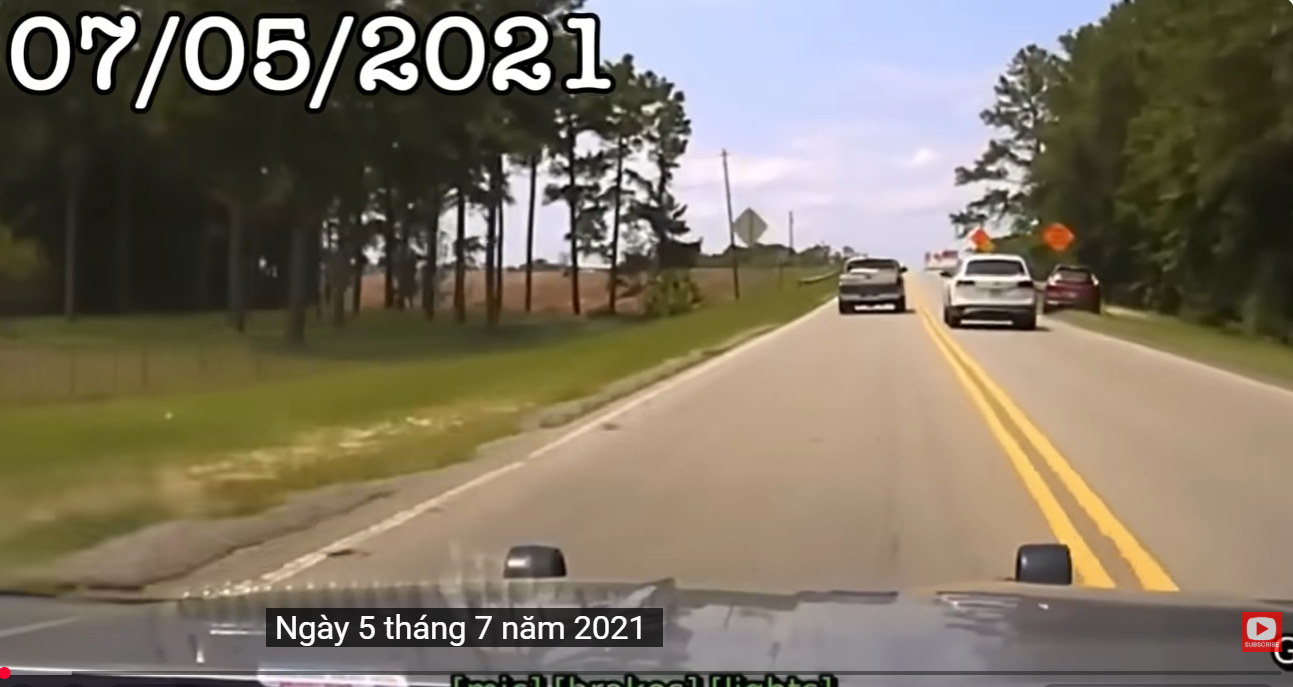
The environment matters because a pursuit does not happen in isolation. The officer is not following the Dodge around a closed track. Other motorists continue using the road normally, often without knowing why a police vehicle behind them may suddenly accelerate or why the pickup ahead is behaving unpredictably.
Construction signs are visible on the roadside. That adds another potential hazard. Work zones can introduce narrowed lanes, uneven pavement, barrels, workers and sudden changes in traffic flow.
The pickup ahead appears to be an older Dodge, likely from the Ram family of trucks. It has a silver or light-colored body, dark lower trim and a rear window covered by dark tint. The footage is not sharp enough to responsibly publish a license-plate number.
That may seem like a minor limitation, but it is important. A blurred plate can easily be misread, and one incorrect character can lead researchers toward an entirely unrelated vehicle or person.
The Pickup Moves Onto a Larger Highway
As the sequence continues, the pursuit reaches a divided multi-lane highway.
The road opens considerably. Opposing traffic is separated by a broad median, and the pickup has more room to maneuver. At first glance, that might appear safer than the narrower road.
In reality, the larger highway introduces a different problem: speed.
On a divided highway, a fleeing driver can accelerate far beyond the speeds possible on a congested city street. Longer sightlines encourage faster travel, and multiple lanes allow rapid lane changes.
The officer has to anticipate not only what the fleeing vehicle will do but what surrounding motorists will do when they hear sirens or notice emergency lights.
The Dodge Becomes the Center of the Chase
Once the patrol vehicle closes the distance, the Dodge dominates the dash-camera view.
The truck is an older full-size pickup with a relatively high ride height and a light rear end. Those characteristics affect how it behaves during abrupt steering.
A pickup carries much of its mass toward the front when the bed is empty. Sudden steering at speed can therefore produce significant body movement. A quick correction can shift weight from side to side, and the higher center of gravity means the truck may react differently from a low passenger sedan.
Those dynamics become visible later in the footage when the Dodge begins to angle across the roadway.
Why Following Distance Matters
During a pursuit, the lead police vehicle cannot simply drive as close as possible to the fleeing vehicle.
Distance creates reaction time.
If the suspect brakes suddenly, strikes another car or loses control, the pursuing officer needs room to avoid becoming part of the same collision.
But too much distance creates another problem. The officer may lose sight of the vehicle, particularly near intersections, curves or exits.
The footage repeatedly shows this balance. The Dodge remains large enough in frame for the officer to track its movement, yet there is still space between the two vehicles.
Civilian Traffic Complicates Every Decision
The most important objects in a pursuit video are often not the police car or the fleeing vehicle.
They are the unrelated cars nearby.
Every civilian driver has incomplete information. Some may hear a siren before seeing the police car. Others may notice the pickup first and assume it is simply speeding. A driver may pull onto the shoulder, brake unexpectedly or change lanes at exactly the moment the pursuit approaches.
Police therefore have to evaluate more than whether they can physically keep up.
They must constantly consider whether continuing the chase creates more danger than allowing the suspect to escape temporarily.
The Pickup Begins Moving Across the Highway
One of the strongest frames from the supplied footage shows the Dodge no longer aligned cleanly with its lane.
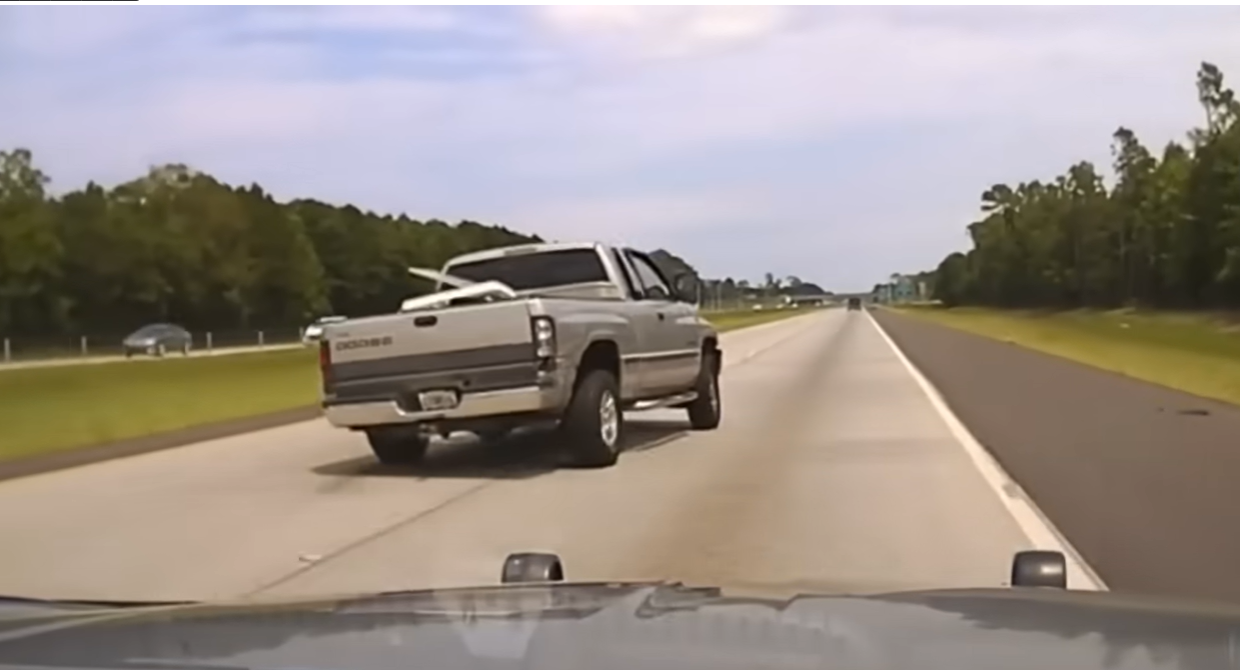
The truck is angled relative to the roadway, with its body appearing to rotate as the patrol vehicle follows.
Without the complete verified incident report, it would be irresponsible to claim that this exact movement was caused by a PIT maneuver, loss of traction or a deliberate steering input. A still frame alone cannot establish the cause.
What the image does establish is instability.
At highway speed, a pickup traveling sideways or partially sideways creates an immediate collision risk. Tires are designed primarily to manage forces in the direction the vehicle is traveling. Once the vehicle rotates, lateral forces increase and the driver's ability to control the truck can deteriorate quickly.
Why a Pickup Can Become Unstable During Abrupt Steering
Vehicle dynamics are central to understanding pursuit footage.
When a driver turns sharply, weight transfers toward the outside tires. When the driver then corrects in the opposite direction, the weight transfers again.
This can create a sequence of overcorrections.
At ordinary speeds, a driver may recover. At highway speeds, the same steering movements can produce a spin, rollover or departure from the roadway.
Older pickup trucks may have less sophisticated electronic stability control than modern vehicles, depending on model year and equipment.
The danger increases further if tire condition, suspension condition or road surface is poor.
The Patrol Camera Gives a Deceptively Calm Perspective
Dash-camera video can make speed difficult to judge.
The camera is fixed. The horizon remains relatively stable. A wide-angle lens can make objects appear farther away than they really are.
As a result, a pursuit may look slower on screen than it felt to the officer.
Roadside objects provide better clues. Lane markings, signs, trees and other vehicles move through the frame quickly as speed increases.
The Dodge's changes in orientation also become more significant when viewed against the fixed lines of the highway.
A Pursuit Is a Continuous Risk Assessment
Police-pursuit policy varies by agency, but the underlying problem is universal.
Officers must balance two risks.
The first is the risk created by allowing a fleeing driver to continue without immediate apprehension.
The second is the additional risk created by pursuing that driver.
That balance can change from second to second.
A pursuit that begins on an empty road may enter heavy traffic. Weather can change. The fleeing driver can begin traveling the wrong way, entering intersections against signals or driving onto shoulders.
Supervisors and pursuing officers therefore continually reassess whether the chase should continue.
The July 5 Date Is an Important Verification Anchor
The visible date overlay is unusually useful.
It clearly reads 07/05/2021.
That allowed searches to be narrowed to police pursuits and crashes reported around July 5, 2021. Several unrelated incidents involving pickup trucks occurred in the United States around that date, including crashes and separate pursuits in other states.
None of the public reports located during research contained enough matching details to responsibly declare it the exact incident shown here.
This is an important research lesson. Matching one characteristic is not enough.
A correct identification should ideally align on multiple independent clues: date, vehicle, road configuration, agency, location, sequence of events and outcome.
Why the Vehicle Alone Cannot Identify the Case
Older Dodge pickups are common throughout the United States.
A silver Dodge on a Southern-looking highway is therefore not a unique identifier.
Even the plate design visible in the footage is too blurred for confident state identification.
The surrounding terrain provides hints but not proof. Pine trees, broad highway medians and roadside construction can be found across numerous Southeastern states.
Assigning the pursuit to a particular department based only on those clues would create a high risk of misidentification.
The Most Reliable Story Is the One the Camera Actually Shows
When external identification remains uncertain, the footage should become the primary source.
Here, the camera establishes a sequence with several clear elements.
A law-enforcement vehicle follows an older silver Dodge pickup.
The sequence occurs on July 5, 2021.
The pursuit moves from a two-lane roadway to a divided highway.
Civilian traffic is present.
The patrol vehicle remains close behind the pickup.
The pickup eventually becomes angled across the roadway during the chase.
Those facts are visible and do not require speculation.
The Highway Environment Raises the Stakes
A divided highway can encourage a fleeing driver to believe there is more room to escape.
There are multiple lanes, long straight sections and fewer intersections.
But speed turns small errors into large ones.
At 70 mph, a vehicle covers more than 100 feet every second. At 100 mph, it travels roughly 147 feet per second.
That means a driver can consume the length of a football field in little more than two seconds at triple-digit speed.
A vehicle that begins to rotate at those speeds can cross an entire lane before the driver has time to process what is happening.
Road Construction Adds Another Layer of Uncertainty
Orange construction signs and roadside work equipment appear in the footage.
Construction zones can alter the geometry drivers expect.
A shoulder may disappear. A lane may shift. Pavement surfaces may change. Barrels or temporary barriers may sit close to traffic.
For an ordinary motorist, those conditions call for reduced speed and increased attention.
For a pursuit, they reduce the margin for error.
The Pursuing Officer Must Watch More Than the Truck
The officer's attention has to move constantly.
The Dodge is the primary target, but focusing exclusively on it would create tunnel vision.
The officer also needs to watch traffic ahead, vehicles approaching from behind, road signs, intersections, construction areas and possible pedestrians.
Radio communication adds another cognitive demand.
The officer may be reporting direction of travel, speed, vehicle description and traffic conditions while simultaneously driving.
That workload is one reason pursuit driving requires specialized training.
Why Police Sometimes Use a PIT Maneuver
The footage includes a moment where the pickup rotates, which naturally raises questions about whether police intentionally caused the movement.
Without a verified report or a complete angle showing contact, this article does not claim that a PIT occurred.
But understanding the tactic helps explain what viewers often see in similar pursuit videos.
A Precision Immobilization Technique involves controlled contact by a police vehicle near the rear quarter of a fleeing vehicle. The goal is to induce rotation and bring the fleeing vehicle to a stop.
It is not appropriate in every environment.
Speed, traffic, pedestrians, roadside hazards, vehicle type and agency policy all influence whether officers may attempt it.
A maneuver involving a high-center-of-gravity pickup can present different rollover risks from one involving a sedan.
What Looks Simple From the Camera Can Be Complicated in Real Time
A viewer can pause the video.
The officer cannot.
A viewer can rewind and study the pickup's movement frame by frame.
The officer has to interpret it immediately.
If the truck begins rotating, the patrol driver must decide whether to brake, steer around it or maintain position.
If the pickup suddenly regains traction, it may accelerate again.
If it stops across the highway, the officer may need to block traffic before approaching.
Every possible outcome requires a different response.
The Pursuit Is Also a Story About Uncertainty
The most engaging police footage often contains uncertainty rather than constant action.
Will the driver stop?
Will the pickup take the next exit?
Will traffic force it to slow down?
Will the truck lose control?
Will the pursuit reach a populated area?
Each unanswered question keeps the viewer focused on the road ahead.
That natural suspense is stronger than invented claims about the driver's motives.
Why Responsible Reporting Avoids Filling the Gaps
Viral police videos are often separated from their original source.
A clip may be downloaded, edited, translated and reposted several times. The original title can disappear. Dates may remain because they are burned into the camera footage, but names and locations may be stripped away.
That creates a temptation to search for a vaguely similar news story and treat it as a match.
Doing so can wrongly associate an innocent person, unrelated defendant or different police agency with the footage.
This article therefore keeps uncertain details out.
If an original agency release or matching full-length upload becomes available, the case can be updated with names, charges and disposition after those facts are verified.
The Dodge's Age Is Another Useful Clue, but Not Enough
The pickup appears to be an older Dodge design, with DODGE lettering across the tailgate, a two-tone rear bumper area and a relatively simple bed and cab profile.
Those styling features narrow the model generation but do not uniquely identify the vehicle.
Millions of similar pickups have been sold and remain on American roads.
The visual clue becomes useful only when combined with stronger information such as a readable plate, agency radio traffic or a confirmed location.
The Road Itself May Eventually Identify the Incident
Road geometry can function almost like a fingerprint.
The first section contains a two-lane road with construction signage and pine-lined shoulders.
The later highway has a broad grassy median, relatively flat terrain and long straight sightlines.
Utility poles, signs and construction patterns may eventually allow the route to be matched to a specific state highway.
But that type of geolocation requires multiple corroborating landmarks. A single generic stretch of highway is not enough.
What the Footage Teaches About Pursuit Dynamics
Even without a confirmed case name, the sequence provides a useful look at pursuit mechanics.
The patrol vehicle maintains visual contact rather than immediately crowding the pickup.
The fleeing vehicle uses available road space to continue moving.
The transition onto the divided highway increases possible speed.
The pickup's later lateral movement demonstrates how rapidly stability can deteriorate.
Civilian vehicles remain present throughout, forcing the officer to account for people who are not involved.
The Most Dangerous Moment May Be the Loss of Alignment
A fleeing vehicle traveling straight at high speed is already dangerous.
A fleeing vehicle traveling sideways is substantially more unpredictable.
Once the pickup rotates, the direction its body faces no longer perfectly matches the direction its momentum is carrying it.
The tires can regain grip abruptly, sending the truck in a new direction.
It can also spin completely, roll or strike another vehicle broadside.
For the pursuing officer, that is a signal to create space and prepare for a sudden stop or collision.
Why the Pursuit Holds Attention Without Exaggeration
The footage has a simple visual structure that naturally builds tension.
It begins on a smaller road.
The officer closes on the pickup.
The truck reaches a larger highway.
Speed and maneuvering room increase.
Then the pickup begins to lose its clean alignment with the roadway.
Each stage raises the stakes.
No invented backstory is necessary.
What We Can Confirm
The supplied footage is dated July 5, 2021.
It shows a law-enforcement dash-camera perspective following an older silver Dodge pickup.
The sequence includes both a two-lane roadway and a divided highway.
Other motorists are present.
Road construction is visible in portions of the footage.
The Dodge is later seen angled across the highway while the patrol vehicle remains behind it.
Those points are directly supported by the visual evidence.
What Remains Unconfirmed
The driver's identity has not been verified from reliable public sources.
The exact law-enforcement agency has not been verified.
The precise city, county and state have not been established with sufficient confidence.
The original reason police attempted to stop the truck is not established by the supplied stills.
The final arrest, charges and court outcome have not been matched to a reliable record.
Rather than turn possibilities into facts, those details remain open.
A Pursuit Defined by Seconds and Road Position
Police chases are often described through speed numbers, but road position can be just as important.
A truck traveling quickly in a stable lane is one kind of threat.
The same truck drifting toward a shoulder or rotating across lanes creates a completely different problem.
The July 5 footage captures that transition.
The officer begins by following.
The highway opens.
The Dodge moves unpredictably.
Then the pursuit reaches the point where controlling the vehicle becomes as important as escaping the officer behind it.
The Camera Leaves One Essential Question
The strongest unanswered question is also the simplest: why did the driver keep going?
Until the original report is located, there is no responsible way to answer it.
Drivers flee police for many different reasons, from outstanding warrants and stolen vehicles to suspended licenses, impairment or panic. Choosing one without evidence would distort the story.
What matters in the footage is the consequence of the decision itself.
Once the pickup refuses to stop, every additional mile exposes more people to the pursuit.
Watch the Full Pursuit
The still images capture the setting and one of the truck's most unstable moments, but the complete sequence is necessary to understand how the pursuit moves from a smaller roadway onto the divided highway and how quickly the pickup's behavior changes once speed increases.
Comments (0)
Loading comments...
May You Like

Police vs Chevy Impala High-Speed Pursuit Ends in TVI

MERIDEN POLICE OFFICER SHOOTS MAN BEATING FATHER WITH A BASEBALL BAT

Karen Entitled’ Woman Gets Tased After Allegedly Ramming Police Cars













