Gas Station Restroom Attack Leaves Clerk Injured as Police Response Comes Under Scrutiny
Gas Station Restroom Attack Leaves Clerk Injured as Police Response Comes Under Scrutiny
A June 2024 attack inside a Sanford, Florida, RaceTrac became disturbing for two separate reasons: the violence suffered by a store employee inside a locked restroom, and the questions later raised about how quickly the first officers at the scene acted. The footage supplied for this article captures the emergency response and its aftermath. Public records and subsequent reporting add an important final chapter: the attacker has now been sentenced to prison.
A routine early-morning shift turns into an emergency
Shortly after 5 a.m. on June 1, 2024, police were called to the RaceTrac at 3760 South Orlando Drive in Sanford, near U.S. Highway 17-92 and Lake Mary Boulevard. According to the arrest account later described by local news outlets and the Office of the State Attorney for Florida’s 18th Judicial Circuit, Randal Lee Lawton had entered the store and ultimately got an employee into the men’s restroom. The circumstances described by investigators were not a chance encounter in a public aisle. The employee was drawn toward the restroom after Lawton asked for help with toilet paper.
The worker later described checking the restroom and discovering that toilet paper was already there. At that point, according to her account, Lawton moved behind the door and closed it. What began as an ordinary request for assistance had suddenly become a confinement inside a small room, away from the open sales floor.
The supplied footage begins in the middle of that crisis rather than at the moment the encounter started. That distinction matters. The video can document what responding officers saw and heard once they arrived, but the details of the initial encounter inside the restroom come from the victim’s account, the police investigation, and later court proceedings. Those sources establish that Lawton forced the employee down and attacked her with a box cutter. The State Attorney’s Office later said he cut her neck and chin while referring to her as “Eve” and making statements about her sins.
The employee fought to protect herself. Investigators said she suffered cuts to her neck and deep lacerations to her hand after grabbing at the blade. She also lost a tooth during the struggle. Some social-media versions of the story describe multiple teeth being ripped out, but the later official sentencing release specifically states that she lost a tooth. That official account is the safer factual description.
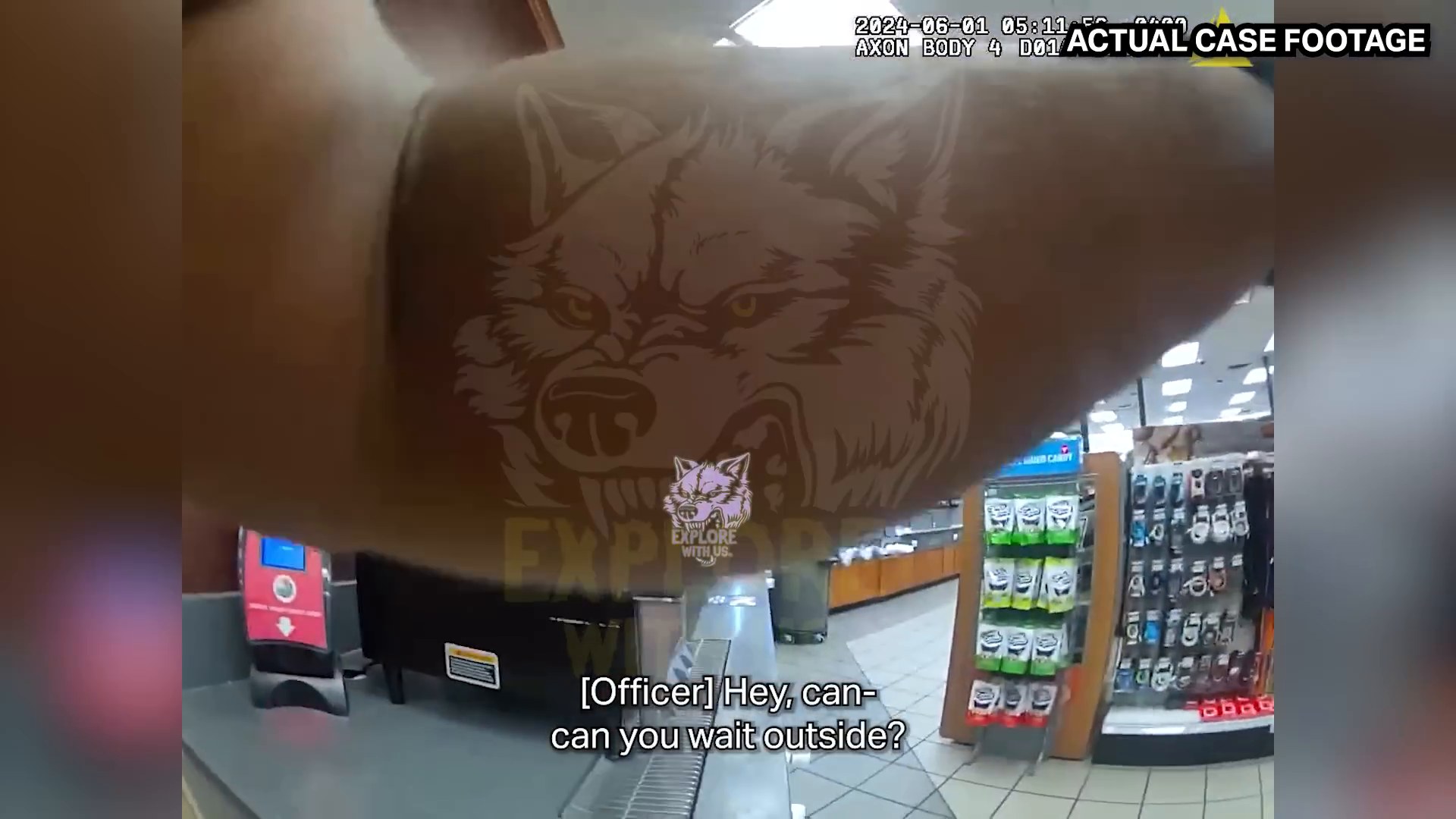
The first officers arrive while the victim is still inside
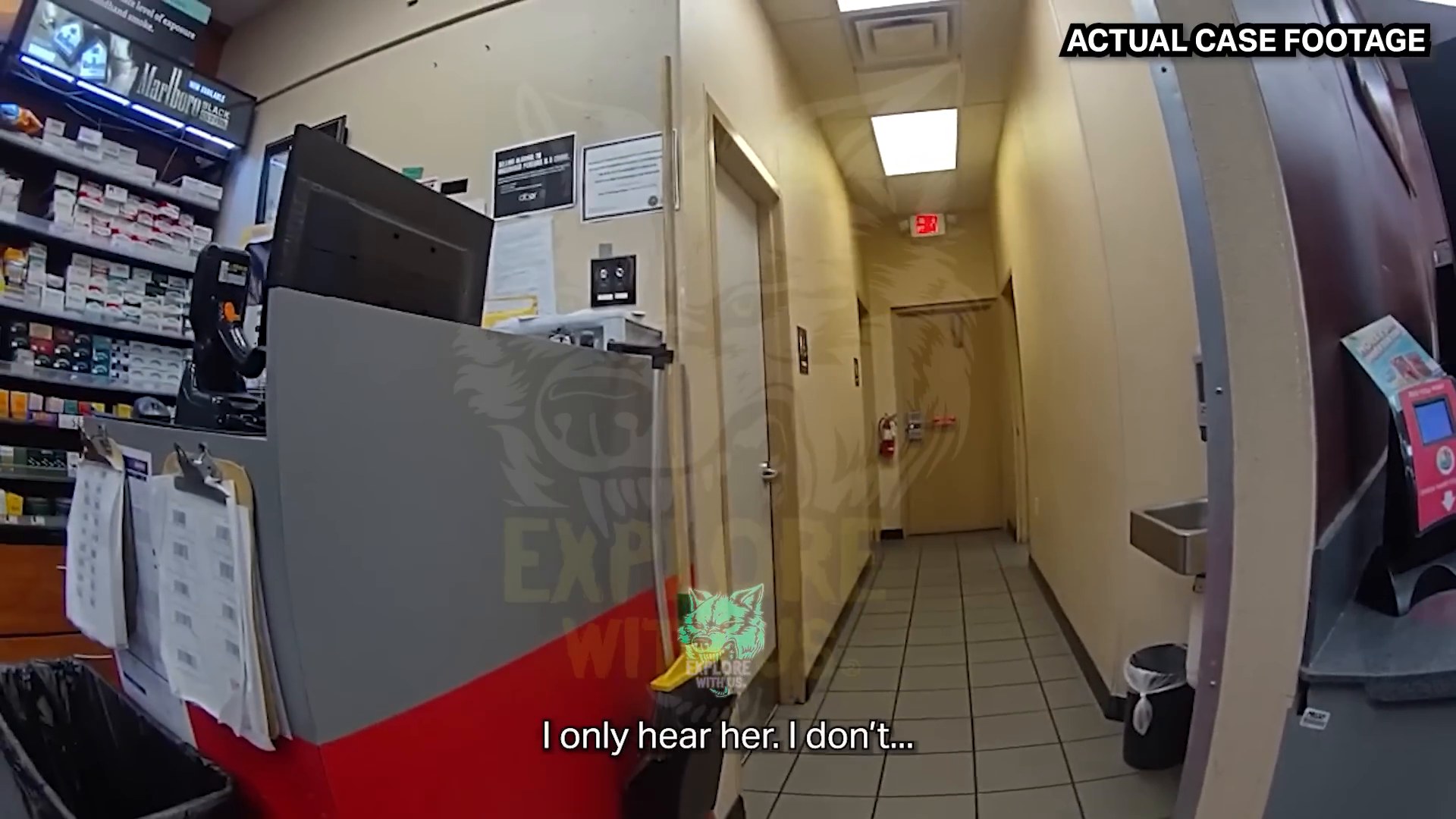
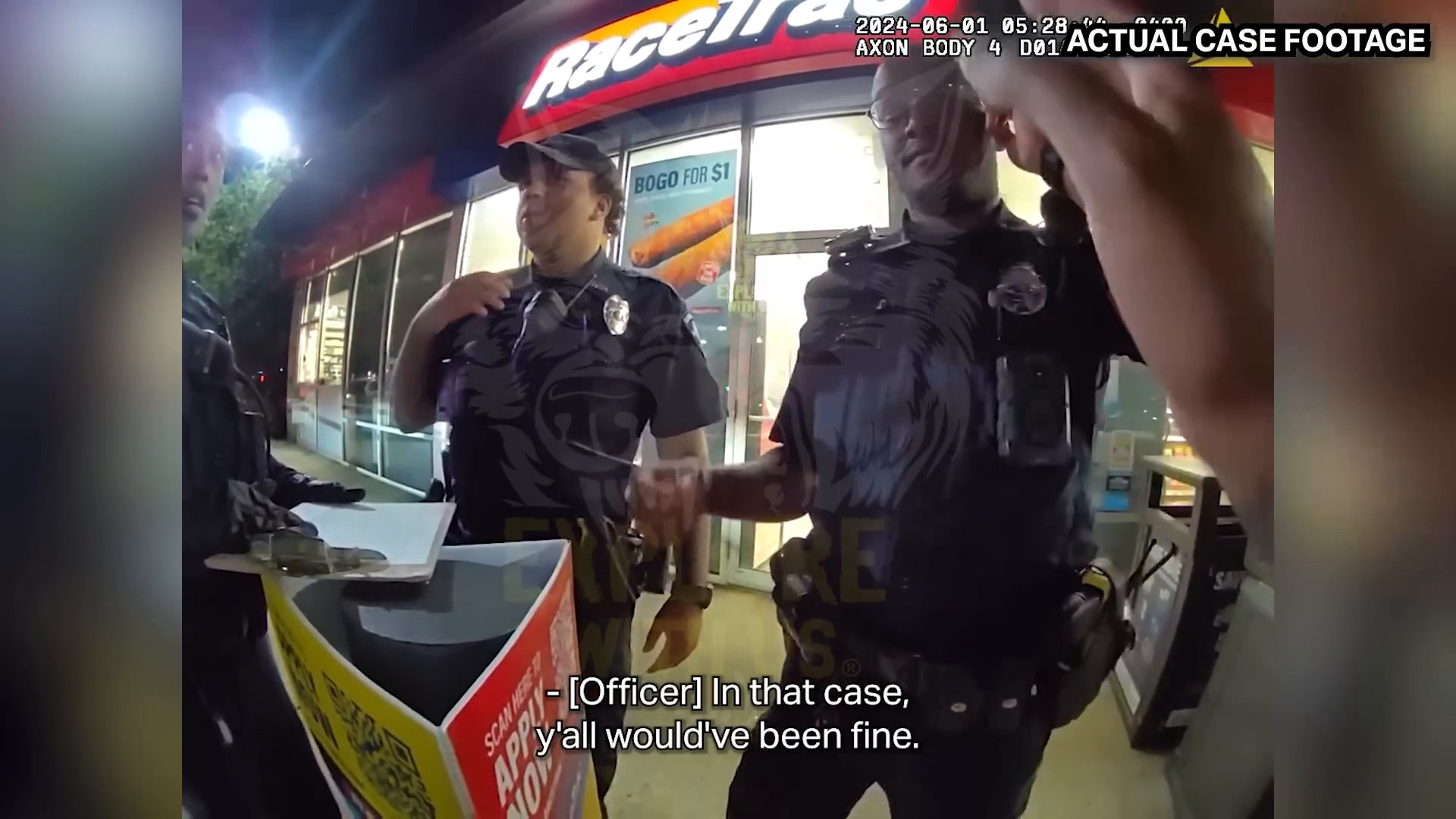
The footage makes the urgency immediately apparent. Officers enter the brightly lit convenience store while employees and bystanders direct them toward the restroom area. The video carries Sanford police body-worn-camera overlays and shows the RaceTrac environment seen in contemporary reporting about the incident. Voices from inside and around the store make clear that the situation has not ended. The victim is still confined with the man who attacked her.
This is the portion of the incident that would later become almost as widely discussed as the attack itself. The first responding officers did not immediately rush through the restroom door. They positioned themselves outside the hallway area, issued commands, and waited as the situation continued behind the door. In the footage, other people at the scene urge officers to move quickly. The tension comes from the gap between what everyone knows is happening and what can be seen: the victim can be heard, but the officers initially do not have a clear view of the attacker or the weapon.
That uncertainty is real, and police entering a confined room with an armed person face obvious risks. Yet the later departmental review concluded that the circumstances required action. Sanford Police Chief Cecil Smith said officers had a duty to act, whether one or two officers were present. The department’s later internal investigation focused specifically on whether the initial hesitation was consistent with what officers should have done during an active threat to a victim.
The footage should therefore be understood on two levels. First, it is evidence of a fast-moving armed assault in which officers had incomplete visual information. Second, it became evidence in a separate administrative examination of police decision-making. Those are related questions, but they are not the same. Lawton’s responsibility for the attack was ultimately resolved in criminal court. The officers’ conduct was handled through the department’s internal process.
Inside the restroom, the struggle is still active
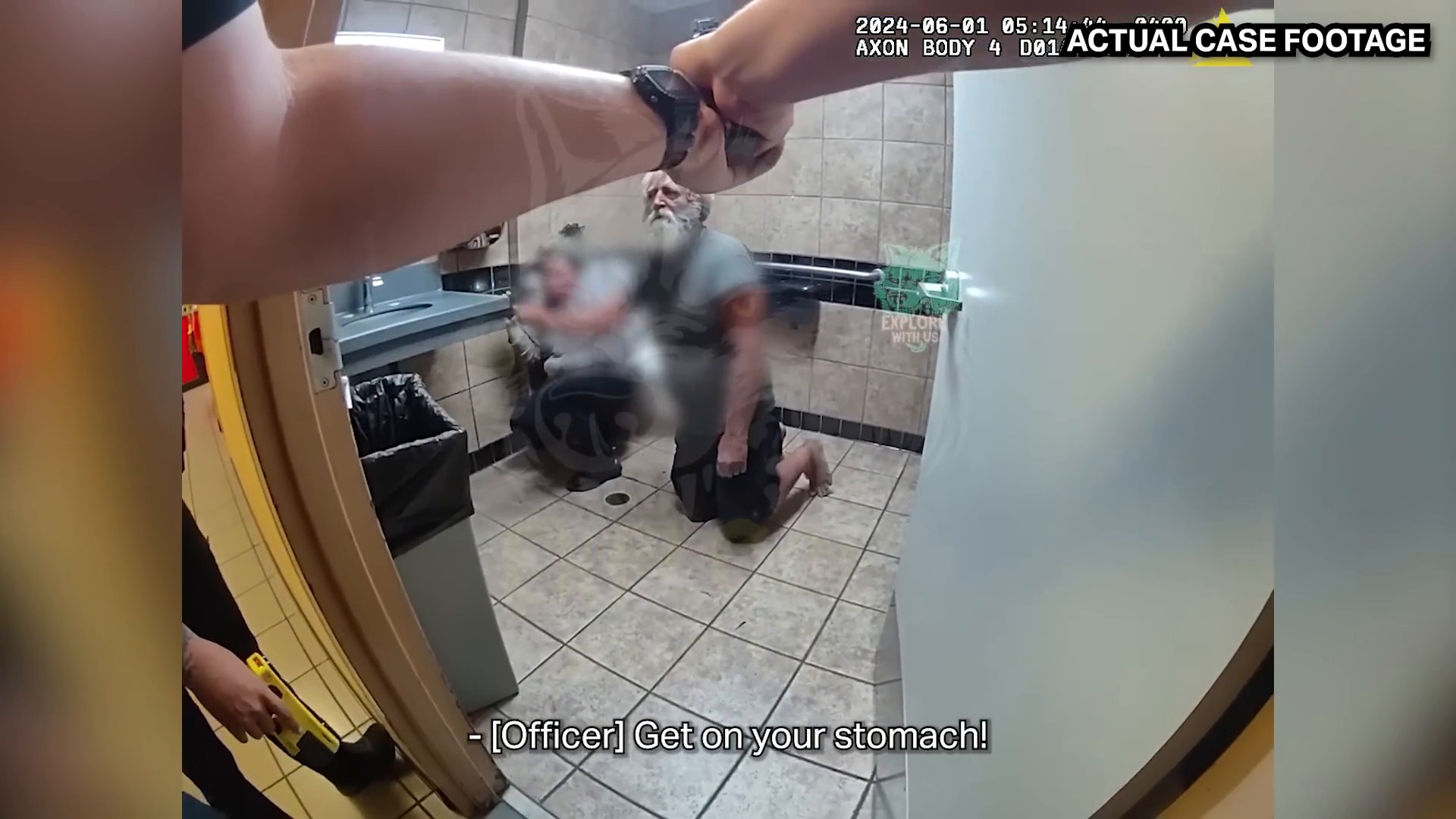
When officers finally move toward the restroom, the scene changes quickly. Commands become more direct and the team pushes into the confined area. The supplied footage shows the victim on the floor and officers confronting Lawton at close range. Later official accounts said officers found the victim still struggling over the box cutter. Lawton surrendered once police entered with their weapons drawn.
What follows is controlled but chaotic. Officers secure Lawton, separate him from the injured employee, and begin sorting out what has happened. The victim is visibly distressed. Her statements captured in the footage describe an attack that went far beyond a simple confrontation. She tells officers that he had tried to cut her throat and explains the injury to her mouth. The physical setting also helps explain why the encounter was so dangerous: the restroom offered little room to retreat, and a closed door separated the victim from the people outside who knew she needed help.
The later prosecution filled in details that are not obvious from every frame of the video. The State Attorney’s Office said Lawton shoved the clerk to the ground, cut her neck and chin with a box knife, and made bizarre religiously themed statements. The employee’s hand injuries were consistent with her trying to control or stop the blade. These facts were not merely allegations left unresolved. In August 2026, Lawton entered a no-contest plea to kidnapping, aggravated battery, and resisting an officer without violence.
The arrest ends the immediate danger, but not the questions
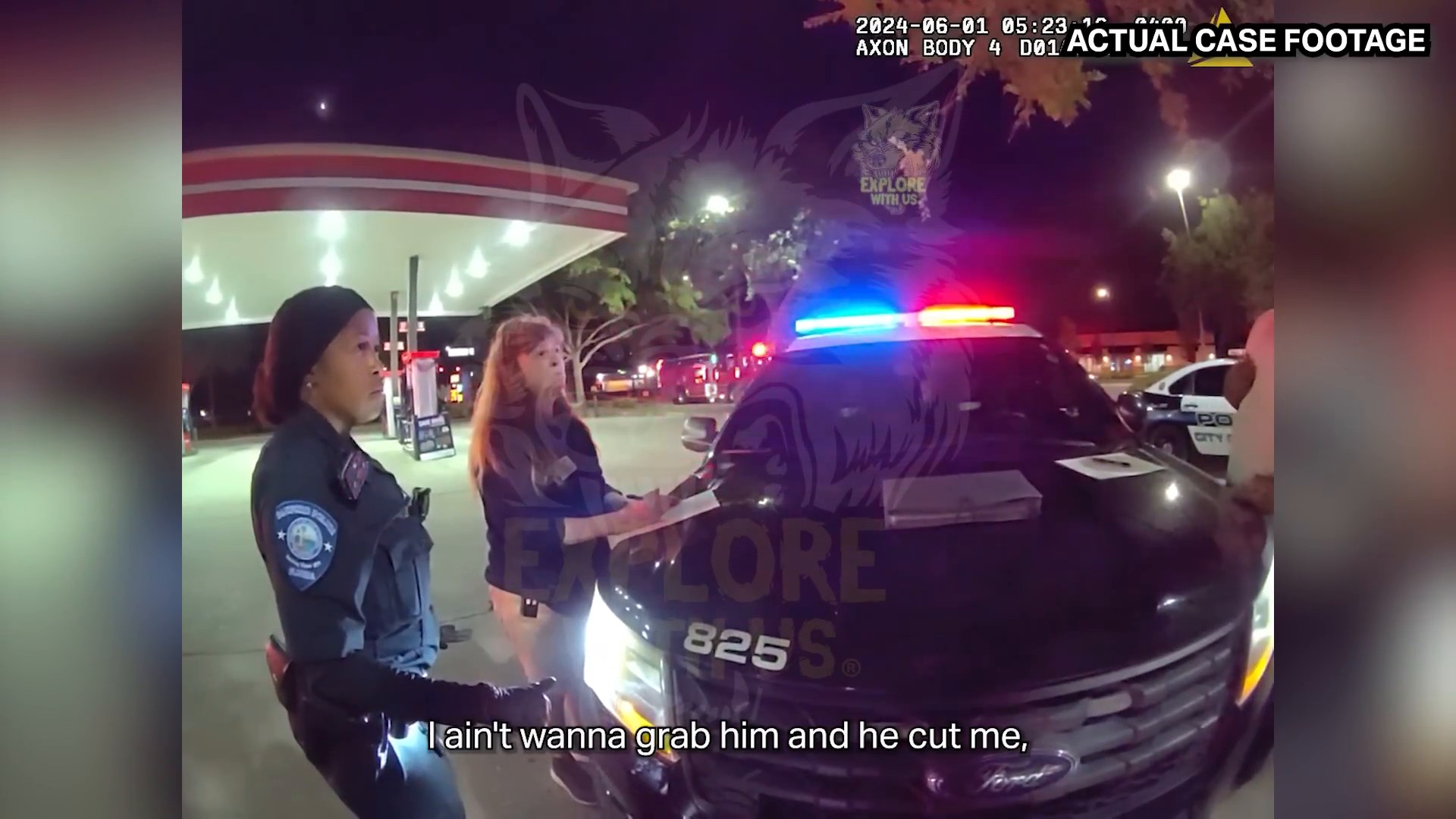
Once Lawton is under control, the footage shifts from rescue to investigation. Officers speak with the victim, employees, witnesses, and one another. Those conversations are significant because they preserve immediate impressions before the event could be reconstructed through reports and later interviews. The employee explains how she ended up inside the restroom. Officers also discuss what they believed they were facing and how the entry was handled.
Lawton was initially booked on serious charges including kidnapping and aggravated battery with a deadly weapon, along with resisting an officer. At that stage, those were accusations, not convictions. That distinction remained important while the criminal case was pending. The case would take more than two years to reach its final sentencing outcome.
Meanwhile, the police response itself drew little broad public attention until body-worn-camera footage began circulating online in 2025. Chief Smith said he learned of the footage after it surfaced publicly and that the incident had not properly made its way up the department’s chain of command. He ordered a review. Two officers were removed from patrol duties while the department investigated why they had waited outside as the employee called for help.
Public criticism centered on a straightforward question: when officers know a victim is trapped with an armed attacker and can hear her asking to be released, how much uncertainty is enough to justify waiting? Police tactics often require officers to slow down when doing so prevents them from walking blindly into an ambush. But an active threat to another person changes the risk calculation. The department’s eventual findings show that Sanford Police did not view the initial delay as simply a defensible tactical choice.
The internal investigation reaches its own conclusion
In May 2025, Sanford Police announced the results of its administrative investigation. WFTV identified the first two responding officers as Dominick Delorbe and Geovanni Castro. According to the station’s report, Delorbe resigned during the investigation. Castro received a 60-hour unpaid suspension and an extension of his probationary period. Other reporting stated that two Sanford officers ultimately resigned in connection with the broader review.
Chief Smith’s public comments were notable because they did not treat the situation as a minor procedural disagreement. He said the officers had a responsibility and duty to act. The department’s review examined the fact that the first officers had information indicating that a serious assault had already occurred and that the danger remained active behind the restroom door.
This does not mean every officer visible in the video received the same finding. The footage includes multiple officers arriving at different moments, and the eventual entry involved additional personnel. It would be inaccurate to flatten all of their actions into one judgment. The internal case focused on the conduct of particular responding officers and the decisions they made with the information available to them at the time.
The episode also illustrates why body-worn-camera footage can have consequences long after an arrest is completed. Video is not only a record used to prosecute a suspect. It can also be reviewed to evaluate training, supervision, tactics, reporting, and compliance with department policy. In this case, footage that resurfaced months later triggered a formal review of an emergency response that otherwise had not received the same level of internal attention.
The criminal case moves toward trial
While the administrative investigation unfolded, Lawton remained jailed awaiting resolution of the criminal case. The State Attorney’s Office later said his public defender filed notice in June 2025 of an intent to pursue an insanity defense. A defense expert reported that Lawton suffered from a neurological disorder associated with years of alcohol abuse and that the condition could produce psychosis.
Competency and criminal responsibility are separate legal concepts. Competency concerns whether a defendant is able to understand the proceedings and assist in the defense at the time the case is moving through court. An insanity defense addresses the defendant’s mental state at the time of the alleged offense under the applicable legal standard. According to the State Attorney’s 2026 release, Circuit Judge Michael Rudisill found Lawton competent to stand trial based on the most recent court-ordered evaluation.
That procedural history is important because the footage contains behavior and statements that viewers might be tempted to diagnose on their own. A video cannot establish a psychiatric diagnosis, and unusual conduct is not enough to determine legal insanity. The court process relied on professional evaluations and legal standards rather than speculation based on body-camera clips.
Prosecutors prepared for trial with witnesses that included the victim. The state’s description of the expected evidence matched the central sequence visible in the footage and documented in the original investigation: Lawton asked the clerk to help with the restroom, trapped her inside, forced her down, attacked her with the box cutter, and was arrested after officers entered.
A final court outcome arrives in August 2026
The case now has a confirmed legal outcome. On August 19, 2026, Lawton pleaded no contest to kidnapping, aggravated battery, and resisting an officer without violence, according to the Office of the State Attorney for the 18th Judicial Circuit. Two days later, the office announced that Judge Rudisill had sentenced him to eight and a half years in prison.
The sentence also includes two years of GPS-monitored probation after his release. The judge ordered Lawton to undergo a psychological evaluation upon leaving prison and to successfully complete any recommended follow-up treatment as a condition of probation. The State Attorney’s Office said he would receive credit for 810 days already spent incarcerated while the case was pending.
That outcome changes how the incident should be described today. In older reporting, Lawton was a suspect accused of kidnapping and aggravated battery. After the no-contest plea and sentence, it is accurate to say the criminal case resulted in a conviction-equivalent adjudicative outcome and prison sentence on those offenses, rather than presenting the charges as unresolved allegations. A no-contest plea does not require a defendant to verbally admit the factual allegations in the same manner as a guilty plea, but it permits the court to impose judgment and sentence.
The official sentencing release also provides the clearest current account of the victim’s injuries. It says she lost a tooth and suffered deep cuts to her hand while grabbing for the knife, in addition to the cuts to her neck and chin. Those details are more precise than the sensational shorthand that circulated with some reposted versions of the footage.
What the footage establishes and what outside records add
The video and the public record overlap, but they should not be treated as interchangeable. The footage directly shows officers arriving at the RaceTrac, moving through the store, responding to the restroom area, taking Lawton into custody, speaking with the victim and witnesses, and discussing the response afterward. It also captures the emotional intensity of the scene in a way a written report cannot.
The external sources establish facts the camera alone cannot reliably prove: the precise address, Lawton’s identity, the filed charges, the later internal investigation, personnel discipline, the competency proceedings, the no-contest plea, and the final prison sentence. Using both forms of evidence produces a fuller account without forcing the footage to answer questions it cannot answer.
That distinction is especially important with viral police video. Edited social-media versions often arrive with a title that compresses an entire case into a few dramatic words. A title may accurately convey the severity of an event while still omitting context or overstating a specific injury. Here, official sources support that the employee suffered a missing tooth and serious lacerations during a box-cutter attack. They also confirm kidnapping and aggravated-battery charges that were ultimately resolved through Lawton’s plea and sentence.
Why this case continued to matter after the arrest
Many police videos end, narratively, when the handcuffs go on. This one did not. The arrest was only the first resolution. The victim still faced the consequences of a frightening workplace attack. The criminal case moved slowly through competency questions and pretrial preparation. Then the body-camera footage generated a second institutional inquiry into the actions of the officers who were supposed to intervene.
The result is a case with two separate forms of accountability. Lawton’s conduct was addressed through the criminal courts, ending with an eight-and-a-half-year prison sentence and supervised probation. The police response was addressed through an administrative process that produced discipline and personnel changes. Neither process erases what happened to the employee, but together they provide a much more complete ending than the early viral clips could offer.
The footage is difficult to watch because much of the fear is conveyed through sound and waiting rather than through a clear view of the attack itself. People in the store know someone is in danger. Officers know there may be a blade behind the door. The victim is still inside. Every additional moment therefore feels consequential. When officers finally enter, the camera records the sudden transition from uncertainty to direct action.
More than two years later, the legal record supplies the ending that the video could not. The man taken into custody that morning did not simply disappear into an unresolved docket. His case progressed through mental-health evaluations, trial preparation, a no-contest plea, and sentencing. The department, meanwhile, publicly revisited its own response and concluded that the initial officers should have acted sooner.
For viewers, that makes the footage more than a shocking arrest clip. It is a record of an attack, a rescue, a disputed police response, and the long process that followed. Watching the full sequence provides context that a short viral excerpt cannot: the information officers received, the time spent outside the restroom, the eventual entry, the victim’s immediate account, and the conversations that helped turn a June 2024 emergency into a case scrutinized well into 2026.
Comments (0)
Loading comments...
May You Like

UCF Student’s Pronoun Dispute With Campus Police Escalates Into an Arrest

🚔⚠️ 911 Call Comes Hours Later After a Troubling Bath Incident | Ohio, USA