
Florida Police Stop Wanted Man Then Chaos Erupts Moments Later
A ROUTINE FLORIDA KEYS TRAFFIC STOP TURNS INTO A LIFE-CHANGING CRASH
The Traffic Stop That Was About to Take a Terrifying Turn
Late at night on April 9, 2024, a Monroe County Sheriff's deputy was conducting what appeared to be another routine traffic stop along the Overseas Highway in Islamorada.
Nothing about the opening moments suggested what was coming.
Deputy Julian Garcia had stopped a Ford Fusion near mile marker 87 on U.S. 1. The driver, identified in reports as 20-year-old Andrew James Gibson, had an active warrant for failing to appear in court.
Garcia was outside his patrol vehicle dealing with Gibson.
Then another vehicle approached.
It was a 2014 Toyota Prius driven by Alexandra Marlene Baraga, a 26-year-old originally from Shoreview, Minnesota.
Within seconds, the routine stop became an emergency.
Authorities say Baraga's Prius slammed into the rear of Garcia's patrol vehicle.
The impact propelled the police vehicle forward.
Garcia was caught between the cruiser and the Ford he had stopped.
ONE MOMENT HE WAS CONDUCTING A TRAFFIC STOP. THE NEXT, HE WAS PINNED BETWEEN TWO VEHICLES WITH DEVASTATING LEG INJURIES.
And the investigation that followed would reveal an even more disturbing detail.
Authorities reported Baraga's blood-alcohol concentration at 0.310% — nearly four times Florida's 0.08% legal limit.
A Nighttime Stop on One of Florida's Most Unusual Highways
The location matters.
U.S. 1 through the Florida Keys is not an ordinary urban road network. The Overseas Highway serves as the primary roadway connecting the island communities.
At night, officers working roadside stops are exposed to passing traffic with relatively little separation.
Garcia had pulled Gibson over near mile marker 87 in Islamorada.
According to reporting based on the Florida Highway Patrol investigation, Garcia was moving between his patrol vehicle and the stopped Ford while carrying out the arrest associated with Gibson's outstanding warrant.
The emergency lights were there.
The patrol vehicle was there.
The traffic stop was clearly underway.
But the approaching Prius did not safely clear the scene.
It struck the cruiser.
The consequences were immediate.
THE IMPACT CHANGED EVERYTHING
The collision itself is the turning point of the entire story.
According to the FHP account reported by the Miami Herald, Garcia and Gibson were alongside the stopped vehicles when Baraga's Prius crashed into the patrol car.
The patrol vehicle was forced forward.
Garcia reacted.
Reports say he pushed Gibson away from danger, but Garcia himself became trapped between the patrol vehicle and the Ford Fusion.
That detail dramatically changes how the incident should be understood.
The deputy was not sitting protected inside his cruiser.
He was standing in the danger zone between vehicles.
There was almost nowhere to go.
The impact happened quickly enough that his response was measured in seconds.
Garcia managed to push the other man away.
He couldn't completely save himself.
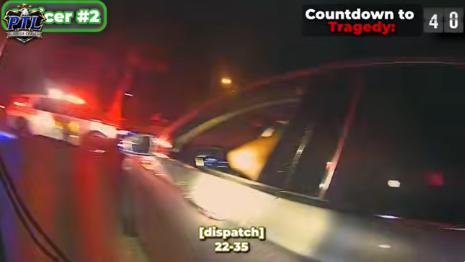
The chaotic lighting visible in the footage captures what happened next.
Red and blue lights wash over the roadway.
Vehicles sit at awkward angles.
Officers rush into the scene.
Commands and screams replace the relative calm of the original traffic stop.
This is the moment the entire purpose of the police response changes.
Nobody is concerned with an ordinary traffic violation anymore.
NOW THEY HAVE A SERIOUSLY INJURED DEPUTY TRAPPED AT THE SCENE OF A MAJOR CRASH.
OFFICERS RUSH TO FREE THE DEPUTY
Responding deputies worked to free Garcia from between the vehicles.
His injuries were concentrated in his lower body, particularly his left leg.
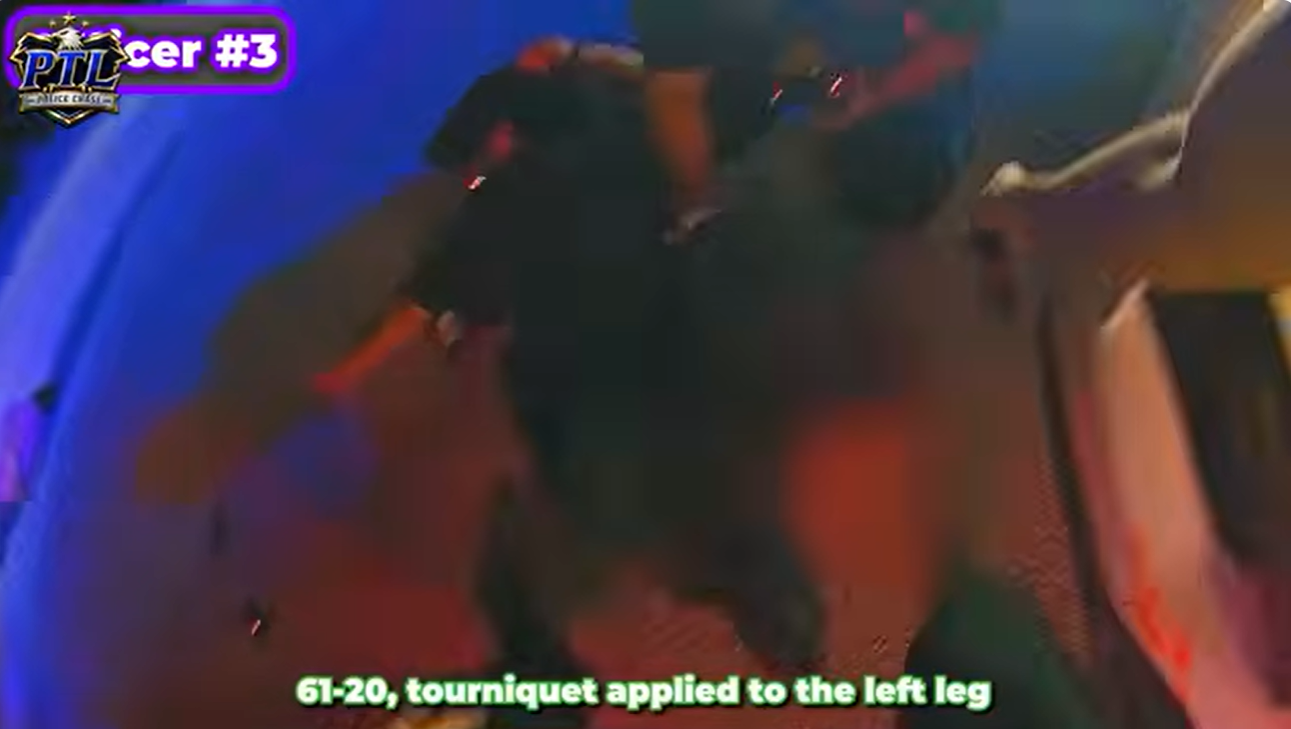
Law-enforcement sources told the Miami Herald that deputies applied a tourniquet while waiting for emergency medical assistance.
A tourniquet at a crash scene immediately communicates the seriousness of the situation.
This was not simply soreness from an impact.
Garcia had suffered major trauma.
Emergency crews ultimately transported him by helicopter to a Miami-Dade trauma center.
The man Garcia had initially stopped was also hurt, though reports described Gibson's injuries as non-life-threatening. He was transported to Mariners Hospital before later being booked on his outstanding warrant.
Meanwhile, investigators turned their attention to the woman driving the Prius.
"I AM SO SORRY"
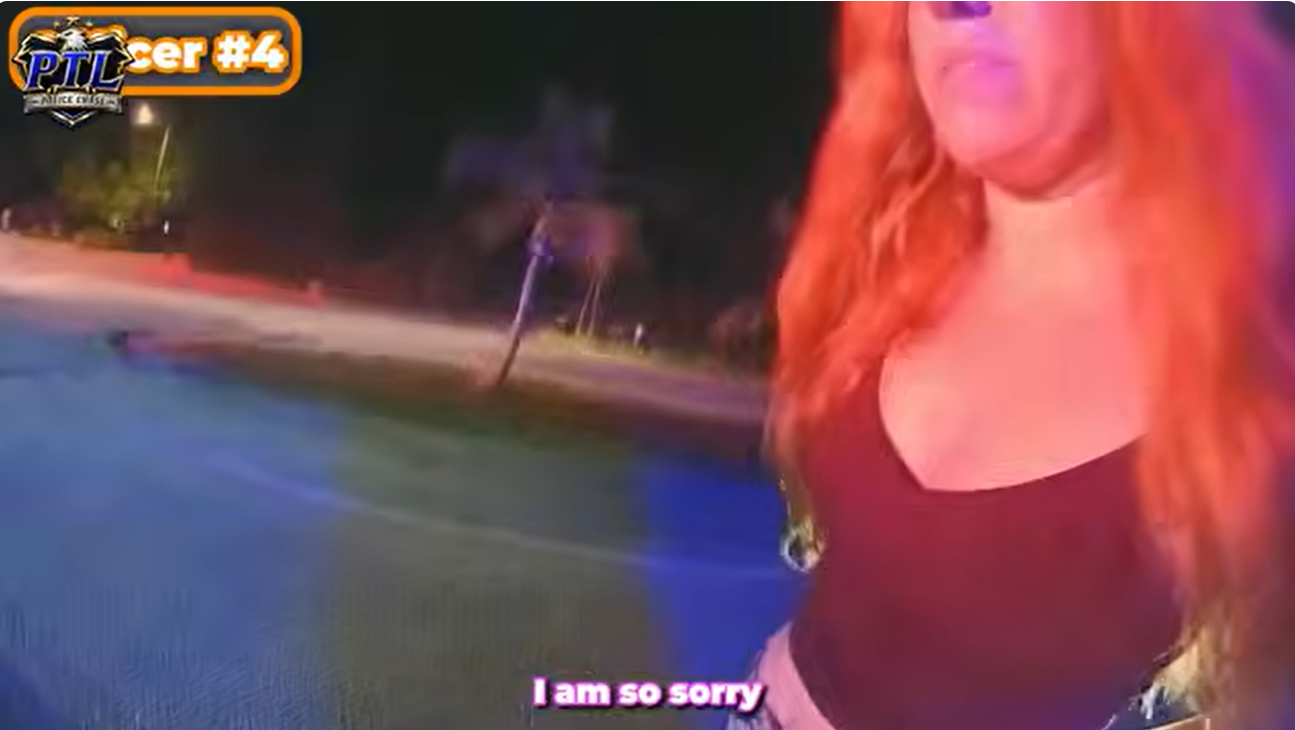
The footage shows Baraga speaking with officers after the collision.
The scene is remarkably different from a conventional high-speed pursuit arrest.
There is no suspect running through the woods.
No dramatic foot chase.
No prolonged standoff.
Instead, a woman stands near officers while a catastrophic scene unfolds around her.
In the footage provided, she repeatedly apologizes.
But the physical evidence and observations documented by investigators would become far more significant than anything said at the roadside.
According to the FHP report cited by the Miami Herald, investigators noted a strong odor of alcohol, bloodshot eyes and speech described as slurred. Baraga voluntarily provided a blood sample.
The reported result was extraordinary:
0.310% BAC.
For context, Florida's legal limit for most adult motorists is 0.08%.
That meant the reported result was almost four times the legal threshold.
The numerical result became one of the defining facts of the investigation.
THE CRASH WASN'T JUST ABOUT THE DRIVER
One of the most important aspects of this case is easy to overlook.
Impaired driving is sometimes framed primarily around what could happen to the impaired driver.
This incident demonstrates why that framing is incomplete.
Baraga was reported to have escaped the collision without injury.
The deputy she struck did not.
Neither did the man standing near him.
The consequences were transferred to people who had no control over whether an impaired driver entered the roadway.
That is why the scene becomes so powerful.
A deputy can activate emergency lights.
He can position his patrol car.
He can wear reflective equipment.
He can follow traffic-stop procedures.
But he cannot completely control the actions of every approaching driver.
THE ARREST AND THE CHARGES
Florida Highway Patrol arrested Baraga following the crash.
Jail and news records at the time showed that she faced one felony DUI charge involving serious bodily injury along with four misdemeanor DUI-related counts.
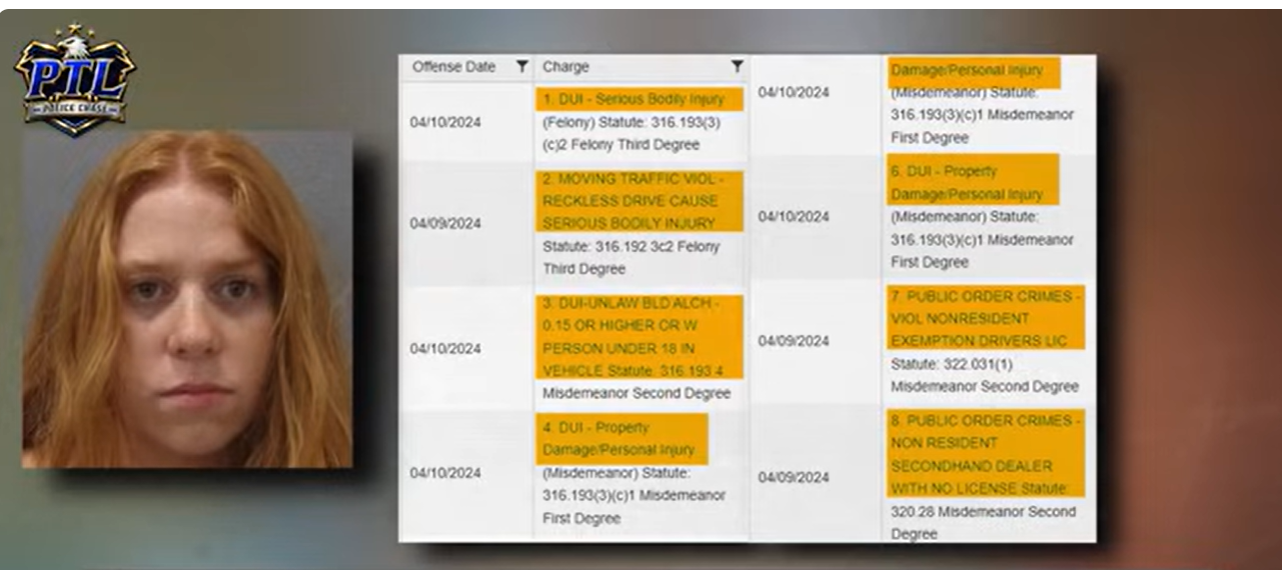
The charge screen shown in the footage also illustrates how a single collision can generate multiple allegations.
But it is important to distinguish charges from convictions.
An arrest record represents allegations made by authorities; guilt is determined through the judicial process.
At the time immediately following the crash, Baraga was held on a reported $95,000 bond. Records cited by local reporting indicate she was subsequently released after posting bond.
The criminal case, however, was only one part of the aftermath.
The far larger story became Garcia's recovery.
A DEPUTY'S INJURIES THAT WOULD NOT END WITH THE NIGHT
Initially, reports described Garcia as suffering serious lower-extremity injuries.
That description barely communicates what followed.
The Miami Herald reported that doctors spent hours operating in an effort to save his leg. Sheriff Rick Ramsay said at the time that the medical team was working to restore blood flow and remained hopeful about his recovery.
Garcia faced multiple surgeries and a long hospitalization.
For his colleagues, this wasn't simply another crash report.
One of their deputies had been seriously injured while doing an everyday part of police work.
And the long-term consequences proved severe.
Later reporting revealed that Garcia ultimately lost his left leg below the knee because of the injuries from the crash.
That development gives the original footage a completely different weight.
When viewers see the confusion beside the roadway, they are not watching an injury that disappeared after a hospital visit.
They are watching the first minutes of an event that permanently changed someone's life.
THE MOVE OVER LAW MATTERS HERE
The case also became a stark example of why roadside emergency-vehicle laws exist.
Florida's Move Over requirements are intended to provide a safety buffer for police, firefighters, emergency medical crews, tow operators and others working beside traffic.
Sheriff Ramsay specifically invoked the principle after Garcia was injured.
Drivers approaching stopped emergency vehicles need to recognize that people may be standing outside those vehicles.
A police cruiser isn't simply another stopped car.
It may have an officer standing beside it.
Someone may be undergoing a field sobriety test.
A driver may be outside their vehicle.
Paramedics could be working.
A tow operator might be loading a damaged car.
A single vehicle that fails to safely negotiate that scene can transform a routine roadside interaction into a mass-casualty risk.
GARCIA'S CRUISER WASN'T THE ONLY THING HIT. THE IMPACT PUSHED THE CRUISER INTO THE PEOPLE STANDING IN FRONT OF IT.
That chain reaction is what made this collision so devastating.
THE OTHER DRIVER SURVIVED
There is another remarkable part of the incident.
Garcia reportedly pushed Gibson away as the patrol vehicle surged forward.
Gibson was still injured, but his injuries were described as non-life-threatening.
Garcia absorbed the far more serious consequences.
That split-second action provides an important piece of context when viewing the aftermath.
The person originally being detained became one of the crash victims.
The deputy carrying out that detention became another.
And the officer's decision in the moment may have prevented Gibson's injuries from becoming considerably worse.
After receiving medical treatment, Gibson was taken into custody on the warrant that had prompted the traffic-stop arrest process in the first place.
It is an unusual ending to the original traffic stop.
The stop technically continued through an entirely separate emergency.
FROM A TRAFFIC STOP TO A TRAUMA CENTER
The sequence can be reduced to only a few steps, yet each one dramatically raises the stakes:
A DEPUTY STOPS A FORD FUSION
↓
THE DRIVER HAS AN OUTSTANDING WARRANT
↓
THE DEPUTY BEGINS THE ARREST PROCESS
↓
A TOYOTA PRIUS APPROACHES THE STOP
↓
THE PRIUS HITS THE PATROL VEHICLE
↓
THE CRUISER IS PUSHED FORWARD
↓
GARCIA PUSHES THE OTHER DRIVER AWAY
↓
GARCIA BECOMES PINNED BETWEEN VEHICLES
↓
DEPUTIES FREE HIM AND APPLY EMERGENCY AID
↓
HE IS AIRLIFTED FOR TRAUMA CARE
↓
BARAGA IS ARRESTED
↓
AUTHORITIES REPORT A 0.310% BAC
↓
GARCIA BEGINS A LONG MEDICAL BATTLE
The most unsettling part is how quickly those steps occur.
There is no lengthy buildup.
The danger arrives from outside the original stop.
WHY THIS FOOTAGE HOLDS ATTENTION WITHOUT EXAGGERATION
For a blog built around police footage, this case doesn't need an exaggerated title.
The verified facts already create the narrative.
The strongest hook is not:
"You won't believe what happened next."
It is much simpler:
A deputy was standing beside a car during a routine traffic stop when another vehicle slammed into his cruiser and changed his life permanently.
That sentence creates the question that keeps a reader moving:
How did this happen?
The article then gradually answers it.
Where was the officer standing?
Why was he outside the vehicle?
Who was driving the approaching Prius?
What did investigators observe?
How badly was the deputy hurt?
And what happened to him afterward?
Each answer leads naturally into the next question.
That's a stronger retention structure than giving every detail away in the opening paragraph.
THE BODYCAM AFTERMATH

Footage after a serious crash has a different quality from footage of a pursuit.
The most consequential event has already happened.
Now viewers see people trying to understand the damage.
Emergency lights dominate the scene.
Officers move between vehicles.
Witnesses and drivers ask questions.
Someone wants to know whether the injured person is okay.
Those moments matter because they show the human transition between impact and consequence.
Seconds earlier, everyone involved had separate plans for the night.
Garcia was working.
Gibson was being detained.
Baraga was driving.
Then all three lives converged at the same point on U.S. 1.
The crash reorganized everything.
A RECOVERY THAT TOOK A VERY DIFFERENT PATH
The story did not end in April 2024.
Later reporting provides an important epilogue.
Garcia ultimately lost his lower left leg, but he continued rehabilitation.
Then came something remarkable.
By late June 2025, he had returned to work with the Monroe County Sheriff's Office. A December 2025 report documented him once again conducting traffic stops, now using a prosthetic leg.
That later development transforms the ending.
The bodycam footage shows the night his life changed.
The later reporting shows what happened after the cameras stopped.
Garcia had gone from conducting a normal traffic stop to suffering catastrophic injuries in seconds.
He underwent surgeries.
He lost part of his leg.
He rehabilitated.
And eventually he went back to the same profession — including the same kind of roadside work during which he had been injured.
That is the strongest conclusion available for this story because it is not manufactured drama.
It happened.
ONE CRASH, YEARS OF CONSEQUENCES
The collision itself took seconds.
Its effects lasted far longer.
There were criminal allegations against Baraga.
There were hospital stays and surgeries.
There was rehabilitation.
There was the loss of Garcia's leg.
And there was eventually his return to duty.
A civil automobile-negligence case involving Julian Garcia and Alexandra Baraga was also filed in Monroe County at the end of 2024, illustrating how the legal aftermath extended beyond the immediate criminal investigation.
That distinction matters.
Bodycam videos often compress incidents into minutes.
Real consequences do not operate on the same timeline.
The camera may stop recording.
The hospital treatment continues.
Court proceedings continue.
Physical rehabilitation continues.
Families continue adjusting.
And in Garcia's case, adapting to a permanent injury became part of everyday life.
THE MOMENT EVERYTHING CHANGED
Look again at the earliest part of the incident.
A police vehicle sits on U.S. 1.
A deputy is handling a stop.
A driver is outside.
Traffic continues passing.
There is nothing inherently spectacular about the scene.
That normality is exactly what makes what happens next so disturbing.
Roadside police work depends heavily on strangers approaching from behind doing the right thing.
Slow down.
Move over.
Remain attentive.
Do not drive impaired.
Most vehicles pass without incident.
This one didn't.
Authorities say Alexandra Baraga entered that scene with a BAC of .310%.
Her Prius struck the patrol vehicle.
The cruiser moved forward.
Garcia pushed another person away.
Then he was trapped.
THE CRASH LASTED SECONDS. THE CONSEQUENCES CHANGED THE REST OF HIS LIFE.
THE ROAD BACK
There is a temptation to end this story with Baraga's arrest.
That would be the conventional ending.
But it isn't the most meaningful one.
The real ending belongs much later.
It belongs to Garcia.
More than a year after the crash, he was again getting out of a patrol vehicle and approaching motorists.
He had lost part of his leg.
He had not lost his career.
Keys Weekly reported that Garcia returned to work in June 2025 and was back conducting traffic stops later that year.
The same activity that had nearly cost him his life was once again part of his job.
That gives the original footage an extraordinary before-and-after quality.
The officer visible before the collision has no idea how dramatically the next few seconds will change his future.
The officer who eventually returns to duty has lived through all of it.
WHEN A ROUTINE STOP BECAME ANYTHING BUT ROUTINE
The April 9 crash near mile marker 87 began with a traffic stop unrelated to Alexandra Baraga.
Garcia had pulled over another driver.
He was dealing with an outstanding warrant.
Then Baraga's Prius entered the scene.
Authorities say the vehicle struck his cruiser hard enough to propel it into the deputy.
Garcia suffered catastrophic injuries.
Gibson suffered lesser injuries.
Baraga was arrested.
Investigators reported her BAC at 0.310%.
And what initially appeared to be another nighttime traffic stop in the Florida Keys became the beginning of surgeries, rehabilitation and permanent physical consequences for a 26-year-old deputy.
Yet that still wasn't the final chapter.
Garcia eventually returned to law enforcement.
Back to the road.
Back to a patrol vehicle.
And, remarkably, back to traffic stops.
THE MOST POWERFUL PART OF THIS STORY IS NOT SIMPLY THAT GARCIA SURVIVED THE CRASH. IT IS THAT AFTER LOSING PART OF HIS LEG, HE EVENTUALLY RETURNED TO THE SAME JOB.
WATCH THE MOMENT THE NIGHT CHANGED
The full footage gives a perspective that photographs and written reports cannot completely reproduce.
You see the roadside environment.
You see the emergency lights.
You see the confusion immediately after the impact.
And you see officers attempting to understand what has just happened while an ordinary traffic stop turns into a major medical emergency.
Knowing what came afterward makes those moments even more significant.
A few seconds on a dark Florida Keys highway would lead to multiple surgeries, an amputation, a lengthy recovery and eventually an extraordinary return to duty.
Follow the link to watch the complete sequence and see how an ordinary nighttime traffic stop became a life-changing emergency in a matter of seconds: https://www.youtube.com/watch?v=J3jINHJcjrQ
Comments (0)
Loading comments...
May You Like

One Driver’s Decision to Flee Brings Police Racing After Him

Entitled Driver Learns Why You Must Obey Lawful Orders During Traffic Stop

[DASHCAM] Drunk Driver Leads Trooper on High-Speed Pursuit Through City Streets













