
FLORIDA DEPUTY PULLS OVER A MAN HE KNOWS HAS NO LICENSE
Familiar Traffic Stop Takes a Sudden Turn When the Driver Decides to Run
A Traffic Stop That Doesn't Feel Like a Traffic Stop
Some police encounters begin with immediate tension.
Emergency lights appear in the mirror. An officer approaches cautiously. The driver nervously hands over a license. Neither person knows what the other might do next.
This encounter is almost the opposite.
On September 14, 2022, Deputy Register spotted a familiar red Chevrolet pickup.
According to the police report later published alongside the body-camera footage, the deputy recognized the driver as a man identified in the report as Preston. More importantly, Register had recently confirmed that Preston's driver's license was suspended and that he had multiple prior suspensions.
That gave the deputy a reason to stop him.
But when the two men begin talking, the interaction feels unusually casual.
There is recognition.
There is conversation.
The atmosphere lacks much of the uncertainty normally associated with a roadside stop between strangers.
For several minutes, viewers could almost mistake the footage for two acquaintances catching up beside a pickup truck.
That impression explains the video's eventual title: “When You and the Cop are Buddies.”
But familiarity does not make a suspended license valid.
And knowing the deputy certainly does not make an arrest disappear.
Eventually Preston realizes that this friendly conversation is still leading toward the back of a patrol car.
That is when everything changes.
He runs.
And within seconds, one of the most relaxed traffic stops imaginable becomes a foot pursuit.
The Deputy Already Knows Who He Is
The opening minutes matter because Deputy Register is not trying to determine the driver's identity from scratch.
According to the report reproduced by Active Police Cam, Register was traveling east when he observed Preston driving the red Chevrolet pickup.
The deputy had recently checked Preston's license status.
It was suspended.
Not only that, the report describes the suspension as involving multiple prior offenses.
That information dramatically simplifies the investigative portion of the stop.
This is not a case where an officer sees a minor equipment violation and unexpectedly discovers a larger problem.
The deputy already knows the problem before approaching.
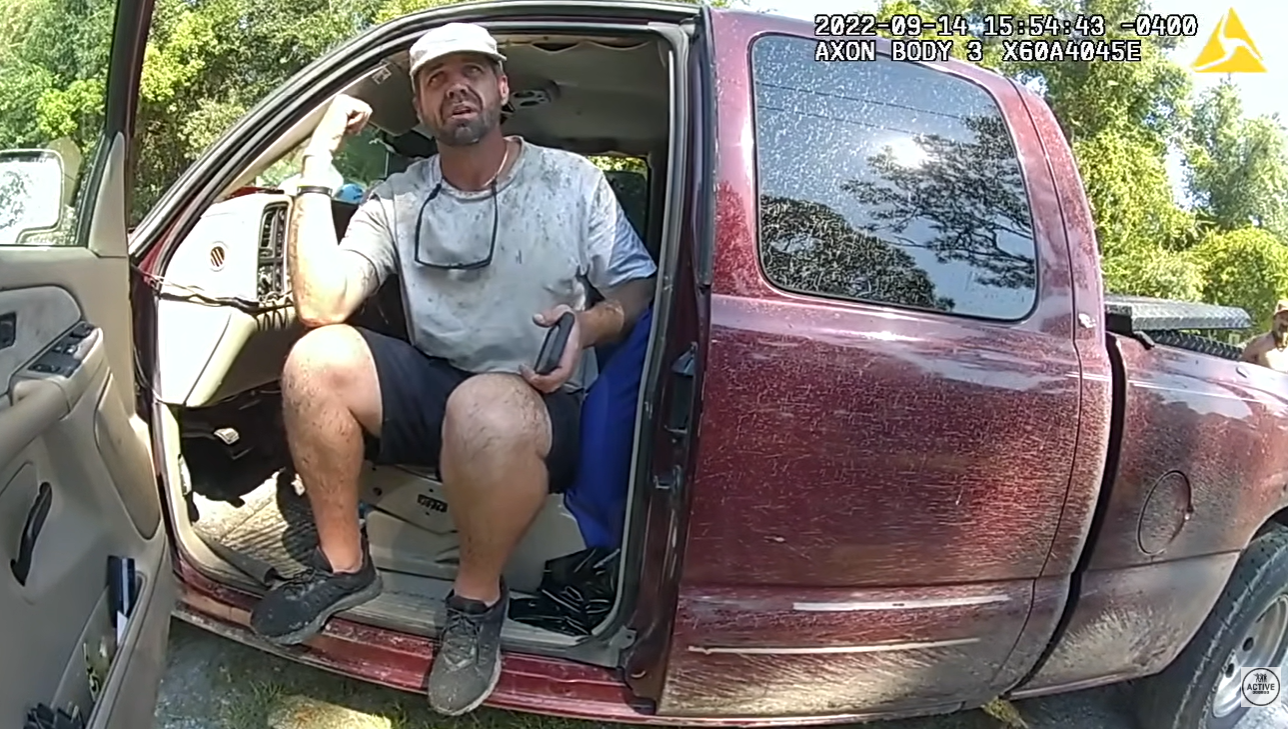
The footage timestamp places the encounter during the afternoon of September 14, 2022. The AXON BODY 3 overlay shows the interaction unfolding in daylight.
Preston stands near the truck while speaking with the deputy.
A Yamaha outboard motor is visible behind him, attached to a boat being transported with the vehicle.
The conversation remains surprisingly relaxed.
That tone is important because it creates the central tension of the footage.
Viewers know this is a police video.
They know something significant is probably going to happen.
Yet for several minutes, very little does.
The two men talk.
The deputy explains the situation.
Preston responds.
There is none of the frantic behavior normally associated with someone preparing to flee.
That makes what happens later considerably more surprising.
It also illustrates an important point about body-camera footage.
Danger does not always announce itself.
A suspect does not necessarily spend five minutes looking toward an escape route or making obvious threats before deciding to run.
Sometimes the decision occurs almost instantly.
One second an officer is walking beside someone.
The next second that person is sprinting away.
That is essentially what happens here.
Familiarity Doesn't Change the License Status
The easygoing tone could create the impression that Preston might somehow talk his way out of the situation.
But Deputy Register has a legal problem in front of him that conversation cannot simply erase.
The report says Preston was operating the truck despite his suspended license.
Driving privileges are administrative and legal matters.
An officer recognizing a driver personally does not restore them.
A friendly conversation does not restore them.
And being cooperative during the first part of a stop does not change what the records show.
This creates an unusual psychological dynamic.
Preston appears comfortable speaking with Register.
But as the encounter progresses, it becomes increasingly clear that familiarity is not going to prevent enforcement action.
The deputy begins escorting Preston toward the patrol vehicle.
For a moment, everything still appears controlled.
There is no obvious struggle.
No shouting.
No confrontation.
Then Preston makes the decision that completely changes the encounter.
He takes off.
One Decision Turns Conversation Into a Foot Pursuit
According to Register's report, Preston began running while the deputy was escorting him toward the patrol car.
Register immediately notified dispatch that he was 10-31, meaning he was involved in a foot pursuit.
The calm interaction disappears instantly.
The deputy runs after him.
This transition is the defining moment of the video.
Only seconds earlier, the men had been close enough to walk together.
Now one is trying to escape from the other.
The body camera begins moving violently as Register accelerates.
Foot pursuits create a different kind of danger from vehicle chases.
The speeds are obviously much lower, but officers have less protection.
There is no patrol-car door between the officer and the person being pursued.
There is no windshield.
The officer is running into an environment where obstacles, weapons or other people may be present.
At the same time, running consumes enormous physical energy.
An officer must chase someone, watch their hands, communicate over the radio, observe the terrain and prepare for the possibility that catching the fleeing person will immediately lead to a fight.
That last possibility becomes reality here.
Register catches Preston.
But catching someone and controlling them are two different things.
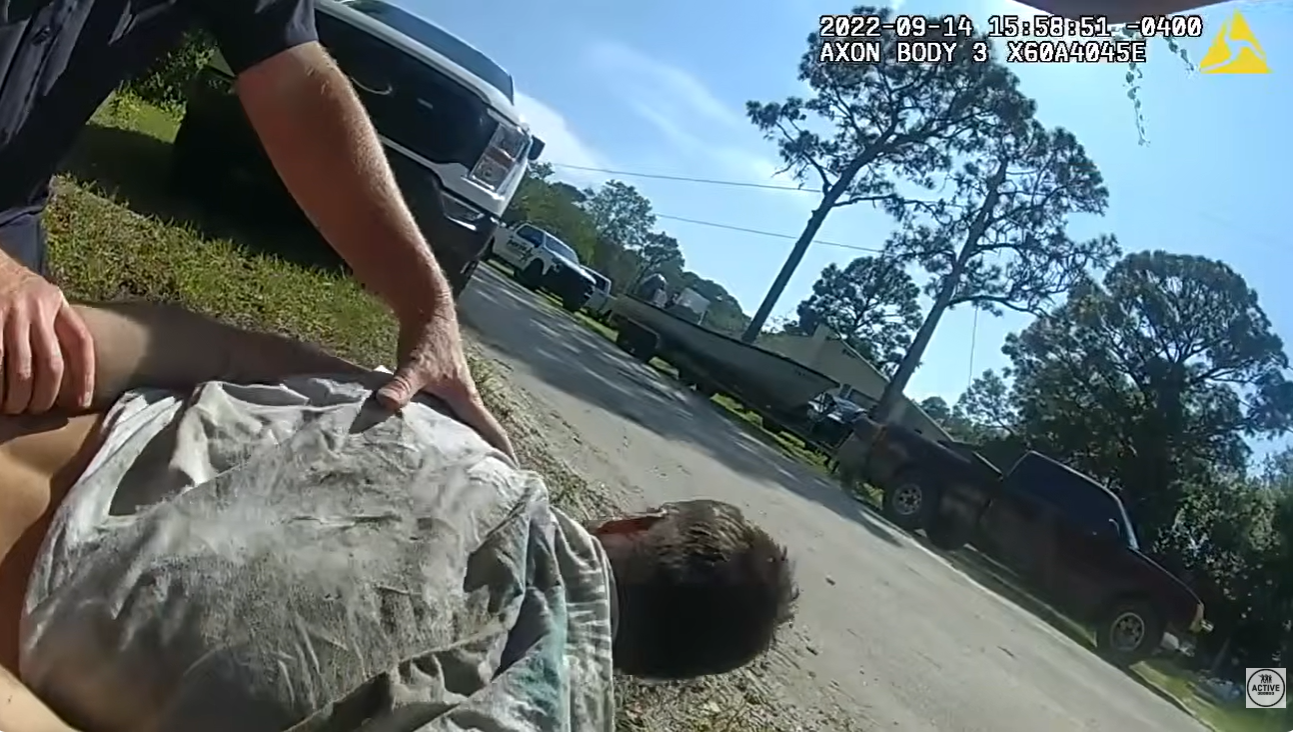
The deputy tackles him to the ground.
The foot pursuit is finished.
The struggle is not.
According to the report, Preston attempts to wrap his arms around Register's body. Register performs another takedown while trying to establish control.
The friendly roadside conversation is now difficult to recognize in what is happening on the ground.
That contrast is precisely why the video works so effectively as a story.
There was no gradual buildup.
No long argument.
No screaming match preceding the chase.
Instead, the situation jumps almost directly from casual conversation to physical resistance.
Catching Him Is Only Half the Problem
Once Preston is on the ground, Deputy Register has another challenge.
He must get him into handcuffs.
According to the officer's report, Preston continues resisting both Register and Deputy Chief Hogan, who arrives to help.
This part of an arrest can be deceptively difficult.
A person does not have to overpower two officers in order to make handcuffing complicated.
Pulling arms underneath the torso, twisting the body, grabbing an officer or simply refusing to present the hands can prolong the struggle.
Meanwhile, everyone involved is becoming tired.
That matters because fatigue reduces coordination.
It can make it harder for officers to control their movements and harder for a resisting person to understand or follow commands.
The longer the physical struggle lasts, the greater the chance somebody gets injured.
Register therefore attempts another method.
The police report says the deputy uses his Taser in drive-stun mode against Preston.
A drive stun differs from the familiar image of two Taser probes being fired from a distance. It involves applying the device directly against a person's body.
According to Register's account, the effect in this case is immediate.
Preston stops resisting.
Officers are then able to secure him in handcuffs.
The entire physical confrontation ends far more quickly than it could have.
No extended chase through the neighborhood follows.
There is no vehicle pursuit.
No barricade.
No second escape.
Once Preston is restrained, the encounter settles back down.
That return to relative calm is almost as striking as the original decision to run.
The incident has essentially passed through three different phases.
First, a surprisingly friendly conversation.
Then a sudden chase and struggle.
Finally, a controlled arrest.
All within roughly eight minutes of body-camera footage.
Why Run From Someone Who Already Knows Who You Are?
This is the question hanging over the entire video.
Running from police rarely offers good odds.
Running from an officer who already knows your identity offers even worse ones.
Register did not need to investigate who Preston was after the escape.
He already knew.
He knew the truck.
He knew the driver's license status.
Even if Preston had successfully created distance during the initial sprint, disappearing permanently would have been another matter entirely.
That makes the decision to run appear especially impulsive.
And impulsive decisions are a recurring feature in police footage.
People often evaluate an arrest as though everyone involved has calmly calculated every possible consequence.
Real encounters do not always work that way.
Stress changes decision-making.
Fear changes it.
The realization that handcuffs are seconds away can trigger a sudden fight-or-flight reaction.
A person may run despite having no realistic escape plan.
That appears to be the central contradiction here.
The deputy already knows Preston.
Preston knows the deputy knows him.
Yet he runs anyway.
The attempt succeeds only in creating an additional physical confrontation.
The original suspended-license problem does not disappear.
Instead, officers now have to chase him, take him to the ground and deal with resistance before completing the arrest.
What had begun as an unusually calm encounter becomes significantly more complicated.
The Title Is Funny, but the Footage Shows a Serious Point
Active Police Cam published the video on August 9, 2023, almost eleven months after the September 2022 encounter. The upload has since attracted hundreds of thousands of views.
Its title emphasizes the humorous aspect:
When You and the Cop are Buddies.
It works because the opening interaction genuinely feels different from the stereotypical police stop.
There is an ease to the conversation.
The deputy does not appear to be meeting Preston for the first time.
But the title also highlights something more important.
Professional responsibility does not disappear simply because an officer knows the person involved.
Register had information indicating Preston was driving while suspended.
Once enforcement action became necessary, familiarity did not prevent it.
Likewise, Preston's apparent comfort with the deputy did not prevent him from suddenly running.
Human relationships and law enforcement duties can overlap in awkward ways, particularly in smaller communities where deputies routinely encounter people they already know.
The bodycam captures that awkwardness directly.
The encounter never begins with the anonymity of a typical traffic stop.
The deputy recognizes the driver.
The driver recognizes the deputy.
That familiarity shapes the conversation.
But it does not ultimately shape the outcome.
The license status does.
Then Preston's decision to flee does.
The Bodycam Timestamp Adds an Important Verification Detail
The supplied footage contains a particularly useful piece of evidence for verifying the incident.
The AXON overlay clearly displays:
2022-09-14
That matches the date in the police report reproduced with the Active Police Cam release.
This matters because viral police footage is frequently reposted months or even years after the actual incident.
The upload date is therefore not necessarily the event date.
In this case, Active Police Cam published the footage in August 2023, while the bodycam and report place the encounter on September 14, 2022.
That distinction prevents a common error when reporting on bodycam videos.
The date viewers discover a video online is not automatically the date the event occurred.
The camera itself provides a contemporaneous reference.
And here, the two independent pieces of information align.
The visual details align as well.
The video shows the red Chevrolet pickup described in the report.
It shows Deputy Register interacting with Preston.
It shows the transition toward the patrol car.
Then comes the sudden run.
Those elements make the identification of this incident considerably stronger than relying on the viral title alone.
The Escape Attempt Only Makes the Situation Harder
There is a simple irony running through the footage.
Preston appears to spend much of the early encounter benefiting from a relatively calm interaction.
There is no frantic felony stop.
No group of officers surrounding the truck.
No weapons drawn.
No immediate physical confrontation.
He is talking with a deputy who appears familiar with him.
Then he chooses to run.
That decision removes nearly every advantage of the calm situation.
Now Register has to pursue him.
Physical contact becomes necessary.
Another officer becomes involved.
A Taser is ultimately used in drive-stun mode.
Preston ends up in handcuffs anyway.
The escape attempt therefore accomplishes almost the exact opposite of its presumed objective.
Instead of avoiding police custody, it makes the route to custody considerably more difficult.
That pattern appears repeatedly in bodycam footage.
People sometimes treat the first moment of arrest as though it is the final opportunity to change the outcome.
It usually isn't.
Legal challenges happen later.
Charges can be contested.
Evidence can be reviewed.
Attorneys can challenge police actions.
Courts determine guilt.
Running does not replace any of those processes.
It simply creates a new immediate problem.
In this case, it creates a literal chase.
A Friendly Beginning Doesn't Guarantee a Friendly Ending
The most memorable police videos are not always the ones with the highest speeds or the most dramatic crashes.
Sometimes what keeps viewers watching is contrast.
This encounter has plenty of it.
The first part almost feels comedic.
An officer encounters someone he apparently already knows.
They talk beside a red pickup and boat.
The driver's suspended-license situation is being handled without obvious chaos.
Then the tone changes in a fraction of a second.
Preston runs.
Register follows.
The camera shakes violently.
The deputy catches him.
They go to the ground.
Deputy Chief Hogan joins the struggle.
Preston continues resisting.
Register uses the Taser in drive-stun mode.
The resistance stops.
Handcuffs go on.
And just like that, the incident is effectively over.
The footage is a useful reminder that the tone of a police encounter can change faster than anyone expects.
A cooperative person can suddenly run.
A relaxed conversation can become a physical struggle.
An officer who was talking casually moments earlier may suddenly have to sprint and make a hands-on arrest.
For Preston, the decision to run did not solve the original problem.
The suspended license remained.
The deputy still knew who he was.
The patrol car was still there.
All the escape attempt accomplished was adding a chase and physical resistance to an encounter that had initially been remarkably calm.
That is what makes the title funny in hindsight.
Yes, the driver and the cop appear unusually familiar.
But when the moment of enforcement arrives, friendship or familiarity does not provide a free pass.
And when Preston tries to turn that moment into an escape, Deputy Register proves just as willing to chase him as he would anyone else.
The friendly conversation ends.
The foot pursuit begins.
And a traffic stop that looked almost too relaxed to become dramatic suddenly produces exactly the kind of bodycam footage hundreds of thousands of people would later watch online.
See how the relaxed roadside conversation suddenly turns into a foot pursuit and hands-on arrest in the complete bodycam footage here: https://www.youtube.com/watch?v=8xGqIlI66Mw
Comments (0)
Loading comments...
May You Like

Traffic Stop Turns Deadly After Man Steps Out of Stolen Car

Woman Tries to Stop Police From Arresting “Brother” — He Denies Knowing Her

Karen Entitled’ Woman Gets Tased After Allegedly Ramming Police Cars












