Female 100 MPH Chase Ends in Brutal TVI and Takedown
100 MPH Arkansas Pursuit Ends With a TVI, an Arrest and a $22,000 Bill
A routine insurance check on an Arkansas interstate turned into a pursuit exceeding 100 mph, two tactical vehicle interventions, a crash against a concrete barrier and a felony case that would follow a Jonesboro woman for months. The dash-camera footage is dramatic on its own, but the court record makes the story even more revealing. The driver was not simply arrested after the crash. She later pleaded guilty to felony fleeing, received five years of probation and was ordered to pay $22,000 in restitution.
The driver was Daisia Ann Pfeifer of Jonesboro. On June 3, 2024, an Arkansas State Police trooper was patrolling Interstate 555 when a license-plate check on the white Nissan Versa she was driving indicated that the vehicle was uninsured. According to the probable-cause affidavit later summarized by KAIT, the trooper attempted a traffic stop near mile marker 46. What could have remained an insurance-related roadside encounter instead developed into a dangerous chase.
The pursuit moved off the interstate, through surface roads and back toward I-555. At one point, Pfeifer stopped near the intersection of Parker Road and Southwest Drive. The trooper got out and directed her to pull into a nearby parking lot. She did not comply. When traffic began moving again, she accelerated across Southwest Drive and entered the southbound ramp to I-555.
Minutes later, the trooper attempted the first Tactical Vehicle Intervention, commonly called a TVI or PIT maneuver. Pfeifer's Nissan went into a ditch but did not remain there. According to the affidavit, she drove back out and continued fleeing south, eventually reaching speeds above 100 mph. A second TVI near the 42-mile marker finally ended the pursuit when the Nissan struck a concrete wall.
The footage captures the intensity of that final stage, but the reporting and court documents explain what happened afterward. Pfeifer was treated for minor injuries and booked into the Craighead County Detention Center. She initially faced felony fleeing, reckless driving and failure to provide insurance. A judge set a $75,000 bond. Three months later, the case ended not with prison but with a guilty plea, probation and a substantial restitution order.
An Insurance Check Starts the Encounter
The pursuit did not begin with a violent felony or a report of a stolen vehicle. According to KAIT's account of the affidavit, an Arkansas State Police trooper was patrolling I-555 at approximately 9:39 a.m. when the trooper ran the license plate of the white Nissan Versa. The return indicated that the vehicle did not have insurance.
That detail is important because it shows how far the incident ultimately moved from its starting point. A vehicle-insurance issue can be handled through an ordinary traffic stop. The driver pulls over, the officer investigates the status of the vehicle and driver, and enforcement action follows if appropriate.
But a traffic stop depends on one basic thing: the driver actually stopping and remaining stopped. Once a driver knowingly accelerates away from police, the situation changes immediately. The original reason for the stop does not disappear, but fleeing creates a new public-safety problem.
The trooper attempted to stop Pfeifer near mile marker 46. Rather than completing the stop on the interstate, Pfeifer took an exit and continued across the overpass onto Woodsprings Road. The encounter then moved toward Parker Road and Southwest Drive.
For viewers watching dash-camera footage, these early moments can feel less dramatic than the eventual crash. Yet they are crucial. The final TVI makes sense only when the sequence before it is understood. The trooper did not begin the encounter by striking Pfeifer's vehicle. Police first attempted to conduct a stop and later tried to direct her into a parking lot.
A Second Chance to Stop Does Not End the Pursuit
According to the affidavit quoted by KAIT, the trooper and Pfeifer came to a stop at Parker Road and Southwest Drive. The trooper exited the patrol vehicle and instructed Pfeifer to pull into a nearby parking lot.
This was a critical moment. The pursuit could still have ended without a high-speed interstate chase. Pfeifer was stopped. The trooper was outside the patrol vehicle. There was an opportunity for the incident to return to a controlled roadside investigation.
Instead, when traffic began moving, Pfeifer accelerated across Southwest Drive and headed toward the southbound entrance ramp for I-555.
That decision changed the risk dramatically. Surface streets and interstate ramps introduce other drivers who have no role in the police encounter. A fleeing motorist is no longer making a decision that affects only herself and the pursuing officer. Every vehicle ahead becomes part of the risk calculation.
This is one reason felony fleeing statutes treat high-speed vehicle pursuits more seriously than simply failing to stop immediately. Speed, traffic, roadway design and reckless maneuvers can transform an attempt to avoid a citation or arrest into conduct capable of seriously injuring uninvolved motorists.
The First TVI Sends the Nissan Into a Ditch
At approximately 9:43 a.m., the trooper attempted the first tactical vehicle intervention. A TVI is designed to rotate a fleeing vehicle by using the police vehicle to make controlled contact with the suspect vehicle's rear quarter area. The objective is to cause the fleeing driver to lose forward momentum and bring the pursuit to an end.
The maneuver carries obvious risks. Road speed, traffic density, barriers, embankments and the type of vehicle can all affect the result. Arkansas State Police has become particularly well known for using TVIs during dangerous pursuits, and videos of those maneuvers frequently circulate online.
In Pfeifer's case, the first attempt did not end the chase. The Nissan entered a ditch, but according to the affidavit, Pfeifer managed to drive it back onto the roadway and continued south on I-555.
That moment is significant because the pursuit had already reached a point where police were attempting to physically stop the vehicle. Returning to the highway after the first intervention meant the danger was continuing rather than decreasing.
From there, the speed climbed.
The Chase Pushes Beyond 100 MPH
Arkansas State Police told local media that the pursuit reached speeds exceeding 100 mph on southbound I-555. At that speed, the amount of roadway covered every second is enormous. A vehicle traveling 100 mph moves roughly 147 feet each second. A driver has far less time to react to slowing traffic, lane changes, debris or a vehicle entering from a ramp.
High-speed pursuits also place enormous demands on the pursuing officer. The trooper must maintain visual contact, communicate with dispatch, monitor traffic, anticipate the fleeing driver's movements and decide whether there is an opportunity to safely terminate the chase.
The supplied footage communicates that speed better than a written number can. Lane markings disappear beneath the patrol car in rapid succession. Vehicles ahead approach quickly. Small steering corrections become consequential.
Yet the chase continued until the trooper found another opportunity to perform a TVI.
The Second TVI Ends Against a Concrete Barrier
Near the 42-mile marker, the trooper attempted another tactical vehicle intervention. This time the maneuver ended the pursuit. Pfeifer's Nissan struck a concrete wall and came to a stop.
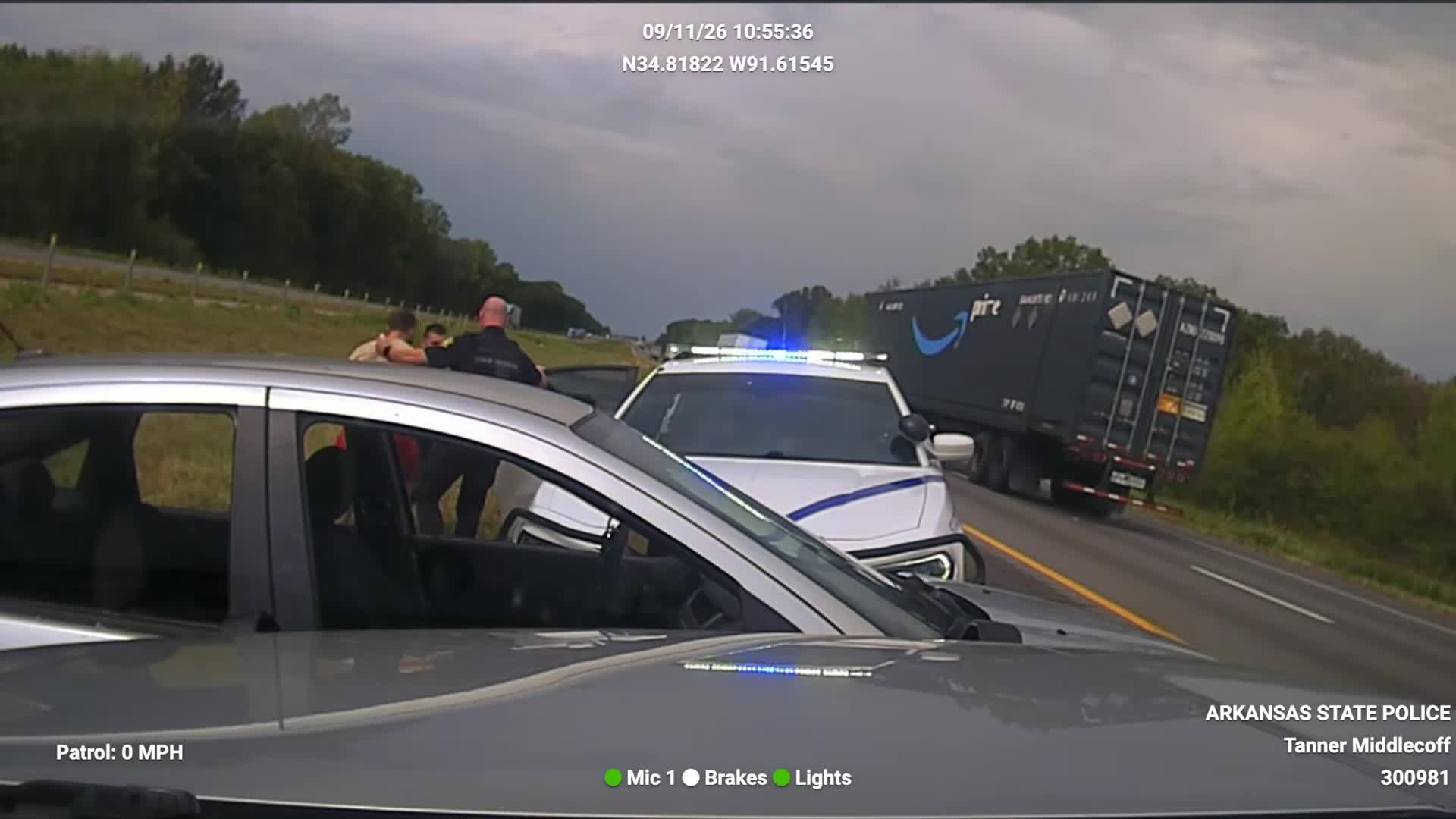
Jonesboro Right Now reported that Pfeifer was treated for minor injuries after the crash. The trooper's patrol vehicle also sustained damage during the maneuver. According to the affidavit, the patrol car's passenger side was damaged by a cable barrier.
That damage would later become financially important. When the criminal case reached sentencing, the court ordered Pfeifer to pay $22,000 in restitution, a figure tied to the losses arising from the pursuit.
The crash also illustrates why a TVI can look severe even when its purpose is to end a greater continuing danger. A pursuit exceeding 100 mph carries substantial risk for everyone on the interstate. Ending it requires balancing the immediate danger created by the maneuver against the danger of allowing the fleeing vehicle to continue.
The fact that Pfeifer suffered only minor injuries was fortunate. High-speed vehicle interventions can produce far more serious outcomes depending on where and how a vehicle leaves the roadway.
The Felony Takedown Comes Immediately After the Crash
Once the Nissan stopped, the pursuit became an arrest scene. Officers moved quickly because the risks do not necessarily disappear the moment a fleeing vehicle crashes. Police do not know whether the driver will attempt to run, restart the vehicle, resist arrest or possess a weapon.
Commands during felony takedowns are therefore intentionally direct. Occupants may be ordered to show their hands, exit in a specific manner, face away from officers and move toward police before being handcuffed. The objective is to reduce uncertainty while officers secure everyone involved.
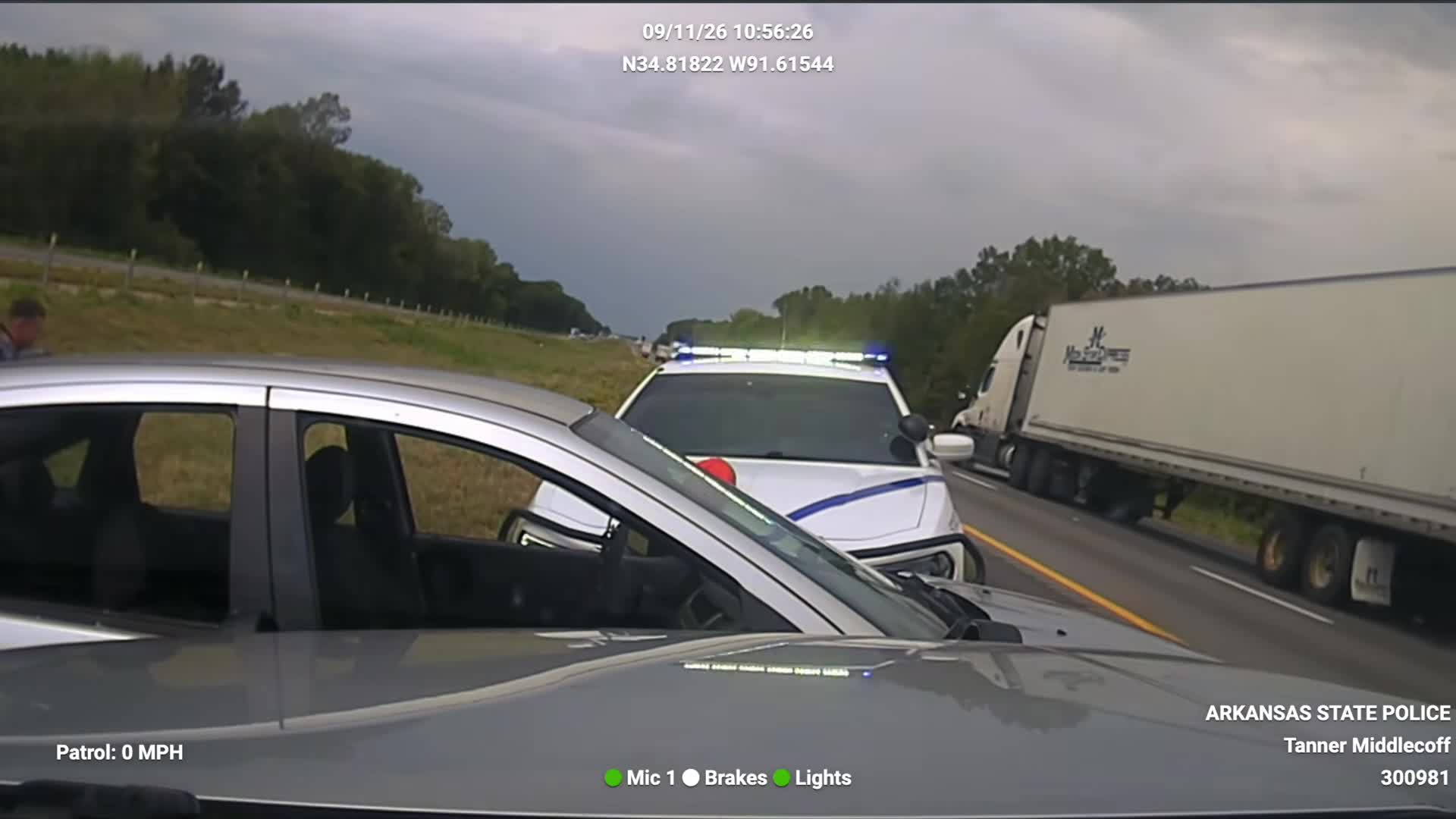
Pfeifer was taken into custody and booked into the Craighead County Detention Center. The initial allegations included felony fleeing, reckless driving and failure to provide insurance.
The irony of the sequence is difficult to miss. The event began because the vehicle reportedly lacked insurance. By the end, the Nissan had crashed, a State Police vehicle had been damaged, Pfeifer had been injured, and a felony prosecution had begun.
A $75,000 Bond Follows the Arrest
Two days after the pursuit, Jonesboro Right Now reported that District Judge Tommy Fowler found probable cause for the charges and set Pfeifer's bond at $75,000. She remained in custody while the case moved forward.
Bond hearings are not trials. A probable-cause finding does not determine guilt, and an initial charge can later be amended, dismissed or resolved through a plea agreement. But the $75,000 bond demonstrated that the case was being treated as substantially more serious than the insurance issue that started the encounter.
Pfeifer's next stage would take place in Craighead County Circuit Court, where prosecutors and defense counsel had to determine whether the case would go to trial or be resolved through a negotiated plea.
The Case Ends With a Guilty Plea
By late August 2024, the criminal case had reached a resolution. KAIT reported that Pfeifer pleaded guilty to one count of felony fleeing.
The other charges, reckless driving and no liability insurance, were dropped as part of the case's resolution. This is an important distinction because initial arrest charges are not the same thing as final convictions. A responsible account of a criminal case should always separate what police alleged at arrest from what ultimately happened in court.
On August 29, Second Judicial Circuit Judge Randy Philhours sentenced Pfeifer, then 24, to 60 months of probation.
She did not receive a prison sentence.
That outcome adds an important final chapter to footage that might otherwise end with the viewer seeing only handcuffs. Viral police videos frequently stop at arrest, creating the impression that the arrest itself is the final legal result. In reality, criminal cases can change significantly after booking. Evidence is reviewed, charges are negotiated, and judges determine sentences under legal standards that a dash camera cannot show.
The $22,000 Consequence That the Video Does Not Show
The court also ordered Pfeifer to pay $22,000 in restitution. KAIT reported that the amount was to be paid in monthly installments of $75 after her release from the Craighead County Detention Center.
Restitution is one of the less visible consequences of fleeing cases. A pursuit can damage police vehicles, highway infrastructure, private property and the fleeing vehicle itself. Those costs do not disappear when the emergency lights are switched off.
In this case, the affidavit specifically noted damage to the trooper's patrol vehicle during the TVI. The $22,000 restitution order means the financial aftermath became part of Pfeifer's sentence alongside five years of probation.
The numbers also demonstrate how dramatically the stakes changed. The incident began with an uninsured vehicle. The attempt to avoid the stop ultimately produced a felony conviction and a five-figure financial obligation.
Why Arkansas State Police Uses the Term TVI
Viewers often know the maneuver as a PIT, short for Precision Immobilization Technique. Arkansas State Police commonly refers to it as a Tactical Vehicle Intervention, or TVI. The underlying concept is similar: a police vehicle makes controlled contact with the rear quarter of a fleeing vehicle to induce rotation and terminate the pursuit.
Arkansas State Police pursuit videos have drawn national attention because troopers have used TVIs at speeds that many viewers consider unusually high. Official State Police records show that the agency trains and recognizes troopers for pursuit driving and tactical interventions in circumstances involving dangerous fleeing drivers.
That does not mean every TVI is automatically justified. As with any use of force, the facts matter. Speed, road conditions, traffic, the seriousness of the fleeing behavior and risks to the public all affect the analysis.
In Pfeifer's case, the second TVI occurred after she had allegedly resumed fleeing following an earlier intervention and reached speeds above 100 mph on I-555. The maneuver ended the pursuit near mile marker 42.
Why Fleeing Can Become More Serious Than the Original Stop
The Pfeifer case is a clear example of a recurring pattern in police pursuits: the reason for the attempted stop may be far less serious than the conduct used to avoid it.
A driver may fear receiving a ticket, having a vehicle impounded or discovering that an insurance or license problem exists. Fleeing can feel, in the moment, like a way to postpone those consequences.
But once a vehicle accelerates away, the driver creates a new legal problem. If the flight involves high speed and dangerous driving, the potential charges can become felonies. A relatively manageable traffic matter can therefore turn into arrest, jail, vehicle damage, restitution and years of court supervision.
The logic is straightforward. Traffic laws regulate one driver's behavior. High-speed fleeing threatens everyone sharing the road.
At 100 mph, a mistake can involve families in nearby cars who know nothing about the police encounter. That public risk is why courts and legislatures treat dangerous vehicular fleeing differently from an ordinary moving violation.
The Footage Shows Only Half the Story
The dash camera provides the adrenaline. News reports and court records provide the consequences.
Watching only the pursuit, a viewer sees a white Nissan accelerating away, a trooper closing the distance, a TVI and a crash. The natural climax is the arrest.
But the legal story continues for months. Pfeifer appears before a judge. Bond is set. Prosecutors file the case. Defense counsel evaluates the evidence. A plea is negotiated. Some charges are dismissed. A felony conviction remains. Probation is imposed. Restitution is ordered.
That complete timeline is more informative than the viral clip because it shows what fleeing actually cost after the chase ended.
Why the Video Holds Attention
The pursuit has a natural narrative structure that makes it difficult to stop watching. It begins with a low-level problem and immediately raises a question: will the driver stop?
Then the driver appears to have another opportunity to comply near Parker Road and Southwest Drive. She leaves again. That creates a second question: how far will the pursuit go?
The first TVI seems as though it may provide the ending, but the Nissan emerges from the ditch and continues. The audience now knows that police are willing to physically terminate the pursuit, yet the chase is still active.
Speed climbs beyond 100 mph. The interstate environment raises the danger. Finally, the second TVI produces the decisive crash.
Good storytelling does not need to exaggerate any of those stages. The real sequence already contains escalating stakes, reversals and a clear resolution.
A Five-Minute Decision Creates a Five-Year Consequence
The most striking contrast in the case is between the duration of the chase and the duration of the consequences.
The high-speed portion unfolded in minutes. Pfeifer's sentence placed her on probation for 60 months.
That difference is worth considering. Decisions made under stress can last only seconds while producing obligations measured in years. The same is true of the $22,000 restitution order. The damage occurred during a brief pursuit, but paying for it could take far longer.
For drivers, the lesson is not complicated. Stopping for police preserves options. A citation can be challenged. An insurance issue can be resolved. An attorney can examine whether a stop was lawful. Fleeing at triple-digit speeds removes many of those practical advantages and introduces risks that are far harder to undo.
What Happened to Daisia Ann Pfeifer
By the time the case concluded, the outcome was clear. Pfeifer pleaded guilty to felony fleeing. The reckless-driving and no-liability-insurance charges were dropped. Judge Randy Philhours sentenced her to five years of probation and ordered $22,000 in restitution.
That verified court outcome is important because it prevents the story from ending with speculation. The video title may emphasize the dramatic TVI and felony takedown, but the final legal result was probation rather than prison.
The case therefore offers a fuller picture of the criminal justice process. Police made the arrest. A judge reviewed probable cause. Prosecutors pursued the felony. The defendant entered a plea. The court imposed punishment and financial restitution.
Each stage answered a different question.
A Traffic Stop That Became Far More Expensive
On the morning of June 3, 2024, an Arkansas State Police trooper encountered a white Nissan Versa that records indicated was uninsured. That could have been the beginning and end of the story.
Instead, the driver fled.
She was given another opportunity to pull into a parking lot and did not do so. She returned to I-555. A first TVI sent the car into a ditch, but she continued. Speeds exceeded 100 mph. A second TVI sent the Nissan into a concrete barrier and finally stopped the chase.
Pfeifer left the scene in police custody with minor injuries. The trooper's vehicle was damaged. Two days later, a judge set a $75,000 bond. Months later, Pfeifer pleaded guilty to felony fleeing.
The sentence was five years of probation and $22,000 in restitution.
That timeline is what gives the footage meaning beyond the crash itself. The dramatic ending lasts seconds. The consequences extend for years.
Watch the Full Pursuit
The final TVI is only the last chapter of a pursuit that included an attempted traffic stop, another chance to comply, a first unsuccessful intervention and speeds exceeding 100 mph on Interstate 555.
Comments (0)
Loading comments...
May You Like

UCF Student’s Pronoun Dispute With Campus Police Escalates Into an Arrest

West Virginia Man Laughs at Police Officer and Ends Up Arrested