Entitled Nurse Caught Stealing From Target Before Work
Nurse Heads to Work After Target Stop, but Police Are Waiting at the Exit
HOOK: SHE THOUGHT SHE COULD SIMPLY PAY AFTER BEING CAUGHT
It looked like an ordinary shopping trip on New Year's Day.
A woman wearing medical clothing moved through a Target store, apparently with somewhere else to be afterward. Nothing about the setting immediately suggested that the trip would end with police officers, handcuffs and body-camera footage that would eventually spread far beyond the store where it happened.
Then she approached the exit.
Waiting nearby were store loss-prevention personnel and police.
According to reporting about the footage, officers had responded on January 1, 2025 to an active retail-theft complaint involving a woman who was allegedly concealing merchandise inside her coat. Rather than completing a normal purchase, authorities said she headed toward the exit.
Once confronted, her response became one of the most memorable elements of the encounter.
She indicated that she could pay.
She emphasized that she was a professional.
And eventually, she told the officer she was a nurse.
But by then, according to the allegations presented in the footage, the issue was no longer whether she had enough money to purchase the merchandise.
The issue was whether she had already attempted to leave without paying.
What followed turned a seemingly mundane retail-theft investigation into a viral example of how quickly an ordinary trip to a big-box store can become a police encounter with potentially serious personal consequences.
A NEW YEAR'S DAY TRIP TAKES AN UNEXPECTED TURN
The incident gained renewed attention after footage was published by the YouTube channel Body Cam Edition in August 2025.
Interaksyon, part of Philstar's digital network, subsequently reported on the video after it began circulating among Filipino social-media users. According to that report, the incident itself occurred on January 1, 2025.
The circumstances initially appear straightforward.
A woman dressed in medical attire entered Target.
According to the account accompanying the footage, store personnel suspected that she had concealed merchandise in her coat.
That distinction matters because retail-theft investigations often begin long before the customer realizes anyone is watching.
Modern loss-prevention operations can involve surveillance cameras, employees monitoring particular departments, transaction records and personnel observing a customer's movements throughout the store.
An apparent lack of confrontation inside the aisles therefore does not necessarily mean suspicious behavior has gone unnoticed.
In this case, police were already involved by the time the woman headed toward the exit.
The encounter consequently changes tone almost immediately.
Instead of leaving the store and apparently continuing with her day, the woman suddenly finds herself facing questions about merchandise she allegedly had not purchased.
And her first instinct appears to be negotiation.
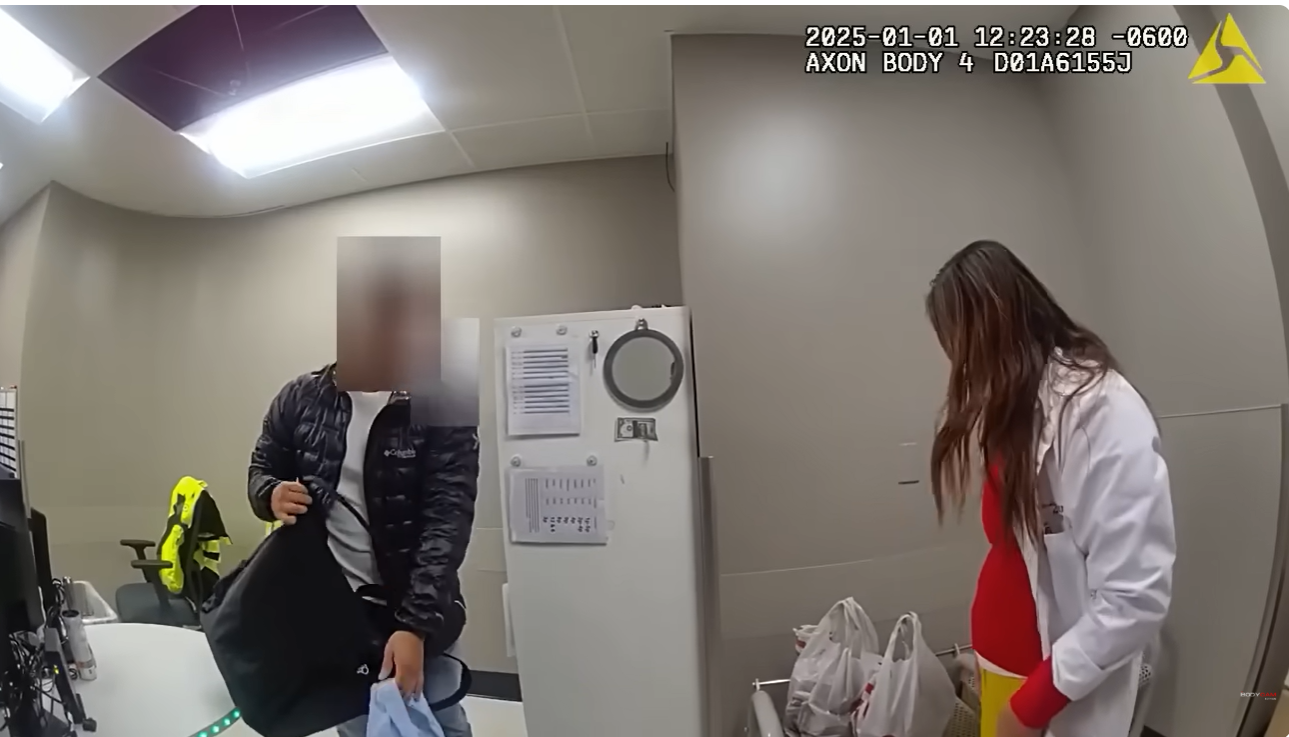
The distinction between "I can pay for it" and "I paid for it" becomes critical.
Once someone has allegedly concealed merchandise and passed the point at which payment is expected, an offer to pay afterward does not necessarily erase the conduct that store personnel and officers believe they have already witnessed.
The footage captures that disconnect.
From the woman's perspective, paying for the items may have seemed like an obvious way to make the problem disappear.
From the investigators' perspective, the alleged offense was precisely the behavior that occurred before she offered to pay.
That disagreement drives much of the tension.
“I'M A PROFESSIONAL”
One detail transformed the encounter from another shoplifting bodycam video into something that attracted substantially more attention.
The woman referenced her occupation.
According to Interaksyon's account of the footage, she described herself as a "professional" and later said that she was a nurse.
The statement appears intended to reassure the officer.
Instead, it creates an uncomfortable contrast.
Nursing is a profession associated with trust, responsibility and accountability. Patients routinely place themselves in extraordinarily vulnerable situations and depend on medical professionals to behave ethically.
But professional status does not create an exemption from ordinary criminal law.
The officer's task was not to determine whether the woman held a respectable job.
It was to investigate the reported theft.
That is why this moment works so effectively in the footage.
The woman seems to believe that information about her employment should change the officer's perception of what has happened.
The officer continues focusing on the alleged conduct.
That mismatch becomes the story.
And there is another layer.
She apparently had somewhere to go.
The video title says she was heading to work, which makes the timing particularly consequential. A shopping stop that may have been intended to last only minutes instead became an encounter with law enforcement.
Her schedule was suddenly irrelevant.
Police were now trying to establish her identity and determine what had happened inside the store.
THE IDENTITY EXCHANGE REVEALS ANOTHER PART OF THE STORY
As officers questioned the woman, the conversation turned toward her identity.
One exchange later attracted considerable attention among Filipino viewers.
When an officer apparently had difficulty understanding part of her name, the woman explained:
“That's Filipino.”
Interaksyon reported that when an officer asked whether "Sumaya" was her middle name, she initially responded with the Filipino term "opo", a respectful affirmative expression, before switching to English when the officer did not understand her.
That short interaction later became important for another reason.
As the video circulated internationally, some social-media posts began incorrectly identifying the woman as Indian.
A subsequent fact-check examined the footage and traced its earlier publication.
DFRAC concluded that the viral claim describing her as an "Indian Hindu nurse" was misleading and reported that the woman was Filipina.
That correction illustrates an important problem with viral police footage.
Once a clip is separated from its original context, captions can change faster than facts can be checked.
A person's nationality can be changed.
Locations can be misidentified.
Old footage can suddenly be presented as new.
Different cases can even become combined into one narrative.
In this instance, the woman's own interaction with the officer helped provide a clue that contradicted some of those later claims.
THE STORE HAD ALREADY BEEN WATCHING
Perhaps the biggest misconception surrounding shoplifting footage is the idea that apprehension begins at the door.
Usually, the important part has already happened.
Loss-prevention personnel need to establish what they believe they observed.
Did the customer select merchandise?
Was merchandise concealed?
Was there an attempt to pay?
Did the customer move past the expected payment area?
What does surveillance footage show?
These questions matter because a police officer arriving at a retail store may not personally have witnessed the conduct inside.
Instead, officers often begin with information supplied by employees or loss-prevention staff and then assess the available evidence.
That is why surveillance is so important in cases like this.
The woman might believe that explaining herself to the officer can reset the encounter.
But investigators may already be working from a sequence documented before they ever spoke to her.
And Target has become particularly associated in public reporting with organized loss-prevention operations.
A separate 2024 case in Renton, Washington illustrates the scale of those operations. During a Target shoplifting sting, police contacted six people, and one arrested suspect allegedly had 48 previous theft incidents at other Target stores, according to Renton police.
That is a different case, but it demonstrates something important about modern retail investigations:
stores can document patterns over time rather than treating every suspicious transaction as an isolated event.
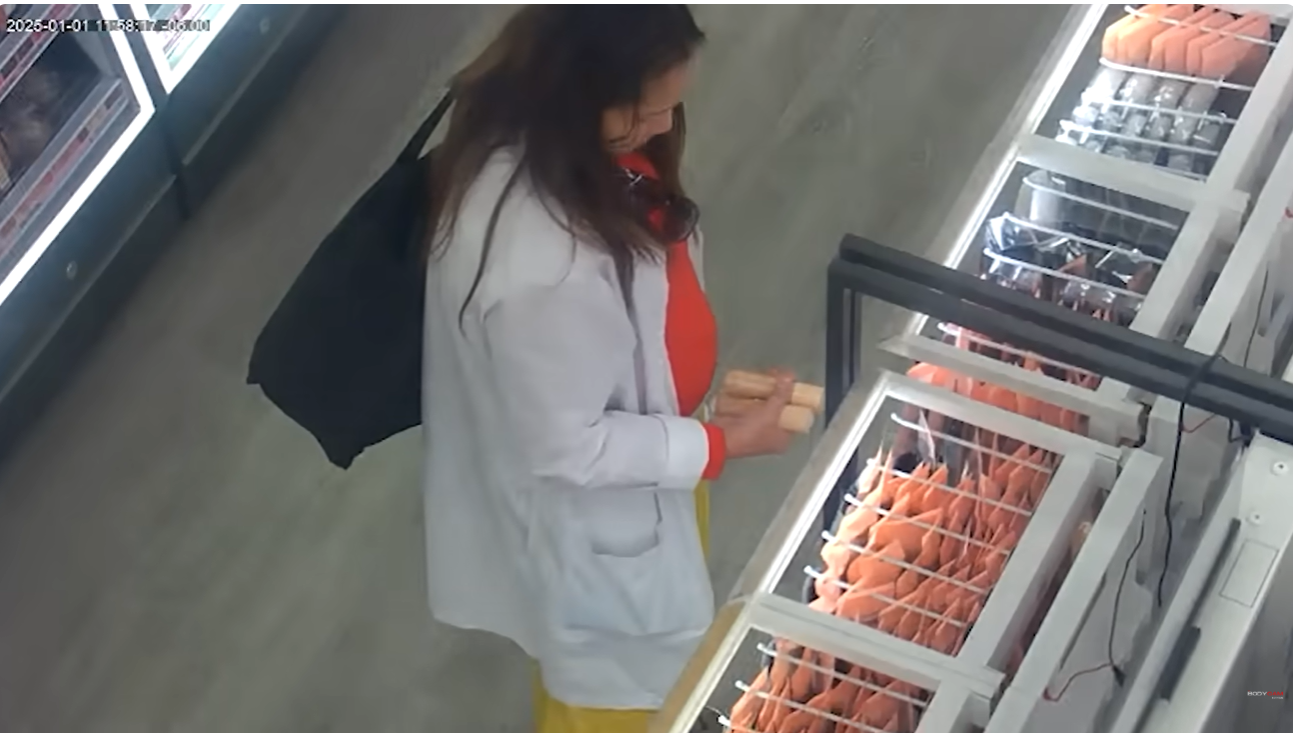
This changes the balance of information dramatically.
A suspect may know only what happened during the last several minutes.
Loss prevention may have video.
They may have transaction information.
They may have observations from multiple employees.
In repeat cases, retailers may even possess records spanning multiple visits.
The conversation at the door is therefore not necessarily the beginning of the investigation.
It may effectively be the end of one.
THE MOMENT THE SITUATION BECOMES REAL
There is a noticeable psychological shift in many bodycam arrests.
Initially, the person being questioned treats the encounter as a problem that can still be solved through explanation.
There is negotiation.
There are alternative explanations.
There are promises.
Sometimes there is disbelief.
Then the handcuffs appear.
That physical action eliminates ambiguity.
In this case, reporting says the woman was ultimately handcuffed and escorted to a police vehicle.
At that point, the tone changes completely.
The shopping trip is finished.
Going to work is no longer the immediate concern.
Professional status no longer matters to the officer's immediate task.
The focus becomes the police process that follows detention.
And this is the part of the encounter that gives the story its broader significance.
The alleged value of merchandise may have been measured in hundreds of dollars.
The consequences of an arrest can extend far beyond the retail value of the items involved.
Employment can be affected.
Immigration consequences can arise depending on an individual's status and circumstances.
Court appearances can follow.
Legal expenses can exceed the value of the merchandise many times over.
And online exposure introduces an entirely separate consequence that did not exist for earlier generations.
The encounter can become permanent digital content.
WHEN A BODYCAM VIDEO BECOMES AN INTERNATIONAL STORY
This particular incident demonstrates that phenomenon unusually well.
The event occurred in the United States.
The footage was later uploaded online.
Filipino social-media communities discovered it.
Posts about the woman's nationality began circulating.
Then inaccurate versions of the story appeared elsewhere.
Eventually, fact-checkers became involved.
A relatively ordinary retail-theft arrest had become an international internet story.
This is one of the biggest changes body-worn cameras have brought to public perceptions of policing.
Historically, an incident like this might have generated a short police report and perhaps a court record.
Most people outside the immediate community would never have known it occurred.
Today, the entire interaction can potentially be viewed by millions.
Viewers hear explanations.
They observe officers' reactions.
They see the transition from questioning to arrest.
They form opinions about everyone involved.
Sometimes that transparency can correct false narratives.
Sometimes it creates new ones.
The incorrect claims about the woman's nationality demonstrate both sides of the equation.
The footage provided evidence.
But social media simultaneously supplied misinformation.
WHY “I'LL PAY NOW” DOESN'T AUTOMATICALLY END THE MATTER
One of the most interesting elements of the video is also one of the simplest.
Why couldn't she just pay?
To someone watching casually, that can sound reasonable.
The store gets its money.
The merchandise is no longer unpaid.
Everyone goes home.
But that reasoning overlooks the alleged conduct that brought police to the scene.
Consider a simplified example.
If someone leaves a restaurant without paying and is stopped outside, offering to pay only after being caught does not necessarily establish that there was never an intent to avoid payment.
Likewise, in retail theft investigations, what matters legally depends on the jurisdiction and the evidence surrounding the person's conduct.
That can include concealment, movement through the store, passing points of sale and other circumstances.
The exact legal standards and potential charges vary by state.
For that reason, it would be irresponsible to assign a specific offense level to this woman without reliable documentation identifying the jurisdiction, charging documents and ultimate disposition.
What the footage does establish is the practical lesson:
Waiting until loss prevention or police confront you is very different from voluntarily paying before leaving.
PROFESSION DOESN'T CHANGE THE INVESTIGATION
The woman's reference to being a nurse also raises a broader point.
Police routinely encounter people from every profession.
Teachers.
Business owners.
Healthcare workers.
Government employees.
Police officers themselves.
Professional status may become relevant later, especially where licensing or employment consequences are concerned, but it does not automatically determine whether probable cause exists during an investigation.
That is why repeatedly emphasizing status can sometimes make bodycam encounters appear stranger rather than more persuasive.
The officer still has to answer the same basic questions.
What allegedly happened?
What did witnesses observe?
What does the evidence show?
Is there sufficient legal basis for detention or arrest?
The suspect's résumé does not answer those questions.
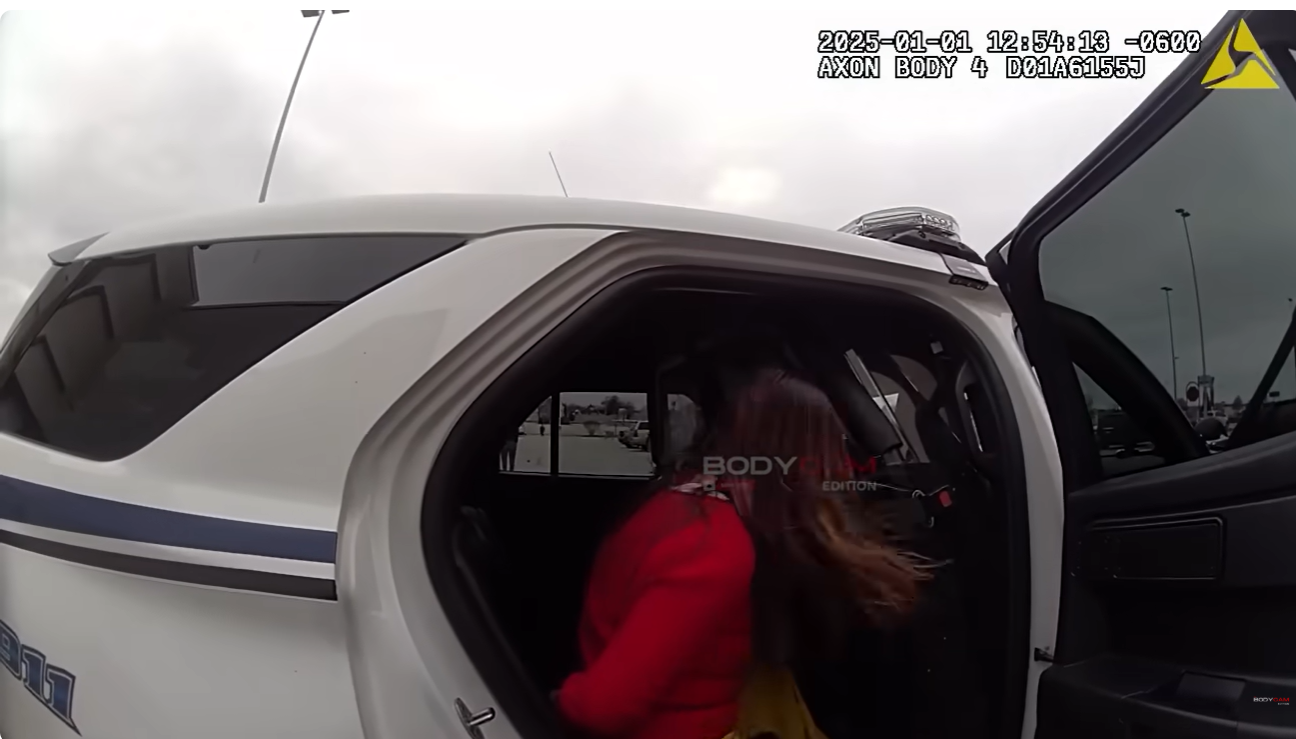
The Florida case pictured above involved a different suspect and different circumstances. Reporting there concerned a woman accused of using false barcodes during Target transactions. It is not the nurse in the January 1 incident.
That distinction is important because visually similar Target arrests can easily be misidentified once photographs circulate without captions.
ENDING: A FEW ITEMS CAN CREATE CONSEQUENCES WORTH FAR MORE
The most striking part of this story is not the amount of merchandise.
It is the imbalance between the alleged short-term gain and the potential long-term cost.
Whatever the merchandise was worth, it was finite.
An arrest is different.
It creates records.
It can create legal obligations.
For someone working in a licensed profession, it may create questions extending beyond the criminal case itself.
And when body-camera footage becomes viral, the reputational impact can become almost impossible to quantify.
The January 1 incident also offers a useful warning about interpreting viral police footage.
Reliable reporting supports several central facts: the encounter involved a woman identified as Filipino, she described herself as a nurse, the incident occurred at Target, and she was handcuffed following the alleged shoplifting incident.
But some details circulating online are far less reliable.
I therefore have not treated unsupported social-media claims about active warrants, licensing consequences, final convictions or other alleged offenses as established facts.
That restraint actually makes the story stronger.
Because the verified sequence is compelling enough.
A woman walks into Target before work.
Loss prevention watches.
Police arrive.
She approaches the exit.
The confrontation begins.
She offers to pay.
She tells the officer she is a professional.
Then she reveals that she is a nurse.
None of it changes what happens next.
The handcuffs go on.
And a shopping trip that probably seemed insignificant only minutes earlier becomes an encounter eventually watched by people thousands of miles away.
Sometimes the most consequential decisions are not dramatic when they are made.
They become dramatic only when the consequences arrive.
CTA: SEE HOW THE ENTIRE ENCOUNTER UNFOLDED
The arrest is only the final part of the story. Watch the full encounter to see what happened inside Target, what the woman told officers when she was confronted, and the moment she realized that offering to pay was not going to make the investigation disappear.https://www.youtube.com/watch?v=4zc2HoUrbBo
Comments (0)
Loading comments...
May You Like

West Virginia Man Laughs at Police Officer and Ends Up Arrested
Officer Stops to Help but the Situation Quickly Escalates