
Drunk Man Loses It at 11 A.M. and Causes a Scene
The 11 A.M. Bar Call That Turned Into a Felony Case
When an Ordinary Morning Call Becomes Anything but Ordinary
At a little after 11 o’clock on a cold December morning in Marshfield, Wisconsin, police were dispatched to the kind of call that can sound deceptively routine over the radio: a disturbance involving a man at a local bar.
There was no high-speed pursuit racing through city streets. No elaborate investigation had brought officers to the scene. There was no indication that the encounter would become a case remembered years later through publicly released body-camera footage.
Yet within minutes, what began as a relatively contained disturbance was turning into a prolonged confrontation.
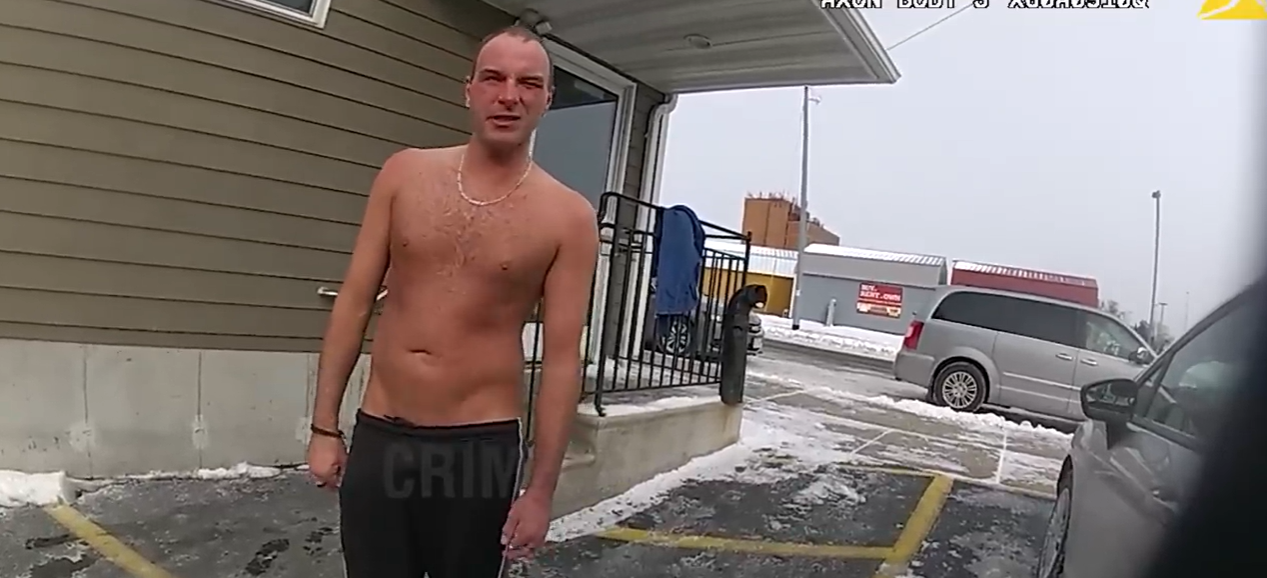
The footage is striking partly because of the hour. The body-camera timestamp places officers at the scene shortly after 11 a.m. on December 7, 2021. Snow and ice are visible outside, while the man officers encounter, identified in the published account only as Matthew, is shirtless.
His condition immediately becomes the central issue.
Instead of a brief conversation followed by a peaceful resolution, officers find themselves attempting to control a situation in which communication, cooperation and physical resistance repeatedly collide.
What makes the episode compelling is not simply the struggle itself. It is the way every additional decision appears to make the consequences more serious.
A disturbance becomes detention.
Detention becomes a physical struggle.
The struggle leads to medical evaluation.
And according to the subsequently published account of the case, conduct that occurred during the broader encounter ultimately resulted in a felony conviction and years of supervision.
It is a vivid example of how quickly an apparently small police call can become something much larger.
A Disturbance at a Marshfield Bar
Marshfield is a central Wisconsin community served by its own municipal police department. Local reporting regularly documents the department handling everything from ordinary calls for service to complex mental-health incidents. In a separate incident only a day after this encounter, for example, Marshfield officers dealt with a man reportedly experiencing hallucinations and making threats during a prolonged standoff, eventually resolving that situation without injury.
That broader context matters. Officers responding to a disturbance rarely know exactly what they will encounter before they arrive.
On December 7, the call involved a man causing problems at a local bar.
According to the description accompanying the subsequently released body-camera footage, officers identified the man as Matthew.
The visual evidence supplied in the video adds details that are easy to miss in a written summary. The body-camera timestamp shows the encounter occurring late in the morning. Winter conditions are visible outside. Matthew is seen without a shirt despite the weather, and officers attempt to communicate with him as the situation develops.
That contrast immediately creates tension.
This is not a crowded Saturday-night entertainment district where officers might expect to find dozens of intoxicated patrons spilling onto the sidewalk. It is morning, and the surrounding environment otherwise appears relatively ordinary.
Yet the encounter is anything but calm.
Context image: the Marshfield Police Department in Wisconsin, from a Central Wisconsin Broadcasting news report. This is not a photograph of Matthew or the December 7 arrest.
The officers face an important problem common to alcohol-related disturbance calls: gaining control without unnecessarily escalating the confrontation.
A person who is highly agitated or impaired may not process instructions in the same predictable way as a calm person. Commands that appear simple to an observer can produce argument, refusal or unpredictable movement.
Body-camera footage makes that process uncomfortable to watch because viewers see it from only a few feet away.
The perspective shakes as officers move. Voices overlap. Distance disappears. What might be summarized later in a report as “resisting” can unfold over several minutes of repeated instructions, physical positioning, negotiation and attempts to restrain someone.
That is essentially what gives this encounter its momentum.
Every opportunity for the situation to settle seems to be followed by another complication.
Resistance Changes the Direction of the Case
The crucial part of the encounter is not one spectacular moment. It is accumulation.
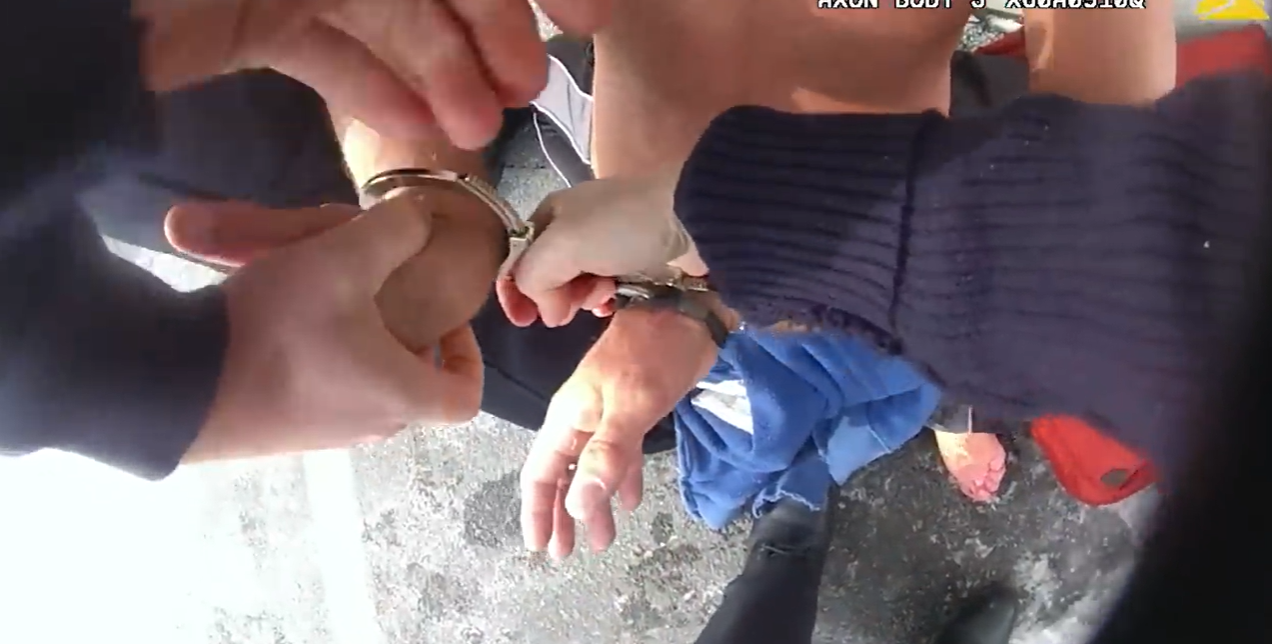
Police attempt to control Matthew. Matthew continues resisting. Officers have to adjust. What could potentially have ended as a disturbance investigation grows into an arrest involving several officers.
This distinction is important when examining police footage responsibly.
A viral title can reduce an incident to entertainment: an intoxicated man “throws a fit,” officers struggle with him, and viewers watch the chaos.
The legal process is much less simple.
Behavior occurring after police arrive can create consequences separate from whatever prompted the original call.
That appears to have happened here.
Crime Scene Cam's account states that Matthew “resisted officers continuously throughout the interaction.” After the initial confrontation, he was taken to a hospital, where the resistance reportedly continued.
Taking him to a hospital is an important part of the sequence.
When somebody appears severely impaired, injured or otherwise medically questionable, arrest is not necessarily the immediate final destination. Medical evaluation can become necessary before jail admission or further processing.
That creates another difficult transition.
An officer may gain enough control to move someone from the original location, only for the confrontation to restart during transportation or inside a medical facility.
The police encounter therefore does not automatically end when the suspect leaves the scene.
In Matthew's case, it apparently did not.
According to the published case summary, his conduct eventually produced several misdemeanor allegations and a much more consequential felony allegation for discharging bodily fluid at a police officer. The specific act connected with that felony was not shown in the published video.
That qualification is important.
We should not manufacture a scene that the available footage does not show. Nor should we claim to know exactly what occurred during an unseen portion of the encounter merely because a charge was subsequently filed.
What can be established is the outcome reported with the footage: Matthew ultimately entered a no-contest plea to the felony. The misdemeanors were dismissed but read in.
For readers unfamiliar with Wisconsin criminal proceedings, a dismissed-but-read-in charge is not the same as a conviction on that charge. Broadly speaking, the defendant does not receive a separate conviction for the read-in offense, although the court can consider the admitted conduct when sentencing on the offense of conviction.
That distinction helps explain why simply listing the original allegations can give a misleading picture of a case.
The final disposition matters more.
Here, the most serious surviving consequence was significant: three years of probation.
Matthew was also ordered to maintain absolute sobriety and attend counseling, according to the published account.
Those conditions change how the story should be understood.
The encounter is easy to package as a bizarre piece of body-camera footage. A shirtless man. A Wisconsin winter. A bar before lunchtime. Repeated resistance. Officers struggling to control him.
But the court outcome points toward another dimension.
The justice system's response was not described simply in terms of punishment. The conditions of probation directly addressed alcohol and behavioral rehabilitation: sobriety and counseling.
That suggests the legal aftermath was aimed, at least in part, at preventing another episode rather than merely imposing confinement.
Context image: a real Marshfield Police vehicle shown in local reporting. It is included only to illustrate the law-enforcement agency and location connected with the incident.
The bodycam also demonstrates why police encounters involving apparent intoxication are unpredictable.
Intoxication can impair judgment, coordination and impulse control. But video viewers should be cautious about diagnosing someone from footage alone. Unsteady behavior can have medical causes as well, and officers in the field may initially have incomplete information about substances, medications, injuries or underlying health problems.
That uncertainty is one reason medical assessment can matter.
It is also why the most responsible way to describe this particular footage is to separate what is visible from what is documented afterward.
Visible: officers responding to a disturbance and struggling with an agitated, shirtless man in winter conditions.
Reported by the source that published the footage: the man's name was Matthew, the incident began at a local Marshfield bar, he was taken to a hospital, resistance continued, criminal charges followed, and he ultimately received probation after pleading no contest to a felony.
Anything beyond those boundaries risks turning documentation into speculation.
The Most Important Part Happened After the Cameras Stopped
Body-camera videos naturally focus attention on the loudest few minutes.
Court cases do not.
Once the physical confrontation ended, Matthew still had to move through medical treatment, criminal charging and eventually the court system.
The misdemeanors connected with the episode were ultimately dismissed but read in. Matthew pleaded no contest to the felony offense described by the source as discharging bodily fluid at a police officer. The resulting sentence was three years of probation, together with absolute-sobriety and counseling requirements.
That ending makes the incident more interesting than its viral title suggests.
At 11:07 that morning, the immediate problem was getting control of an increasingly difficult disturbance.
By the end of the legal process, the focus had shifted toward what happened next in Matthew's life.
Could he stay sober?
Could counseling help prevent another confrontation?
Could three years of supervision accomplish something that a short period of punishment might not?
The footage cannot answer those questions.
What it does show is how dramatically the consequences of a person's choices can expand during a single police encounter.
The original call was about a disturbance.
Had the interaction ended quickly and peacefully, its legal significance might have been entirely different. Instead, resistance prolonged the encounter, medical intervention became necessary, further conduct reportedly occurred, and the case eventually reached felony territory.
That progression is the real story.
Not simply that someone was apparently intoxicated before noon.
Not simply that officers had difficulty restraining him.
And not simply that the footage makes for dramatic viewing.
The larger lesson is how rapidly a chaotic few minutes can produce consequences measured in years.
Watch the Incident With the Full Context in Mind
Body-camera footage is most useful when it is treated as evidence of a sequence rather than as a collection of shocking moments. This Marshfield encounter begins as an ordinary disturbance call and gradually becomes a physical, medical and ultimately legal problem, illustrating how each stage of an encounter can affect what comes next.
The video may initially draw attention because of its unusual circumstances, but the lasting part of the story is the aftermath: a felony disposition, three years of probation, mandatory sobriety and counseling.
Watch the complete body-camera encounter here to see how the situation developed from the officers’ arrival through the arrest: https://www.youtube.com/watch?v=b4Fgm-Uo-xw
Comments (0)
Loading comments...
May You Like

One Driver’s Decision to Flee Brings Police Racing After Him

Traffic Stop Turns Deadly After Man Steps Out of Stolen Car













