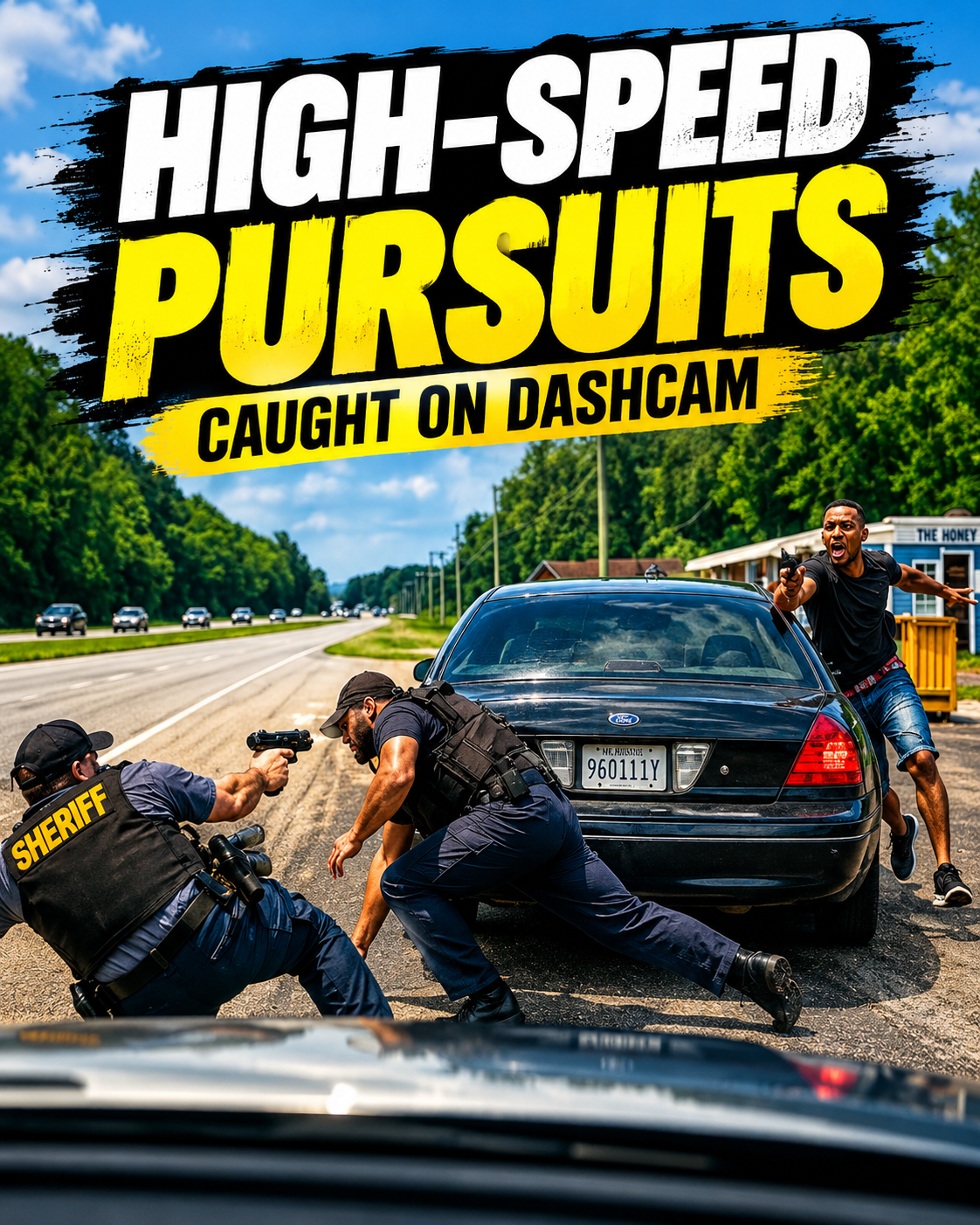
🚨 Driver Takes Off as Arkansas Police Close In on the Vehicle
🚨 Driver Takes Off as Arkansas Police Close In on the Vehicle
A Documentary-Style Police Storytelling Article
On a seemingly ordinary day in Arkansas, a routine police encounter appeared to take a sudden and dangerous turn.
The scene, captured from what appears to be a police vehicle's dashcam, shows a marked North Little Rock Police SUV moving toward a black sedan on a narrow, dusty roadway. Two officers are visible outside the police vehicle, apparently attempting to control the situation as the sedan begins moving away.
What happens next is the kind of moment that can transform an ordinary vehicle investigation into a rapidly unfolding police incident.
The black sedan accelerates down the dirt-covered road, kicking up a cloud of dust behind it. Officers are left reacting to the sudden movement of the vehicle as the police SUV attempts to maneuver into position.
For the officers on the ground, there is little time to think.
Everything is happening within seconds.
THE ENCOUNTER BEGINS
The footage opens with a marked police SUV positioned across part of the roadway.
The vehicle clearly bears the markings of the North Little Rock Police Department, while officers wearing police uniforms are positioned around the scene.
At first glance, the situation does not immediately appear to be a high-speed pursuit.
The police SUV is stopped near a building, and an officer can be seen moving toward the area where the black sedan is located.
The sedan appears to be near the entrance of a narrow roadway surrounded by buildings, utility poles, fences, and vegetation.
It is a confined environment.
There is not much room for a vehicle to maneuver.
That becomes important.
Because when a driver decides not to remain at the scene, the available space can disappear almost instantly.
One moment, officers are approaching a vehicle.
The next, the vehicle is moving.
And the officers have to react.
THEN THE DRIVER TAKES OFF
The black sedan suddenly begins pulling away.
Dust rises from the roadway as the vehicle accelerates forward.
An officer positioned near the right side of the scene appears to react to the movement, while another officer is moving from the direction of the police SUV.
The situation has changed completely.
Whatever the original purpose of the encounter may have been, officers are now dealing with a moving vehicle.
The police SUV begins to reposition.
The camera captures the vehicle turning sharply as officers attempt to follow the sedan's path.
For a police officer, pursuing a vehicle in such a confined area presents a number of immediate challenges.
The roadway is uneven.
Visibility is limited.
Buildings and parked vehicles can obstruct movement.
And the fleeing vehicle has already created a cloud of dust that makes the scene even more difficult to read.
The officers cannot simply assume the driver will continue in a predictable direction.
A SPLIT-SECOND REACTION
The most dramatic part of the encounter comes as the police vehicle attempts to follow the fleeing sedan.
The SUV turns toward the direction of travel while the black sedan continues farther down the roadway.
From the camera's perspective, the police vehicle appears to be fighting for space as it moves around the corner.
An officer is also seen close to the moving police SUV.
The combination of the vehicle's movement, the uneven ground and the sudden acceleration creates a chaotic scene.
This is one of the reasons police bodycam and dashcam footage can provide such a different perspective from a written police report.
A report can describe what happened.
Video can show how quickly it happened.
A decision that may look simple when described afterward can unfold in only a few seconds when viewed from inside the incident itself.
THE VEHICLE DISAPPEARS DOWN THE ROAD
As the sedan continues away, the distance between the suspect vehicle and the officers begins to increase.
Dust hangs in the air behind it.
The police SUV is now pointed in the direction of the fleeing vehicle.
The officers have gone from investigating a car to attempting to keep up with one.
And that transition is critical.
Police pursuits can develop from relatively minor encounters into situations requiring rapid decisions about speed, direction, traffic, and public safety.
Every second matters.
The driver of the sedan has the advantage of already being in motion.
The officers have to react.
The surrounding environment creates another complication.
The road visible in the footage is not a wide, open highway.
It appears to be a narrow access road or industrial/residential area with buildings and utility infrastructure nearby.
That means there is little margin for error.
THE DANGER OF A MOVING VEHICLE
A fleeing vehicle can become dangerous even before it reaches high speed.
In a confined area, acceleration, sudden turns and limited visibility can put officers, pedestrians and other drivers at risk.
For the officers involved, the immediate objective is not simply catching a vehicle.
They must also remain aware of what is around them.
A vehicle can turn suddenly.
A person can step into the roadway.
Another car can appear from an intersecting street.
A police officer standing outside a patrol vehicle can find himself in the path of danger before there is time to move.
That is what makes moments like this so unpredictable.
The footage captures that uncertainty.
The sedan is moving.
The police SUV is repositioning.
The officers are reacting.
And the dust rising from the roadway makes the entire scene feel even more chaotic.
WHAT THE CAMERA REVEALS
One of the most striking elements of the footage is the perspective.
The viewer is not watching the event from a helicopter or a distant news camera.
The scene is viewed from close to the action.
The hood of the police vehicle occupies the bottom portion of the frame.
Ahead, the marked police SUV moves across the roadway.
The black sedan is visible farther ahead.
Officers are on foot.
Dust is rising.
It gives the viewer a sense of how quickly the situation developed.
This is the value of police video footage in documenting law-enforcement encounters.
It can preserve small details that might otherwise be difficult to remember later.
The position of vehicles.
The movements of officers.
The direction a suspect vehicle traveled.
The environmental conditions.
And most importantly, the sequence of events.
A ROUTINE ENCOUNTER CAN CHANGE IN SECONDS
Police officers routinely approach vehicles for a variety of reasons.
Some encounters end with a warning.
Others result in citations, arrests or further investigation.
But there are also situations in which a driver decides to leave before officers have finished their interaction.
When that happens, the entire nature of the encounter can change.
What begins as an investigation becomes a vehicle-related incident.
The officers must determine what happened, where the vehicle went and what actions are appropriate under department policy and the circumstances of the incident.
The footage alone does not establish every detail behind the encounter.
It does, however, show the critical visual sequence: officers near a marked police vehicle, a black sedan moving away, and police attempting to respond.
THE MOMENT AFTER THE SEDAN LEAVES
Once the sedan has disappeared farther down the roadway, the immediate confrontation at the original location is over.
But for the officers, the incident may only be beginning.
If a vehicle leaves unexpectedly, officers may need to communicate with other units, identify the vehicle, determine the direction of travel and document what happened.
The information collected during the first moments can become extremely important.
The vehicle's appearance.
Its direction.
The location.
The officers involved.
Any available camera footage.
And the circumstances that led to the encounter.
All of these pieces can help investigators reconstruct the incident afterward.
THE STORY BEHIND THE FOOTAGE
The image may look like a simple moment of police activity: a patrol SUV, two officers and a sedan driving away.
But scenes like this demonstrate how quickly police encounters can escalate.
There is a clear difference between approaching a stationary vehicle and responding to a vehicle that suddenly begins driving away.
Once the sedan starts moving, the officers have to react immediately.
The police SUV turns.
The driver continues down the roadway.
Dust fills the air.
And for a few moments, the scene becomes a rapidly changing pursuit situation.
That is precisely why police footage has become such an important part of modern crime and law-enforcement storytelling.
It allows viewers to see the uncertainty of the moment rather than simply hearing about it afterward.
THE FINAL IMAGE
The last impression left by the footage is the black sedan disappearing down the dusty roadway while police attempt to follow.
Behind it, the roadway is filled with dust.
The police SUV remains in pursuit.
The officers have been forced to transition from a stationary investigation to a rapidly moving situation in only seconds.
What began with police approaching a vehicle has become a scene of sudden movement and uncertainty.
And that is often the reality of police work.
Officers can begin an encounter without knowing how it will end.
A routine vehicle check can remain routine.
Or, in a matter of seconds, a driver can accelerate away and force officers to make immediate decisions.
In this Arkansas incident, the camera captures that transformation in real time.
A police vehicle moves into position.
Officers react.
A sedan takes off.
Dust fills the road.
And the investigation becomes a pursuit.
For viewers watching the footage, the most important question is what happened next — and whether officers were ultimately able to locate the driver and determine why the vehicle suddenly fled
Comments (0)
Loading comments...
May You Like

UCF Student’s Pronoun Dispute With Campus Police Escalates Into an Arrest

🚨⛽ Man Caught in a Disturbing Incident at a Gas Station | Police Respond US