Domestic Disturbance Leads to Police Chase and Armed Confrontation in Rural Minnesota
Domestic Disturbance Leads to Police Chase and Armed Confrontation in Rural Minnesota
A June 2025 domestic-disturbance call near Albert Lea escalated into a multi-county pursuit, a return to a rural residence, and a fatal armed confrontation captured by several law-enforcement cameras.
A Nighttime Call Quickly Becomes a Multi-Agency Emergency
On the evening of June 10, 2025, a call in rural southern Minnesota developed into the kind of incident that forces officers from several agencies to make decisions with very little time and incomplete information. What began as a reported domestic disturbance near Albert Lea soon expanded into a search for a fleeing driver, a vehicle pursuit across county lines, a return to the original property, and an armed confrontation involving multiple law-enforcement officers.
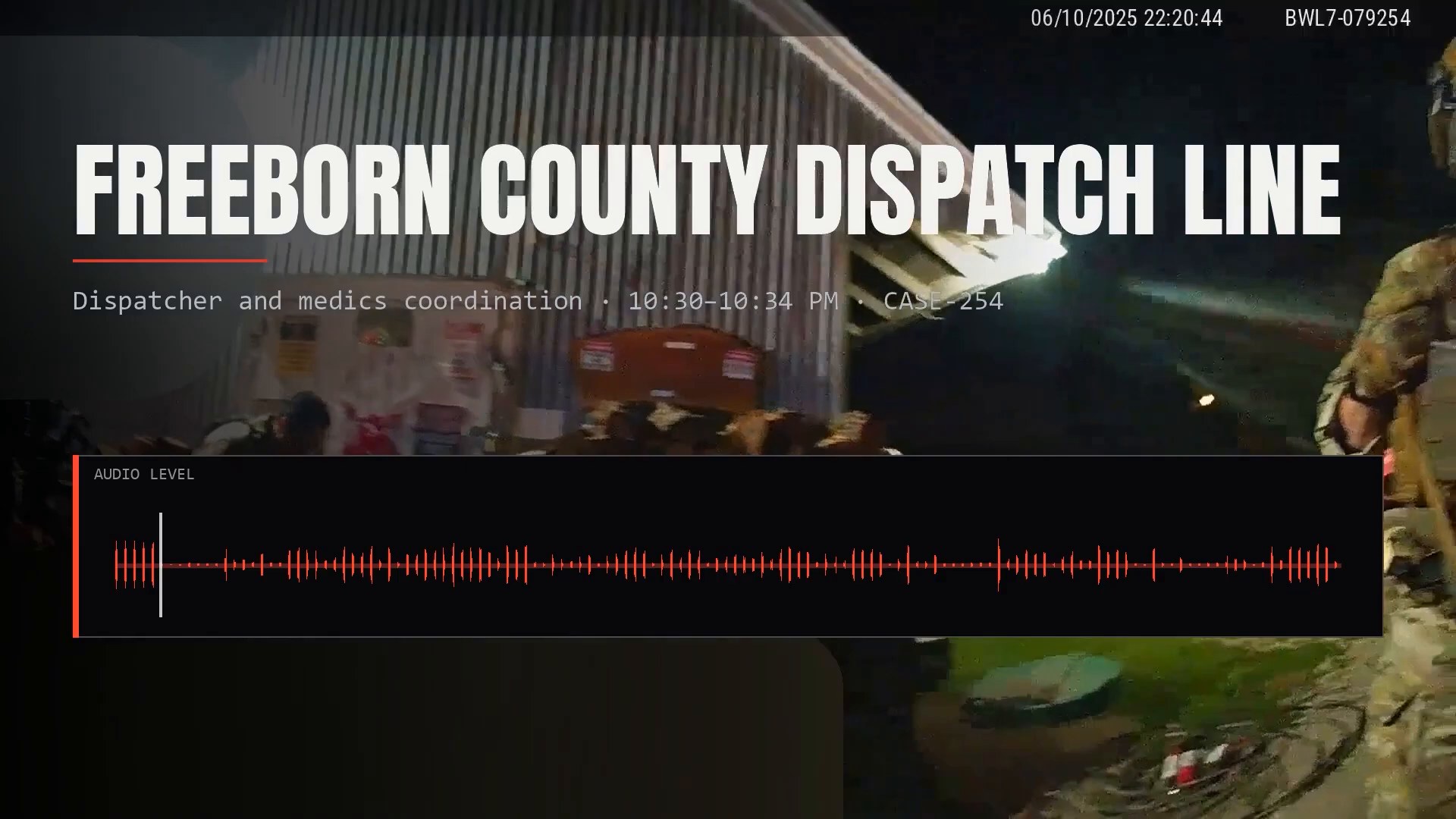
The supplied footage is a compilation of dash-camera and body-worn-camera views. Its overlays show June 10, 2025, and the sequence moves between officers responding to the pursuit and officers arriving at the rural property. Those details match reporting from the Minnesota Bureau of Criminal Apprehension investigation as described by CBS Minnesota and KTTC. Authorities identified the man as 44-year-old Nathaniel Bailey of Albert Lea.
According to the BCA's preliminary account reported by local media, officers were dispatched at about 7 p.m. to a residence in the 21000 block of 880th Avenue in rural Albert Lea. The reported reason for the response was especially serious: investigators said a man had texted a woman and stated that he had just killed his mother. Bailey had reportedly left the residence in a vehicle before officers arrived.
That allegation shaped everything that followed. Officers were not simply looking for a motorist who had failed to stop. They were searching for a person connected to a report of lethal violence and possible firearms. That distinction matters because officers approaching a vehicle or residence under those circumstances must consider the possibility that a weapon is present even before they can see one.
The video does not independently establish every fact behind the initial call. It shows the law-enforcement response and later confrontation, while the background information comes from the BCA's preliminary investigation and subsequent reporting. Keeping those two categories separate is important: the footage documents what officers encountered during the pursuit and at the property, while investigators supplied the context that brought them there.
The Search Moves Onto the Road
Authorities said Bailey's vehicle was eventually located near Austin in Mower County. Officers attempted a traffic stop, but the vehicle did not remain stopped. The pursuit then moved back toward the rural Albert Lea area.
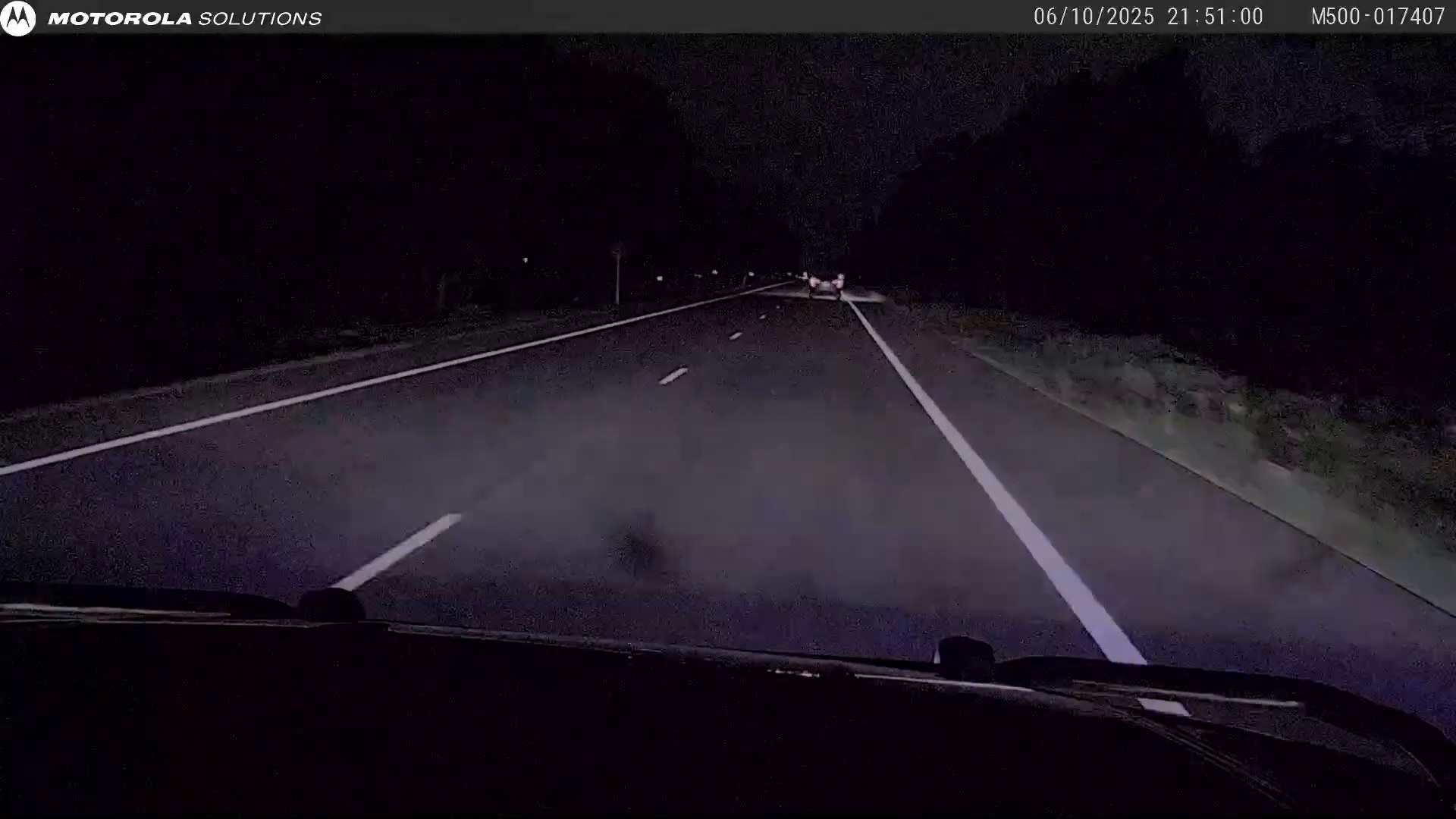
The dash-camera portions of the supplied video convey how difficult a nighttime pursuit can be. Headlights illuminate only a narrow corridor of road, while the target vehicle remains ahead in darkness. Officers must simultaneously track the fleeing vehicle, listen to radio traffic, watch intersections, judge road conditions, and maintain enough distance to react if the driver brakes or changes direction suddenly.
A pursuit involving several jurisdictions also becomes a communications problem. The original call was in Freeborn County, while the vehicle was located near Austin in Mower County. The BCA later identified officers from the Mower County Sheriff's Office, Steele County Sheriff's Office, Freeborn County Sheriff's Office, Albert Lea Police Department, and Faribault County Sheriff's Office as having been involved in the final use of force. That breadth helps explain why the footage contains perspectives from different cameras and agencies.
Police pursuits are not simply about catching up with a vehicle. Officers continually have to assess the risk created by the fleeing driver against the risk created by continuing the pursuit. In this case, the underlying report involved possible lethal violence and firearms, making the stakes very different from a routine traffic violation. The supplied footage shows officers maintaining the pursuit as the vehicle travels through dark rural roads toward the location where the incident had begun.
The direction of travel would become critical. Instead of ending at an unrelated location, the pursuit returned to the original rural property. For officers, that meant the scene they were approaching potentially contained both evidence connected to the initial emergency and a person they had reason to treat as potentially armed.
The Pursuit Returns to the Original Property
As the vehicles arrive at the rural residence, the character of the incident changes immediately. A pursuit gives officers a moving target and some physical separation. A stop at a residence compresses everything into a smaller area. Vehicles, buildings, darkness, uneven ground and limited visibility all become tactical considerations.
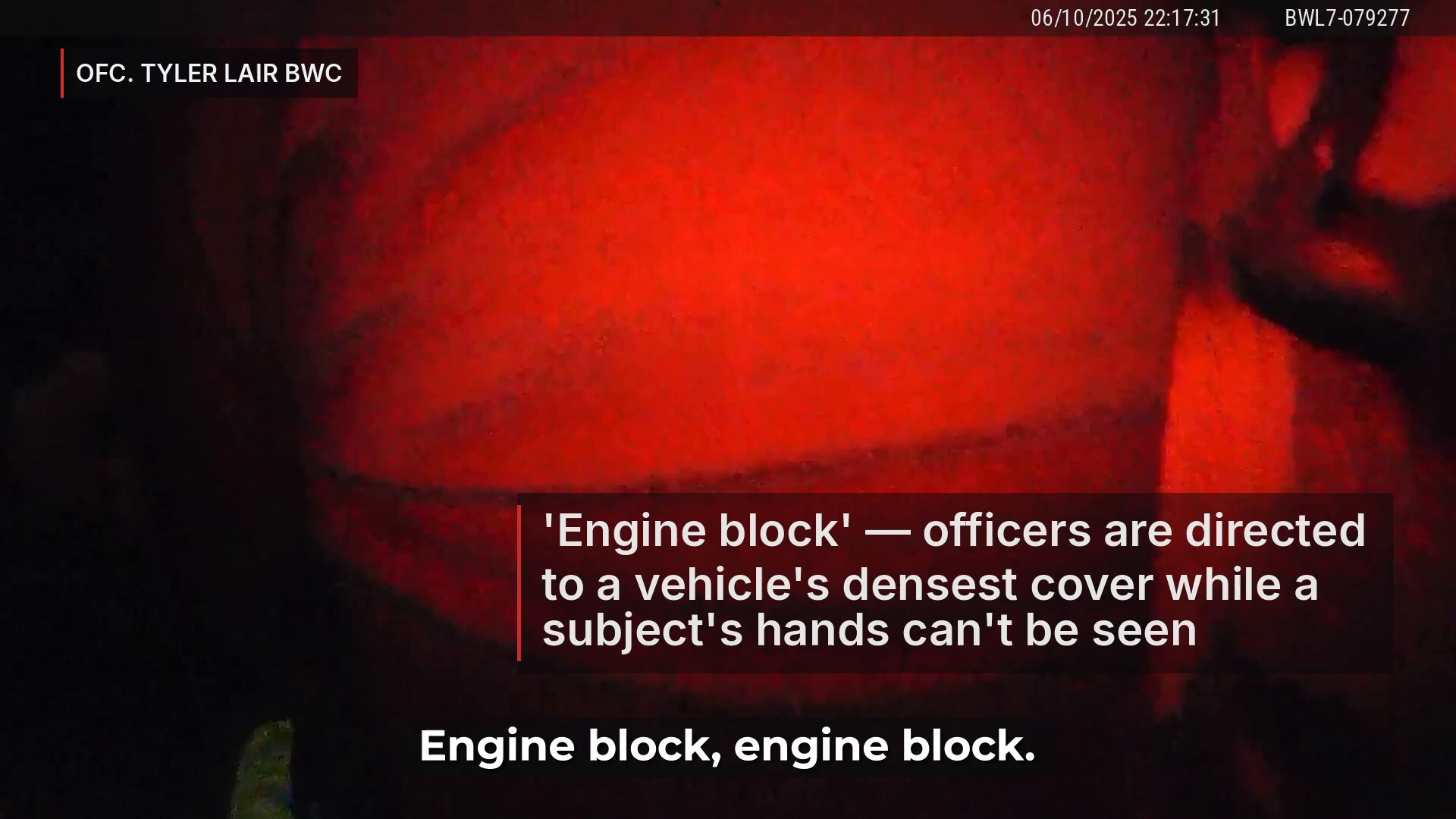
The supplied body-camera footage shows officers taking positions and using vehicles as cover. At one point, the video itself includes an explanatory graphic referring to the engine block as the densest portion of a vehicle available for cover when a subject's hands cannot be seen. The footage also captures officers issuing urgent commands as they try to determine what Bailey is doing.
This is one of the most important moments in the sequence because officers do not have the benefit of knowing what viewers may learn afterward. They are reacting in real time. From their perspective, they have followed a man associated with an extremely serious report back to the original property. Visibility is poor, multiple officers are arriving from different directions, and the subject's actions must be interpreted within seconds.
According to the BCA's preliminary findings reported by CBS Minnesota and KTTC, Bailey exited his vehicle armed with a handgun. Officers then discharged their firearms. The video captures the rapid transition from shouted commands to gunfire. It is brief, chaotic and difficult to reduce to a single camera angle, which is precisely why investigators normally examine multiple recordings, physical evidence, officer statements and scene evidence rather than relying on one clip alone.
The BCA identified five officers who discharged their weapons: Mower County Sergeant Katlynne Fisher, Steele County Deputy Sean Robbins, Freeborn County Deputy Darik Weigel, Albert Lea Police Detective Sy Vanthavong, and a Faribault County Sheriff's Office deputy whose identity was withheld because of undercover status. The agencies placed the involved officers on critical-incident leave while the investigation proceeded, a standard administrative step following an officer-involved shooting and not, by itself, a finding of wrongdoing.
Seconds of Gunfire Followed by a Different Kind of Urgency
Once the shots are fired, the priorities visible in the footage change again. Officers still have to ensure the immediate threat has ended, but they also have to move toward medical response and scene control. This transition can happen within seconds: the same officers who were giving commands and seeking cover may soon be coordinating aid.
The BCA said medical aid was rendered at the scene, but Bailey was pronounced dead. The Ramsey County Medical Examiner's Office later determined that he died from a gunshot wound. The footage shows the aftermath from several perspectives, including officers moving around vehicles and coordinating their next steps under emergency lighting.
The visual confusion is significant. Red and blue lights reflect across vehicles and nearby surfaces, body cameras shake as officers reposition, and radio traffic competes with voices on scene. A viewer watching a finished compilation can replay individual moments. Officers at the location could not. Their decisions were made within the information and visibility available at that moment.
This distinction is also important when discussing police procedure. In an officer-involved shooting, investigators generally reconstruct the event from far more than the final seconds of body-camera footage. They examine the original dispatch information, radio transmissions, vehicle movements, body-camera recordings, firearm evidence, cartridge casings, medical findings and the positions of the people involved. The BCA crime-scene team reportedly recovered a handgun and cartridge casings during its investigation.
The footage therefore provides a valuable record, but it is not the entire investigative file. Different cameras can capture different pieces of the same event, and a camera mounted on an officer's body does not necessarily show exactly what the officer's eyes were focused on. The multi-camera nature of this video is useful because it shows how several officers converged on the same rapidly developing confrontation.
The Search of the Property Reveals the Scale of the Case
The confrontation with Bailey was not the end of the investigation. Officers still had to determine what had happened at the residence that generated the original call.
While searching the property, authorities found a woman dead. The BCA later identified her as 66-year-old Brenda Krause of Albert Lea. Officials said she had died from gunshot wounds, and her death was ruled a homicide. Early reporting described the dispatch as stemming from a message in which Bailey allegedly said he had killed his mother. Publicly available family information indicates Krause was Bailey's stepmother, illustrating why careful wording matters when an initial report and a later-established family relationship are not exactly the same thing.
The discovery transformed the scene from the endpoint of a police pursuit and officer-involved shooting into a homicide investigation as well. Investigators now had two deaths to reconstruct: Krause's death inside the property and Bailey's death during the confrontation with law enforcement.
That is why the original video's title can be misleading if read too literally. The core sequence is supported: police responded after a message claiming a mother had been killed, Bailey fled, officers pursued him, he returned to the residence, and an armed confrontation followed. But reliable reporting identified Krause as the woman found dead, while family records describe her as Bailey's stepmother. A responsible account should preserve that distinction instead of repeating the most dramatic version of the title as an established fact.
CBS Minnesota reported that the relationship between Krause and Bailey was initially unclear in the BCA's public information. Other public records provide additional family context, but they do not change the central evidentiary point: investigators ruled Krause's death a homicide, and the law-enforcement response began after the reported text message attributed to Bailey.
Local reporting also described a community trying to process an unusually violent event in a rural area. ABC 6 News spoke with residents who described the incident as deeply unsettling. Some reporting referenced prior domestic-abuse concerns involving Bailey, but those background details should not be used to fill gaps in the video itself. The June 10 incident must stand on the evidence tied to that night.
Why Multiple Agencies and Cameras Matter
One of the strongest aspects of the supplied footage is that it does not present the confrontation through only one officer's camera. The viewer sees the pursuit, arrival and aftermath from different law-enforcement perspectives. That makes it easier to understand why one officer may have had a clear view while another did not, or why commands and movements can appear differently depending on camera position.
Multi-agency incidents create additional complexity. Officers may arrive with different radio channels, different assignments and different knowledge of what happened before they joined the response. Command structure has to form quickly. Officers have to avoid crossing lines of fire, identify safe positions and communicate where the subject is located. At night, those tasks become harder.
The footage's repeated emphasis on cover reflects a basic tactical principle: officers facing a possible firearm threat try to place substantial material between themselves and the threat whenever circumstances allow. A vehicle is not uniformly protective, which is why the engine area can be treated differently from a door panel or window. The on-screen explanation in the supplied video highlights that distinction during the standoff portion.
At the same time, tactical terminology should not obscure the human reality of the event. A woman had been found dead, a man was dead after exchanging a rapidly escalating encounter with officers, and multiple agencies were now responsible for preserving a complicated scene. The officers who fired were placed on critical-incident leave, and the BCA took responsibility for investigating the law-enforcement use of force.
Independent investigation after an officer-involved shooting is intended to separate the involved agency's immediate operational response from the later evidentiary review. Investigators collect and compare recordings, physical evidence and witness information before submitting their findings for legal review. Early statements are therefore preliminary by nature. They describe what investigators believe occurred based on the evidence available at that stage, not a final judicial determination.
What Is Verified and What the Footage Alone Cannot Prove
The most reliable way to understand this case is to separate three layers of information.
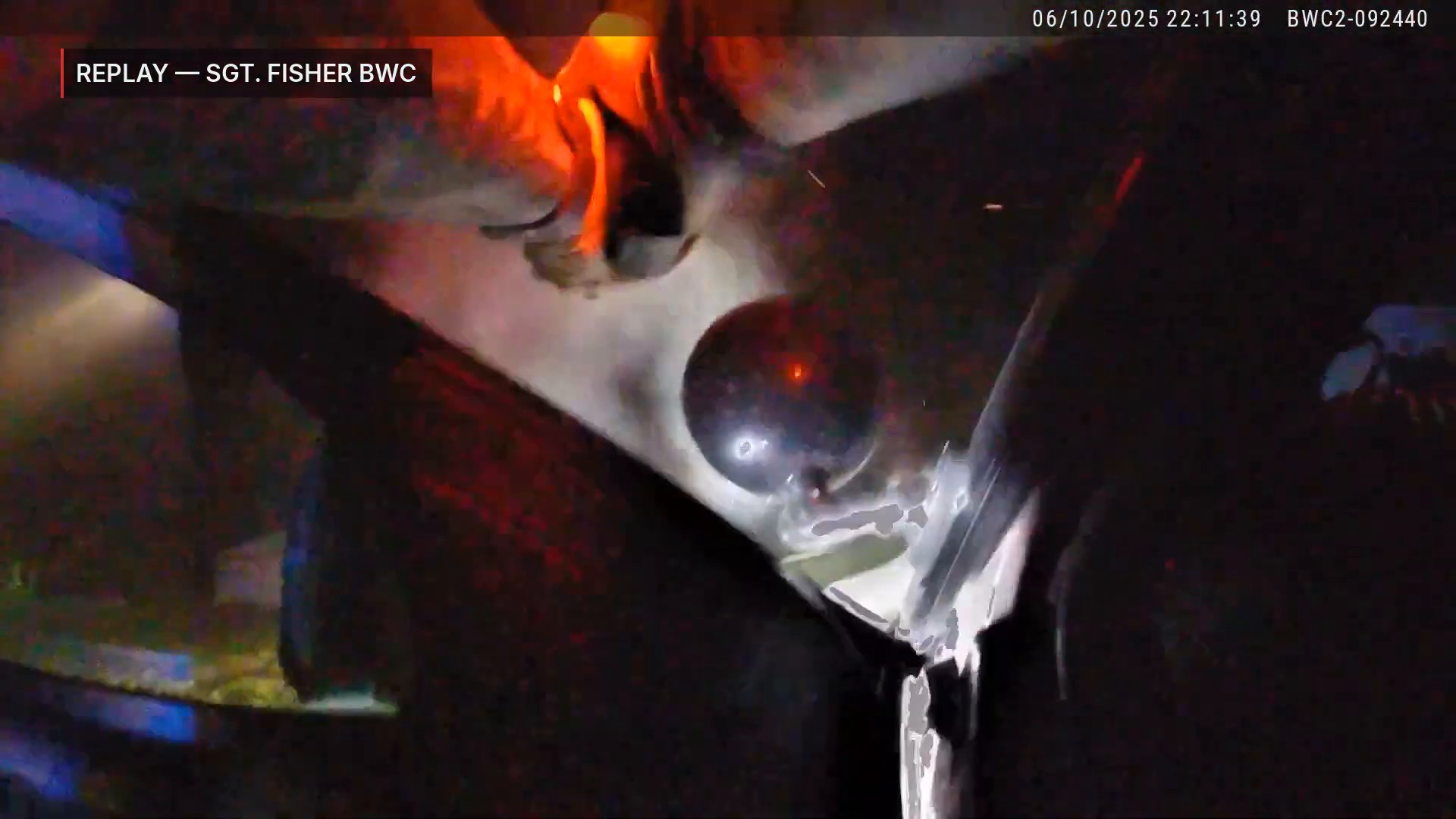
First, the video itself shows a nighttime law-enforcement operation involving a pursuit, officers converging on a rural location, urgent commands, a shooting and the controlled aftermath. Camera overlays visible in the supplied footage display June 10, 2025. One replay is labeled as Sergeant Fisher's body-worn camera, which aligns with the BCA's identification of Mower County Sergeant Katlynne Fisher as one of the officers who fired.
Second, official investigative information reported by established Minnesota news organizations identifies Nathaniel Bailey, 44, as the man officers pursued and later shot. It identifies Brenda Krause, 66, as the woman found dead at the property. It also states that Bailey exited his vehicle with a handgun and that five officers discharged their firearms.
Third, some questions cannot be answered from the video compilation alone. The footage does not independently establish Bailey's intent before the initial dispatch, the complete circumstances of Krause's death, or every communication between agencies during the pursuit. Those issues belong to the broader investigation. It would be inappropriate to invent motives, diagnoses, exact words not captured in the footage, or legal conclusions that were never reached because Bailey died at the scene.
This separation is more than a journalistic formality. Body-camera video can feel definitive because it places viewers close to the action. But proximity is not the same as completeness. A camera captures a limited field of view, and an edited compilation necessarily selects certain moments. The most accurate account combines the footage with corroborated investigative information while leaving unresolved questions unresolved.
A Case That Changed in Minutes
The June 10 incident moved through several distinct phases in a remarkably short period: an alarming domestic-disturbance report, a search for a vehicle, a pursuit across jurisdictions, a return to the rural residence, an armed confrontation and then the discovery of a homicide victim.
That progression explains why the response grew to include officers from numerous agencies. Each stage increased the amount of information officers had to process while also reducing the time available to act. By the time the pursuit returned to the property, officers were dealing with a suspect associated with a reported killing, a possible firearm, darkness and a rapidly changing scene.
The footage is most powerful when viewed with that chronology in mind. The chase is not an isolated pursuit. The commands at the property are not a routine felony stop. And the shooting is not the beginning of the story. Each moment is connected to the dispatch information and to what investigators later found at the residence.
The case also demonstrates why careful verification matters when dramatic video circulates online. A short title can compress a complicated incident into a few words, sometimes losing distinctions that later reporting makes clear. Here, the underlying event is already serious enough without exaggeration. The verified facts describe a homicide investigation, a multi-county pursuit and a fatal law-enforcement confrontation.
For viewers, the complete sequence offers something a short clip cannot: the buildup, the distance covered during the pursuit, the coordination between officers, the sudden change when the vehicle reaches the property, and the tense aftermath as law enforcement secures the scene.
The investigation described in the early BCA reporting was preliminary, and any assessment of the officers' actions ultimately depends on the full evidentiary record rather than a single edited view. What the available material does establish is a tragic sequence in rural Minnesota that ended with two people dead and several agencies involved in the investigation that followed.
If you want to understand how quickly the call developed from a search into a pursuit and then an armed confrontation, the full footage provides the clearest chronological view of the law-enforcement response.
Comments (0)
Loading comments...
May You Like
Entitled Teen REFUSES To Exit Vehicle, Takes Off On Police Instead

UCF Student’s Pronoun Dispute With Campus Police Escalates Into an Arrest