
[DASHCAM] Woman Steals Police Cruiser & Leads Cops On 125+ MPH Pursuit!
Stolen Sheriff’s SUV Pursuit Ends in a Devastating Head-On Crash on Florida Highway
A call about suspicious behavior at a shopping plaza in Silver Springs, Florida, initially gave deputies little indication of the catastrophe that would follow. Within minutes, 33-year-old Kendra Boone had climbed into a Marion County Sheriff’s Office SUV and driven away. What began as an attempted vehicle theft investigation became a long, high-speed pursuit along State Road 40, with the stolen patrol vehicle repeatedly changing direction and reaching speeds well above 100 mph.
The chase ended on February 1, 2024, when the stolen SUV crossed into oncoming traffic and collided head-on with a pickup truck. Boone died at the scene. Two people traveling in the pickup also died, while a third occupant was critically injured. Contemporary reporting later identified the two people killed in the pickup as Richard Earl Middleton, 73, and Diane Lynn Held, 72, of Waterloo, South Carolina.
The supplied 15-minute video closely matches the incident documented by the Marion County Sheriff’s Office and multiple Florida news organizations. Its police-camera overlays show February 1, 2024. During the pursuit, an in-car display shows the stolen vehicle traveling at triple-digit speeds, including approximately 110 mph in one supplied frame. Later body-camera footage shows the wreckage scattered beside the highway after the pursuit has ended.
Yet the most important part of this story is not the speedometer. It is how quickly a relatively ordinary call became a fatal event involving people who had no role in the original encounter.
The case also generated a difficult public discussion after the crash. Sheriff Billy Woods strongly defended the deputy whose SUV was stolen and placed responsibility on Boone. Boone’s family later told the Ocala Gazette that they had been deeply concerned about her mental state before the incident and had sought help the night before. Those two parts of the story are not mutually exclusive: the footage documents dangerous actions that afternoon, while the family’s account provides context about events leading up to them.
A Suspicious-Person Call at Forest Plaza
The incident began around 2 p.m. at Forest Plaza in the 15900 block of East Highway 40 in Silver Springs.
According to the Marion County Sheriff’s Office account reported by the Ocala Gazette, deputies were told that Boone had attempted to take an elderly woman’s car keys and tried to get into her vehicle but had been unsuccessful.
Deputy Christopher Witte responded and made contact with Boone. He directed her toward the rear of his patrol vehicle.
The encounter then changed in seconds.
After Witte exited the SUV, Boone moved through the passenger side and climbed into the driver’s seat. Body-camera footage captured the deputy realizing what was happening as the vehicle began to move.
Another deputy was close enough to respond immediately, and the pursuit began.
The Theft Happens Almost Instantly
One reason the video attracted widespread attention was how fast the patrol SUV was taken.
After the footage was released, questions were raised about how Boone had managed to gain control of a marked sheriff’s vehicle. Sheriff Woods publicly defended the deputy, arguing that the rapid sequence could have caught even an experienced officer off guard.
The video is useful because it shows why the incident cannot be understood simply from the phrase “stole a police car.” There was no long attempt to defeat a lock or start an unattended vehicle. Boone allegedly used an opportunity that appeared for only moments.
Once she reached the driver’s seat, the problem facing deputies changed dramatically. A marked law-enforcement SUV is not an ordinary stolen car. It is a powerful vehicle equipped for emergency response, and other motorists may react differently when they see it approaching at speed.
That created an immediate public-safety concern as Boone headed east on Highway 40.
A Miles-Long Pursuit Begins on State Road 40
Deputies pursued the stolen SUV eastbound as the vehicle accelerated away from the plaza.
News4JAX reported that Boone eventually made a U-turn near a weigh station west of Highway 19. Additional deputies joined the effort, and officers prepared stop sticks in an attempt to end the chase.
Before she reached the planned deployment area, however, Boone changed direction again.
She made another U-turn and headed east on Highway 40.
The pursuit now involved multiple law-enforcement units spread along a rural highway where civilian traffic continued to travel in both directions.
The supplied video illustrates the speed involved. A frame from the stolen vehicle’s dash camera at approximately 2:14 p.m. shows the SUV traveling around 110 mph.
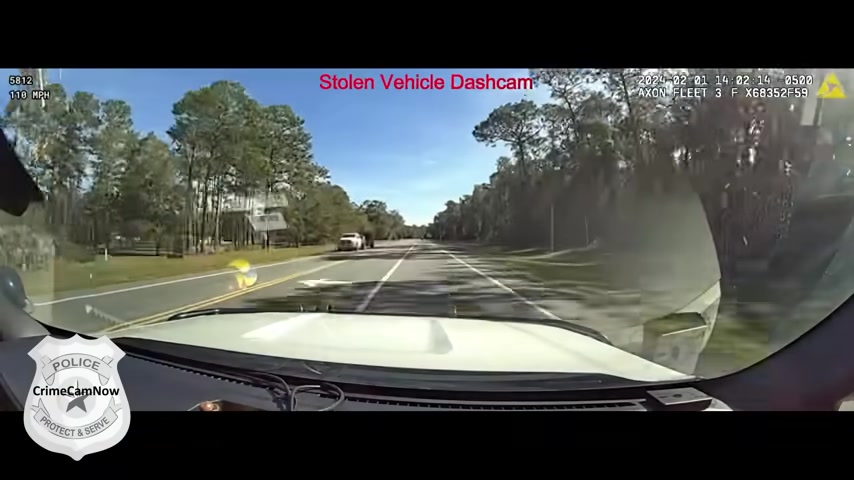
Reports from the Sheriff’s Office said the vehicle traveled well over 100 mph. Later accounts placed the peak speed at approximately 125 to 127 mph.
At those speeds, the distance available to react to normal traffic conditions collapses. A vehicle traveling 120 mph covers about 176 feet every second. Even a small steering correction can become dangerous, and a driver approaching slower traffic has only moments to decide whether to brake, change lanes or leave the roadway.
Businesses Along the Highway Hear the Pursuit Coming
The chase was impossible for people along Highway 40 to ignore.
Spectrum News spoke with business owner Glen Elledge, who described seeing groups of deputies moving rapidly through the area and hearing a continuing stream of sirens.
Employees and customers along the highway did not necessarily know why police were moving so quickly. They simply saw an unusual concentration of emergency vehicles heading in the same direction.
That perspective matters because the pursuit was unfolding through a community, not on a closed course. Every driveway, intersection and oncoming vehicle represented another potential conflict point.
Officers were simultaneously trying to stop Boone and avoid creating additional danger for people who had no idea what was approaching.
Stop Sticks Are Prepared but Never Get the Chance
Stop sticks are designed to gradually deflate tires after a vehicle drives over them. When they work as intended, they can reduce a fleeing driver’s ability to continue at speed without requiring direct vehicle-to-vehicle contact.
Deputies planned to use them during the pursuit.
But a pursuit moving at triple-digit speeds can outrun a tactical plan almost as quickly as officers can organize it.
Boone’s U-turn changed the direction of travel before she reached the area where the stop sticks had been positioned.
That forced deputies to adjust again.
The sequence demonstrates one of the central difficulties of high-speed pursuits: police are reacting to decisions made by the fleeing driver. A tactic that looks viable one minute may become irrelevant after a sudden turn.
The Stolen SUV Continues at Extreme Speed
The stolen patrol vehicle’s own camera creates an unusual perspective on the chase.
Most pursuit footage shows a suspect vehicle from behind. Here, the viewer can also see the road from the stolen sheriff’s SUV itself.
That makes the speed feel different.
Road markings pass beneath the hood rapidly. Oncoming traffic closes distance in seconds. The rural landscape offers long straight sections that make extreme speed possible, but those same roads still contain trucks, driveways and ordinary motorists.
The footage also shows why a speed reading by itself does not capture the full danger. A vehicle traveling 110 mph on an empty controlled track is one thing. The same speed on a two-lane or divided public highway with traffic is another.
The Final Attempt to Pass a Semi-Truck
According to the Sheriff’s Office, the decisive moment came when Boone approached a semi-truck while traveling east.
She moved onto the right shoulder in an attempt to pass it.
That maneuver left almost no margin for error.
The shoulder is not designed to function as a high-speed passing lane. Its surface, width and roadside obstacles may differ from the travel lane. More importantly, the driver eventually has to return to the roadway.
Authorities said Boone lost control as she attempted to reenter the highway.
The stolen SUV crossed into the opposite lane.
A black pickup truck was approaching from the other direction.
The Head-On Crash Ends the Pursuit
The collision was catastrophic.
The stolen sheriff’s SUV struck the pickup head-on in the 26700 block of East Highway 40.
Boone died.
Two occupants of the pickup also died. A third occupant was transported to a hospital in critical condition.
The Florida Highway Patrol took responsibility for the traffic-homicide investigation. Lt. Patrick Riordan described the scene as extremely large, requiring investigators to measure, photograph and document debris and other evidence.
That description is reflected in the later body-camera footage.
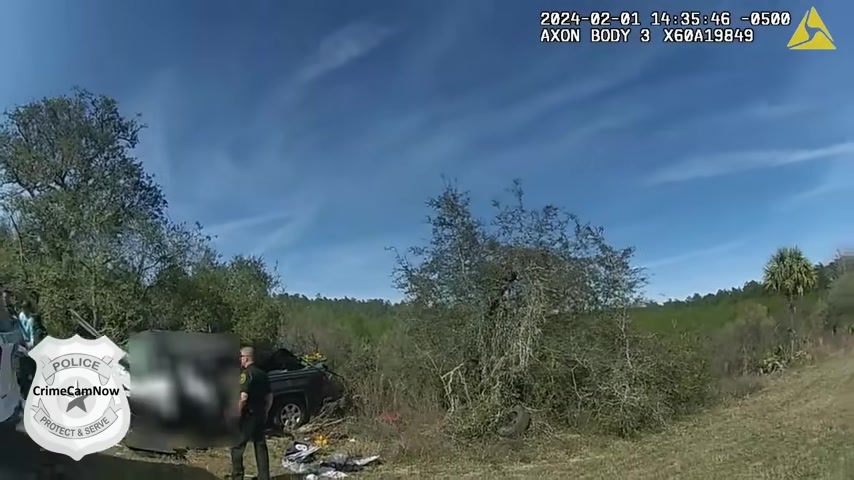
The roadway and shoulder no longer resemble a pursuit scene. They resemble a major collision investigation. Vehicle debris and equipment are scattered around the damaged vehicles while responders work across a wide area.
The transition from chase footage to crash footage is abrupt, but that is precisely how the event unfolded. Minutes of movement ended in an instant.
Richard Earl Middleton and Diane Lynn Held
Later reporting identified the two people killed in the pickup as Richard Earl Middleton, 73, and Diane Lynn Held, 72, both from Waterloo, South Carolina.
They were not participants in the theft or pursuit. They were traveling in the opposite direction when the stolen SUV entered their lane.
A third pickup occupant survived the initial crash but was critically injured.
Their presence is essential to understanding the consequences of the pursuit. High-speed flight does not place only the fleeing driver and police at risk. The most serious harm can fall on people who happen to be in the wrong place when control is lost.
The victims had no opportunity to influence the decisions that created the collision.
The Florida Highway Patrol Takes Over the Crash Investigation
Because a stolen Marion County Sheriff’s Office vehicle was involved, the fatal collision required detailed independent crash reconstruction.
The Florida Highway Patrol investigated the wreck.
Traffic-homicide investigators typically examine tire marks, vehicle damage, roadway evidence, event-data recorders and video to reconstruct speed and movement before impact.
In this case, investigators also had extensive law-enforcement video. Body cameras documented the initial encounter. Dash cameras recorded the pursuit. The stolen vehicle itself carried recording equipment.
That means the investigation could compare physical crash evidence with a second-by-second visual record of the SUV’s movement.
The Sheriff Defends the Deputy
The day after the crash, Sheriff Billy Woods faced questions about whether the patrol vehicle should have been left running and how Boone had been able to take it.
Woods rejected the suggestion that the deputy’s actions were responsible for the deaths.
His comments were forceful and attracted national attention. He placed responsibility on Boone for stealing the vehicle, fleeing and driving dangerously.
Spectrum News reported that Woods argued the theft happened so quickly that it could have happened to an officer with decades of experience.
The body-camera footage became central to that defense because viewers could see the speed of the transition from contact with Boone to the stolen SUV moving away.
The Sheriff’s Language Creates a Second Controversy
The pursuit was not the only part of the story that generated debate.
At his press conference, Woods repeatedly used harsh language when describing Boone. His comments drew criticism from people who believed the public discussion should acknowledge possible mental-health issues surrounding the incident.
The Ocala Gazette later published a detailed story based on an interview with Boone’s older sister, Karisten Hinsinger.
Hinsinger said the family had been deeply worried about Boone’s mental health before the crash.
According to the Gazette, Boone’s parents had contacted the Marion County Sheriff’s Office for help the night before the incident, but Boone left before deputies arrived.
The Sheriff’s Office declined to provide the newspaper with details about all of its contacts with Boone in the days before the crash.
The Family Describes a Mental-Health Crisis
Boone’s family did not dispute the tragedy caused by the crash. Her mother told Spectrum News that the family was mourning Kendra while also feeling deeply sorry for everyone affected by the pursuit and collision.
Her sister’s later interview added context about Boone’s condition before February 1.
The Gazette reported that the family believed untreated mental-health problems played a major role in the behavior that culminated in the fatal chase.
This context should not be used to erase the consequences of Boone’s actions. Nor should the consequences be used to pretend the preceding mental-health concerns did not exist.
Both can be part of an accurate account.
The criminal behavior that afternoon created an immediate public danger. At the same time, the family’s attempt to seek help the previous night raises broader questions about how communities respond when relatives believe someone is entering a severe behavioral crisis.
A Tragedy With More Than One Point of Failure
After a catastrophic event, public discussion often searches for a single moment that could have changed everything.
What if Boone had never reached the patrol SUV?
What if she had stopped when deputies began pursuing?
What if the stop sticks had been deployed successfully?
What if she had not attempted to pass the semi on the shoulder?
What if the family had been able to secure effective intervention the night before?
Each question looks backward from an outcome that is already known.
The difficulty is that people living through the event did not know where the chain of decisions would lead.
The deputy at Forest Plaza did not know that the woman standing near his vehicle would soon be driving it at more than 100 mph. The occupants of the pickup could not know that a stolen police SUV would suddenly cross into their lane.
Why the Patrol SUV Made the Pursuit Especially Dangerous
A stolen police vehicle introduces unusual risks.
Other drivers may see emergency lights or law-enforcement markings and assume the driver is an officer responding to a legitimate emergency. They may yield, pull over or make sudden movements.
The vehicle may also contain equipment unavailable in an ordinary passenger car.
And because patrol vehicles are built to spend long periods on the road and respond rapidly to emergencies, they are capable of sustained high-speed operation.
In the wrong hands, those same characteristics become liabilities.
The Video Shows More Than a Viral Chase
Online, the incident is often reduced to a title such as “Woman Steals Police Car, 125 MPH Chase Turns Deadly.”
That description is factually close to the most dramatic elements, but it compresses a much larger event into a single sentence.
The complete footage shows the stages.
There is the initial contact.
There is the sudden theft.
There is the pursuit and repeated change of direction.
There is the extreme speed.
Then there is the aftermath, when the movement stops and responders are left with a crash scene involving multiple casualties.
Seeing those stages together changes the meaning of the video. The speed becomes less like spectacle and more like a countdown toward a risk that grows with every mile.
Why Triple-Digit Speed Changes Everything
At 60 mph, a vehicle travels about 88 feet every second.
At 120 mph, it travels roughly 176 feet every second.
That difference affects every decision.
A driver who sees a hazard 500 feet ahead has less than three seconds to reach it at 120 mph, before accounting for perception and reaction time.
Steering inputs also become more consequential. A correction that would be manageable at ordinary highway speed can destabilize a vehicle at extreme speed, particularly when moving between pavement and shoulder.
The final crash demonstrates those physics brutally. Once the SUV moved into oncoming traffic, the approaching pickup had almost no time or space to avoid the collision.
The Innocent Motorists Become the Central Loss
Police pursuits naturally focus attention on the person fleeing and the officers following.
But Richard Earl Middleton and Diane Lynn Held are the reason this case cannot be treated merely as an extraordinary chase video.
They were traveling on the highway when another vehicle suddenly entered their path.
Their deaths turned the pursuit into a tragedy extending far beyond the original call at Forest Plaza.
The critically injured third occupant carried the consequences forward as well.
For the victims’ families, the event did not end when the sirens stopped or the highway reopened.
The Footage Provides an Unusually Complete Timeline
Many major incidents are reconstructed from fragments: a witness sees the beginning, a security camera captures the middle and police arrive for the aftermath.
This case is different because law-enforcement recording systems captured much of the sequence.
Body camera shows the initial interaction.
Vehicle cameras show the chase.
The stolen patrol SUV’s own system records the road ahead.
Later body-camera footage records the crash scene.
That continuity is valuable for investigators and the public because it reduces the need to rely on memory alone.
The Case Also Became a Debate About Accountability
There were at least three different forms of accountability discussed after the crash.
The first concerned Boone’s actions: the attempted theft allegation, the taking of the patrol SUV, the decision to flee and the extreme driving behavior.
The second concerned law-enforcement procedure: whether anything about the deputy’s actions or vehicle security could be changed to reduce the possibility of a similar theft.
The third concerned the community response to mental-health crises, particularly after Boone’s family said they had sought help before the incident.
These questions do not have to cancel one another out.
Examining police procedure does not require denying Boone’s responsibility for her driving. Discussing mental-health intervention does not require minimizing the deaths of innocent motorists.
A serious review can examine all three.
What Can Be Confirmed From the Sources
The core timeline is supported by multiple independent reports.
On February 1, 2024, deputies responded to Forest Plaza in Silver Springs after a report involving an attempted vehicle theft.
Kendra Boone, 33, gained access to a Marion County Sheriff’s Office SUV and drove away.
Deputies pursued her along East Highway 40.
She made multiple changes of direction and drove at speeds exceeding 100 mph.
Authorities attempted to position stop sticks.
Boone eventually tried to pass a semi-truck using the right shoulder.
She lost control while returning to the roadway and entered oncoming traffic.
The stolen SUV collided head-on with a pickup.
Boone and two pickup occupants died, while another pickup occupant was critically injured.
The Florida Highway Patrol investigated the collision.
Boone’s family later said they had been concerned about her mental state and had sought help the night before.
What Should Not Be Oversimplified
The case invites simple conclusions because the video is so dramatic.
But the consequences deserve more care than a viral caption.
Boone’s driving created an extraordinary danger and ended with innocent people dead.
That is central to the story.
Her family’s account of a mental-health crisis is also part of the documented record.
The deputy’s split-second loss of control of the patrol SUV became a matter of public discussion, even as his sheriff strongly defended him.
The pursuit itself raises familiar questions about balancing immediate apprehension against danger to surrounding motorists.
None of those issues can be fully resolved by watching only the crash.
Twenty Minutes That Changed Several Families
WCJB reported that the pursuit lasted about 21 minutes.
That is a short period on a clock.
For the people involved, it contained an entire chain of irreversible events.
A deputy arrived at a shopping plaza.
A woman entered his patrol SUV.
Another deputy began following.
The stolen vehicle accelerated down Highway 40.
Stop sticks were prepared.
Direction changed.
Speed increased.
A semi-truck appeared ahead.
The SUV moved onto the shoulder.
Control was lost.
An oncoming pickup had nowhere to go.
By the time emergency crews reached the final scene, three people were dead.
A Pursuit That Became a Community Tragedy
The most compelling police videos often contain a clear turning point. In this case, there are several.
The first occurs when Boone moves into the patrol SUV.
The second comes when the pursuit reaches triple-digit speed.
The third is the attempted pass on the shoulder.
The final one is irreversible: the stolen SUV crosses the center of the highway.
Each stage increases the stakes until people who were never part of the original police call become victims.
That is why the footage remains difficult to watch even years later. The viewer knows the outcome while watching ordinary traffic continue ahead of the stolen SUV.
The Aftermath Is Quieter Than the Chase
By the time the later body-camera footage begins, the pursuit is over.
There is no more 110-mph movement.
Officers stand near damaged vehicles and debris. Responders work around the roadside. The Florida landscape beyond the crash remains almost unchanged.
That quietness makes the final images more powerful.
A pursuit that filled the highway with sirens has ended in a fixed location where investigators must document what happened and families must be notified.
The contrast is a reminder that the consequences of speed last much longer than the chase itself.
Why the Full Video Matters
A short clip of Boone entering the patrol SUV can make the incident look like an astonishing theft.
A short clip of the chase can make it look like a high-speed pursuit.
A photograph of the crash can make it look like a traffic tragedy.
The complete sequence shows that all three are the same event.
That continuity is necessary to understand how rapidly risk accumulated and why the final collision cannot be separated from the decisions made miles earlier.
Watch the Full Incident
The complete footage documents the transition from the initial encounter to the stolen patrol vehicle, the prolonged high-speed pursuit and the devastating aftermath on East Highway 40. Watching the sequence in order provides far more context than the crash or theft alone.
Comments (0)
Loading comments...
May You Like

Police Follow the Driver Until His Escape Route Runs Out

What Happens when you get Caught Shoplifter Stealing Local Store

Stolen Charger Flees Police During Highway Traffic Stop












