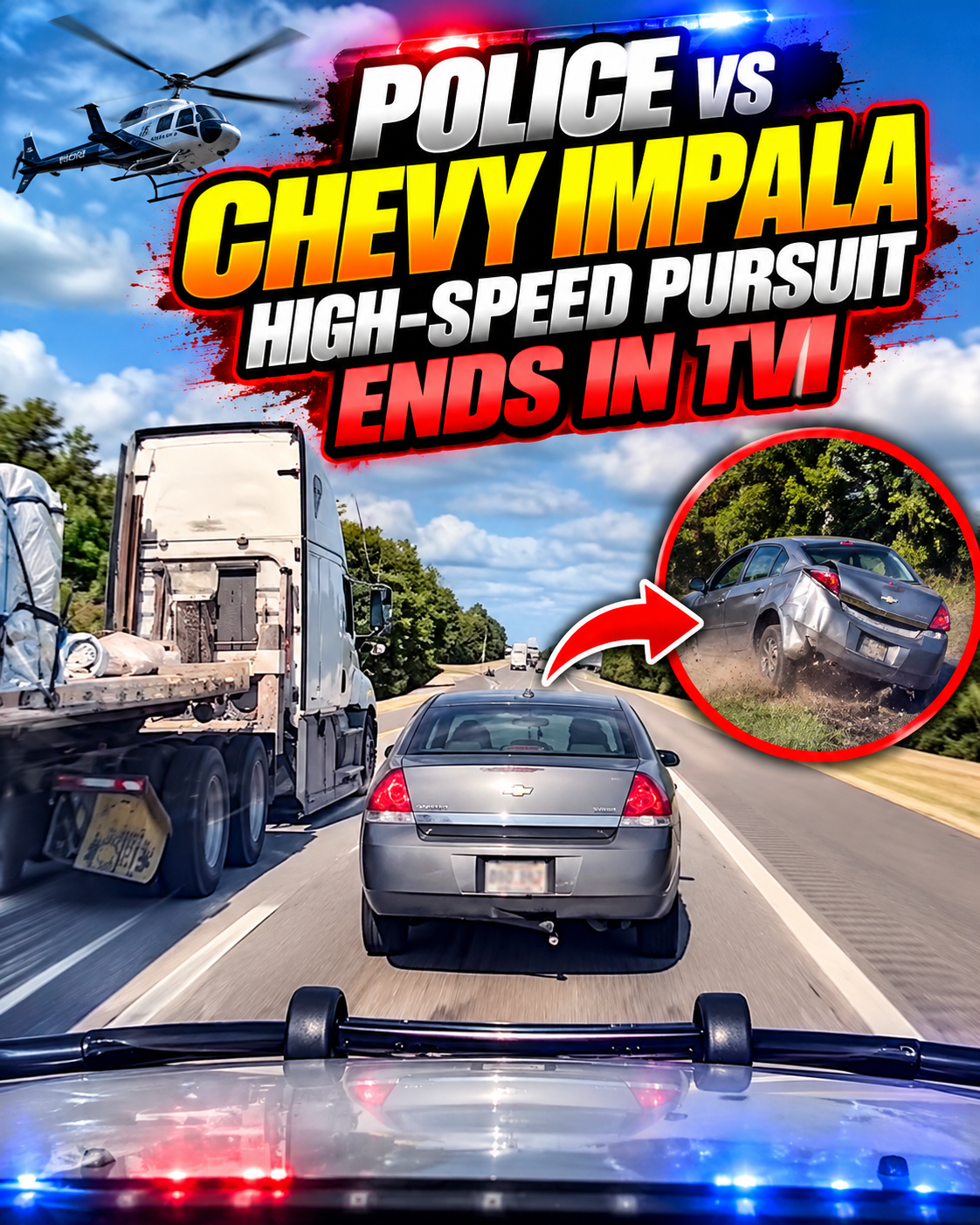
[DASHCAM] Convicted Felon Thought He Could Outrun ASP in a Chevy Equinox-100 MPH +TVI
100 MPH Chevy Equinox Pursuit Ends When Arkansas Trooper Pins Armed Felon’s SUV
A Traffic Stop Turns Into a Multi-City Pursuit
On August 4, 2026, what began as a Jacksonville traffic stop escalated into a pursuit that crossed an interstate, shopping-center parking lots, busy city streets and residential neighborhoods before an Arkansas State Police trooper finally stopped a silver Chevrolet Equinox in North Little Rock.
The dash-camera video supplied for this article captures the Arkansas State Police portion of the pursuit. Its timestamp shows the afternoon of August 4, and the sequence matches a detailed police report attributed to Trooper Dustin Medford.
The driver was later identified as Antoine Pennington. Police said he initially provided another name during the traffic stop, fled when officers tried to have him exit the Equinox, reached speeds as high as 108 mph and repeatedly changed direction while officers looked for a safe opportunity to perform a Tactical Vehicle Intervention, commonly called a TVI.
The pursuit eventually slowed in a residential area. On Lindenhurst Drive, Medford used his patrol vehicle to rotate and pin the Equinox. Pennington tried to climb out through the passenger-side window, but officers were already positioned around him. He surrendered.
According to the police reports reproduced with the released footage, officers recovered two loaded handguns from Pennington. Police described him as a convicted felon and booked him into the Pulaski County Regional Detention Facility on a long list of allegations, including felony fleeing and possession of firearms by certain persons.
The most striking part of the video is not simply the speed. It is the amount of time the trooper spends waiting for the right place to end the chase.
The Stop Begins in Jacksonville
A Jacksonville police report reproduced with later video coverage places the beginning of the incident at approximately 3:25 p.m.
An officer identified as Lambert reported seeing a silver SUV with an unsecured license plate and expired registration while traveling south on North First Street.
The officer activated emergency lights and stopped the vehicle at 205 West Martin Street.
At this stage, there was no pursuit.
According to the report, the driver identified himself as Antonio Johnson. Police later determined that he was Antoine Pennington.
The driver reportedly told the officer that the vehicle did not have insurance.
A passenger was identified as Jacqualla Norfleet. Police said a records check showed active warrants for the passenger from multiple jurisdictions.
The report also states that the identity supplied by the driver produced a record containing felony convictions and a search waiver. Officers decided to have the occupants exit the vehicle so they could conduct a search.
That is when the encounter changed.
Police Say Pennington Drives Away
When the Jacksonville officer returned and instructed the driver to get out, police said Pennington put the Equinox into drive and accelerated across the parking lot.
The passenger was dropped off.
The SUV then went over a curb and continued east on West Martin Street.
The officer pursued.
From there, the Equinox traveled through Jacksonville before entering the interstate system. The police report says Pennington went east on West Martin, north on North First Street, north on Vandenburg and west on John Harden Drive before merging onto Interstate 57 southbound.
By then, the incident had moved far beyond the original registration and insurance issues.
Police were dealing with a driver actively refusing to stop and accelerating through traffic.
The Equinox Reaches More Than 100 MPH
Jacksonville police reported that the Equinox reached a maximum speed of approximately 108 mph during the pursuit.
Trooper Medford's report similarly describes radio traffic advising that Jacksonville officers were pursuing a silver Chevrolet Equinox south on Interstate 57 at more than 100 mph.
Those details align with the supplied dashcam.
The video shows the ASP cruiser accelerating rapidly after joining the pursuit, with the Equinox moving through highway traffic ahead.
Speed is only one component of the risk visible in the recording. The suspect vehicle changes lanes, crosses medians, enters parking lots and later moves onto narrower urban streets.
The environment continually changes, meaning a maneuver that might be possible on one stretch of road can become dangerous seconds later.
Trooper Dustin Medford Waits Near the Interstate
Medford reported hearing Pulaski County radio traffic about the pursuit at approximately 3:45 p.m.
Arkansas State Police communications broadcast a request for assistance.
Medford was already positioned near the southbound Interstate 57 on-ramp around the three-mile marker.
He could see the pursuit approaching.
Rather than immediately entering behind it, the trooper began moving down the ramp while anticipating that the Equinox would pass him on the interstate.
His plan, according to the report, was to position himself for a possible TVI.
Pennington did something different.
As the marked Arkansas State Police unit came into view, the Equinox suddenly left the interstate, crossed a grassy median and moved across the on-ramp behind the trooper.
The dashcam captures the unusual maneuver and the trooper's attempt to reposition.
The Pursuit Becomes a Game of Positioning
Medford crossed the grass near the end of the ramp and moved toward Warden Road, again trying to get into a useful position.
Pennington then crossed the median again and returned to the interstate.
Medford followed and became the primary Arkansas State Police unit in the pursuit.
This sequence demonstrates an important feature of police pursuits that is easy to miss in a short highlight clip.
Catching the fleeing vehicle is not the same thing as safely stopping it.
A trooper performing a TVI needs room, appropriate speed, predictable vehicle positioning and enough separation from uninvolved traffic to reduce the risk of striking someone else.
For much of this chase, those conditions did not exist.
Too Much Traffic for an Immediate TVI
The pursuit continued toward Exit 1 and McCain Boulevard.
Medford wrote that there was too much traffic for him to safely perform a TVI.
That decision is visible throughout the dashcam sequence. The patrol vehicle repeatedly closes the distance to the Equinox, but the trooper does not simply make contact whenever he gets close.
Civilian cars occupy surrounding lanes.
Intersections appear.
The road curves.
The suspect vehicle changes direction.
Each of those factors can turn an attempted intervention into a collision involving an uninvolved motorist.
The trooper continues following while waiting for a better opportunity.
The Equinox Enters McCain Mall
Pennington exited toward the McCain Boulevard area and drove into the McCain Mall parking lot.
Medford was unable to safely make the same turn and briefly lost sight of the Equinox.
Jacksonville police remained in the pursuit.
The dashcam then shows the Arkansas trooper moving through the shopping area while trying to reacquire the suspect vehicle.
Police pursuits through commercial parking lots create a different kind of risk than interstate pursuits.
Speeds may be lower, but pedestrians, parked cars, curbs, storefront traffic and drivers backing from spaces can appear with almost no warning.
Medford's report states that when he regained visual contact in the rear parking areas around Lakewood Village, pedestrian activity was low and many of the lots were largely empty.
ASP Regains the Primary Position
The pursuit returned to public roads on Fairway Avenue and continued toward McCain Boulevard.
Medford again moved into the primary position.
The Equinox continued west.
The trooper still did not immediately perform a TVI.
His report cites hills and curves as reasons he could not safely attempt the maneuver.
This is one of the clearest themes in the entire pursuit: the officer repeatedly has the suspect in front of him but continues waiting.
For viewers, that can make the chase feel longer than necessary.
From the trooper's perspective, however, ending a pursuit requires considering what will happen to both vehicles after contact. A spinning SUV can travel across several lanes, strike parked cars, enter a sidewalk or roll into nearby property.
The Chase Enters the Levy Area
The Equinox eventually moved into the Levy neighborhood of North Little Rock.
Pennington drove through an apartment complex that Medford identified as Summertree Apartments.
Police said the driver appeared to be trying to lose the trooper.
It did not work.
Medford maintained or regained contact, but the environment became increasingly restrictive.
Residential roads meant homes, parked vehicles, driveways and potential pedestrians.
The pursuit had moved from interstate speeds into an area where even a lower-speed crash could easily involve someone who had nothing to do with the chase.
A First TVI Opportunity Disappears
On Camp Robinson Road, Medford attempted to position the patrol vehicle for a TVI.
Pennington reacted by braking hard.
The maneuver was avoided.
The Equinox then entered the neighborhood west of Camp Robinson Road.
Medford wrote that there continued to be no suitable opportunity because of the terrain and vehicles parked along the streets.
The dashcam shows the trooper staying close without forcing contact.
This is a useful reminder that a TVI is not simply a matter of hitting the rear quarter of a fleeing vehicle. Timing and surroundings matter.
A poorly timed intervention can redirect the suspect vehicle into a house, a parked car or an oncoming lane.
Lindenhurst Drive Finally Provides an Opening
The chase reached Lindenhurst Drive.
Here, the conditions changed.
Pennington slowed enough for Medford to attempt the intervention on a residential street.
The trooper moved alongside the Equinox and made contact.
According to Medford's report, he maintained that contact while accelerating and used the motion of the Equinox to rotate it across the front of the patrol vehicle.
The SUV turned sideways.
Medford then pinned the driver's side.
The chase was over.
The Final TVI Looks Different From a Highway PIT
Many Arkansas State Police pursuit videos end with a dramatic high-speed spin.
This one is different.
The final maneuver happens at relatively low speed.
Instead of striking the Equinox and immediately separating, the trooper maintains pressure and uses his cruiser to control the suspect vehicle's movement.
The result is less visually spectacular than a 100-mph highway intervention, but tactically it achieves the same goal: the Equinox can no longer continue fleeing.
The patrol vehicle's position also blocks the driver's side, which becomes important seconds later.
Pennington Tries the Passenger Window
With the driver's side pinned, Pennington moved toward the opposite side of the Equinox.
Medford reported that he attempted to flee on foot by rapidly climbing out through the passenger-side window.
The dashcam shows officers converging immediately.
Before Pennington can establish any meaningful distance, officers are already in front of him.
He is ordered to the ground.
He surrenders and is handcuffed.
After a pursuit lasting through highways, shopping districts and residential streets, the final arrest takes only seconds.
Police Report Two Loaded Handguns
The most consequential discovery came after the arrest.
Police reported that Pennington said he had two firearms on his person.
The weapons were described as a Smith & Wesson SD40 VE and a SCCY CPX-2.
Both were loaded, according to the police report.
Officers secured the firearms.
The reports also described Pennington as a convicted felon, which led to a charge of possession of firearms by certain persons.
That allegation is one reason the original video title emphasizes his prior felony status.
It is important, however, to separate the verified arrest allegation from a final court outcome. The available sources reviewed for this article document the arrest and charges, but they do not establish a later conviction in this new case.
The False Name Becomes Another Allegation
Police said Pennington initially identified himself as Antonio Johnson.
After his arrest, he reportedly admitted that he had given his brother's name because he was scared.
That conduct led to an allegation of nonfinancial identity fraud.
The detail also helps explain why the roadside records check did not initially reveal the driver's correct identity.
It is another example of how the facts of a traffic stop can change as officers verify information after an arrest.
The Passenger Is Left Behind Early in the Pursuit
The passenger, Jacqualla Norfleet, did not remain in the Equinox for the full pursuit.
According to the Jacksonville police report, Pennington dropped her off as he fled from the original stop.
That distinction matters.
The dashcam therefore should not be described as showing a high-speed pursuit with a passenger trapped inside throughout.
By the time Arkansas State Police took the primary position, police accounts describe Pennington as the driver they were pursuing.
Avoiding that kind of assumption is important when reconstructing a chase from a forward-facing dash camera, which usually provides little visibility into the suspect vehicle's cabin.
A Dog Was Reportedly Inside the Equinox
The charge list associated with the arrest also includes cruelty to animals.
Video coverage of the police report stated that a dog was inside the Equinox during the pursuit.
That allegation adds another layer to the risk created by the chase.
The dog had no control over the driver's decisions and was carried through the same high-speed interstate movements, median crossings and abrupt maneuvers.
The available reporting reviewed here does not provide enough reliable detail about the animal's condition after the pursuit to add anything beyond the documented charge and its reported connection to the dog being in the vehicle.
The Charge List Is Extensive
The charges reproduced with the released police report include felony fleeing, possession of firearms by certain persons, nonfinancial identity fraud, cruelty to animals, third-degree battery, improper display of license tags, no liability insurance, no driver's license or an expired license, registration-related violations and reckless driving.
Those are arrest-stage allegations.
They should not be rewritten as convictions.
A long charge list can make a case sound legally settled when it is actually at the beginning of the court process.
For this article, the charges are reported as police allegations arising from the August 4 arrest.
Why the Video's Date Matters
The supplied dashcam overlay shows August 4, 2026.
That matches the detailed incident reports reproduced in public video coverage.
The time also aligns closely.
Jacksonville police described the original stop at approximately 3:25 p.m., while Medford reported hearing the pursuit around 3:45 p.m.
The Arkansas State Police dashcam then records the trooper joining the pursuit.
These independent timeline details strongly support the identification of the footage as the Antoine Pennington pursuit rather than another Arkansas Equinox chase.
The Route Can Be Reconstructed
The reports allow much of the pursuit route to be reconstructed.
It begins around West Martin Street in Jacksonville.
Pennington moves through North First Street, Vandenburg and John Harden Drive.
He enters Interstate 57 southbound.
Arkansas State Police joins near the three-mile marker.
The pursuit moves toward McCain Boulevard and Warden Road.
Pennington enters the McCain Mall and Lakewood Village area.
The chase continues onto Fairway Avenue and McCain Boulevard.
It then moves through the Levy area and Summertree Apartments before reaching Camp Robinson Road.
Finally, the Equinox enters residential streets west of Camp Robinson and reaches Lindenhurst Drive, where Medford ends the pursuit.
That route explains why the dashcam background changes so dramatically over the ten-minute recording.
Why Arkansas Calls the Maneuver a TVI
Arkansas State Police commonly uses the term Tactical Vehicle Intervention, or TVI, for a maneuver that many viewers know as a PIT.
The basic concept is to use controlled contact to rotate a fleeing vehicle and bring the pursuit to an end.
The terminology is especially familiar in Arkansas pursuit footage because ASP regularly releases or is featured in dashcam videos involving the maneuver.
But the Pennington chase demonstrates that the decision to use a TVI is not automatic.
Medford's report repeatedly documents locations where he considered an intervention but decided conditions were not safe enough.
The Trooper's Restraint Is Part of the Story
The video title naturally emphasizes the successful ending.
Yet much of the tactical story lies in what Medford does not do.
He does not force a TVI while surrounded by interstate traffic.
He does not make contact simply because the Equinox enters a parking area.
He waits through curves and hills.
He abandons one opportunity when the suspect brakes.
He continues following through a neighborhood with parked vehicles.
Only after the Equinox slows on Lindenhurst does he commit to sustained contact.
The pursuit is therefore as much about restraint and timing as it is about the final maneuver.
No Bystander Vehicles Were Reported Damaged
Medford's report states that no Arkansas State Police units were damaged and no bystander vehicles were damaged.
That is notable given the route.
The chase passes highway traffic, shopping centers, apartment areas and residential streets.
A pursuit covering that variety of environments creates repeated opportunities for secondary collisions.
The absence of reported bystander-vehicle damage is an important outcome, especially because the trooper specifically delayed intervention several times due to surrounding traffic and terrain.
The Dashcam Cannot Show Everything
The supplied video is a strong source for the Arkansas State Police portion of the chase, but it has limits.
It does not show the beginning of the Jacksonville traffic stop in detail.
It cannot independently verify what name the driver gave the first officer.
It cannot show the contents of Pennington's pockets before the arrest.
It does not establish his prior felony record by itself.
Those facts come from police reports and arrest information.
Likewise, the written reports cannot reproduce the exact traffic conditions, closing distances and split-second positioning visible in the dashcam.
Using both sources creates a more complete account.
The Original Stop Was Relatively Minor
One of the most striking contrasts in the case is the gap between the original reason for the stop and what followed.
Jacksonville police described an unsecured plate, expired tags and a lack of insurance.
Those are ordinary traffic-enforcement issues.
The encounter escalated when officers attempted to have the occupants exit the vehicle and the driver fled.
From there came a 100-plus-mph pursuit, repeated reckless maneuvers, a TVI, an attempted foot escape and the reported discovery of two loaded handguns.
The escalation was not inherent in the initial traffic violation. It resulted from the decisions police say the driver made after the stop.
Why the 108 MPH Figure Needs Attribution
The highest reported speed of approximately 108 mph comes from the Jacksonville police account.
The Arkansas State Police report independently describes the Equinox as traveling at more than 100 mph when Medford heard the pursuit broadcast.
The dashcam speed display also shows the patrol vehicle accelerating aggressively while trying to catch the fleeing SUV.
Taken together, those sources support describing the pursuit as exceeding 100 mph.
Still, the precise 108 mph figure should remain attributed to the police report rather than presented as a speed independently calculated from the video.
A Convicted Felon Allegation Changes the Arrest
The reported recovery of two loaded handguns turned the arrest into something far more serious than a fleeing case alone.
Arkansas law restricts firearm possession by certain people with felony convictions.
Police therefore charged Pennington with possession of firearms by certain persons.
The original title's phrase “convicted felon” reflects the police report's description of his status.
This article does not attempt to reconstruct every prior conviction from unrelated databases. Doing so would create unnecessary risk of mixing records belonging to people with similar names.
The relevant fact is narrower: officers described Pennington as a convicted felon when explaining the firearm charge in this incident.
What Is Verified and What Remains Unresolved
The video and available reporting support a clear core narrative.
On August 4, 2026, Jacksonville police stopped a silver Chevrolet Equinox.
Police say the driver initially gave another name.
When officers attempted to have him exit, he fled.
The driver was later identified as Antoine Pennington.
The pursuit reached more than 100 mph and continued into North Little Rock.
Arkansas State Police Trooper Dustin Medford joined and eventually became the primary pursuing unit.
After multiple locations proved unsuitable for a TVI, Medford ended the chase on Lindenhurst Drive by rotating and pinning the Equinox.
Pennington attempted to exit through the passenger window and surrendered.
Police reported recovering two loaded handguns and described him as a convicted felon.
What the reviewed sources do not establish is a final disposition of all the charges arising from this August 2026 arrest. No conviction or sentence in this case is therefore claimed here.
Why the Pursuit Holds Attention Without Exaggeration
The footage already has a natural narrative structure.
A trooper hears another department asking for help.
The pursuit approaches at highway speed.
The suspect unexpectedly crosses a median.
The trooper becomes primary.
Traffic repeatedly prevents an intervention.
The Equinox disappears into a mall complex.
The trooper finds it again.
The chase moves into residential streets.
One attempted TVI is avoided.
Finally, the suspect slows enough for the trooper to make sustained contact and pin the SUV.
Then the driver tries to climb out the opposite window.
That progression creates tension without needing invented dialogue, inflated speeds or unsupported claims about the driver's motives.
The Final Seconds Explain the Entire Chase
The last moments on Lindenhurst provide the payoff to everything that comes before them.
Medford has spent much of the pursuit searching for a place where he can safely stop the Equinox.
When that opening finally appears, he does not hesitate.
The patrol car moves into position.
Contact is made.
The Equinox rotates.
The driver's side is pinned.
Officers converge.
Pennington moves toward the passenger window but finds officers already waiting.
The pursuit that stretched across multiple road types ends in a confined residential space without a reported collision involving an uninvolved vehicle.
A High-Speed Chase Defined by Timing
The Antoine Pennington pursuit is easy to summarize as a 100-mph chase ending in a TVI.
That description is accurate but incomplete.
The more interesting story is the timing.
The Arkansas trooper has several moments when he is close enough to the Equinox to consider intervention.
Each time, the surroundings matter.
Traffic matters.
Curves matter.
Parked vehicles matter.
Speed matters.
Only after those conditions improve does the trooper act.
The final TVI lasts only seconds, but the decision about when to perform it develops over most of the chase.
Watch the Full Pursuit
The complete dashcam is worth watching from beginning to end because the most important details are not limited to the final impact.
Watch how the Equinox changes direction when the Arkansas State Police unit first appears. Notice the civilian traffic that prevents an early intervention, the transition through McCain Mall and Lakewood Village, and the repeated moments when the trooper closes the gap but waits.
Then compare those moments with Lindenhurst Drive.
The suspect vehicle is slower. The roadway gives the trooper a better opportunity. Medford commits to the TVI, maintains contact and pins the driver's side before officers make the arrest.
The footage demonstrates how a pursuit that exceeds 100 mph can ultimately be ended at much lower speed through positioning rather than a dramatic highway crash.
Comments (0)
Loading comments...
May You Like

Woman Tries to Stop Police From Arresting “Brother” — He Denies Knowing Her

[DASHCAM] Drunk Driver Leads Trooper on High-Speed Pursuit Through City Streets