[Dashcam + Bodycam] Police surrounded and subdued a reckless driver
Ohio Pursuit Ends in Wapakoneta After Police Track Suspect Across Auglaize County
A Wednesday Morning That Escalated Fast
On October 6, 2021, law enforcement in Auglaize County, Ohio, was already looking for James Wilcox before the first cruiser began following his vehicle. According to contemporaneous reporting based on the Auglaize County Sheriff's Office account, deputies had been investigating a domestic-violence incident in which Wilcox was accused of threatening a family member with a firearm. While officers were trying to locate him, a separate theft was reported and Wilcox was also identified as a suspect in that incident.
The situation shifted shortly after 8:15 a.m. when a Wapakoneta police officer spotted the vehicle Wilcox was driving and attempted to stop him. Wilcox did not stop. What followed was a pursuit across multiple county roads before officers finally brought the chase to an end back in Wapakoneta.
The supplied video, “James Wilcox Pursuit [Body Cam + Dashcam],” aligns closely with those reports. Its Axon dash-camera overlay shows October 6, 2021. The footage follows a dark vehicle through rural roads, shows multiple law-enforcement units becoming involved, and later transitions to body-camera footage surrounding the arrest. Those details make it possible to connect the video to the pursuit reported by WHIO-TV and Hometown Stations.
The case is compelling not because it needs exaggerated language, but because the pursuit is only one part of a much larger sequence. Police were not beginning with an unexplained traffic violation. They were attempting to locate a man already suspected in two separate incidents. Once the vehicle failed to stop, the investigation became a moving confrontation that put officers, the fleeing driver and other motorists at risk.
The Search Began Before the Pursuit
The background is essential to understanding why officers were looking for Wilcox. WHIO reported that Auglaize County deputies first responded to a domestic-violence investigation. Wilcox, then 25 and identified as being from Cridersville, was accused of threatening the life of a family member with a gun.
That allegation was serious enough to make locating him an immediate priority. While deputies were investigating and attempting to find him, another call came in involving a theft. Authorities considered Wilcox a suspect in that case as well.
This meant that by the time a Wapakoneta officer encountered the vehicle, police already had a reason to make contact beyond ordinary traffic enforcement. The pursuit did not emerge from nowhere. It was the next stage of an investigation already underway.
It is also important to keep the language precise. The reports described Wilcox as a suspect and listed preliminary charges after his arrest. Those allegations should not be rewritten as proven facts beyond what the public reporting established. The strongest account is therefore the simplest one: officers were searching for Wilcox in connection with a domestic-violence complaint and a separate theft report, and he fled when police attempted to stop his vehicle.
The Dashcam Captures the Chase Moving Into the County
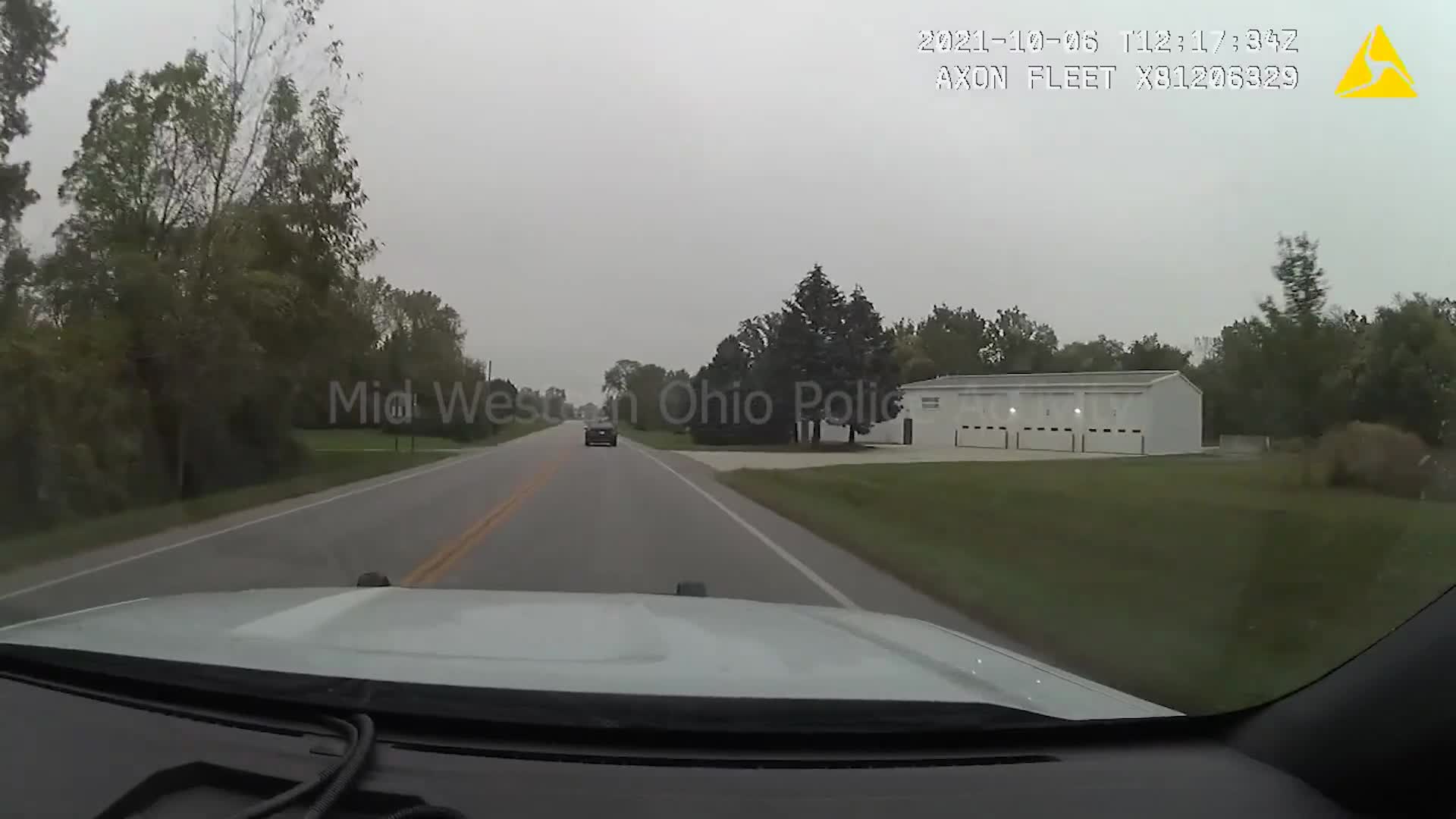
The dashcam footage gives the pursuit a very different feeling from a short written police summary. The road stretches ahead beneath an overcast Ohio sky. Trees, homes, farm properties and roadside buildings pass by as the cruiser maintains contact with the vehicle ahead.
The camera timestamp reads October 6, 2021. At points the recording carries a Mid-Western Ohio Police Videos watermark, but the underlying Axon Fleet overlay remains visible and provides the date and recording system.
The pursuit moved through parts of Auglaize County. Hometown Stations reported that it crossed several county roads before eventually returning to Wapakoneta. That route matters because rural pursuits present a different set of hazards from chases through dense city streets. Speeds can rise on long open stretches, intersections may appear with little warning, and officers may have fewer physical barriers separating the roadway from homes, fields and driveways.
The Pursuit Becomes a Multi-Unit Response
As a chase continues, the officer who first attempts the stop is rarely the only person involved. Dispatchers relay location updates. Deputies move toward likely routes. Units ahead of the pursuit may prepare to assist, while supervisors have to evaluate the changing risk.
The Wilcox footage reflects that expansion. What begins with one patrol vehicle following the suspect becomes a coordinated response involving Wapakoneta police and Auglaize County deputies.
This is one of the reasons pursuit footage can appear deceptively simple. From the dashcam, viewers mostly see the rear of the suspect vehicle and the road ahead. Behind that view, radio traffic is organizing a much larger operation. Every turn changes where assisting officers need to position themselves.
The chase also had real consequences for law-enforcement equipment. Both WHIO and Hometown Stations reported that two sheriff's office cruisers were damaged during the pursuit. WHIO noted that both vehicles were still able to be driven after the incident. The available reporting did not provide enough detail to responsibly claim exactly how each cruiser was damaged, so this article does not speculate beyond that confirmed fact.
A Rural Road Leaves Little Room for Error
Open roads can create the impression that a pursuit is safer because traffic may be lighter. In reality, speed can quickly erase that advantage.
A driver approaching an intersection at high speed has less time to react to cross traffic. A vehicle pulling from a driveway may not realize a pursuit is approaching. Curves, hills and roadside vegetation can limit sight distance. Even a road that appears empty on camera can become dangerous in seconds.
The supplied footage repeatedly shows this environment. The suspect vehicle remains ahead while the cruiser follows along two-lane roads bordered by trees, grass and scattered buildings. The scene is not visually chaotic, yet the tension comes from the fact that every mile gives the pursuit another opportunity to go wrong.
The Chase Returns Toward Wapakoneta
According to the sheriff's office account reported by local media, the pursuit eventually returned to Wapakoneta. That return changed the environment again.
A city introduces more intersections, parked vehicles, pedestrians and cross traffic. Officers have to anticipate not only the fleeing driver's next move but also the actions of people who may have no idea a pursuit is approaching.
The chase ultimately ended at the intersection of Pearl Street and Willipie Street. That location is one of the most important independently reported details because it anchors the end of the footage to a specific place rather than leaving the video as an unidentified police chase.
The Vehicle Finally Stops
Every pursuit has a point at which the central question changes from “Where is the driver going?” to “What will happen when the vehicle stops?”
A stop does not automatically end the danger. Officers may not know whether a suspect is armed, whether anyone else is inside the vehicle or whether the driver intends to run. In Wilcox's case, the earlier allegation involving a gun gave officers an additional reason for caution.
The body-camera portion of the supplied video captures the transition from vehicle pursuit to arrest scene. Officers move quickly around the stopped vehicle and surrounding area. The camera perspective becomes tighter and more unstable than the dashcam because the officer is now outside the cruiser and moving on foot.
This shift is one of the strongest narrative moments in the footage. For most of the chase, the suspect is separated from police by distance and a moving vehicle. At the end, that distance disappears.
Wilcox Is Taken Into Custody
Authorities reported that Wilcox was taken into custody at Pearl Street and Willipie Street in Wapakoneta.
The arrest ended a sequence that had begun with deputies investigating a domestic-violence complaint, expanded with a separate theft report and then turned into a countywide vehicle pursuit.
The fact that officers were able to take Wilcox into custody gave investigators the opportunity to move from an active pursuit back to evidence collection and case preparation. The road could be cleared, damaged cruisers assessed, video preserved and reports completed.
The chase was over, but the legal process was only beginning.
The Preliminary Charges
WHIO reported that Wilcox was booked into the Auglaize County Correctional Center on preliminary charges of fleeing and eluding, tampering with evidence and aggravated menacing.
Hometown Stations likewise reported fleeing and eluding, tampering with evidence and aggravated menacing following the pursuit and domestic-violence investigation.
These were the publicly reported charges at the time of arrest. That wording matters. An arrest charge is not the same as a conviction, and the available contemporary articles used for this story do not establish the complete later court disposition.
Rather than filling that gap with an unrelated record for someone with the same name, the responsible approach is to stop at what can be verified from the incident-specific sources.
A $110,000 Bond
Both local reports stated that Wilcox was being held on a $110,000 bond following the arrest.
Bond figures can become one of the most repeated details in crime reporting because they provide an immediate sense of how the case entered the court system. But a bond amount should not be treated as a measure of guilt. Its purpose is tied to pretrial release conditions and judicial decisions made while a case is pending.
In this incident, the figure helps establish what happened immediately after the pursuit: Wilcox was not simply cited and released. He was booked into the county correctional center and held on a substantial bond while the case proceeded.
Why the Alleged Gun Threat Changes the Context
The allegation that Wilcox threatened a family member with a firearm is central to the background of the pursuit.
For officers, information that a wanted person may have access to a gun can change how they approach a vehicle, how they communicate with one another and how they prepare for the eventual stop. It does not mean every movement by the suspect should automatically be interpreted as armed aggression, but it is operationally relevant information.
That context also explains why the arrest phase deserves as much attention as the driving itself. Officers had to end the pursuit without knowing exactly how the suspect would respond once the vehicle could no longer continue.
The available reports do not say that Wilcox fired at officers during the pursuit, and this article does not imply that he did. The verified allegation concerned the earlier domestic incident.
Two Sheriff’s Cruisers Were Damaged
One of the clearest signs of the pursuit's physical cost is the damage to two Auglaize County Sheriff's Office vehicles.
WHIO reported that both cruisers were damaged but remained drivable after the investigation. Hometown Stations also confirmed that two sheriff's cruisers were damaged during the pursuit.
Police vehicles are designed for emergency operation, but they are still vulnerable to collisions, road debris and mechanical stress. Pursuits also create costs that extend beyond the visible arrest: repairs, inspections, evidence processing and the temporary loss of vehicles from normal patrol service.
No reliable source reviewed for this article reported injuries resulting from that cruiser damage, so no injury claim is added here.
What the Video Adds That the News Reports Cannot
The local articles provide the factual skeleton: the prior allegations, the attempted stop, the pursuit, the arrest location, preliminary charges, bond and cruiser damage.
The video supplies the experience between those facts.
It shows the distance involved. It shows how long a suspect vehicle can remain ahead while officers maintain contact. It shows the change from rural roadway to the final arrest environment. It also shows the difference between dashcam and bodycam perspectives.
Dashcam is comparatively stable. The hood of the patrol vehicle stays at the bottom of the frame while the road unfolds ahead. Bodycam is personal and immediate. Once the officer leaves the cruiser, every movement changes the image.
Together, those perspectives make the pursuit easier to understand without requiring unsupported narration.
Why the Date Overlay Was the Key to Verification
The video filename already contained the name James Wilcox, but a filename alone is not enough to identify an incident. Reposted police footage is frequently renamed, edited or combined with unrelated descriptions.
The Axon overlay provided the stronger clue: October 6, 2021.
Searching that date together with Wilcox and Ohio produced contemporary reporting from WHIO-TV and Hometown Stations. Both stories described the same suspect, the same county, the same morning pursuit and the same arrest.
The footage itself then supplied additional visual consistency with an Ohio county-road pursuit.
This is the type of multi-point match that is needed before adding names and charges to a bodycam story.
The Timeline Is Shorter Than the Consequences
The active pursuit occupied only part of one morning. The events that led to it began earlier, and the legal consequences continued afterward.
That contrast is common in police footage. A dashcam can compress a life-changing sequence into minutes. The suspect makes a decision not to stop. Officers react. Roads and intersections pass rapidly. Then the car is stationary, handcuffs are applied and the pace suddenly slows.
The legal system moves at a very different speed. Reports have to be written. Prosecutors review evidence. Charges may be filed or changed. Hearings follow.
The camera captures urgency; the court process deals with the aftermath.
A Pursuit Built on a Chain of Decisions
The most useful way to understand the Wilcox incident is as a chain rather than a single dramatic event.
Deputies receive a domestic-violence complaint.
Wilcox is accused of threatening a family member with a gun.
While officers look for him, a separate theft is reported.
A Wapakoneta officer locates Wilcox's vehicle.
The officer attempts a stop.
Wilcox does not stop.
The pursuit moves across county roads.
Multiple law-enforcement units become involved.
Two sheriff's cruisers are damaged.
The chase returns to Wapakoneta.
Wilcox is taken into custody at Pearl and Willipie.
Each stage changes what officers have to do next. That natural escalation is more effective at holding a reader's attention than exaggerating any single moment.
The Importance of Separating Allegation From Observation
Police footage encourages viewers to make quick conclusions because they can see part of an event with their own eyes. But cameras do not automatically answer every legal question.
The video can establish that a pursuit occurred. It can show the vehicle's path, officers' movements and the arrest scene.
The news reports establish additional information attributed to investigators: the domestic-violence allegation, the separate theft report, Wilcox's identity, the preliminary charges and bond.
Those categories should remain distinct.
Doing so makes the story more credible and protects against a common problem in online police content: turning an allegation into a proven fact simply because the accompanying footage is dramatic.
Why This Pursuit Works as a Long-Form Story
The footage has a strong retention structure without artificial suspense.
The opening gives the viewer a target vehicle and an immediate question: why are police following it?
The background answers that question but introduces a more serious one: can officers stop a man they were already seeking in connection with two incidents?
The rural pursuit then stretches the uncertainty. The suspect continues moving through the county while more units become involved.
The damaged cruisers raise the cost of the chase.
Finally, the return to Wapakoneta creates a natural climax because the pursuit is moving back into a populated area and toward its eventual endpoint.
The arrest provides closure, while the reported charges and bond explain what happened after the cameras stopped recording.
The End of the Chase
At Pearl Street and Willipie Street, the pursuit finally ended.
Wilcox was taken into custody and booked into the Auglaize County Correctional Center. The two damaged sheriff's vehicles remained drivable. Officers shifted from pursuit tactics to investigation.
For the public, the most visible part of the incident was finished. For the agencies involved, the work continued.
The chase had connected three separate phases of one morning: an investigation, a search and an arrest.
That broader context is what turns the dashcam footage from an isolated pursuit clip into a complete incident narrative.
What Is Confirmed
The most reliable facts come from the overlap between the supplied footage and the two contemporary local reports.
James Wilcox was 25 and was reported as being from Cridersville, Ohio. Auglaize County deputies were investigating a domestic-violence incident in which he was accused of threatening a family member with a gun. A separate theft was then reported, and authorities also considered him a suspect.
Shortly after 8:15 a.m. on October 6, 2021, Wapakoneta police attempted to stop the vehicle Wilcox was driving. He refused to stop and led officers on a pursuit through parts of Auglaize County.
The chase ended in Wapakoneta at Pearl Street and Willipie Street, where he was arrested.
He was booked on preliminary charges of fleeing and eluding, tampering with evidence and aggravated menacing, and local outlets reported a $110,000 bond.
Two sheriff's office cruisers were damaged during the pursuit but remained operable.
The Moment the Sirens Stop
The final minutes of any pursuit often feel strangely quiet compared with what came before.
A moving target becomes a parked vehicle. Radio updates slow. Officers who were separated by miles converge on one location. The road that had been the center of the incident begins returning to normal.
For Wilcox, the stop meant the end of the escape attempt and the beginning of detention.
For investigators, it meant they could finally address the allegations that had prompted the search in the first place.
The supplied video preserves that transition in a way a brief article cannot. It lets viewers see how an incident that began with officers looking for one person grew into a multi-agency pursuit and then collapsed back into a single arrest scene.
Watch the Full Pursuit
The written record establishes the verified facts, but the complete dashcam and bodycam footage shows how the pursuit actually unfolded across Auglaize County, how officers maintained contact over rural roads, and how the chase ultimately ended in Wapakoneta.
Sources and Verification
This article was cross-checked against contemporaneous reporting by WHIO-TV 7 and Hometown Stations, both published October 6, 2021 and based on information from Auglaize County law enforcement. The supplied video independently displays an October 6, 2021 Axon timestamp and matches the reported pursuit. The two images embedded here are real frames extracted from the supplied video; no AI-generated images are used.
Comments (0)
Loading comments...
May You Like
Four Suspects Try Killing a Cop After Police Chase

🚨⛽ Man Caught in a Disturbing Incident at a Gas Station | Police Respond US