
[DASHCAM] 110 MPH Interstate Motorcycle Chase Ends in Fall and Surrender by Police
Arkansas Motorcycle Pursuit Reaches Triple-Digit Speeds Before Rider Goes Down and Surrenders
A Nighttime Interstate Stop Turns Into a Fast-Moving Pursuit
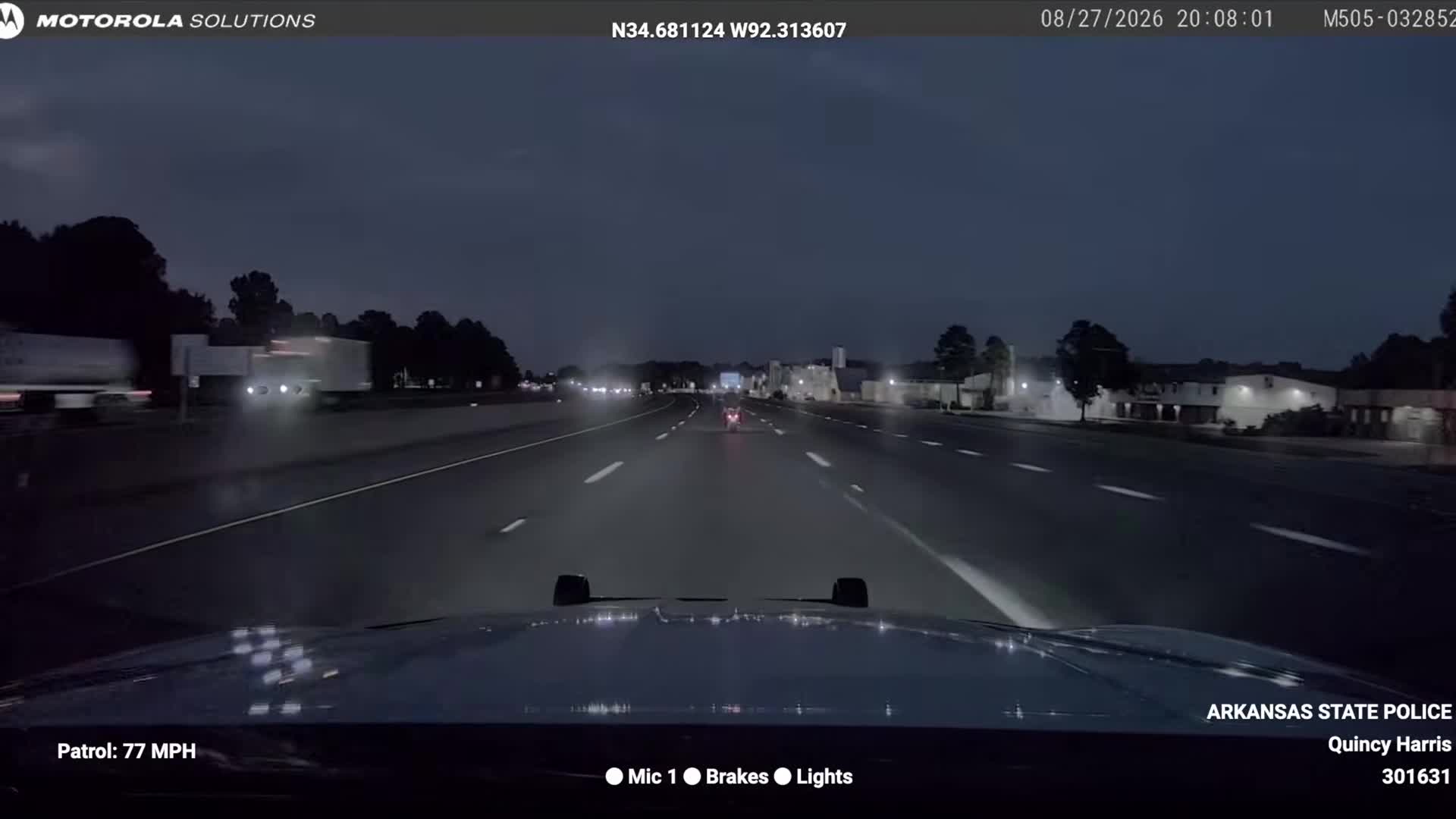
The dash-camera video begins on the evening of August 27, 2026, with an Arkansas State Police cruiser traveling through the Little Rock area. The overlay identifies the trooper as Quincy Harris and provides something especially useful for verification: a live date, time, GPS coordinates and patrol speed.
Ahead is a motorcycle. What might have ended as an ordinary traffic stop instead develops into a pursuit that rapidly moves into triple-digit speeds.
The footage is unusually informative because the Motorola Solutions overlay records the patrol car's speed throughout the chase. At one point the cruiser display reaches 120 mph. The motorcycle remains ahead as traffic, interstate geometry and darkness turn every second into a risk calculation.
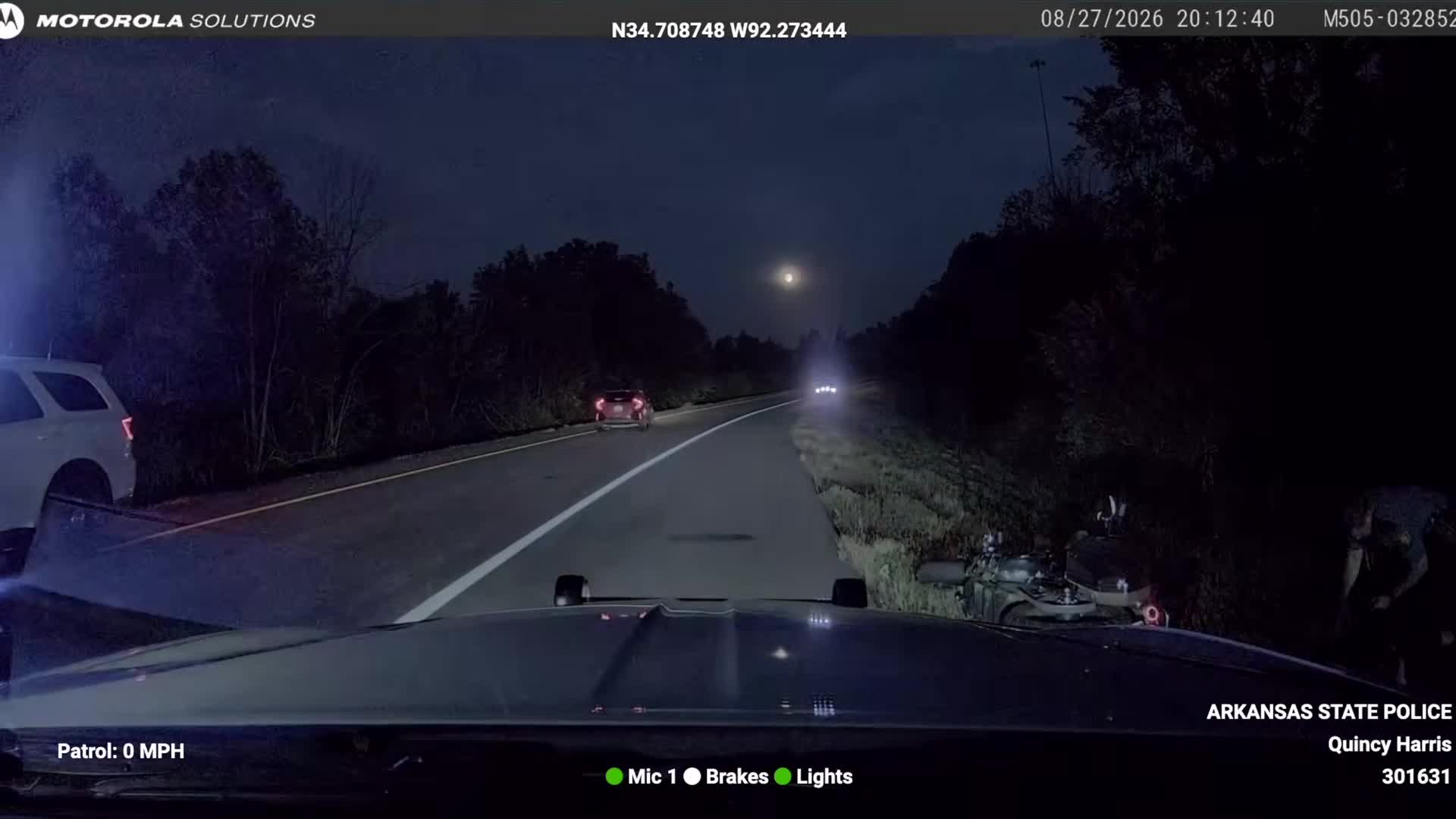
The pursuit eventually leaves the faster interstate environment. Later footage places the trooper near coordinates around 34.7087, -92.2734, south of central Little Rock. By then the motorcycle is down beside the roadway and the rider is no longer fleeing.
The rider ultimately surrenders and is taken into custody.
Public web searches conducted for this article did not locate a reliable Arkansas State Police release, local-news report or court filing that independently identifies the rider or lists the exact charges from this August 27 incident. Because the video is recent, that material may not yet be indexed publicly. This article therefore does not invent a name, criminal history, reason for fleeing or final charges.
What can be documented is compelling enough: an ASP pursuit through the Little Rock area, a motorcycle traveling at very high speed, Trooper Quincy Harris following, a crash or fall near the end of the pursuit, and a surrender captured on police video.
The Dashcam Gives the Case a Precise Date and Location
The strongest evidence comes directly from the recording.
The overlay reads August 27, 2026. Early in the pursuit the coordinates are approximately 34.6811 north and 92.3136 west, placing the cruiser in the Little Rock area. Later, the coordinates move east and north as the pursuit develops.
The lower-right corner identifies Arkansas State Police and Quincy Harris.
Those details make the footage much easier to authenticate than a generic chase compilation with no date or officer information.
Arkansas Department of Public Safety records also independently establish that Quincy E. Harris joined the Arkansas State Police Highway Patrol Division and was assigned to Troop A in Pulaski County. That assignment is consistent with the Little Rock-area location visible in the video.
The Speed Display Changes the Way the Footage Feels
Watching a motorcycle disappear into the darkness can make speed difficult to judge.
The patrol-speed display removes much of that ambiguity.
At different moments the cruiser is traveling well above ordinary highway speed, and one frame records 120 mph.
That does not automatically mean the motorcycle is traveling at exactly the same speed at every instant. The distance between vehicles changes and the trooper may accelerate to close a gap.
But it confirms that this is a genuine high-speed pursuit, not a dramatic title attached to an ordinary traffic stop.
At Triple-Digit Speeds, Distance Disappears Quickly
At 110 mph, a vehicle covers more than 160 feet every second.
At 120 mph, it travels roughly 176 feet per second.
That means a driver has only a tiny window to react to a lane change, debris, a disabled vehicle or another motorist entering the roadway.
Motorcycles add another layer of vulnerability because the rider has no passenger compartment, seat belt or surrounding structure.
A mistake that produces body damage on a car can throw a rider directly onto pavement.
The Interstate Is Open, but It Is Not Empty
The early portion of the pursuit shows multiple lanes and other motorists.
The roadway may look relatively clear compared with daytime Little Rock traffic, but the rider and trooper still have to negotiate vehicles moving at normal highway speeds.
Closing speed becomes critical.
A driver traveling 70 mph may check a mirror, see distant headlights and begin changing lanes without realizing that a pursuing vehicle is approaching at far greater speed.
That is why high-speed pursuits create danger beyond the fleeing driver and police officer.
The Motorcycle's Size Creates Both Advantages and Risks
A motorcycle can accelerate quickly and fit through spaces that a patrol car cannot safely use.
That can tempt a rider to believe escape is possible.
But the same small contact patch and exposed riding position make sudden maneuvers unforgiving.
Road seams, gravel, wet leaves, uneven shoulders and abrupt braking all matter more when stability depends on two wheels.
Darkness further reduces the rider's ability to see those hazards early.
Trooper Quincy Harris Remains in the Pursuit
The video identifies the pursuing officer as Quincy Harris.
Arkansas Department of Public Safety records show Harris was among a class of new troopers assigned to Highway Patrol in 2019 and that he was sent to Troop A, Pulaski County.
The footage therefore matches his documented patrol region.
During the chase, the cruiser remains behind the motorcycle as the route changes from the broader interstate environment toward a narrower roadway.
The recording does not show viewers every radio transmission clearly enough to reconstruct command decisions, so this article avoids guessing about supervisory instructions.
Arkansas State Police Has a Distinct Pursuit Culture
Arkansas State Police pursuit tactics have received extensive public attention in recent years.
The agency refers to the PIT-style maneuver used to intentionally redirect fleeing vehicles as a Tactical Vehicle Intervention, or TVI.
ASP has publicly defended the use of pursuit-ending tactics when fleeing drivers create danger for the public. In a 2024 release concerning a stolen Mustang, Colonel Mike Hagar said fleeing is reckless and emphasized that troopers will act to stop drivers who endanger other motorists.
That broader policy context matters, but this motorcycle video should not automatically be treated as a TVI case.
The visible ending shows the motorcycle down near the roadside. The footage available here does not establish that Harris intentionally struck the motorcycle to cause the fall.
The Chase Moves Away From the Interstate
As the pursuit progresses, the surroundings change.
The multilane highway gives way to a darker and narrower road bordered by trees.
Street lighting becomes limited.
The moon is visible above the tree line in later frames.
The environment now gives the rider fewer lanes and fewer escape options, but it also makes a crash more dangerous.
There is less paved recovery space and less room for a patrol car to maneuver around a fallen rider.
The Ending Happens Quickly
By approximately 8:10 p.m. on the dashcam clock, the motorcycle is visible down near the right side of the roadway.
The patrol car stops.
The high-speed phase is over.
This transition is striking because the preceding minutes are defined by motion and engine speed. Suddenly the scene becomes almost still.
The motorcycle lies near the shoulder while emergency lighting illuminates the road.
The rider does not continue running.
A Fall Changes the Entire Risk Calculation
Once a motorcycle is down, officers have several immediate concerns.
The rider may be injured.
The motorcycle can leak fluids.
Traffic may continue approaching the scene.
The rider may still attempt to flee on foot or resist arrest.
And officers do not automatically know whether the person is armed.
That is why commands and positioning after a crash can look cautious even when the chase itself has ended.
The Rider Surrenders
The supplied video ends with the rider giving up rather than attempting another escape.
That surrender matters.
A foot pursuit on a dark roadside could have created another dangerous phase.
Instead, the encounter transitions into custody.
The footage does not provide enough verified information to state whether the rider was transported for medical evaluation, booked immediately, or cited for particular offenses.
Those details require the incident report or court record.
Why the Rider's Identity Is Not Included Here
Recent police footage often reaches YouTube before court databases, agency press releases and local news archives have fully indexed the underlying case.
That appears to be the situation here.
Searches combining the date, Arkansas State Police, Quincy Harris, motorcycle, Little Rock and the pursuit speed did not return a trustworthy exact-match report identifying the rider.
A similar Arkansas motorcycle pursuit from another date would not be a safe substitute.
The correct choice is to leave the rider unnamed until a source explicitly connects a name to the August 27, 2026 incident.
The Same Rule Applies to Charges
It would be easy to assume charges such as felony fleeing, reckless driving, speeding, no insurance or registration violations.
Arkansas motorcycle pursuits often produce combinations of those allegations.
But an assumption is not a charging document.
Without the exact report, this article describes the conduct visible in the video and does not present a speculative charge list as fact.
Fleeing in Arkansas Has Become a Major Policy Issue
Arkansas lawmakers and police officials have spent considerable time discussing vehicle pursuits.
Minutes from an Arkansas State Police Commission meeting show agency officials discussing pursuit frequency and TVIs, with ASP emphasizing that the fleeing driver initiates the dangerous situation.
That perspective is central to how the agency publicly frames pursuits: troopers are responding to a driver who refuses to stop.
Critics of high-speed pursuits, meanwhile, focus on the additional risk created when police vehicles also travel at extreme speeds.
Both concerns become visible in footage like this one.
A Motorcycle Pursuit Raises Different Tactical Questions
Stopping a car and stopping a motorcycle are not identical problems.
A standard TVI maneuver involves intentional contact designed to rotate a fleeing vehicle.
Applying force to a motorcycle can have far more severe consequences because the rider is exposed.
Older federal litigation involving Arkansas State Police has discussed the distinction between low-speed contact with a motorcycle and a formal PIT maneuver, illustrating how important the exact circumstances of contact can be.
In the August 27 footage, the safest factual description is simply that the motorcycle goes down and the rider surrenders. The video does not justify claiming a deliberate PIT unless the full incident report says so.
Why the 120 MPH Frame Matters
One frame from the chase is especially revealing.
The patrol display reads 120 MPH.
The motorcycle's taillight remains visible in the distance.
There are still other vehicles on the roadway.
That single image explains the danger more effectively than any dramatic adjective.
At that speed, the patrol car is covering nearly the length of a football field every two seconds.
The GPS Overlay Provides an Unusual Verification Tool
Modern police video systems can preserve more than pictures and sound.
This recording includes GPS coordinates.
That allows the route to be placed geographically without relying entirely on signs that may flash past too quickly to read.
The coordinates shown near the end, around 34.7087 north and 92.2734 west, are in the Little Rock area.
Combined with Harris's documented Troop A assignment, the geographic evidence strongly supports the Arkansas identification.
The Night Setting Increases Uncertainty
Night driving compresses what a driver can see.
Headlights illuminate only a limited distance.
Dark vehicles, wildlife and roadside debris can appear late.
A motorcycle rider traveling at triple-digit speed can outrun the practical safety margin provided by the headlight beam.
The trooper faces a similar problem while trying to follow the motorcycle and monitor radio traffic at the same time.
The Video Does Not Explain Why the Rider Ran
Perhaps the biggest unanswered question is motive.
Why not stop?
The footage itself does not answer.
There may have been a licensing issue, a registration problem, an outstanding warrant, fear of a ticket, or something else entirely.
Until a report establishes the reason, choosing one would be storytelling rather than reporting.
That uncertainty actually strengthens the narrative.
A decision made in seconds transforms a traffic encounter into a dangerous chase, yet the reason behind that decision remains unknown.
The Pursuit's Real Drama Comes From Escalation
The most effective way to tell this story is not to begin with the crash.
It is to show how quickly the stakes increase.
First there is a motorcycle on an interstate.
Then the distance begins changing.
The patrol speed rises.
Traffic appears ahead.
The chase reaches triple digits.
The route narrows.
Finally the motorcycle is on the ground.
That escalation keeps the reader engaged because each stage changes the risk.
What Is Independently Verified
Several details can be stated with confidence.
The footage is dated August 27, 2026.
It is marked Arkansas State Police.
The dashcam identifies Quincy Harris.
GPS data places the pursuit in the Little Rock area.
The patrol vehicle reaches at least 120 mph during the recorded chase.
The motorcycle later ends up down beside the road.
The rider remains at the scene and surrenders.
Arkansas Department of Public Safety records independently confirm Quincy Harris as an ASP trooper assigned to Troop A in Pulaski County.
What Remains Unverified
The rider's name remains unverified.
The exact reason for the attempted stop remains unverified from the sources located.
The complete charge list is not independently confirmed.
The exact motorcycle model is not established strongly enough from the night footage to state as fact.
The precise cause of the fall is also not conclusively established by the selected frames.
And no final court outcome can responsibly be reported so soon after the incident without a matching case record.
Why That Distinction Improves the Article
Crime stories lose credibility when every blank space is filled with a confident answer.
Bodycam and dashcam footage can establish a great deal, but it cannot automatically provide the legal history that follows an arrest.
Separating visible facts from later allegations protects the accuracy of the story.
It also gives readers a clearer understanding of what they are actually watching.
The Broader Arkansas Pursuit Debate
Arkansas State Police's use of high-speed pursuits and TVIs has attracted scrutiny from journalists and lawmakers.
Reporting by KHBS has examined fatal outcomes associated with pursuit-ending maneuvers and noted that ASP policy evaluates the objective reasonableness of force based on the totality of circumstances.
ASP, for its part, has repeatedly argued that fleeing drivers create immediate danger and that troopers must sometimes intervene to stop them.
This motorcycle chase sits inside that larger debate even though the visible footage does not establish a TVI.
The central policy question remains familiar: when a person refuses to stop, how should police balance immediate apprehension against the danger of continuing the chase?
The Roadside Ending Is Almost Anti-Climactic
After minutes of speed, the final scene is quiet.
The motorcycle is no longer moving.
The patrol car is stopped.
Other vehicles pass.
The rider's attempt to get away has ended.
There is no second high-speed escape and no prolonged standoff visible in the footage.
That contrast gives the video its strongest ending.
The chase that briefly reaches extraordinary speed concludes on an ordinary dark roadside.
A Traffic Stop Can Become a Life-or-Death Decision in Seconds
The lasting lesson is not that motorcycles are fast. Everyone already knows that.
It is how quickly a refusal to stop can multiply risk.
The rider faces the possibility of a catastrophic fall.
The trooper has to drive at speeds where reaction time is measured in fractions of a second.
Uninvolved motorists can become part of the incident without choosing to be.
Whatever prompted the rider to flee, the chase created consequences far greater than the original traffic encounter visible at the beginning.
Watch the Full Pursuit
The complete Arkansas State Police dashcam footage shows the progression from interstate pursuit to triple-digit speed, the transition onto darker roads and the moment the motorcycle ends up down near the shoulder before the rider surrenders.
It is a strong example of why police pursuit footage should be watched in sequence rather than reduced to its final crash.
The most important part is the escalation that comes before it.
Click here to watch the full incident unfold.
Comments (0)
Loading comments...
May You Like

Woman Tries to Stop Police From Arresting “Brother” — He Denies Knowing Her

Stolen Charger Flees Police During Highway Traffic Stop

Traffic Stop Turns Deadly After Man Steps Out of Stolen Car













