
Cops Give Entitled Driver a Fast Reality Check
A Street-Side Dispute Turns Into a Much Bigger Police Encounter
Some police encounters become complicated because of what officers discover. Others become complicated because of what happens after the first few words are exchanged. The body-camera footage in this case falls into the second category. What appears at first to be a straightforward vehicle-related encounter on a residential street develops into a long, tense confrontation in which the driver's choices, the officers' instructions, and the question of who controls the scene become more important than the ordinary setting around them.
The footage carries an AXON timestamp of April 9, 2024, shortly after 5 p.m. The scene is unmistakably urban and residential: closely spaced homes, parked vehicles, one-way signage, overhead utility lines, and regular traffic continuing through the intersection. A black Honda Civic with New Jersey plates becomes the center of attention. A man in a bright red shirt is outside the vehicle as officers approach and begin trying to sort out what has happened.
From there, the encounter becomes a study in escalation. The driver appears convinced that he can explain, challenge, or argue his way through the situation. The officers, meanwhile, repeatedly attempt to establish control and move the interaction toward a clear resolution. The result is a confrontation that lasts far longer than the opening moments suggest it should.
That slow escalation is exactly what makes the footage worth examining. There is no need to exaggerate it. The tension comes from watching a relatively ordinary situation change one decision at a time. A question leads to another instruction. An instruction produces an argument. The argument creates delay. The delay increases police attention. Eventually, the encounter no longer resembles the simple street-side interaction viewers saw at the beginning.
An Ordinary Residential Street Becomes the Center of Attention
The first striking feature of the footage is how normal everything looks. There is no closed highway, major crash scene, or large police perimeter. Vehicles continue along the road. Houses sit only a few yards from the interaction. The Honda Civic is stopped close to an intersection, and the driver is already outside or moving around the vehicle during the early stage of the encounter.
That matters because police officers approaching a vehicle-related call have to establish basic facts quickly. Who was driving? Why is the vehicle stopped here? Is everyone involved staying at the scene? Is there an immediate safety issue? Does the driver have valid documentation? Is the vehicle legally operable? The answers determine whether the contact remains brief or develops into something more serious.
The footage shows the officer trying to move through that process while the driver repeatedly engages him in conversation. The driver does not appear eager to simply stand back and allow the investigation to proceed. Instead, he challenges aspects of what is happening and continues interacting even as the officer attempts to give directions.
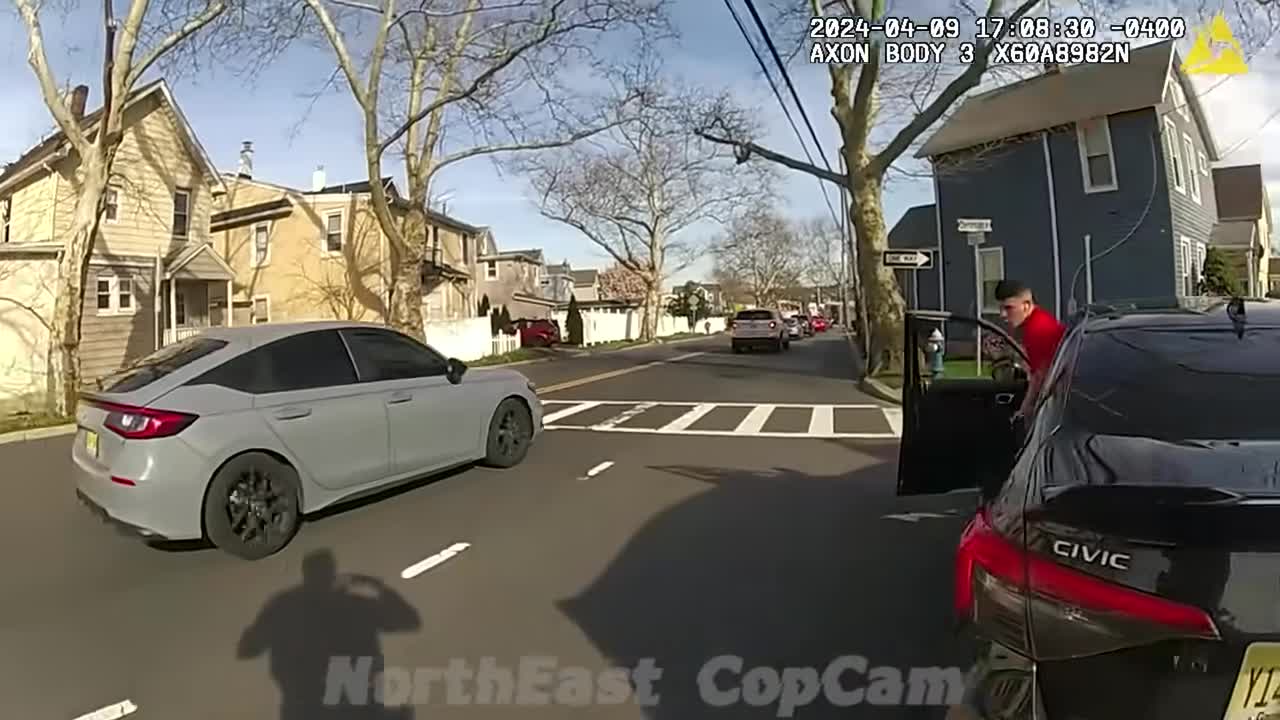
In a normal conversation, arguing a point may be harmless. During a traffic detention or roadside investigation, however, constant interruption can create practical problems. Officers are watching hands, traffic, nearby people, vehicle movement, and the physical distance between themselves and the person they are dealing with. A driver who unexpectedly changes position or approaches an officer can force that officer to stop gathering information and focus instead on maintaining distance and control.
This is one reason traffic-stop footage can be misleading when reduced to a few seconds on social media. A short clip may show an officer suddenly giving a firm command without showing the previous minutes in which softer instructions were repeated. Full footage provides the sequence. It allows viewers to judge whether escalation was immediate or gradual.
Here, the escalation is gradual. The driver's demeanor and continued resistance to the direction of the encounter keep drawing attention away from whatever initially brought police to the vehicle. The more time passes, the less important the original issue seems compared with the driver's willingness to follow instructions.
When Conversation Stops Moving the Situation Forward
Police officers do not need motorists to agree with them. They do, however, need a workable environment in which they can perform lawful duties. That distinction is central to understanding the footage.
A person can question why an officer stopped them. A driver can disagree with a citation. A citizen can ask for an officer's name or badge number, document an encounter, and later challenge police action through court proceedings or a formal complaint. None of those actions automatically turns a disagreement into a crime. But the practical line becomes more important when disagreement changes into conduct that prevents officers from completing the task in front of them.
The man in the red shirt repeatedly places himself at the center of the interaction. His frustration is visible in his movements and posture. The officer's responses become increasingly direct. The encounter begins to revolve around basic commands rather than explanation.
This is a familiar pattern in body-camera footage. A person may believe that continuing to argue will eventually force an officer to reconsider. In reality, roadside encounters rarely operate that way. An officer who believes there is a lawful basis for a stop or detention will normally complete the process and allow any dispute over legality to be resolved later. The roadside is not a courtroom, and neither the driver nor the officer has the final legal word simply because one of them speaks more forcefully.
The most productive option for a driver is often to preserve the disagreement rather than physically prolong it: ask the reason for the stop, comply with lawful safety instructions, avoid making unnecessary statements, keep a record if permitted, and contest any citation or arrest through the legal system afterward. That approach does not require agreeing with the officer. It simply separates immediate compliance from later legal challenge.
The Driver's Movements Begin to Matter as Much as His Words
As the footage continues, physical positioning becomes increasingly important. Officers repeatedly monitor where the driver is standing and how close he is to them. This may appear trivial to viewers watching safely from a screen, but distance is a major element of police encounters.
An officer cannot know with certainty whether an angry person moving closer intends only to continue arguing or is preparing to interfere physically. That uncertainty is why officers frequently use commands about where someone should stand, whether they should remain inside or outside a vehicle, and whether they should keep their hands visible.
The driver appears unwilling to let the officer control that space without challenge. His behavior keeps the encounter active. Instead of the officer being able to step away, check information, write paperwork, or consult another officer, attention repeatedly returns to the driver's actions.
That change is subtle but crucial. The original incident may have been vehicle-related, but once officers must devote significant attention to managing a person's movements, the nature of the encounter changes. What could have remained administrative becomes an officer-safety problem.
There is also a psychological element. People under stress often interpret repeated commands as disrespect, while officers may interpret repeated noncompliance as a sign that stronger intervention will soon be necessary. Both sides can therefore experience the same interaction in very different ways. Body-camera footage gives viewers an unusual opportunity to see that feedback loop forming in real time.
Why Attitude Alone Is Not the Legal Issue
The title attached to the supplied video characterizes the driver as “entitled.” That is a common style of headline for police-footage channels because it quickly communicates conflict. But it is important to separate a provocative title from legal analysis.
Being rude to a police officer is not, by itself, the same thing as committing a crime. A person does not lose constitutional protections because they are sarcastic, angry, insulting, or difficult. American courts have long recognized substantial protection for verbal criticism of government officials, including police officers.
What can create legal consequences is conduct. If a person physically interferes with an officer, refuses a lawful order under circumstances in which compliance is legally required, attempts to leave a lawful detention, or otherwise obstructs official duties, the analysis changes. The precise law depends on the jurisdiction and facts.
This distinction is important because it prevents viewers from treating body-camera videos as morality plays. Police do not have lawful authority simply because a motorist is unpleasant. Likewise, a motorist does not gain immunity from lawful police action simply because the original issue seems minor.
The correct question is not whether the driver has a “bad attitude.” It is what he actually does, what the officers actually instruct him to do, why those instructions are being given, and what happens when he does not follow them.
That evidence-based approach also makes the story more compelling. Instead of deciding immediately who is right, viewers can follow the interaction and watch the legal stakes change with each decision.
The Presence of More Officers Signals a Change
As the encounter continues, additional police resources become visible. A marked police vehicle is positioned near the Honda, and the scene has clearly become more structured than it was during the first contact.
To a driver, the arrival of additional officers can feel disproportionate. If the person believes the original issue is minor, seeing more uniforms and vehicles may reinforce the belief that police are overreacting. But additional officers are often responding not merely to the initial reason for contact but to information being relayed about how the encounter is developing.
This difference is easy to miss in edited clips. A viewer may see three officers around one motorist and assume three officers were dispatched for a minor traffic issue. The full timeline may instead show that one officer initiated the contact and requested assistance only after the driver's behavior made the situation harder to manage.
The footage here demonstrates why context matters. By the later stage, the encounter is no longer simply an officer asking a driver a few questions. Police are controlling a scene, the Honda remains in place, and the driver's freedom of movement has clearly narrowed.
The Moment the Encounter Crosses a Threshold
Every escalating police encounter has a threshold at which the possibility of arrest or detention becomes visibly real. Before that point, the person may still believe the situation can be talked away. After it, the officer's priorities change.
The supplied footage reaches that threshold when officers move from repeated verbal management to physical control. The camera becomes close and unstable during portions of the contact, a common feature of body-camera recordings when officers are using their hands rather than simply standing and talking.
That visual change is significant. A body camera worn on the torso does not provide a cinematic view. When an officer moves quickly, reaches forward, turns, or struggles with another person, the camera can be partially blocked by arms, clothing, or the other person's body. Audio often becomes more useful than the image during those moments.
This limitation is another reason to be cautious about drawing conclusions from individual screenshots. One frame can look dramatic without revealing what happened immediately before or after it. The full sequence is the evidence that matters.
Once officers physically control the driver, the encounter enters a different phase. The questions are no longer primarily about whether he will voluntarily follow instructions. Officers now have to secure him, determine what happens to the vehicle, communicate with dispatch or other personnel, and document the event.
The Honda Civic Becomes Part of the Aftermath
Later footage shows the black Honda Civic still at the scene alongside a marked police vehicle. The driver's door is open, and the vehicle is no longer simply transportation. It has become part of the police investigation and scene management.
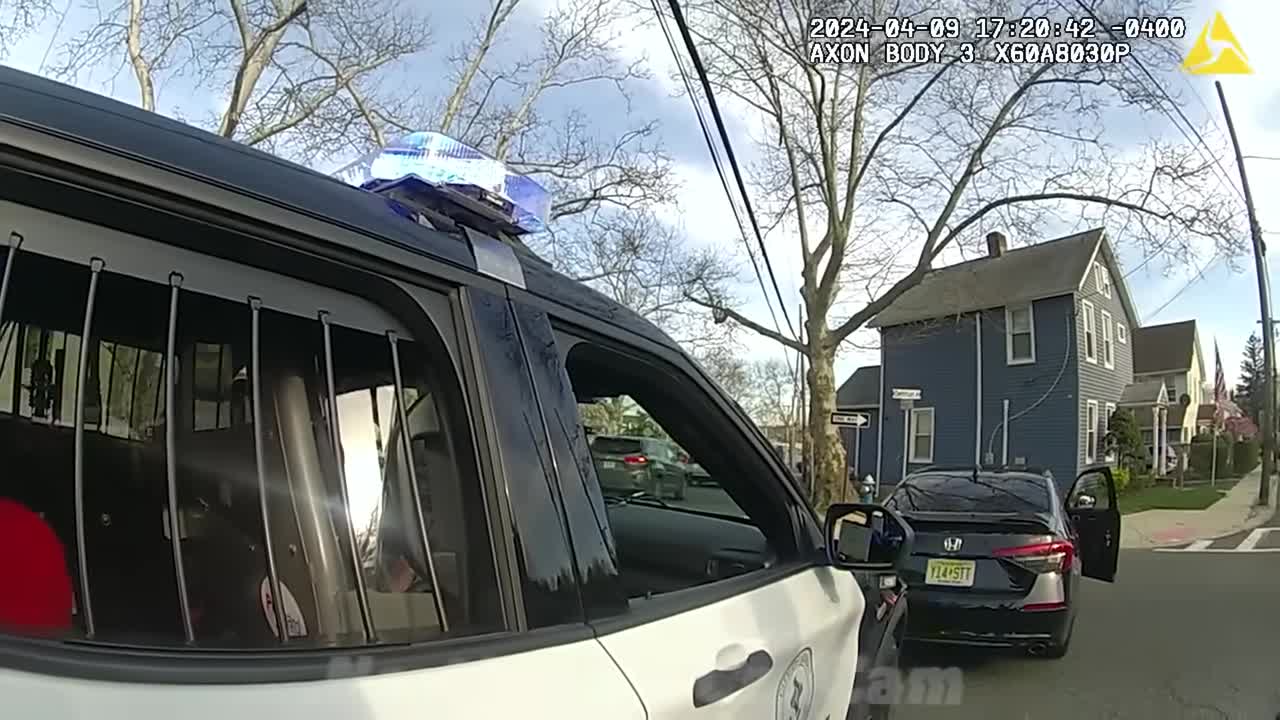
Whenever a driver is detained or arrested, officers may need to decide whether a vehicle can remain where it is, whether another authorized driver can take possession of it, or whether it must be towed. The rules governing towing and inventory procedures vary by department and jurisdiction, and the presence of an arrest does not automatically justify every possible vehicle search. Those questions depend on specific legal authority and department policy.
What the footage makes clear is that the car remains central to the aftermath. The street is still active, other vehicles continue passing, and officers must resolve both the human side of the encounter and the practical problem of the stopped vehicle.
This is another example of how a driver's decisions can increase the scale of an otherwise routine incident. A citation or warning may take minutes. An arrest can require transport, reports, vehicle disposition, evidence handling, supervisor review, and potentially court proceedings. The consequences extend far beyond the moment captured on camera.
What Can Be Verified and What Remains Unconfirmed
Responsible reporting requires acknowledging the limits of available evidence. The body-camera overlay provides a date and time of April 9, 2024, in the late afternoon. The vehicle displays New Jersey registration. The supplied footage clearly documents a prolonged police interaction involving the driver of a black Honda Civic on a residential street.
However, research did not produce a reliable local-news article or official police release that could be confidently matched to this exact footage. Searches around the visible date, vehicle, state, and the title used by the footage publisher returned unrelated incidents. For that reason, this article does not invent the driver's name, the exact municipality, a list of criminal charges, or a final court outcome.
That limitation is important. Body-camera channels frequently obtain footage through public-records requests and then publish it months or years later under newly written titles. The upload title may be useful for discovery, but it is not the same as an official incident report. Without a reliable match to police or court records, adding names and charges would create certainty that the available evidence does not support.
The two images in this article therefore come directly from the supplied video. No AI imagery has been used, and no unrelated news photograph has been presented as if it belonged to this incident.
Why the Encounter Holds the Viewer's Attention
The strongest police-footage stories often follow a simple retention pattern: ordinary beginning, unresolved question, escalating obstacle, turning point, and consequence. This video naturally contains all five.
The ordinary beginning is the residential street and stopped Honda. The unresolved question is why the interaction is becoming so difficult. The obstacle is the repeated conflict between the driver's behavior and the officers' attempts to control the encounter. The turning point comes when verbal instructions are no longer enough. The consequence is the later police response and management of the driver and vehicle.
For a blog, preserving that sequence is more effective than revealing everything in the first paragraph. Readers stay engaged because each section answers one question while opening another. Why are police focused on this driver? Why does the conversation continue? Why are more officers involved? At what point does the driver's behavior change the likely outcome?
This approach also avoids exaggeration. The story does not need invented danger or unsupported accusations. The real tension is procedural: watching a person repeatedly test the boundaries of an encounter and seeing those boundaries become progressively firmer.
A Short Encounter That Became Much Harder Than It Needed to Be
The footage ultimately illustrates a simple principle: a roadside disagreement and a legal challenge are not the same thing. A driver can disagree with police and still preserve every available legal argument by complying with lawful instructions and contesting the matter afterward.
Trying to win the dispute in the street can produce the opposite result. The original issue may become secondary. Officers begin documenting new conduct. Additional personnel may arrive. The person's movements become restricted. A situation that could have ended with paperwork can instead end with detention and a much larger record of events.
For officers, the footage also underscores the value of patience and specificity. Repeated commands are most defensible when they are clear, consistent, and connected to a legitimate investigative or safety purpose. Body cameras preserve not only a citizen's conduct but also the officer's words, tone, timing, and decision-making.
That is why these recordings are valuable beyond entertainment. They allow the public to examine escalation as a process rather than a headline. Viewers can see that the final outcome is usually built from a chain of smaller moments.
In this case, a man, a Honda Civic, and a residential intersection become the setting for a confrontation that grows far beyond its opening minutes. The footage does not need a dramatic narrator to make the point. The sequence itself does the work.
Watch the Full Encounter
A short excerpt cannot show how many times instructions were given, how the driver's behavior changed, or why officers eventually shifted from conversation to physical control. The complete footage provides the context needed to understand how the encounter developed from beginning to end.
Comments (0)
Loading comments...
May You Like

A Suspicious Vehicle Leads Officers Into an Unexpected Chase

Couple Arrested for leaving 10 Dogs and Cats in Hot car in Florida

Cop thinks sandwich is phone












