
Cop Runs Over Armed Man on a Bicycle
Florida Deputy Uses Patrol Vehicle to Stop Armed Bicyclist After Gun Appears During Chase
Just before midnight on January 4, 2025, a Flagler County sheriff's deputy was patrolling the W-Section of Palm Coast, Florida, when he noticed a man beside a bicycle on Pine Lakes Parkway. There was no high-speed car chase, no major crash and no large police response at the beginning. It was simply a deputy approaching a man standing on a sidewalk late at night.
Within moments, however, that ordinary-looking encounter became a pursuit. The man got onto his bicycle and rode away. He briefly appeared to comply when the deputy activated emergency lights, then accelerated away again and turned onto Westminster Drive. The deputy followed in his patrol vehicle.
Then came the moment that changed the entire encounter. According to the Flagler County Sheriff's Office, Deputy Christopher Murphy saw the bicyclist reach into his pants and pull out a firearm. Murphy later said he feared the man was about to use it against him. Instead of waiting to see what happened next, the deputy used the patrol vehicle to strike the bicycle, throwing the rider off and causing the gun to fall away.
The man was identified as 38-year-old Michael McDermott. Deputies recovered a 9-millimeter Ruger handgun near him and said he was wearing a holster. McDermott suffered a minor ankle injury, was treated at AdventHealth Palm Coast Parkway and was then taken to the Sheriff Perry Hall Inmate Detention Facility.
The supplied video, titled “Cop Runs Over Armed Man on a Bicycle,” matches the official Flagler County Sheriff's Office account and contemporary local reporting. Its Axon body-camera timestamp shows January 4, 2025, just before midnight. The footage also captures the aftermath from an officer's body camera, including McDermott on the ground, the bicycle nearby, officers securing the scene and the recovered weapon.
This is a case where the official record matters. A short viral clip could easily be reduced to the image of a police vehicle striking a cyclist. The full sequence provides the missing context: the deputy had already attempted to stop the rider, the rider fled, and the sheriff's office says the deputy saw him produce a firearm during the pursuit.
A Late-Night Patrol on Pine Lakes Parkway
Deputy Christopher Murphy was conducting routine patrols in Palm Coast's W-Section when he saw McDermott along Pine Lakes Parkway. According to the sheriff's office, the bicycle was on the ground beside him.
Murphy attempted to make contact. McDermott responded by picking up the bicycle and riding away.
At this stage, there had been no vehicle strike. Murphy activated his emergency lights and attempted to conduct a traffic stop on the bicyclist.
The official release says McDermott appeared to comply. He slowed enough for Murphy to stop the patrol vehicle and get out.
Then McDermott pedaled away again.
The Second Escape Changes the Tone
McDermott turned onto Westminster Drive while Murphy returned to the patrol vehicle and followed.
A bicycle pursuit creates a very different tactical problem from a conventional vehicle chase. The bicyclist is slower than a patrol car but much more maneuverable. He can move onto sidewalks, between obstacles or into areas inaccessible to a full-size vehicle.
At night, visibility adds another problem. The deputy must watch the rider, the roadway and the surrounding environment while also anticipating a sudden turn.
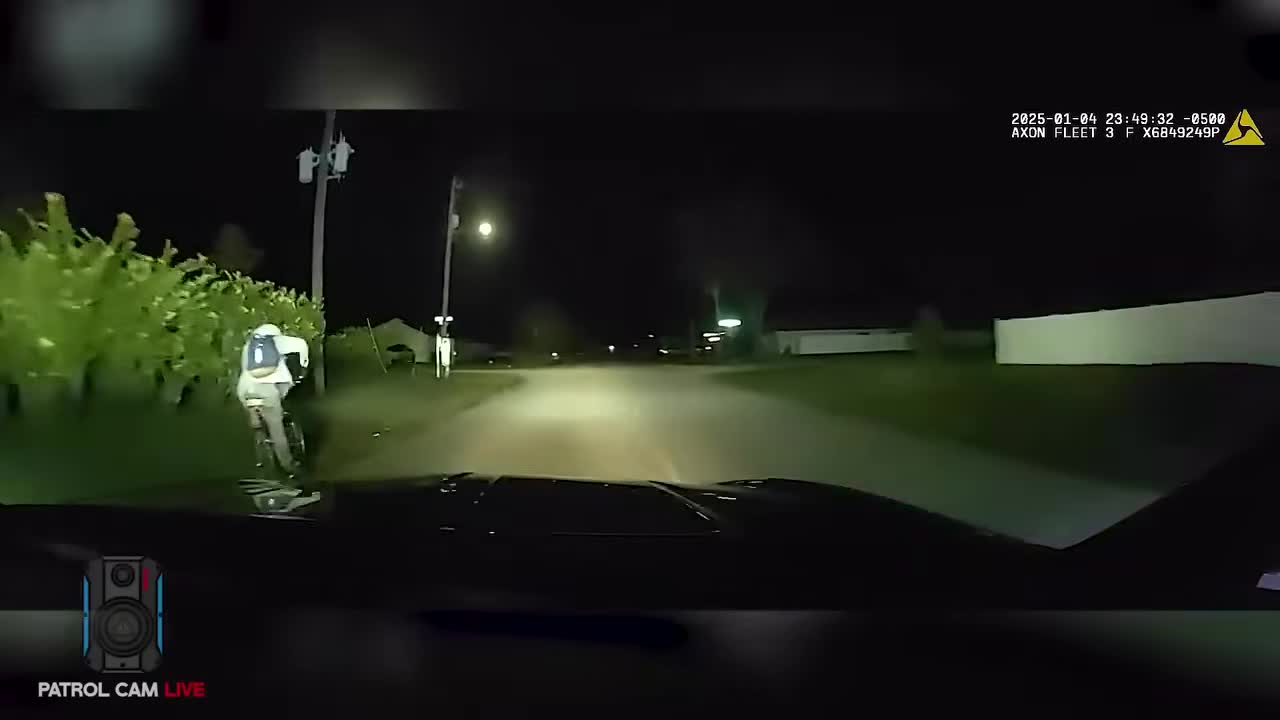
The footage shows the rapid transition from an attempted stop to an active pursuit.
The Gun Becomes the Critical Detail
As Murphy turned onto Westminster Drive, the sheriff's office says he observed McDermott pulling a firearm from his pants.
This is the decisive fact in the official account.
Without it, the patrol vehicle striking the bicycle would look like an extreme response to a person simply riding away. With it, the deputy's decision becomes part of an immediate armed-threat assessment.
According to Flagler County Sheriff Rick Staly, Murphy had to make a split-second decision during a dangerous encounter with an armed felon. The sheriff said the incident could have taken a deadly turn and expressed relief that it was resolved quickly.
Murphy Uses the Patrol Vehicle
The sheriff's office says Murphy feared McDermott would engage him with the firearm. He therefore struck McDermott with the patrol vehicle.
The impact knocked McDermott from the bicycle.
It also caused him to drop the firearm.
The maneuver ended the pursuit almost instantly. Instead of continuing down Westminster Drive with an armed suspect on a bicycle, Murphy had a stationary suspect and a gun separated from him.
That did not mean the danger was automatically over. Officers still had to secure McDermott and locate the weapon.
Backup Arrives Within Seconds
Deputy Michael Anderson arrived as backup within seconds, according to the Flagler County Sheriff's Office.
Together, the deputies secured McDermott without further incident.
The body-camera footage shows the close-range aftermath. Flashlights illuminate grass, bushes and the roadside while officers control the suspect and assess what has happened.
The abruptness is striking. Seconds earlier, the deputy was pursuing a moving bicycle. Now the rider is on the ground and officers are searching the immediate area.
A 9-Millimeter Ruger Is Recovered
Deputies reported recovering a 9-millimeter Ruger firearm near McDermott.
The sheriff's office also said McDermott was wearing a holster.
Those details provided physical evidence supporting Murphy's statement that he saw a gun during the pursuit. Contemporary reports from FOX 35 Orlando, WFTV, Action News Jax, FlaglerLive and the Palm Coast Observer all repeated the firearm recovery based on the sheriff's office account.
The gun is therefore not simply an interpretation of a blurry video frame. It was documented by the agency and reported by multiple local outlets.
The Bodycam Shows the Scene After the Impact
The body-camera portion of the supplied video gives viewers a perspective different from the dash camera.
The dashcam captures the decision to follow and the vehicle's movement toward the bicycle. The bodycam shows what officers faced after everyone stopped moving.
McDermott is on the ground near roadside vegetation. Deputies issue commands and secure him. The bicycle and other items are visible around the scene.
Why the Patrol Car Became the Deputy's Immediate Tool
Law-enforcement encounters involving firearms can develop faster than officers can transition between different tools.
A deputy driving a patrol car while following a suspect is already operating a large piece of equipment capable of changing the suspect's movement. Exiting the vehicle would take time. Creating distance might give an armed person more opportunity to turn and fire.
The sheriff's office says Murphy believed McDermott was preparing to engage him with the firearm. Under that interpretation of the threat, the patrol vehicle was the tool immediately available.
The result was forceful but brief: one impact ended the bicycle pursuit and separated the suspect from the gun.
The Incident Was Not Reported as a Shooting
No gunfire was reported during the encounter.
That is important because the circumstances contained the ingredients for a potentially deadly confrontation: an armed suspect, a pursuing deputy and a weapon being drawn during flight.
Instead, the encounter ended with the patrol vehicle strike and physical arrest.
McDermott suffered what the sheriff's office described as a minor injury to his right ankle.
Medical Treatment Came Before Jail
After the arrest, McDermott was transported to AdventHealth Palm Coast Parkway.
He was treated for the ankle injury and released.
Only after medical clearance was he transported to the Sheriff Perry Hall Inmate Detention Facility.
This sequence is standardly important after a use-of-force event because medical evaluation documents injuries and ensures the suspect is stable enough for detention.
The Initial Charges
The Flagler County Sheriff's Office announced that McDermott was arrested for assault or battery on a law-enforcement officer, fleeing and eluding, resisting an officer with violence and possession of a firearm by a convicted felon.
Those charges reflected the agency's account immediately after the incident.
As with any criminal case, initial arrest charges should be distinguished from the final court disposition. Charges can be amended, dismissed or resolved through a plea.
Later FlaglerLive reporting provides additional context indicating that McDermott ultimately served a 15-month prison sentence after a conviction involving fleeing and eluding and possession of weapons as a felon.
A Recent Release Before the Bicycle Encounter
At the time of the January arrest, the sheriff's office said McDermott had only recently been released from the county detention facility.
According to the official release, he left the Sheriff Perry Hall Inmate Detention Facility on December 17, 2024 after serving a 90-day sentence for possession of fentanyl.
That placed the bicycle encounter less than three weeks after his release.
The sheriff's office also said McDermott had an extensive arrest history in Flagler County dating back to 2013.
Why the Prior Record Matters, and Why It Does Not Explain the Use of Force
McDermott's criminal history provides background, but it should not be confused with the reason Murphy used the patrol vehicle.
The deputy's immediate decision had to be based on what was happening in front of him, not simply on McDermott's past.
The sheriff's office identified the gun being drawn during the pursuit as the critical event.
That distinction matters when evaluating police footage. Prior convictions may explain why a firearm-possession charge is legally significant, but they do not by themselves justify force in a new encounter.
The W-Section Setting
Palm Coast's W-Section is a residential area where streets wind through neighborhoods rather than following a dense downtown grid.
That environment affects a bicycle pursuit. A rider can turn onto side streets quickly and potentially disappear between homes or into darker areas.
Murphy's decision unfolded before the pursuit could expand deeper into the neighborhood.
The entire critical sequence occurred over a relatively short distance.
Why a Bicycle Can Still Create a Difficult Pursuit
A bicycle is obviously slower than a motor vehicle, but that does not make a fleeing bicyclist easy to stop.
A patrol car cannot safely follow everywhere a bicycle can go. Curbs, narrow paths and landscaping can suddenly remove the vehicle's advantage.
An armed rider adds another dimension because the suspect does not need to stop the bicycle completely to reach for a weapon.
The deputy therefore has to balance maintaining contact with avoiding a position that gives the rider a clear opportunity to fire.
The Dashcam and Bodycam Tell Different Parts of the Story
The most useful aspect of the released footage is the combination of perspectives.
The dashcam explains how the pursuit developed. It shows the road ahead and the relative positions of the patrol vehicle and bicycle.
The bodycam explains the aftermath. It shows deputies securing McDermott, working around roadside vegetation and dealing with the recovered evidence.
Neither perspective alone tells the complete story as effectively as the two together.
Why the Official Release Is Essential
Video can show movement, but it cannot always show intent.
A camera may capture McDermott's arm moving, yet viewers may not be able to identify an object clearly in the darkness and motion.
The sheriff's office fills that gap by stating that Murphy saw McDermott pull a firearm and that deputies recovered a 9-millimeter Ruger near him.
Independent local outlets reported the same agency account.
That cross-check prevents the article from relying on a sensational upload title alone.
The Difference Between “Ran Over” and “Struck”
The supplied video title says a cop “runs over” an armed man on a bicycle.
The official description is more precise: Murphy struck McDermott with the patrol vehicle, ejecting him from the bicycle.
Those phrases are not necessarily equivalent.
“Ran over” can imply that the wheels of the vehicle passed over a person's body. The available official reporting describes an impact that knocked McDermott from the bike, not a vehicle driving over his body.
For accuracy, this article uses “struck” rather than adopting the more dramatic wording of the video title.
The Weapon Changes How the Viewer Understands the Clip
Short clips often begin immediately before the most dramatic action.
If a viewer sees only a patrol car hitting a bicycle, the natural question is why an officer would use a vehicle against a cyclist.
The preceding seconds answer that question according to investigators: Murphy saw a gun being drawn.
Context does not prevent people from debating police tactics, but it is necessary for the debate to be about the actual event.
No Extended Standoff Followed
After the impact, Murphy and Anderson were able to secure McDermott without a prolonged fight or standoff.
That quick resolution reduced the time officers, McDermott and nearby residents remained exposed to an armed confrontation.
The recovered gun could be secured, McDermott could receive medical attention and the scene could shift from an active threat to an investigation.
Evidence at the Scene
The firearm was one of the most important pieces of evidence.
Its location relative to McDermott and the bicycle could help reconstruct what happened at the moment of impact.
The holster was also relevant because investigators said McDermott was wearing it.
Dashcam and bodycam footage preserved the sequence and the immediate condition of the scene.
Together, physical evidence and video give investigators more than one source from which to reconstruct the event.
The Role of Deputy Michael Anderson
Murphy was the deputy who initiated contact and made the decision to strike the bicycle, but the arrest was not completed entirely alone.
Deputy Michael Anderson arrived within seconds.
Backup is especially important after a suspect has been associated with a firearm. One deputy can focus on controlling the person while another watches the surroundings, locates the weapon or assists with handcuffing.
The rapid arrival of another unit helped stabilize the scene.
The Sheriff Defends the Split-Second Decision
Sheriff Rick Staly publicly supported Murphy's actions.
In the agency's release, Staly emphasized that deputies sometimes have to make split-second decisions and described the encounter as one involving an armed felon.
He said he was thankful the incident was resolved before it became deadly.
That statement reflects the sheriff's office's interpretation of the event. It is not merely commentary added by a reposting channel.
Local News Coverage Confirms the Core Sequence
The incident received coverage from multiple Florida outlets in the days after the arrest.
FOX 35 Orlando reported that Murphy encountered McDermott beside the bicycle, followed him after he fled and struck him after seeing the gun.
WFTV described McDermott being knocked from the bicycle and into bushes after the deputy caught up with him.
Action News Jax reported the recovery of the Ruger handgun, the ankle injury and the announced charges.
FlaglerLive and the Palm Coast Observer provided additional local detail drawn from the sheriff's office.
Why Multiple Sources Matter
Police agencies are primary sources for their own incident reports, but news coverage provides a useful second layer.
Local reporters can compare the release with jail records, charging affidavits and court documents. They may also preserve details after agency social-media posts become difficult to locate.
In this case, the core facts remain consistent across the official release and local reporting.
That consistency gives greater confidence in the identity, location, weapon and sequence than would be possible from the video alone.
The Later Court Context
A later FlaglerLive report concerning a separate 2026 investigation mentioned McDermott's history and stated that he had completed a 15-month prison sentence following a conviction for fleeing and eluding and possessing weapons as a felon.
That later reference appears consistent with the offenses at the center of the January 2025 bicycle encounter.
Because the later article summarizes the prior conviction rather than reproducing the complete judgment and sentencing order, it is safest to describe it at that level rather than inventing a precise plea date or sentencing structure.
The Encounter Could Have Taken Several Worse Paths
If McDermott had continued into the neighborhood, the pursuit might have expanded beyond the deputy's immediate view.
If the firearm had been discharged, the encounter could have become a shooting.
If the vehicle strike had caused more serious injuries, the outcome could also have been substantially different.
Instead, authorities reported a minor ankle injury and no gunfire.
The suspect was arrested, the weapon was recovered and the scene was brought under control within moments.
The Opening Gives No Hint of the Ending
One reason the footage is compelling is how ordinary the first contact appears.
A man stands beside a bicycle.
A deputy attempts to speak with him.
The man rides away.
Nothing in that simple description predicts that seconds later the deputy will be facing what he believes is an armed threat.
That unpredictability is central to the story.
One Decision Ends the Pursuit
Murphy could not know exactly what McDermott intended to do with the firearm.
According to his account, he believed the gun was being brought into play against him.
His response was immediate.
The patrol vehicle hit the bicycle, McDermott came off it and the weapon was separated from him.
There was no extended exchange of gunfire and no long pursuit through Palm Coast.
The Arrest Turns a Viral Moment Into a Criminal Case
Online, the vehicle strike is the moment most likely to be replayed.
In the justice system, however, the more important questions concern the evidence and charges that followed.
Was McDermott legally prohibited from possessing the recovered firearm? What conduct supported the fleeing and resisting allegations? What did the camera show about the weapon?
Those are the questions that turn a dramatic clip into a prosecutable case.
What Is Confirmed
The incident occurred just before midnight on January 4, 2025 in Palm Coast, Florida.
Deputy Christopher Murphy of the Flagler County Sheriff's Office encountered Michael McDermott, 38, beside a bicycle on Pine Lakes Parkway.
McDermott rode away and then fled again after initially appearing to stop.
He turned onto Westminster Drive.
The sheriff's office says Murphy saw him pull a firearm from his pants.
Murphy struck the bicycle with his patrol vehicle.
Deputy Michael Anderson assisted in taking McDermott into custody.
A 9-millimeter Ruger was recovered, and authorities said McDermott was wearing a holster.
McDermott was treated for a minor ankle injury before being taken to jail.
A Short Pursuit With a Long Legal Aftermath
The pursuit itself lasted only a brief period.
The consequences lasted much longer.
McDermott faced multiple criminal allegations, and later reporting indicates he ultimately served a prison sentence following convictions involving fleeing and weapons possession as a felon.
The footage therefore captures only the first few minutes of a case that continued through the court system long after the patrol lights were turned off.
Why the Full Sequence Matters
The incident is a strong example of why police footage should be viewed in sequence rather than as a single dramatic frame.
The impact is the climax, but it is not the beginning.
The beginning is a deputy attempting to contact a man beside a bicycle.
The middle is the repeated attempt to flee.
The turning point is the reported appearance of the firearm.
The ending is the arrest, weapon recovery and medical evaluation.
Removing any of those pieces changes how the viewer understands what happened.
From Sidewalk Contact to Armed Confrontation
In only a matter of moments, Deputy Murphy's patrol shifted from a routine observation to an encounter involving a fleeing bicyclist and a firearm.
McDermott's bicycle gave him mobility, but it did not give him enough distance to escape the patrol vehicle.
When the deputy believed a gun was being drawn, the pursuit ended with a decisive collision.
The outcome was an arrest rather than a shootout.
Watch the Full Incident
The still images show the aftermath, but the complete video provides the critical sequence: the attempted contact, McDermott riding away, the renewed pursuit, the moment the deputy reports seeing the firearm and the rapid arrest that follows.
Comments (0)
Loading comments...
May You Like

A Suspicious Vehicle Leads Officers Into an Unexpected Chase

Cop thinks sandwich is phone

[DASHCAM] Drunk Driver Leads Trooper on High-Speed Pursuit Through City Streets













