
CCTV: Armed Robber Demands Cash at Family Dollar Register!
Surveillance Video Captures Daylight Armed Robbery at Milwaukee Family Dollar
A Two-Minute Video Preserves a Milwaukee Armed Robbery
At first glance, the surveillance footage looks like an ordinary afternoon inside a neighborhood discount store. Customers move through the aisles. Employees work near the registers. Nothing in the opening seconds suggests that the store is about to become the scene of an armed robbery.
Then the tone changes.
The supplied Milwaukee police video identifies the incident in unusually precise terms before the surveillance sequence even begins: “ARMED ROBBERY,” 2510 W. North Ave., August 21, 2017, and incident report number 17-233-0105.
Those details provide a strong factual foundation. Independent public records confirm that 2510 W. North Avenue was Family Dollar Store #5469 in Milwaukee. Wisconsin Department of Corrections retailer records list a Family Dollar at the same address, while City of Milwaukee licensing records identify the location as Family Dollar Store #5469.
The surveillance timestamp places the store activity at approximately 2 p.m. on Monday, August 21, 2017.
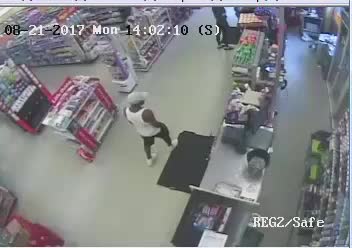
The video then shows a man moving through the store and approaching the front counter area. The encounter unfolds quickly. The footage is low-resolution, as many commercial security recordings from that period were, but it captures the movements of the person police wanted viewers to see.
What the available public record does not provide is just as important. Searches of Milwaukee-area news archives and indexed police material did not uncover a reliable article or court record that connects this exact incident number to a named defendant, arrest, conviction or sentence.
That means the responsible story ends where the verified evidence ends.
This article does not invent a suspect's identity or claim the case was solved. Instead, it reconstructs what the surveillance footage establishes, verifies the store and location through independent records, and examines why even a short piece of retail surveillance can become important evidence in an armed-robbery investigation.
The Address Identifies the Store
The title card gives the address as 2510 W. North Ave.
That location can be independently verified.
A Wisconsin Department of Corrections list of approved cash-payment retailers identifies Family Dollar at 2510 W. North Avenue in Milwaukee. City licensing records go further, identifying the business as Family Dollar Store #5469.
That cross-check matters because the surveillance images themselves do not display a large exterior sign.
Without the address card, viewers might know only that they are looking at a discount retailer.
With the address and municipal records, the scene can be tied confidently to a specific Milwaukee Family Dollar.
The Incident Number Is an Important Clue
The opening card includes IR#17-233-0105.
Police incident numbers are valuable because they distinguish one call from thousands of similar events.
The number provides a potential route to the underlying report even when newspaper coverage is absent.
It also helps prevent accidental mixing of this robbery with other Family Dollar crimes in Milwaukee.
Retail chains operate many locations, and armed robberies can occur at different stores within the same year.
An exact address plus an incident number is therefore much stronger evidence than a generic video title.
The Camera Clock Places the Robbery in Broad Daylight
The surveillance overlay reads August 21, 2017, and shows a time shortly after 2 p.m.
That makes this a daytime robbery, not an after-hours burglary.
The distinction changes the risk.
A burglary after closing may threaten property.
An armed robbery during business hours places employees and customers directly inside the event.
The footage shows people in the store as the sequence develops, meaning the offender is operating in an occupied commercial space rather than an empty building.
The Store Initially Looks Completely Normal
One reason the footage is unsettling is how ordinary the opening appears.
The camera looks down over shelves, checkout fixtures and the front portion of the store.
People move normally.
There is no warning alarm visible to the viewer.
No one runs at first.
That calm opening creates the strongest natural hook in the video because the audience already knows, from the police title card, that an armed robbery is coming.
The question is not whether something will happen.
It is when.
A Person Moves Toward the Front of the Store
The surveillance sequence shows a person wearing a light-colored top and dark pants moving through the front area.
Because the video resolution is only 240p, fine facial details are limited.
That limitation should be respected.
Low-resolution footage can still be useful for clothing, movement, approximate build and sequence, but it should not be treated as a perfect identification photograph.
Investigators can compare the video with witness descriptions and other evidence. A public viewer should not attempt to name someone solely from these pixels.
The Checkout Area Becomes the Center of the Incident
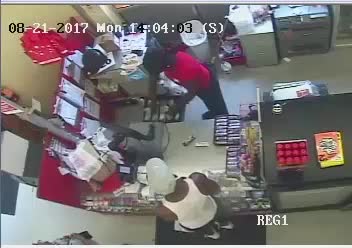
As the sequence continues, activity concentrates around the registers.
The front counter is where a retail robbery often becomes most dangerous.
Employees are positioned near cash drawers.
Customers may be trapped between aisles and exits.
An offender who displays or claims to possess a weapon can rapidly control the behavior of everyone nearby.
The supplied police video labels the incident an armed robbery, so the classification comes from the agency presentation rather than speculation based on body language alone.
Why the Police Label Matters
The words “ARMED ROBBERY” appear on the Milwaukee police title card.
That is stronger than a social-media uploader simply calling the event a robbery.
Police had an incident report and chose that classification when releasing or compiling the surveillance.
Still, the short video does not show the complete investigative file.
It does not tell us what type of weapon was reported, whether it was recovered, how much property was taken or whether anyone was physically injured.
Those details should not be invented from the label.
A Short Crime Can Produce a Large Investigation
An armed robbery may last only a few minutes.
The investigation can last weeks, months or longer.
Officers may interview employees and customers.
Detectives can collect surveillance from neighboring businesses.
They may examine transaction records and determine the exact time of the offense.
Images can be circulated internally or publicly.
Tips can be compared with other robberies.
If an arrest is eventually made, prosecutors then have to connect the defendant to the crime through admissible evidence.
The two-minute video is therefore only the visible beginning of a much larger process.
Commercial Cameras Preserve Sequence
Security footage is especially valuable because it preserves order.
Witnesses under stress may remember individual moments but disagree about timing.
A camera records who entered first, where people moved and how long the event lasted.
It can show whether a suspect visited a particular aisle before approaching the register.
It can reveal whether another person appeared to act as a lookout.
It can establish when the offender left.
Those details help detectives test statements against an objective timeline.
Why Image Quality Does Not Make the Footage Useless
The video is visibly low-resolution.
That was common for many store surveillance systems in 2017, particularly systems designed to retain many hours of footage on limited storage.
But low resolution does not mean zero evidentiary value.
Clothing patterns, footwear, approximate height relative to fixtures, direction of movement and distinctive behavior may still be visible.
Investigators can also work from the original recording rather than a compressed online copy.
The version circulating on YouTube may have lost detail through repeated encoding.
The Front Counter Creates a Predictable Vulnerability
Discount stores are designed for efficient customer flow.
Registers are usually positioned close to the entrance and exit.
That layout is convenient for ordinary shopping, but it also means an offender can potentially approach a cashier and reach an exit quickly.
Employees working the front may have limited physical barriers separating them from customers.
Retail security therefore depends heavily on procedures, cameras, cash-handling policies and employee training rather than fortress-like architecture.
Employee Safety Comes Before Merchandise
In an armed robbery, protecting human life is more important than protecting the cash drawer.
Retail employees are generally not expected to physically fight an armed offender over store property.
A confrontation can turn a property crime into a shooting within seconds.
The safest response often involves complying with demands when necessary, observing details when possible and contacting police once it is safe.
The surveillance footage underscores why those policies exist.
Several people can be placed at risk by one offender's decision to introduce a weapon into an ordinary commercial interaction.
Witness Memory and Video Work Together
A camera sees what enters its field of view.
A witness may hear words the camera microphone does not capture clearly.
An employee may see a weapon from an angle hidden from the overhead camera.
Another customer may notice the direction in which the suspect runs after leaving.
Investigators combine those sources.
Neither witness memory nor video needs to carry the entire case alone.
The strongest reconstruction often comes from comparing them.
The Store's Location Adds Investigative Possibilities
North Avenue is an urban commercial corridor.
A person leaving the Family Dollar could potentially be captured by other businesses, traffic cameras or private security systems nearby.
Detectives investigating a robbery may therefore work outward from the store.
The Family Dollar camera establishes the core event.
Surrounding cameras can sometimes establish approach and escape.
That broader video trail can become crucial when the interior camera cannot provide a clear face.
The Incident Happened on a Monday Afternoon
August 21, 2017, was a Monday.
The timestamp around 2 p.m. places the robbery during normal daytime business activity.
That timing can help investigators identify potential witnesses.
Employees can be matched to work schedules.
Transactions around the relevant minutes can identify customers who were present.
Delivery drivers or neighboring workers may have seen something outside.
A precise timestamp turns a general request for information into a much narrower investigative window.
Why the Register Camera Is So Valuable
The second embedded frame shows activity directly around the checkout counter.
That angle gives investigators a different view from the wider aisle camera.
Multiple cameras reduce blind spots.
One may capture the suspect approaching.
Another may capture the interaction at the register.
A third may show the exit.
Even when no single image is perfect, the combined sequence can establish a coherent account of the offender's movements.
Retail Robberies Can Be Difficult to Solve
A stranger can enter a store, conceal identifying features, commit a robbery and leave within minutes.
If no one recognizes the person and no physical evidence is recovered, investigators may initially have little more than witness accounts and surveillance.
That is why public release of images can matter.
Someone outside the store may recognize clothing, mannerisms or a distinctive physical feature.
A tip can provide the lead that the camera itself cannot.
But Public Identification Carries Risks
Crowdsourced identification can also go wrong.
Poor-quality images encourage confident guesses.
People can resemble one another.
A mistaken social-media accusation can harm an innocent person and interfere with the investigation.
The correct approach is to send information to investigators rather than publicly declaring that a blurry person is a particular individual.
That principle is especially important with footage as compressed as this 240p copy.
The Video Does Not Establish the Amount Taken
Nothing in the supplied footage reliably establishes how much money or merchandise was taken.
A viewer may see activity at the register, but a dollar figure would require the police report, store accounting or court documents.
No trustworthy exact-match source located during this research provides that number.
Therefore this article does not create one.
The seriousness of an armed robbery comes from the threatened or actual use of force, not merely the amount of property obtained.
The Video Does Not Establish a Final Arrest
The same caution applies to the outcome.
Searches using the exact address, date, store name and robbery terms did not produce a reliable indexed news article identifying an arrest for incident 17-233-0105.
That does not prove no arrest ever occurred.
Police records from 2017 are not all fully indexed on the public web.
It simply means the available evidence is insufficient to state a named suspect or conviction as fact.
Why This Limitation Should Be Stated Clearly
Crime reporting becomes unreliable when gaps are quietly filled with details from similar cases.
Milwaukee had many Family Dollar locations.
The city experienced other retail robberies.
A defendant charged with robbing another dollar store should not be inserted into this story merely because the offense sounds similar.
The exact incident number is a safeguard against that mistake.
Until a source explicitly connects a person to 17-233-0105 at 2510 W. North Avenue, the suspect should remain unidentified in the article.
The Business Address Is Independently Documented
Public records leave little doubt about the location.
Wisconsin Department of Corrections retailer records list Family Dollar at 2510 W. North Avenue.
City of Milwaukee licensing records identify Family Dollar Store #5469 at the same address.
Those sources are useful because they were created for administrative purposes, not to promote the robbery video.
Independent records matching the video title card strengthen the identification.
What the Surveillance Footage Directly Shows
The video directly supports a limited but meaningful set of observations.
It shows the interior of a retail store.
The timestamp is August 21, 2017, shortly after 2 p.m.
A person moves through the store and toward the checkout area.
Other people are present.
The sequence focuses on the front register area.
The police title card identifies the event as an armed robbery at 2510 W. North Avenue and gives incident report number 17-233-0105.
Those are the facts that can be stated confidently from the recording itself.
What Comes From External Records
External records establish that the address belonged to a Milwaukee Family Dollar.
City licensing documents identify it as store #5469.
Wisconsin records independently list the same retailer and address.
These sources confirm the location but do not provide the robbery narrative.
That distinction is important.
The video establishes the incident.
The administrative records establish the business.
Neither source, by itself, supplies a defendant or court outcome.
Why a Police-Released Surveillance Clip Can Resurface Years Later
The supplied file is an older surveillance video now being viewed in a modern online context.
That can create confusion about timing.
The event occurred in 2017, not 2026.
Police footage and surveillance clips often remain online indefinitely, and YouTube channels can repackage or archive them years later.
Always reading the original timestamp and title card prevents an old case from being accidentally reported as breaking news.
The Most Reliable Timeline
On Monday, August 21, 2017, an armed robbery occurred at the Family Dollar located at 2510 W. North Avenue in Milwaukee.
The police title card identifies the case as incident report 17-233-0105.
Store surveillance around 2 p.m. captured the person police associated with the incident moving through the business and toward the checkout area.
Customers or employees were present during the sequence.
The video was preserved and released as evidence connected to the armed-robbery investigation.
Independent Wisconsin and Milwaukee municipal records confirm that Family Dollar operated at 2510 W. North Avenue.
Public web searches conducted for this article did not locate a reliable exact-match source identifying a suspect, arrest, amount stolen or final court disposition.
Those details therefore remain unreported rather than guessed.
Why the Story Still Matters Without a Named Suspect
An unresolved public record does not make the footage meaningless.
The video shows how quickly an ordinary shopping environment can become a crime scene.
It demonstrates the evidentiary value of overhead cameras.
It highlights the vulnerability of employees working near cash registers.
And it shows why exact dates, addresses and incident numbers matter when researching archival police footage.
Sometimes the most responsible conclusion is not a dramatic courtroom ending.
It is a clear account of what is known and an equally clear statement of what is not.
The Strongest Narrative Is the Contrast
The footage holds attention because of contrast.
The store looks routine.
People move normally.
The camera is static.
Then an event classified by police as an armed robbery unfolds in the same ordinary space.
That contrast does not need exaggerated language.
It reminds viewers that serious crimes do not always announce themselves with a chase or visible confrontation outside.
They can begin in the middle of an ordinary Monday afternoon.
Watch the Full Surveillance Sequence
The complete two-minute video shows the Milwaukee police title card and the surveillance angles that preserved the August 21, 2017 incident at the North Avenue Family Dollar.
Viewed carefully, it is less a sensational crime clip than a compact piece of evidence: a timestamped record of an ordinary retail environment becoming the scene of an armed-robbery investigation.
Click here to watch the full incident unfold.
Comments (0)
Loading comments...
May You Like

The Truth Behind the Suspicious Vehicle and the Standoff with Police

Karen Entitled’ Woman Gets Tased After Allegedly Ramming Police Cars

Police vs Chevy Impala High-Speed Pursuit Ends in TVI














