Bully Attempts to Use the Race Card During Traffic Stop and Fails
Driver Challenges Officers During Traffic Stop as Tensions Rise
Verification note: The footage shows an AXON timestamp of July 31, 2025 and an Illinois municipal plate on a police vehicle. Public-source research did not produce a report or court record that could be matched to this exact stop with sufficient confidence. Accordingly, this article does not invent the driver’s identity, department, exact city, charges or court outcome and is based primarily on the supplied footage, with general legal context clearly separated from incident-specific facts.
A Traffic Stop That Quickly Becomes an Argument
The encounter begins like countless roadside contacts do: a vehicle is stopped on a residential street, an officer approaches the driver's window, and a conversation begins about why police have made contact. Yet the supplied body-worn-camera footage does not remain a simple exchange of documents and explanations for long. The driver repeatedly questions the officers' actions, challenges their account of the stop, and raises the issue of race. Officers, meanwhile, continue trying to control the scene and move the stop forward.
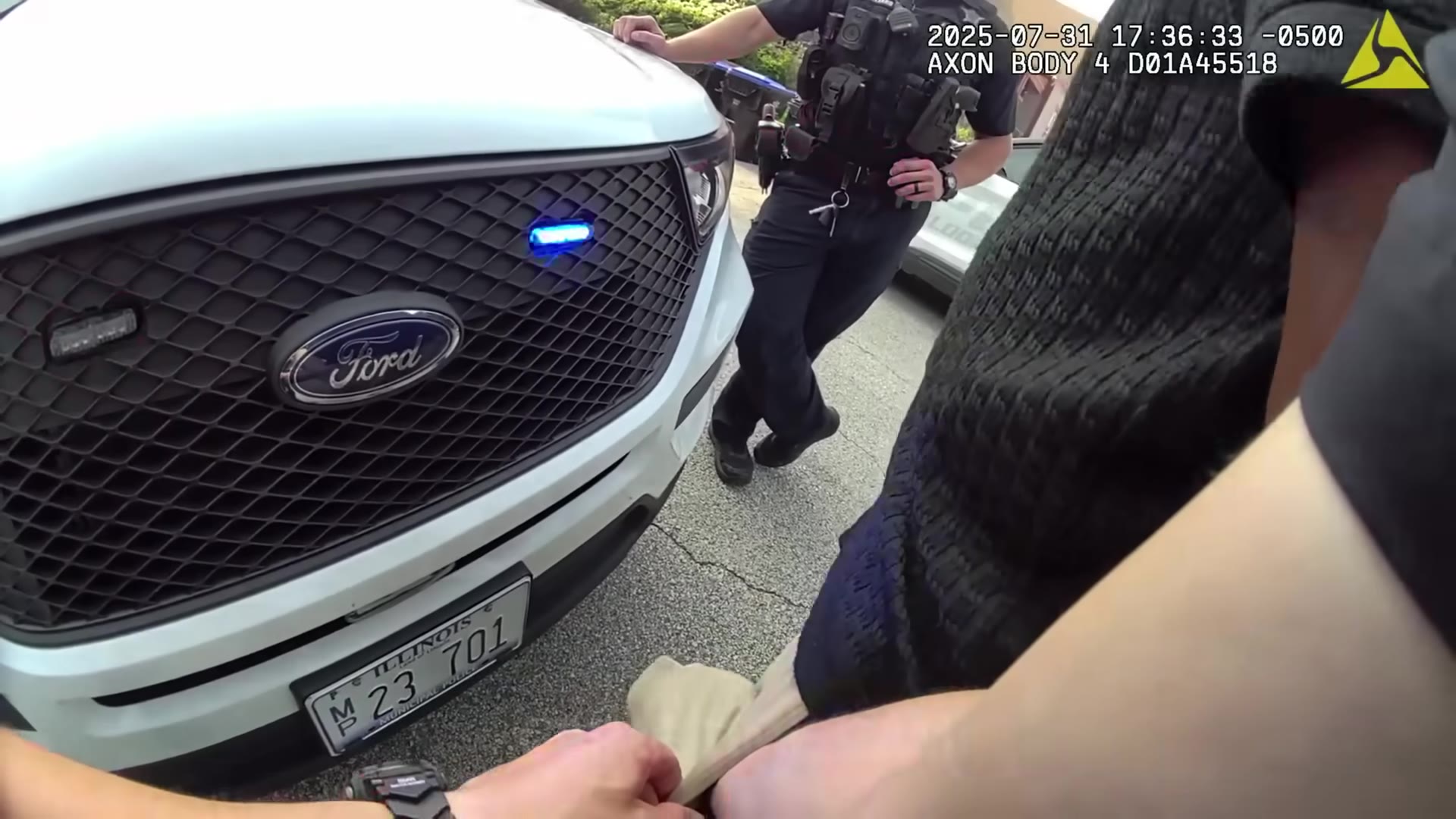
The footage is dated July 31, 2025, with the visible AXON overlay showing the encounter unfolding in the late afternoon. The surroundings are unmistakably residential. Detached homes, lawns, sidewalks, utility poles and parked vehicles line the street. The driver's vehicle is stopped along the roadway while police vehicles position nearby. An Illinois municipal license plate is visible on one police Ford, establishing an important geographic clue, although the footage available here does not provide enough reliable information to identify the exact municipality beyond doubt.
That limitation matters. Searches of public reporting and indexed records did not produce a source that could be confidently matched to this exact stop using the date, footage, vehicle, setting and sequence. Because of that, this article does not assign a name to the driver, identify individual officers, state an exact city, or invent charges or a court outcome. The account below separates what can be observed in the supplied footage from broader legal and procedural context.
The original upload title characterizes the driver as a “bully” who “pulls the race card.” Those are editorial judgments, not neutral facts established by the camera. A more accurate description is that the driver argues with officers and alleges that race is relevant to the way he is being treated. Whether racial bias actually motivated the stop cannot be determined simply by watching a short encounter. At the same time, raising an allegation of racial profiling does not automatically invalidate a lawful traffic stop. Both questions depend on evidence.
Questions About the Stop Take Center Stage
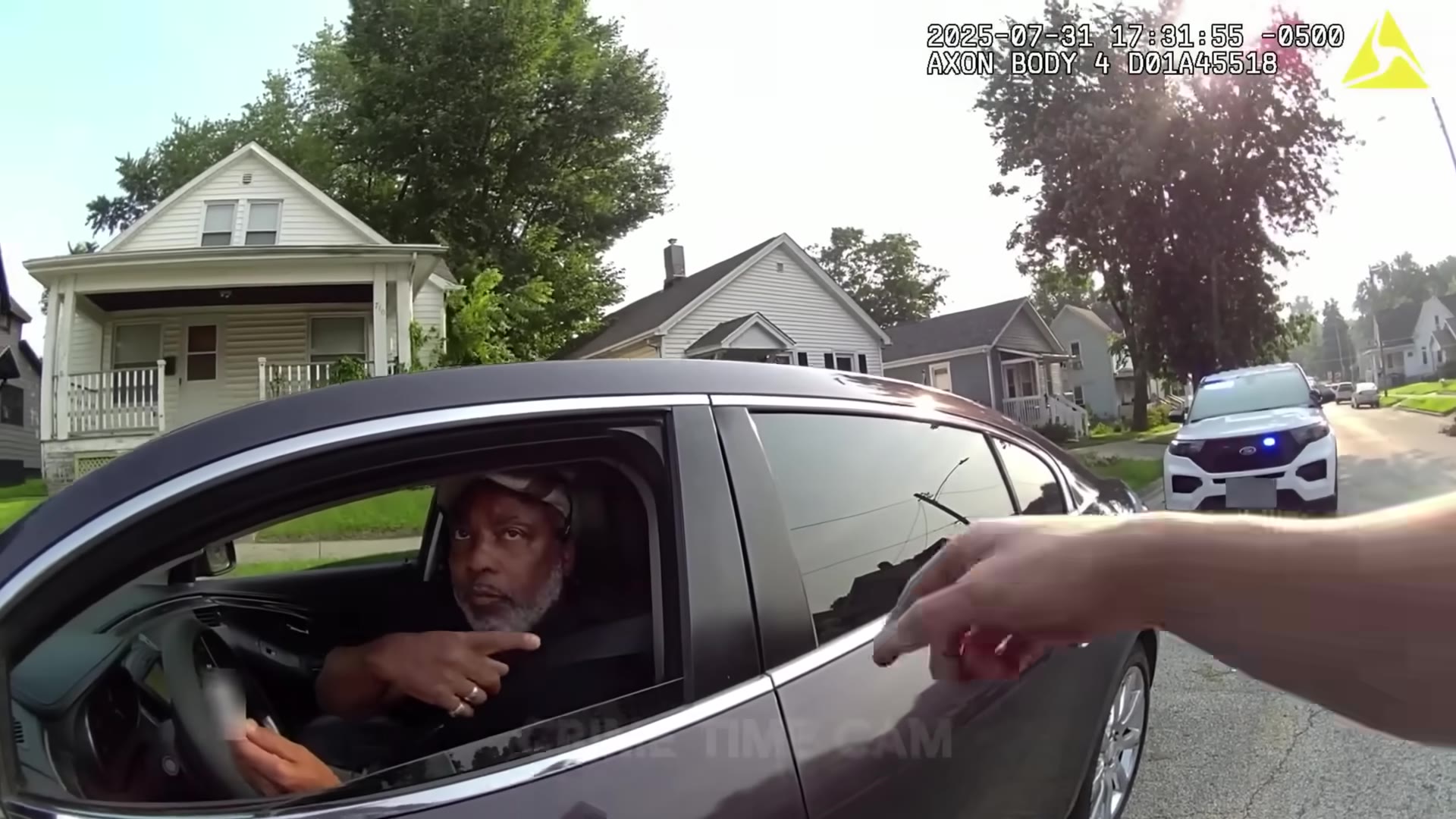
Much of the video is conversational rather than action-driven, but that does not make it uneventful. The tension comes from the competing interpretations of the same roadside encounter. The driver wants officers to explain and justify what they are doing. The officers attempt to keep the discussion focused on the traffic stop and the instructions they are giving him.
This distinction is common in body-camera footage. A motorist may view a stop through the larger lens of previous experiences with police, community relationships or concerns about unequal enforcement. An officer may be concentrating on a narrower set of questions: what violation prompted the stop, who is driving, whether the person is licensed, whether the vehicle is properly registered and insured, and whether there are safety concerns. When those two frames collide, even an otherwise ordinary stop can become a prolonged argument.
The driver's tone becomes increasingly confrontational at points. He gestures toward officers, speaks forcefully, and disputes the way the encounter is being handled. Officers remain close to the vehicle and additional personnel are visible during the stop. Nothing in the frames used for this article establishes that the driver is armed, and the article does not infer that he is. Likewise, the mere presence of several officers does not by itself prove that police considered him dangerous. Backup officers can arrive for many reasons, particularly when a stop becomes contentious or prolonged.
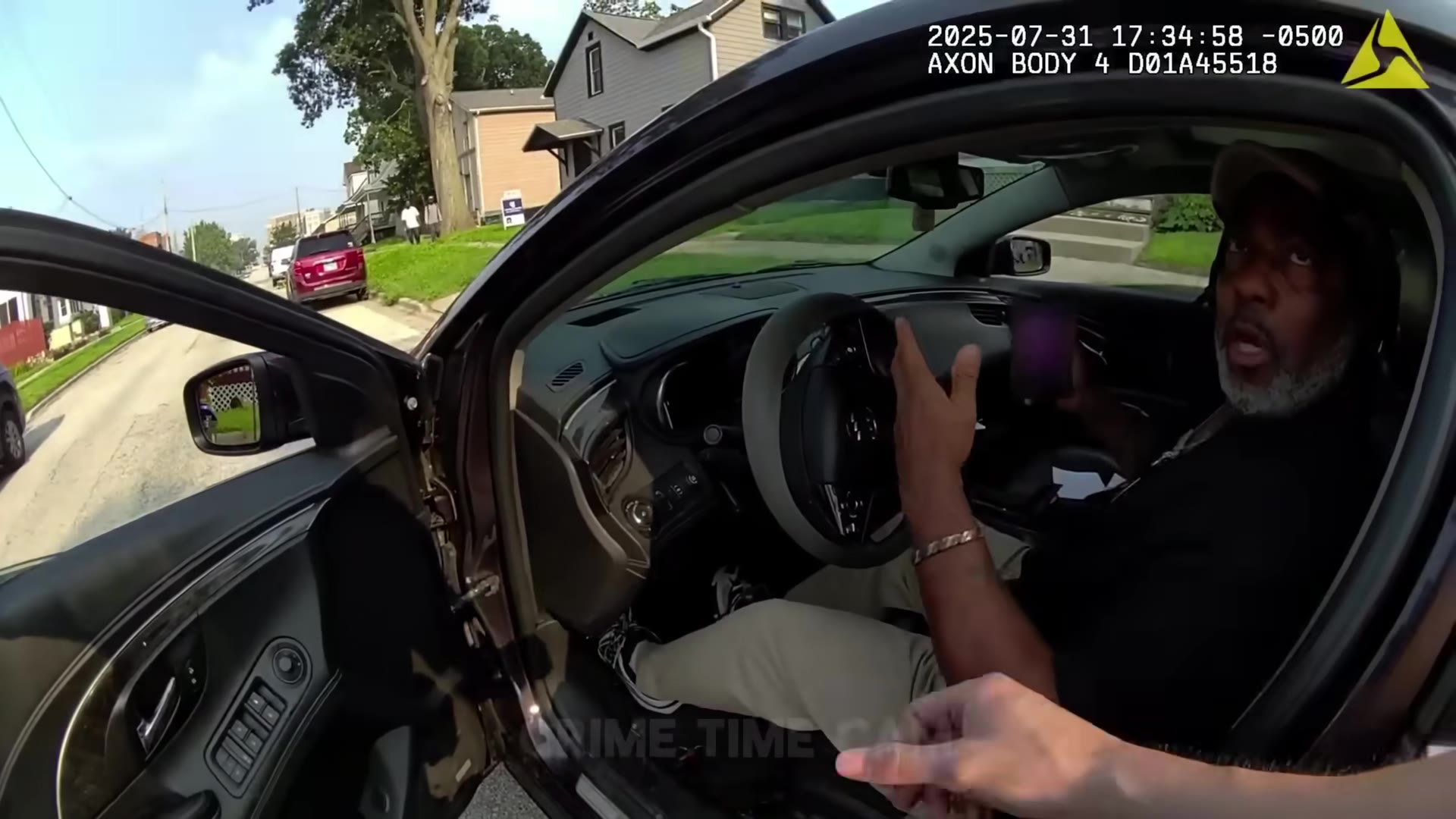
One of the most important details visible in the video is that the driver's window remains open for much of the exchange. The conversation therefore unfolds face-to-face. That makes the disagreement unusually easy to follow compared with footage where doors are closed or audio is obscured. The camera captures not just commands, but body language: pointing, changes in distance, officers conferring, and the driver's continued engagement from the front seat.
Race, Policing and What a Camera Can Actually Prove
The driver's references to race become a central theme of the encounter, which is why the original online title emphasizes them. But the evidentiary question is more complicated than a viral title suggests. A body camera can show what an officer said, what a driver said, where people stood, and what actions followed. It generally cannot reveal an officer's unspoken motive by itself.
Claims of racial profiling require careful analysis. Relevant evidence can include the stated reason for a stop, objective observations made before the stop, dispatch or plate information, enforcement patterns, statements by officers, treatment of similarly situated drivers, and department records. A video may contribute to that analysis, but viewers should resist treating a disagreement on camera as a complete civil-rights investigation.
Illinois has a long-running statutory system for collecting traffic-stop data in part to study possible racial disparities in enforcement. Recent statewide reporting continues to show that racial disparities remain a significant subject of public scrutiny, while law-enforcement agencies and researchers also debate how best to measure driving populations and interpret stop-rate comparisons. That broader context makes concerns about racial profiling legitimate subjects for public discussion. It does not, however, establish what motivated this particular officer on this particular street.
The same caution applies in the other direction. A motorist's accusation of bias is not proof that a stop is unlawful, but neither does an officer's denial automatically settle the issue. The proper approach is evidence-based: identify the traffic basis for the stop, examine what officers knew before contact, compare their actions with law and policy, and look for reliable records if the incident was formally challenged.
Because no matching police report or court file could be verified for this footage, the exact legal basis for the initial stop is not stated here as fact. The video should not be stretched beyond what it reliably shows.
The Encounter Moves Away From the Driver's Window
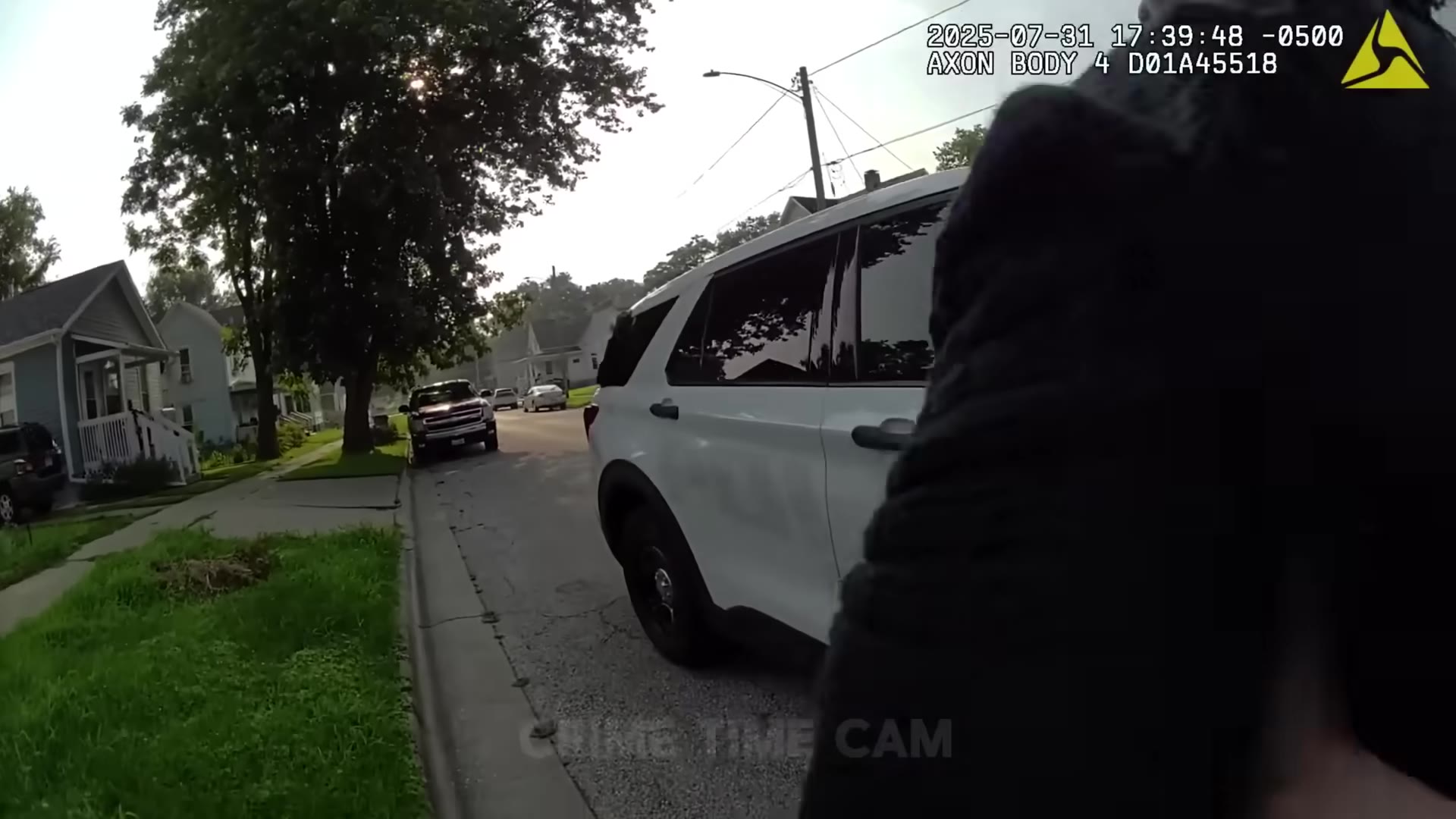
As the stop progresses, the physical dynamics change. The driver is no longer simply seated behind the steering wheel while one officer stands at the window. Officers reposition around the vehicle and along the street. The footage shows a white Ford police SUV with emergency lights operating, and an Illinois municipal plate can be seen clearly in one sequence. Other officers are present nearby.
This is the point where an argumentative stop can become more difficult for everyone involved. Officers must decide whether continued conversation is helping them complete the stop or simply prolonging conflict. A driver, meanwhile, may interpret additional officers or a change in positioning as escalation. Body-camera footage is valuable precisely because it preserves these transitions instead of reducing the event to the final minute.
Police procedure during traffic stops is heavily shaped by safety concerns. Courts have long recognized that roadside stops expose officers and occupants to risk from traffic as well as from unpredictable interactions. Officers therefore commonly control where people stand, whether occupants remain in or exit a vehicle, and how the parties position themselves while records are checked. Those safety powers are not unlimited, but they explain why an officer may insist on instructions that a motorist sees as unnecessary.
The footage also illustrates why arguing about the legitimacy of a stop at roadside rarely resolves the underlying dispute. Officers generally will not conduct a full legal hearing on the shoulder of a road. If a citation is issued, the driver can challenge it in court. If a person believes an officer engaged in misconduct, departments typically provide complaint procedures, and civil litigation may be available in appropriate circumstances. None of that requires a driver to agree with the officer during the stop.
At the same time, verbal disagreement alone is not the same thing as physical resistance. The distinction matters when describing video. The driver is plainly upset and argumentative. Those observable facts should not be converted into a more serious allegation unless the footage or official records support it.
A Physical Detention Changes the Tone
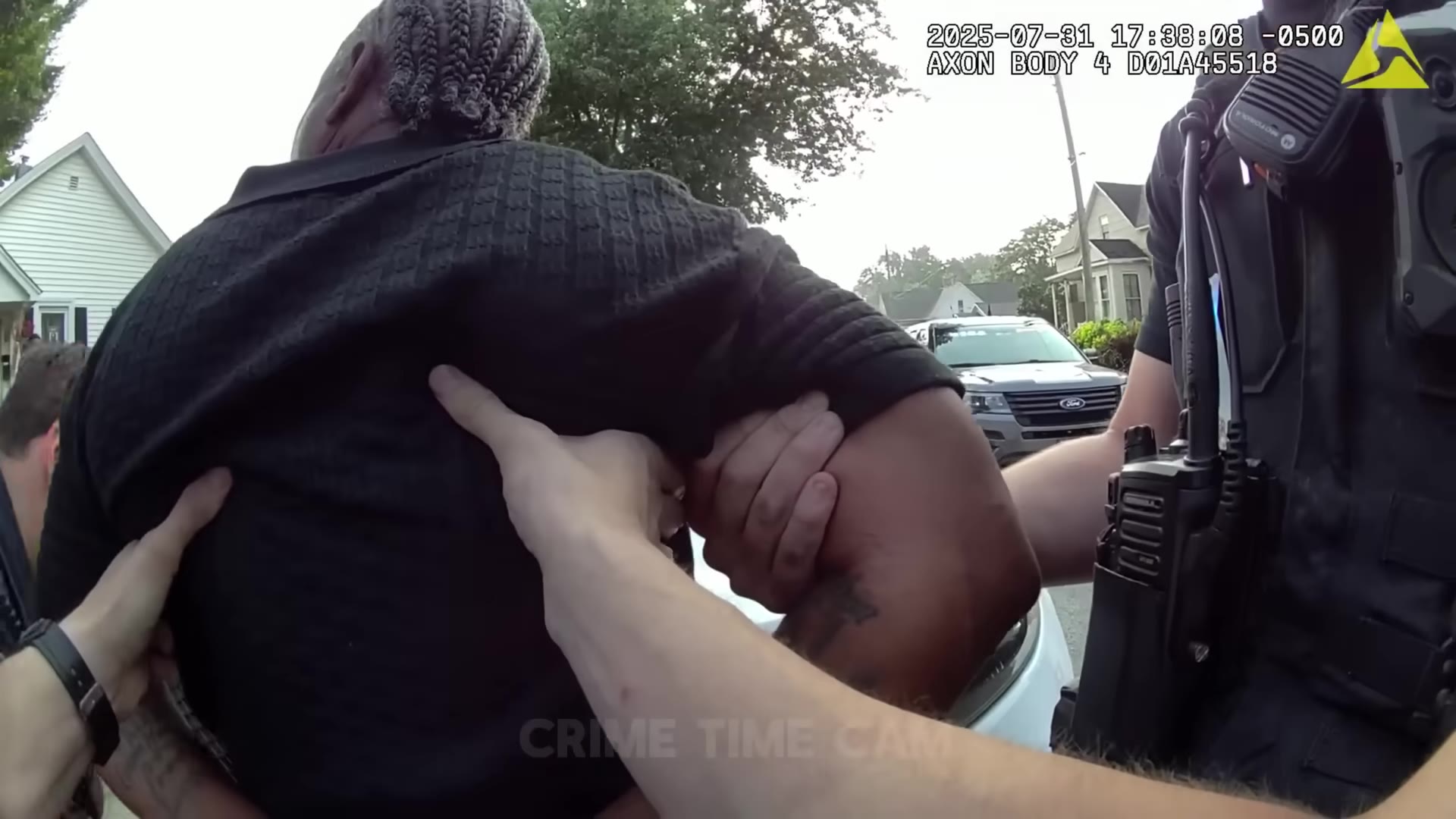
Later in the supplied footage, the encounter becomes more physically controlled. Officers move close to the driver and the camera perspective tightens around the police vehicle and the people involved. The scene no longer resembles the opening minutes of a conversational traffic stop. Officers are directing the driver's movement and maintaining close control over him.
That transition is the natural climax of the footage because it changes the stakes. Earlier, the conflict is mostly verbal. Now the question is no longer simply who is winning an argument. The immediate issue becomes compliance with officers' instructions and the safe management of a detention.
The video should still be described carefully. Without a verified incident report, it would be irresponsible to attach a specific criminal charge to the driver's behavior. A temporary detention, handcuffing or physical control does not automatically mean that a person was ultimately booked, prosecuted or convicted. Police may detain someone during an investigation and later release that person. Conversely, a traffic stop can uncover an unrelated warrant or another offense. The footage alone is not enough to choose among those possibilities.
What the camera does establish is the progression: roadside contact, extended disagreement, multiple officers on scene, movement away from the simple driver-window conversation, and a more restrictive physical detention. That progression is more useful to readers than a sensational label because it describes the actual sequence without claiming facts the video cannot prove.
Why the Original Viral Framing Needs Caution
Titles built around phrases such as “race card,” “bully,” “Karen,” or “entitled” are common in the online body-camera ecosystem. They offer viewers an immediate hero-and-villain structure. The problem is that they can also predetermine how an audience interprets ambiguous behavior before the first second of footage plays.
In this case, the driver clearly raises race and clearly challenges the officers. Those facts make the original title understandable as internet packaging. But saying that someone “fails miserably” is commentary, not an objective outcome. It suggests that the footage conclusively disproves every concern the driver expresses. Without a verified report explaining the initial traffic basis and without a court or administrative finding addressing a racial-profiling complaint, that conclusion goes beyond the available evidence.
A stronger account can still be compelling. The conflict is visible without embellishment. One person believes he is being treated unfairly. Officers continue enforcing their authority. The conversation becomes repetitive and increasingly tense. More officers are present. Eventually the encounter becomes physically controlled. Viewers can see the escalation and judge the communication for themselves.
This approach also protects against a common mistake in police-video commentary: confusing unpleasant behavior with illegality. A person can be rude without committing a crime. An officer can be curt without violating the Constitution. A lawful stop can be handled poorly, and a professionally handled stop can still be legally challenged. Those categories overlap sometimes, but they are not interchangeable.
The most useful question is therefore not whether the driver “won” or “lost” the argument. It is what the footage establishes, what remains unknown, and what official records would be needed to resolve the disputed issues.
The Legal Framework Behind an Ordinary Traffic Stop
Traffic stops in the United States are seizures under the Fourth Amendment. In general, an officer needs an objective legal basis to stop a vehicle, such as probable cause to believe a traffic violation occurred or reasonable suspicion of unlawful activity. Once a stop begins, its duration and scope are also subject to constitutional limits. Officers may perform ordinary tasks tied to the traffic mission, including checking a driver's license, registration, warrants and related records.
The Supreme Court has also recognized substantial officer-safety authority during lawful traffic stops. That is why an officer may direct occupants in ways that would seem unusual during an ordinary civilian interaction. But constitutional authority does not erase equal-protection rules. Selective enforcement based on race raises a different legal issue. A stop can therefore involve more than one constitutional question: whether there was an objective basis for the seizure and whether enforcement decisions were impermissibly discriminatory.
For viewers, the practical lesson is that body-camera footage rarely supplies every piece of the legal puzzle. The camera begins from the officer's perspective and may start after observations have already been made. It may not show the alleged traffic violation. It may not capture information relayed through an in-car computer. And an edited internet upload may omit minutes that appeared in the original evidence.
That is why the research stage matters. A reliable article should compare footage with police reports, citations, dispatch records, court dockets and official statements where those materials are available. For this particular video, public searches did not yield a record that could be matched with sufficient confidence. Rather than attaching an unrelated Illinois traffic case to the footage, the responsible choice is to leave identities and charges unconfirmed.
What Remains Unverified
Several details that viewers often expect from a body-camera story remain unverified here. The driver's name is not stated as fact. The individual officers are not identified. The exact Illinois municipality is not named. The original traffic violation is not presented as a confirmed fact. No BAC result, criminal history, arrest charge, conviction, sentence or civil-case outcome is attributed to the driver.
That is not a weakness in the reporting. It is the boundary between verification and invention.
The AXON timestamp provides a strong date clue: July 31, 2025. The Illinois municipal plate on the police Ford provides a state clue. The neighborhood, vehicle and people provide visual clues. But none of those elements alone produces a unique incident identity. Searches can return superficially similar stops, racial-profiling disputes and Illinois police records from the same date. Substituting one of those cases simply because it looks close would create a false narrative.
If an official incident number, department name, citation, unedited source upload or clearer badge/patch frame becomes available, the research could be narrowed substantially. Until then, the safest account is footage-led.
This is particularly important because accusations involving race and policing carry real consequences. Misidentifying an officer or driver could falsely associate someone with conduct they had nothing to do with. The same is true of invented charges. Responsible use of body-camera footage means being willing to say “not verified” when the evidence stops.
The Final Minutes Leave the Argument Behind
By the later portion of the footage, the original debate at the driver's window has been overtaken by the practical realities of the police encounter. Officers remain around the scene, the driver is under close control, and police vehicles occupy the residential street. The verbal disagreement that dominated the opening has led to a far more restrictive situation.
For an audience, this change is what gives the video its narrative momentum. A viewer begins with a disagreement about a stop and watches the consequences of continued escalation unfold. But the lesson should not be reduced to “never question police.” People retain constitutional rights during police encounters, including important speech protections. Nor should the lesson be that every claim of profiling is automatically credible. Rights and factual proof are separate questions.
A more useful takeaway is that roadside encounters are poor places to resolve complex legal disputes. Drivers can ask why they were stopped and can document encounters where lawful to do so, but physical compliance with lawful orders and later legal challenge are generally safer than trying to litigate the entire issue in real time. Officers, for their part, can reduce unnecessary escalation by explaining the reason for a stop clearly, maintaining professional communication and distinguishing verbal frustration from genuine threats.
The body camera preserves both sides of that communication. It records the driver's frustration and the officers' responses. It also records how quickly the atmosphere changes once several people are speaking, positions shift and physical control enters the encounter.
A Video With a Clear Sequence but an Unconfirmed Case File
The supplied footage provides a coherent picture of the encounter even though the exact public case record could not be verified. A driver is stopped on an Illinois residential street. He challenges officers and repeatedly raises concerns about how he is being treated. Officers maintain the stop, additional personnel are present, and the encounter grows increasingly tense. Later, officers physically control the driver as the roadside argument gives way to detention.
Those are the facts the camera can support.
What the camera cannot independently establish is equally important: the precise legal reason for the stop, the driver's identity, whether the department later reviewed the incident, what citations or charges were filed, or whether any allegation of racial bias was formally investigated. Those questions require records that could be confidently connected to this exact footage.
That distinction makes the full video worth watching. Short clips and provocative titles encourage instant conclusions. The longer sequence shows the pauses, repeated questions, officer positioning, changes in tone and gradual escalation that disappear when an encounter is reduced to a few seconds.
Whatever conclusion a viewer reaches about the communication on either side, the footage is a useful reminder that police encounters are best understood through evidence rather than labels. The video documents a tense stop. The unanswered legal questions should remain unanswered until reliable records establish them.
Comments (0)
Loading comments...
May You Like
Everything Changed When Cops Asked About Weapons
After Dad’s Arrest, One Emotional Moment With an Officer Stands Out