
Bold Thief Tricks Gun Store Employee & Steals Glock G47!
Man Walks Into a Gun Store and Leaves With a Glock He Never Paid For
A Normal Gun-Store Visit Takes a Sudden Turn
Nothing about the opening seconds immediately looks extraordinary.
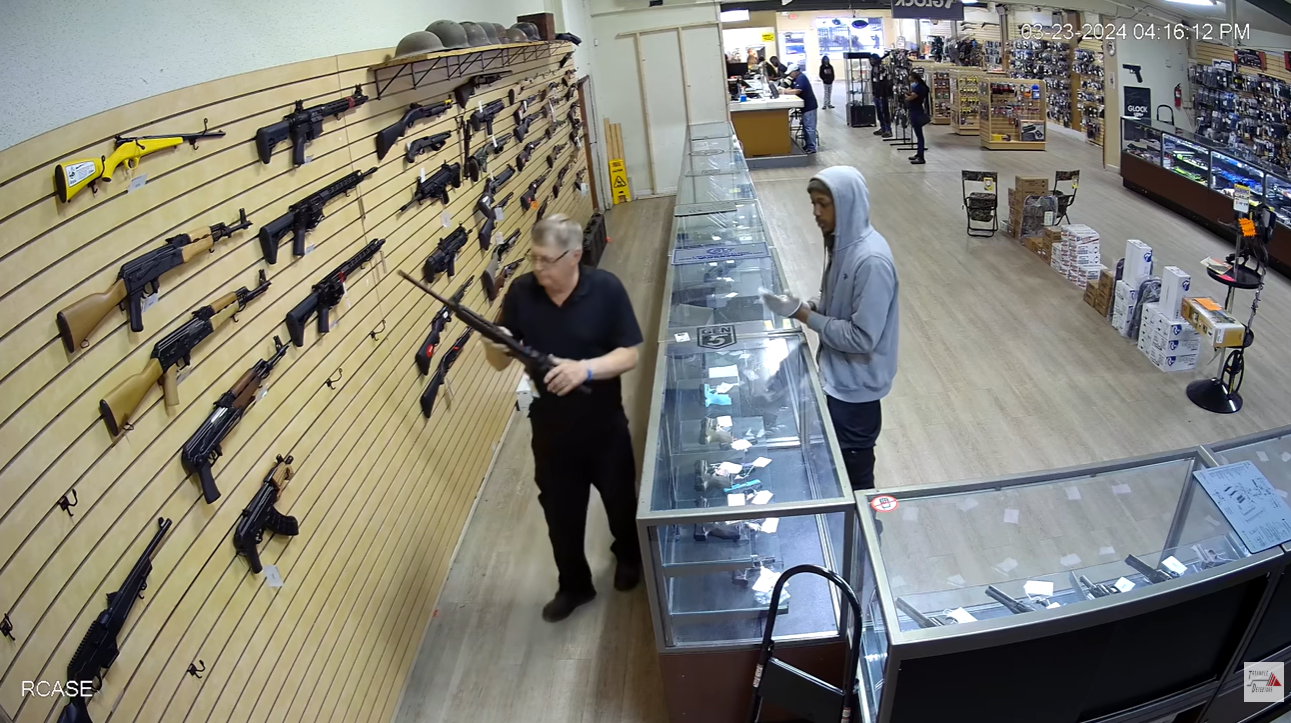
A man stands at the glass display counter of a gun store in Durham, North Carolina.
Firearms cover the wall behind the employee. Handguns sit beneath the glass. The customer appears to be doing what thousands of legitimate customers do every day: looking at products, asking questions and examining a firearm before deciding whether to purchase it.
But the surveillance footage captures something very different.
The man is not simply shopping.
Within moments, one of the firearms will disappear with him.
The video later published online as “Glock G47 Stolen” shows the interaction from a fixed security-camera position above the sales floor. According to the description accompanying the footage, the customer tries to get the employee to bring out two firearms at the same time.
He also reportedly explains why he is wearing gloves, telling the employee that a skin condition or cut requires him to wear them before handling anything.
That detail may seem insignificant.
Soon it becomes part of a much larger story.
The employee continues assisting him.
A handgun is placed on the counter.
The customer examines it.
The conversation appears ordinary.
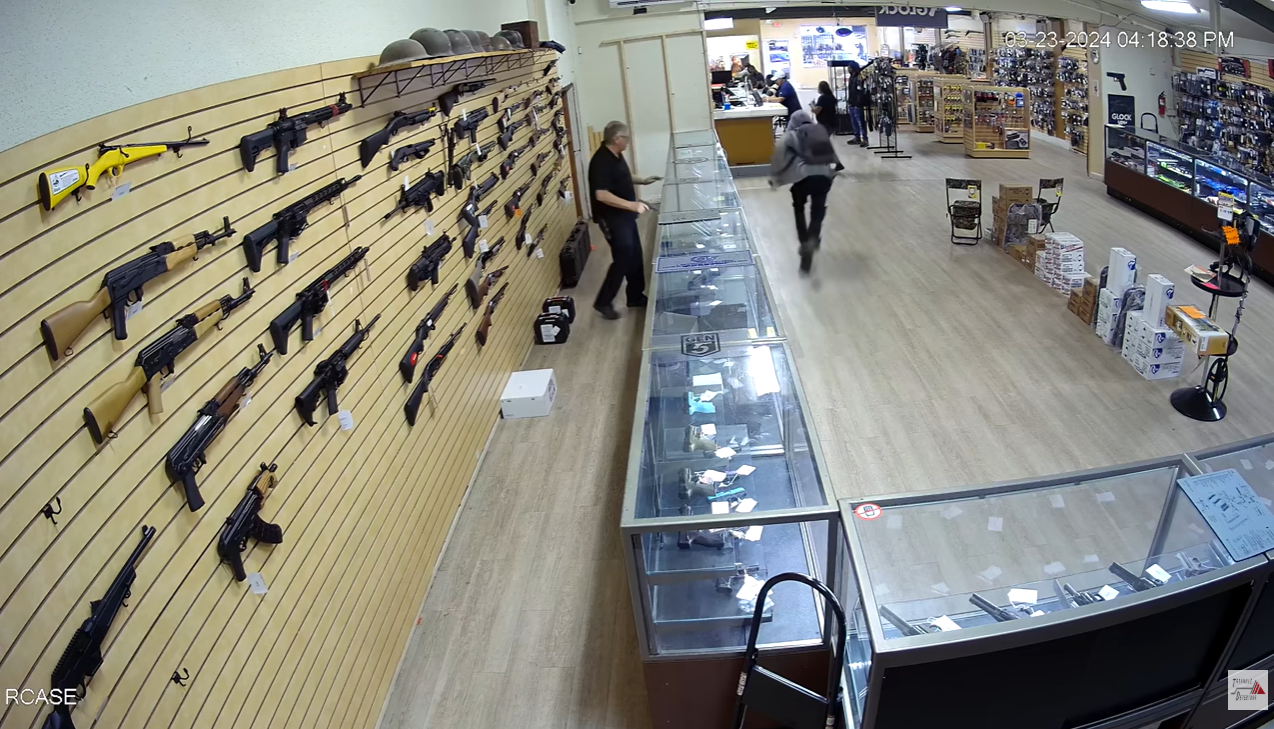
Then the employee's attention moves elsewhere.
The man sees his opportunity.
According to the video description, he grabs his identification and runs from the store with the handgun. The firearm is identified in the video as a Glock G47.
The entire theft takes far less time than the interaction leading up to it.
There is no dramatic break-in.
No shattered display case.
No masked group entering after closing time.
Instead, the firearm allegedly leaves through the front of the business during an ordinary customer interaction.
But the story does not end when the surveillance footage stops.
Court records later reported by North Carolina news outlets connect Aaron Deshown Williams, then 25, to an alleged firearm theft from Bull City Armory on Roxboro Road in Durham in March 2024. Williams was charged with offenses including altering the weapon's serial number and possession of a firearm by a felon.
Months later, his name would appear in local and national news again.
This time, the allegations would involve a Lowe's employee, a sledgehammer and injuries severe enough to send a 65-year-old man to the hospital.
What looks in the surveillance video like a remarkably simple gun-store theft therefore became one chapter in a much more troubling sequence of alleged crimes.
The Theft Happens in Plain Sight
The security footage is striking because of how little chaos surrounds the alleged theft.
The store is brightly lit.
Other merchandise is visible.
The employee is only feet away.
There is no obvious attempt to conceal the interaction from the security camera.
Instead, the suspect appears to rely on timing.
The employee has to balance several responsibilities during a firearm sale.
He needs to answer questions.
He needs to retrieve merchandise.
He needs to maintain control of firearms removed from secured areas.
And he needs to monitor the customer.
The suspect allegedly tries to get two firearms onto the counter at once.
That matters.
The more items an employee is managing, the more divided his attention can become.
The surveillance footage shows the employee and customer interacting across the glass case. At several moments, the customer appears focused on the handgun while the employee continues talking and handling merchandise.
Then the opportunity develops.
The employee looks away.
The suspect moves.
And the transaction suddenly becomes a theft.
The video's uploader describes the man as grabbing his identification and fleeing with the firearm.
What had been an ordinary retail interaction is over.
The employee is left behind.
The gun is gone.
News Reports Later Connect Aaron Williams to Bull City Armory
The video itself does not provide a full police report.
That is why the later reporting matters.
ABC11 and WRAL both reported that Aaron Deshown Williams had been accused of stealing a firearm from Bull City Armory, a gun shop on Roxboro Road in Durham. ABC11 described the allegation while reviewing Williams' history after his arrest in a separate 2024 case.
WRAL provided additional detail.
According to court records reviewed by the station, Williams was accused in March 2024 of stealing a Glock handgun from Bull City Armory. WRAL reported that he subsequently faced allegations involving alteration of the firearm's serial number and felony possession of a firearm by a felon.
Bull City Armory is a federally licensed firearm dealer located at 4528 A North Roxboro Street in Durham. ATF's current license verification records identify the business at that address.
Those details line up with the broader story surrounding the surveillance footage.
The YouTube upload identifies the stolen firearm as a Glock G47.
The video shows the theft occurring inside a firearm retailer.
And independent local reporting identifies Williams as having been accused of stealing a Glock from Bull City Armory in Durham during the same period.
Because the available news reports do not reproduce every detail of the original theft case, it is important not to add facts that the sources do not establish.
But the connection between Williams and the alleged Bull City Armory Glock theft is documented in multiple local reports.
Why a Stolen Firearm Creates a Different Kind of Theft Case
A stolen handgun is fundamentally different from most stolen retail merchandise.
If someone runs out of a store with clothing, electronics or tools, the business suffers a financial loss.
A stolen firearm introduces another concern.
The object can remain in circulation.
It can be transferred.
It can be concealed.
And it can potentially appear in later crimes.
That is why firearm thefts attract particular attention from law enforcement.
It also explains why allegations concerning the serial number matter.
A firearm's identifying markings help investigators trace its history.
When police recover a gun, tracing can potentially help establish where it was originally sold and how it entered a criminal investigation.
WRAL reported that Williams faced a charge involving alteration of the stolen firearm's serial number as well as possession of a firearm by a felon.
Those allegations move the case beyond a simple retail loss.
The firearm itself becomes evidence.
The store's surveillance footage becomes evidence.
Records connected to the weapon can become evidence.
And the suspect's identity and criminal history become relevant to investigators.
The video also illustrates a vulnerability unique to firearm retail.
Customers need to physically inspect products before making legitimate purchases.
Employees therefore have to place valuable and potentially dangerous merchandise within reach of people they may have met only minutes earlier.
Most customers follow the rules.
A single person exploiting that trust can create an immediate public-safety problem.
Months Later, the Same Name Appears in a Much More Violent Case
The gun-store footage might have remained a relatively obscure surveillance clip if Aaron Williams' name had not appeared again.
On the evening of July 27, 2024, police responded to a Lowe's Home Improvement store in the 4400 block of Fayetteville Road in Durham.
This time, the allegations were far more violent.
Investigators said an employee was helping Williams locate merchandise.
The employee was later identified as 65-year-old John Wilburn.
According to Durham police, Williams had a sledgehammer in his shopping cart.
During the interaction, he allegedly removed the sledgehammer and struck Wilburn in the head.
Wilburn collapsed.
Police said Williams then grabbed a drill-set box and ran from the store.
Emergency responders transported Wilburn to the hospital with serious injuries.
His family later said he suffered a fractured skull and broken hip. ABC11 reported that Wilburn had worked at Lowe's for eight years.
The contrast with the gun-store video is disturbing.
In the earlier footage, the alleged crime depends on distraction.
Wait until the employee looks away.
Take the handgun.
Run.
At Lowe's, according to police, the alleged theft involved direct violence against the employee.
The employee was not merely bypassed.
He was seriously injured.
Williams was arrested four days after the Lowe's attack and booked into the Durham County Jail. ABC11 reported that he faced aggravated assault and robbery allegations.
ABC News reported the allegations as assault with a deadly weapon with intent to kill inflicting serious injury and robbery with a dangerous weapon.
As with any criminal case, charges and allegations should not be described as convictions unless a court establishes guilt.
But the arrest caused reporters to examine Williams' existing court history.
That is when the earlier gun-store case resurfaced publicly.
Court Records Reveal a Longer Pattern of Legal Trouble
WRAL's review found that Williams already had multiple pending cases when he was arrested after the Lowe's attack.
The station reported that the March firearm case involved the alleged Glock theft from Bull City Armory.
It also identified other pending allegations in Wake County.
Williams had prior convictions as well.
WRAL reported that he had previously pleaded guilty to offenses involving speeding and driving without a license, and that in February 2021 he was convicted of felony fleeing to elude arrest while operating a motor vehicle.
The records also revealed a deeply complicated personal element.
According to WRAL, Williams' mother had filed for legal guardianship in July 2023 and sought to have him declared incompetent.
She wrote that her son had suffered a traumatic brain injury approximately a decade earlier while playing basketball and subsequently experienced paranoia and unpredictable behavior.
That information provides context.
It does not excuse criminal conduct, nor does it independently establish Williams' mental state during either the alleged firearm theft or Lowe's attack.
But it is part of the court record reported by journalists and helps explain why his history cannot responsibly be reduced to a simple label.
Criminal cases can contain multiple layers at once.
There can be victims who deserve accountability.
There can be serious public-safety concerns.
And there can also be questions about the defendant's cognitive or psychological condition.
Recognizing one does not erase the others.
The Lowe's Employee Survives, but the Attack Leaves Serious Damage
The most important person in the later case is not Williams.
It is John Wilburn.
Surveillance footage and headlines can easily turn violent incidents into stories about suspects.
But Wilburn was the person who absorbed the consequences.
He was working.
He was reportedly helping a customer.
Then he was struck in the head with a sledgehammer.
An employee interviewed anonymously by WRAL described discovering Wilburn on the floor after the attack and seeing blood around him. The witness said the experience made returning to work frightening.
Wilburn was transported to the hospital.
Initial reports described his injuries as serious but said his condition had stabilized.
ABC11 later reported the fractured skull and broken hip.
The fact that he survived should not make the attack sound minor.
A head injury from a heavy striking tool can change a person's life even when the victim survives the initial trauma.
Recovery can involve hospitalization, rehabilitation and lasting effects that are invisible in a short news report.
The incident also raised broader concerns among Lowe's employees about what workers should do when they suspect theft.
An anonymous employee told WRAL that workers worried about safety and about how quickly police were contacted. The worker described uncertainty surrounding company procedures for confronting or reporting suspected shoplifters.
That discussion reflects a problem far larger than this one case.
Retail employees are not police officers.
Merchandise can be replaced.
An employee's life cannot.
The alleged attack on Wilburn demonstrates how quickly a routine interaction with a suspected shoplifter can become violent.
The Gun-Store Video Looks Different Once You Know What Came Later
Watching the original Glock footage without context creates one impression.
It looks brazen.
A customer apparently walks into a firearm store, convinces an employee to let him examine a handgun and waits for a moment of distraction.
Then he runs.
There is an almost unbelievable simplicity to it.
Watching the same footage after reading the later court reporting creates another impression.
The alleged theft was not necessarily an isolated event in the suspect's contact with law enforcement.
WRAL reported that by the time Williams was arrested after the Lowe's attack, he had pending cases across multiple counties.
That does not mean every accusation should be merged into one assumption of guilt.
Each case has its own evidence.
Each allegation must stand on its own.
But chronology matters.
The alleged Bull City Armory theft occurred in March.
The Lowe's attack occurred in July.
When reporters examined Williams' history after the violent July arrest, the gun case became relevant again.
The surveillance video now functions as more than a viral theft clip.
It documents an earlier encounter connected to someone who would soon become the subject of much more serious headlines.
A Few Seconds of Distraction Were Enough
Perhaps the most striking part of the original incident is the imbalance between preparation and execution.
The suspect spends time inside the store.
He talks with the employee.
He handles the merchandise.
The situation develops slowly.
The actual alleged theft happens quickly.
That pattern appears in many forms of retail crime.
The critical moment is not necessarily when the suspect first enters the building.
It is the moment attention is divided.
Security systems can record the event.
Cameras can help identify the person afterward.
Inventory records can establish what disappeared.
But none of those tools physically prevent someone from running once a firearm is within reach.
That makes employee procedures especially important at firearm retailers.
Again, legitimate customers need access to merchandise.
A store cannot operate by treating every visitor as a thief.
But firearms require tighter control than ordinary products precisely because the consequences of losing one extend beyond its retail value.
This case demonstrates that tension in less than a minute.
The employee is trying to provide customer service.
The customer appears interested in the product.
Then trust is exploited.
And the handgun leaves with someone who, according to later court reporting, was legally prohibited from possessing it.
The Story Doesn't End at the Door of the Gun Store
If the surveillance footage were the only evidence available, the story would be straightforward.
A man examines a Glock.
The employee becomes distracted.
The man runs.
End of video.
But real criminal investigations do not stop where viral clips stop.
Police identify suspects.
Court records accumulate.
Separate cases reveal connections.
Journalists revisit previous allegations.
In Aaron Williams' case, the alleged firearm theft became part of the history reporters uncovered after the Lowe's attack.
ABC11 specifically noted that Williams had previously been accused of stealing a gun from Bull City Armory on Roxboro Road.
WRAL went further, identifying the stolen firearm as a Glock handgun and reporting the associated allegations involving its serial number and possession by a felon.
Then came July.
A Lowe's employee was seriously injured.
Police searched for Williams.
Four days later, they arrested him.
What began months earlier as a quiet interaction across a glass gun-store counter had become part of a much larger public record.
One Camera Captures Only the Beginning
Security cameras are powerful because they preserve moments people might otherwise dispute.
The footage from the gun store captures behavior.
It shows the layout.
It shows the employee.
It shows the customer.
It shows how close they are to one another.
And it shows how quickly an apparently normal interaction can change.
But cameras do not explain everything.
They do not tell us what someone is thinking.
They do not independently establish every element of a criminal charge.
And they cannot show what will happen months later.
That is where reporting, court records and police investigations become essential.
In this case, those sources reveal the larger sequence.
A Glock was allegedly stolen from Bull City Armory in March 2024.
Aaron Deshown Williams was accused in connection with that theft and later faced firearm-related charges.
On July 27, Durham police say Williams attacked 65-year-old Lowe's employee John Wilburn with a sledgehammer and fled with merchandise.
Wilburn survived but suffered serious injuries, including a fractured skull and broken hip, according to his family.
Williams was arrested four days later.
The gun-store surveillance footage therefore captures only an early chapter.
And perhaps that is what makes it so unsettling.
Nothing in the first seconds tells the viewer how much larger the story will become.
There are no police lights.
No violent struggle.
No dramatic chase.
Just a customer and an employee standing across a counter.
Then the employee looks away.
The customer moves.
And a Glock disappears out the door.
Months later, the same man's name would appear in headlines attached to an allegation far more violent than the theft captured on that camera.
The original footage lasts barely more than a minute.
The consequences did not.
Watch the complete surveillance footage and see how an ordinary-looking gun-store interaction suddenly turns into the alleged theft of a Glock G47 here: PASTE-YOUR-LINK-HERE: https://www.youtube.com/watch?v=kRWsXLQhPqE
Comments (0)
Loading comments...
May You Like

Stolen Charger Flees Police During Highway Traffic Stop

Police Chase Ends as Driver Hits Stoplight, Crashes Into West Towne Mall

[DASHCAM] Drunk Driver Leads Trooper on High-Speed Pursuit Through City Streets













