
[BODYCAM] Watch What Happens When This Fleeing Suspect Hides Under a Pool Cover
Suspect Flees a Traffic Stop, Climbs Rooftops and Hides Under a Pool Cover
A suspicious vehicle, an attempted traffic stop and a decision to run turned into one of Pierce County's more unusual manhunts of the summer. On the evening of August 13, 2026, deputies working with a regional auto-theft task force encountered a vehicle near 72nd Street and Portland Avenue in the Tacoma area. The registration did not check out normally, and deputies developed reasonable suspicion that the vehicle might be stolen.
The driver could have stopped and allowed deputies to investigate. Instead, he accelerated away.
What followed was not a conventional bumper-to-bumper police pursuit. A supervisor made the decision to back deputies away and let a Washington State Patrol aircraft known as “Smokey” follow the vehicle from above. That decision transformed the encounter into a coordinated aerial surveillance operation. The fleeing driver could create distance from patrol cars, but he could not easily disappear from an aircraft watching from thousands of feet above Pierce County.
The vehicle eventually entered a neighborhood near the 7000 block of South M Street. The driver and passenger abandoned it and ran. The vehicle, deputies later learned, was not stolen after all. But by then, the driver's attempt to escape had created an entirely new set of problems.
With the aircraft tracking his movements, the driver jumped fences, climbed onto rooftops and moved through residential yards. Eventually he reached a backyard with a swimming pool. There, according to the Pierce County Sheriff's Office, the 37-year-old man chose an extraordinary hiding place: beneath a pool cover, in the water.
Deputies found him. They could hear him breathing beneath the cover. They repeatedly ordered him to come out. He refused. For roughly 20 minutes, the strange standoff continued before deputies approached the pool and pulled him from the water.
The man was arrested for felony eluding, first-degree driving while license suspended and obstruction. The passenger, who had also fled on foot, was not arrested because deputies said they lacked probable cause to take that person into custody. The vehicle was impounded.
The official Pierce County Sheriff's Office account is almost difficult to believe without the video. Yet the supplied footage provides a remarkable second perspective: the Washington State Patrol aircraft's view from above. It shows the suspect vehicle moving through Tacoma-area streets and later shows the aircraft searching residential blocks where the driver attempted to disappear.
A Multi-Agency Auto-Theft Operation Spots a Suspicious Vehicle
The incident began at approximately 8:30 p.m. on August 13. Pierce County deputies were participating in a multi-agency emphasis with the Puget Sound Auto Theft Task Force when they spotted the vehicle near 72nd Street and Portland Avenue.
The location visible in the aircraft footage matches the Sheriff's Office account. The aerial system displays Tacoma-area street information, including Portland Avenue East and East 72nd Street. A Safeway sign and surrounding commercial properties provide additional visual landmarks.
Deputies checked the vehicle's registration and received an invalid return. That did not prove the vehicle was stolen, but it gave deputies reason to investigate further. The Sheriff's Office said deputies developed reasonable suspicion that the vehicle could be stolen and attempted a traffic stop.
That distinction is important. Police did not know with certainty that the vehicle was stolen when the stop began. The purpose of the stop was to investigate suspicious information associated with the vehicle.
The driver did not remain to resolve that question.
Instead, the vehicle fled at high speed. Once that happened, deputies had to decide whether staying immediately behind it was worth the risk of a ground pursuit through an urban area.
Deputies Back Off and Let “Smokey” Take Over
One of the most significant decisions in the incident came early. Rather than maintaining a close ground pursuit, a sergeant directed deputies to back off and allowed Washington State Patrol's aircraft to track the vehicle.
The Sheriff's Office identified the aircraft by its familiar name, “Smokey.” Washington State Patrol aviation units can provide law-enforcement agencies with a perspective that patrol cars simply cannot match. From altitude, an aircraft can follow a vehicle across intersections, around buildings and through neighborhoods while ground units remain farther away.
This tactic can reduce some of the dangers associated with a traditional pursuit. A fleeing driver who no longer sees police vehicles immediately behind him may reduce speed. Officers can avoid racing through traffic while still maintaining awareness of where the suspect is going.
The aircraft footage demonstrates that advantage. The camera operator can remain focused on the target while the map overlay identifies streets and direction of travel. The vehicle may turn through a commercial area or residential block, but the aircraft continues watching from above.
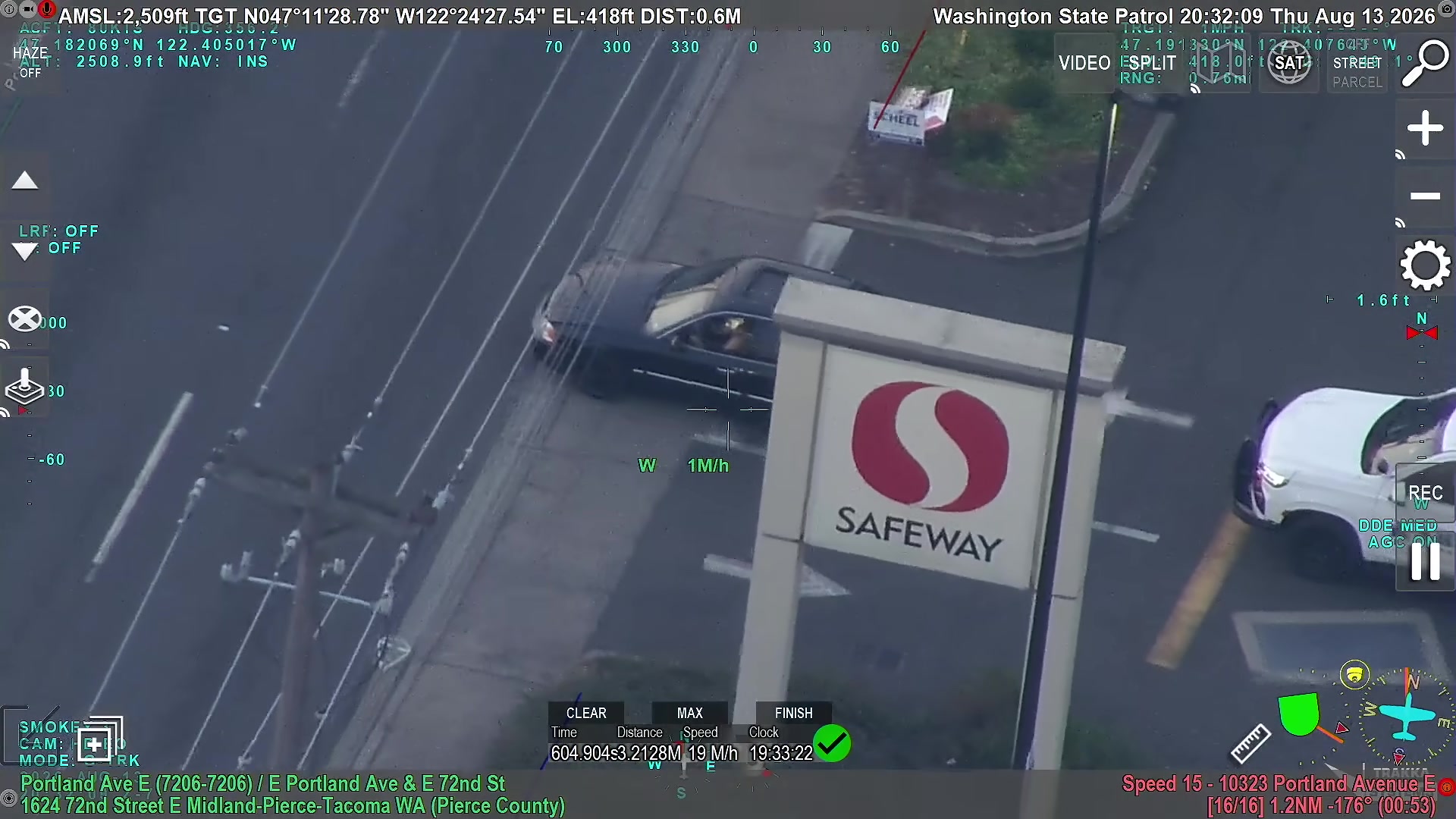
The on-screen display is unusually informative. It shows the Washington State Patrol identifier, date and time, geographic coordinates, altitude and street information. At one point, the system places the aircraft more than 2,500 feet above the area while the camera remains tightly focused on the vehicle below.
For a fleeing driver, that creates a major problem. A patrol car can be lost around a corner. An aircraft has a much broader field of view.
The Driver and Passenger Abandon the Vehicle
The fleeing vehicle eventually entered a neighborhood near the 7000 block of South M Street. There, the driver and passenger abandoned it and continued on foot.
This is a familiar turning point in police pursuits. Drivers sometimes assume leaving the vehicle will make tracking more difficult. On the ground, that can be true. A person can move through narrow spaces unavailable to patrol cars, jump fences, enter yards and use buildings or vegetation as concealment.
But an aircraft changes that calculation.
From above, the crew can watch a person move from one property to another and relay those movements to deputies on the ground. Officers do not necessarily need to chase directly behind the suspect. They can move toward predicted exit points while the aircraft maintains observation.
The supplied video shows the search transitioning from streets to a dense residential environment. Houses, garages, backyards, trees and fences fill the camera view. The thermal and aerial imaging modes allow the crew to examine areas that would be difficult for officers to see from street level.
Meanwhile, investigators made an ironic discovery: the vehicle that deputies initially suspected might be stolen was not actually stolen.
Had the driver stopped, that fact could have been established during the original investigation.
The Escape Becomes a Rooftop and Backyard Manhunt
The driver's decision to run did not end when he left the vehicle. According to the Sheriff's Office, he jumped fences and climbed onto rooftops while trying to avoid deputies.
Residential neighborhoods provide countless places to hide, but they also create additional risks. A fleeing person may enter private property, encounter homeowners, damage fences or roofs, or unexpectedly appear in yards where residents have no idea a police operation is underway.
Deputies must also be careful. Searching yard by yard at night is slow and dangerous. Officers may not know whether a person is armed or whether an unrelated resident will mistake police activity for a break-in.
This is where the aircraft's role becomes especially valuable. Rather than sending deputies blindly through every yard, the aircrew can provide updates about where the suspect is moving.
The video shows the aircraft examining the South M Street area from above. The camera switches into a monochrome mode that makes streets, buildings and vegetation appear in sharp contrast. Street labels such as South M Street and South 72nd Street remain visible on the mapping overlay.
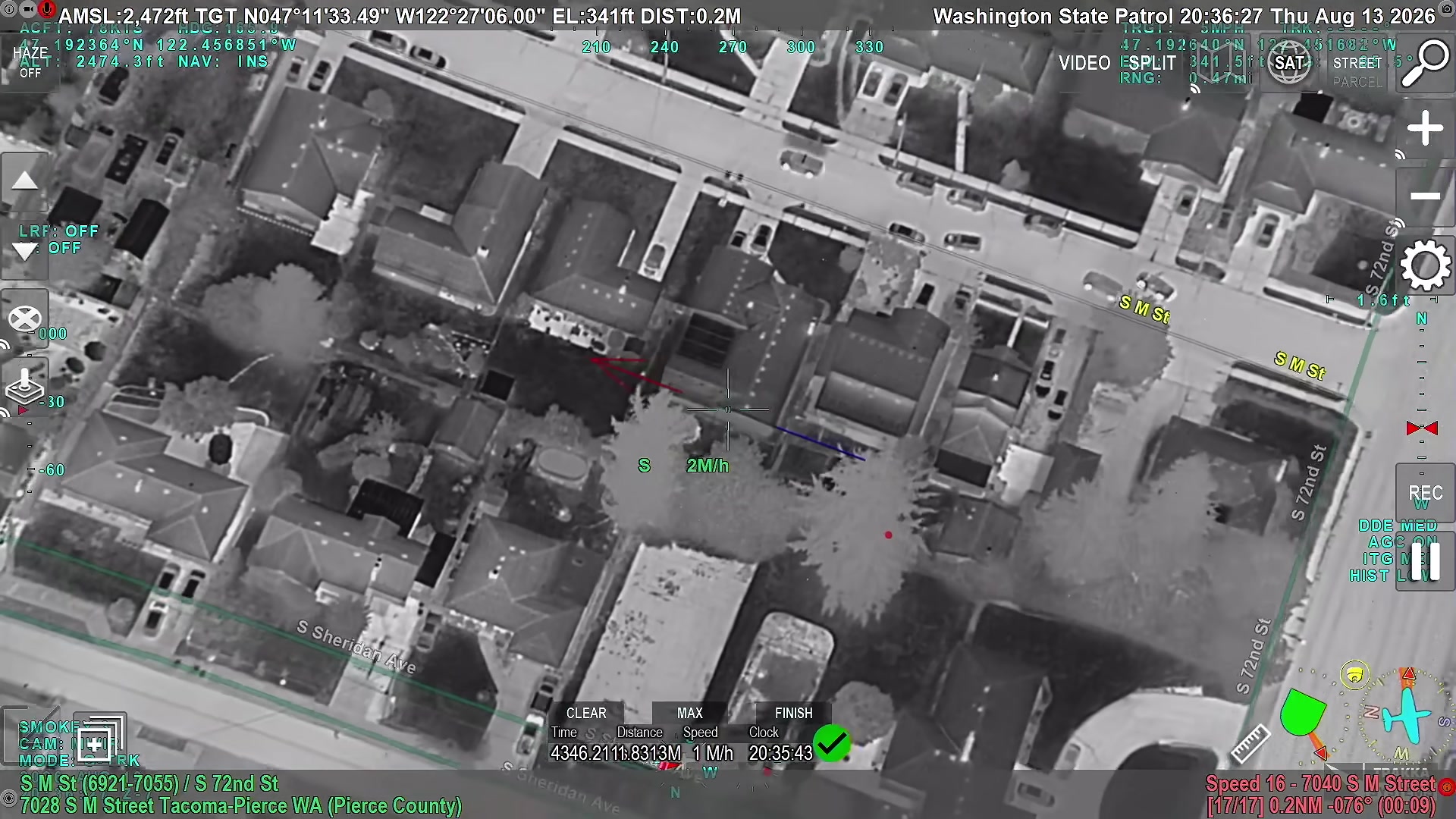
The view emphasizes the scale of the problem. From street level, each fence and building blocks sightlines. From the aircraft, the neighborhood becomes a grid. A suspect may believe a backyard has removed him from police view while the crew above can still track his general location.
The Driver Finds a Swimming Pool
Eventually, the man entered a backyard containing a swimming pool.
At that point, his escape strategy took an unusual turn.
According to the Pierce County Sheriff's Office, the suspect got into the pool and hid beneath the pool cover. The choice may have seemed clever in the moment. A pool cover can obscure someone from officers approaching on foot, especially after dark. A person lying low in the water might believe deputies will search sheds, bushes or neighboring yards and move on.
But hiding in water creates obvious problems. A person still has to breathe. Remaining concealed becomes physically exhausting. And if police already know which yard the suspect entered, the number of possible hiding places becomes much smaller.
The deputies reached the backyard.
Then they heard breathing.
Deputies Realize Someone Is Under the Pool Cover
The Sheriff's Office said deputies could hear the suspect breathing beneath the pool cover. At that point, the hiding place had failed.
Yet the man still refused to come out.
Deputies gave him repeated commands to emerge. He remained beneath the cover. The resulting standoff lasted approximately 20 minutes.
The situation sounds almost comedic when summarized afterward, but officers at the scene still had to treat it carefully. They did not know whether the suspect had a weapon. A pool cover obstructed their view of his hands and body position. Entering the water or reaching beneath the cover could place deputies in an awkward physical position.
There was also a medical risk. Remaining under a pool cover while trying to breathe through a limited opening could become dangerous, particularly after the physical exertion of fleeing, jumping fences and climbing roofs.
The safest outcome was for the suspect to follow commands and come out voluntarily.
He did not.
Twenty Minutes Later, Deputies Go In
After approximately 20 minutes of commands and waiting, deputies approached the pool and physically removed the suspect.
The prolonged delay demonstrates the limits of hiding once police have confirmed a person's location. At that point, concealment no longer creates an escape opportunity. It merely postpones the arrest.
The Sheriff's Office's own summary captured the absurdity of the outcome with a warning that if an escape plan ends with hiding underwater, it may be time for a different plan.
But behind the humor is a serious point about police pursuits. The driver had already created substantial legal exposure by fleeing in the vehicle. Continuing to run, enter private property and refuse commands could only make the situation more complicated.
The Vehicle Was Not Stolen After All
Perhaps the most striking detail in the entire incident is that the vehicle was ultimately determined not to be stolen.
Deputies had attempted the original stop because the registration returned invalid and they had reasonable suspicion that the vehicle could be stolen. That was a question to be investigated, not a conclusion already established.
If the driver had stopped, deputies could have checked the vehicle, spoken with the occupants and determined its status without the aerial pursuit and neighborhood search.
Instead, the decision to flee created probable cause for an entirely different investigation.
This pattern appears repeatedly in law-enforcement cases. A person may run because they fear what police will discover, but fleeing itself can become the most serious part of the encounter. Even when the original suspicion turns out to be wrong or less serious than expected, the conduct during the attempted escape does not simply disappear.
A 37-Year-Old Man Faces Three Allegations
The Pierce County Sheriff's Office said the driver was a 37-year-old man. Officials did not identify him by name in the public blotter post.
He was arrested for felony eluding, driving while license suspended in the first degree and obstruction.
Those are arrest allegations rather than a statement of final conviction. The public Sheriff's Office account did not provide a later court disposition, and this article does not assume how the case was ultimately resolved.
The charge list nevertheless explains why the driver may have been motivated to avoid contact. A first-degree suspended-license allegation is a serious licensing problem, and the attempted flight added felony eluding and obstruction allegations.
Whatever the driver's reason for leaving, the result was that an investigation that began with an invalid registration return ended with a felony arrest.
The Passenger Also Runs but Is Not Arrested
The passenger fled from the abandoned vehicle as well. However, the Sheriff's Office said deputies did not have probable cause to arrest that person.
This detail is important because it demonstrates that being present during a police incident does not automatically make someone criminally responsible for the driver's conduct.
Police need legal justification for each arrest. The driver's actions and legal status created one set of facts. The passenger's actions created another. According to the Sheriff's Office, the available evidence did not establish probable cause to arrest the passenger.
That distinction adds credibility to the official account because it shows the investigation did not simply treat everyone associated with the vehicle as equally culpable.
Why the Aircraft Changed the Entire Pursuit
Without Washington State Patrol's aircraft, the incident could have unfolded very differently.
Ground deputies faced a difficult choice when the vehicle accelerated away. Continuing a close pursuit through Tacoma-area streets could have increased the danger to other motorists and pedestrians. Terminating the pursuit entirely might have allowed the driver to disappear.
The aircraft provided a third option.
Deputies could create distance while the aircrew continued watching. That approach preserved the ability to locate the vehicle without requiring patrol cars to remain immediately behind it at high speed.
Once the suspects abandoned the vehicle, the aircraft became even more useful. A person moving through yards can quickly vanish from ground officers. From the air, movements across roofs, fences and open spaces can remain visible.
The technology visible in the supplied footage shows how sophisticated modern aerial law-enforcement surveillance has become. The camera can zoom from a broad neighborhood view to an individual vehicle. Mapping data identifies roads beneath the aircraft. Coordinates and altitude remain displayed. Thermal-style imagery can improve visibility in low-light environments.
That does not make the aircraft all-seeing. Trees, buildings and covered spaces can still hide people. But it dramatically changes the odds.
The Pool Cover Was One of the Few Places the Aircraft Could Not Simply See Through
The suspect's eventual choice of a covered pool is interesting precisely because it exploits one of the limitations of aerial observation.
A roof blocks a camera. Dense structures block a camera. A pool cover can also conceal a person from direct visual observation.
But concealment from the aircraft did not mean concealment from deputies on the ground.
The aircrew had already helped officers narrow the search to a particular area. Once deputies entered the backyard, the suspect's breathing reportedly gave away the final hiding place.
The case therefore became a demonstration of how aerial and ground units complement each other. The aircraft maintained the larger picture. Deputies handled the close search. Neither perspective alone was as effective as the two working together.
Why Police Backing Off Can Be More Effective Than Chasing Closely
To viewers accustomed to pursuit videos, seeing patrol cars back away can look like police are allowing a suspect to escape. In some situations, the opposite is true.
A close pursuit can encourage a fleeing driver to continue at extreme speed. The suspect constantly sees emergency lights in the mirror and reacts to every movement of the police car. If an aircraft can maintain surveillance, ground officers may be able to reduce that pressure while still tracking the vehicle.
This tactic is not available in every jurisdiction or every incident. Aircraft are expensive, weather can limit operations and crews cannot always arrive quickly enough. But when aviation support is already present, it can give supervisors more options.
In this case, the Sheriff's Office explicitly said the sergeant chose to back off and let Smokey safely track the vehicle.
The suspect still fled, but deputies did not need to remain directly behind him throughout the entire route.
From a Registration Question to a Neighborhood Search
The escalation is remarkable when the incident is viewed as a timeline.
Deputies see a vehicle with an invalid registration return.
They develop reasonable suspicion that it could be stolen.
They attempt a stop.
The driver flees.
Ground units back away while an aircraft tracks the vehicle.
The driver and passenger abandon the car.
The driver runs through a neighborhood, jumps fences and climbs roofs.
He enters a backyard.
He gets into a swimming pool and hides beneath the cover.
Deputies hear him breathing.
He refuses repeated commands for approximately 20 minutes.
Deputies pull him from the pool and arrest him.
Then investigators confirm that the vehicle was not stolen.
That final fact gives the story its strongest irony. The initial suspicion that triggered the attempted stop did not become the main legal problem. The escape did.
Why the Video Is So Effective at Holding Attention
The footage has an unusual advantage over many pursuit videos: the viewer sees the incident from a perspective the suspect cannot.
The driver may believe he has lost the deputies. The audience can see the aircraft still watching.
The occupants abandon the vehicle and run. The audience can see the camera move into the neighborhood.
The search becomes harder as houses and trees fill the screen, creating genuine uncertainty about whether the suspect will disappear.
Then the official account provides the final twist: the hiding place is not a shed, attic or crawlspace. It is a swimming pool.
This structure naturally creates reader retention. Each stage resolves one question while introducing another. Will deputies keep pursuing? Can the aircraft maintain contact? Where will the occupants run? Can officers find the driver? Why does the search suddenly stop at a backyard?
The story does not need invented danger or exaggerated claims. The real sequence is already unusual enough.
The Arrest Ends a Search That Never Needed to Happen
There is an obvious practical lesson in the incident. Running did not solve the driver's problem.
The vehicle was not stolen. Yet instead of staying at the scene while deputies investigated the registration issue, the driver created a pursuit and then a neighborhood manhunt.
The attempt to escape required coordination among Pierce County deputies, the Puget Sound Auto Theft Task Force and Washington State Patrol aviation. It led officers into residential yards and eventually into a backyard pool.
The driver still ended up in custody.
For the surrounding community, the incident also demonstrates how one person's decision can affect people who have no involvement in the original stop. Residents suddenly had police moving through their neighborhood. A homeowner's pool became part of an arrest scene. Patrol resources were diverted to searching for a fleeing suspect.
What the Official Record Confirms
The Pierce County Sheriff's Office published its account on August 21, 2026, eight days after the incident. The agency confirmed the approximate time and location, the multi-agency auto-theft operation, the invalid registration, the attempted stop, the decision to use the State Patrol aircraft, the abandonment of the vehicle, the rooftop and fence-hopping escape, the pool hiding place and the eventual arrest.
The aircraft footage independently reinforces many of those details. Its overlay displays August 13, 2026, Tacoma/Pierce County mapping data and Washington State Patrol identification. The Safeway near Portland Avenue and 72nd Street is visible early in the recording, and later frames place the search around South M Street and South 72nd Street.
Local television outlet KING 5 also reported the incident, describing the suspect's failed attempt to hide underwater during the Pierce County chase.
Together, the official Sheriff's Office account, local reporting and the supplied aircraft video provide an unusually strong match between written documentation and visual evidence.
An Escape Plan That Ended Under a Pool Cover
The incident began with uncertainty about a vehicle registration. It ended with deputies standing beside a swimming pool listening for a suspect beneath the cover.
Between those two moments came a vehicle pursuit, aerial surveillance, an abandoned car, a foot chase, fences, rooftops and a 20-minute refusal to surrender.
The 37-year-old driver was ultimately arrested for felony eluding, first-degree driving while license suspended and obstruction. The passenger was not arrested. The vehicle was impounded and determined not to have been stolen.
The outcome makes the original decision to flee difficult to understand in hindsight. But that is precisely why the footage is compelling. Viewers watch a person repeatedly choose another layer of escape even as the chances of getting away become smaller.
First the driver tries the car.
Then he tries running.
Then fences and rooftops.
Finally, he tries disappearing beneath the surface of a backyard pool.
None of it works.
Watch the Full Search
The pool arrest is the memorable ending, but the aerial footage shows why deputies were able to reach that backyard in the first place. From the initial sighting near Portland Avenue and 72nd Street to the search around South M Street, the Washington State Patrol aircraft provides a rare overhead view of how a suspect can be tracked even after ground units deliberately create distance.
Comments (0)
Loading comments...
May You Like

Cop thinks sandwich is phone

One Driver’s Decision to Flee Brings Police Racing After Him

[DASHCAM] Drunk Driver Leads Trooper on High-Speed Pursuit Through City Streets














