
[BODYCAM] Police's daring collision and interception
Arkansas Trooper Deliberately Takes a 100 MPH Head-On Crash to Stop a Wrong-Way Driver
On a September night in Little Rock, an Arkansas State Police trooper faced the kind of decision that leaves almost no time for hesitation. A fleeing driver had entered Interstate 630 in the wrong direction and was racing east through westbound traffic at approximately 100 mph. Motorists ahead had little warning that a vehicle was coming directly toward them. Trooper Austin Duncan was traveling west on I-630 to assist another trooper when the radio traffic changed the nature of the call completely.
Duncan was no longer simply responding to a pursuit. He was driving toward a wrong-way vehicle that could collide head-on with an unsuspecting motorist at interstate speed.
Near the University Avenue exit ramp, Duncan positioned his Arkansas State Police cruiser on the shoulder with its emergency lights activated. The suspect vehicle approached rapidly. Duncan moved his patrol unit into its path. The driver swerved around him. Duncan then turned the cruiser again, deliberately placing it in front of the fleeing vehicle.
The vehicles collided head-on.
The impact stopped the wrong-way driver. Duncan then took the female passenger into custody and immediately told responding officers that the male driver had fled on foot. His actions later earned him the Arkansas State Police Trooper of the Year Award for 2023, as well as recognition for valor.
The award was announced on June 27, 2024, during the annual Arkansas State Police awards ceremony hosted by the Arkansas State Police Foundation. State Police officials credited Duncan's quick thinking and willingness to place himself in extreme danger with preventing a potentially catastrophic collision involving an innocent motorist.
The supplied video is short, but it captures the reason the award mattered. The incident is not simply another pursuit clip. It shows an officer making a deliberate decision to use his own vehicle as a barrier against a car traveling the wrong direction at highway speed.
A Pursuit Begins on I-430
The incident occurred on September 15, 2023. According to the Arkansas State Police account later released with the award announcement, Trooper Joseph Killian attempted to stop a vehicle on northbound Interstate 430 near Shackleford Road.
The driver fled.
At first, this was a conventional vehicle pursuit. Killian was attempting to stop a motorist who had refused to yield. But the fleeing driver soon made a decision that dramatically increased the danger: the vehicle merged onto Interstate 630 and began traveling eastbound in the westbound lanes.
Wrong-way driving on an interstate is among the most dangerous situations police can encounter. Closing speeds can become enormous. If one vehicle is traveling 70 mph and another approaches in the opposite direction at 100 mph, the distance between them can disappear at a combined rate equivalent to 170 mph.
An innocent driver may see headlights ahead but initially assume the other vehicle is on the opposite side of the interstate. By the time the mistake becomes obvious, there may be only seconds to react.
Police therefore faced a rapidly developing emergency. The suspect was not merely trying to escape. Every westbound motorist on I-630 had become a potential victim.
Austin Duncan Was Driving Toward the Threat
Duncan was already traveling westbound on I-630 while responding to assist Killian. He heard radio traffic warning that the suspect vehicle was coming east in the westbound lanes.
That placed Duncan in an unusual position. Most pursuing officers are behind a fleeing vehicle. Duncan was ahead of it, traveling toward it.
He continued westbound past other motorists until reaching the University Avenue exit ramp. The decision to continue toward the wrong-way vehicle meant Duncan was placing himself between the suspect and drivers farther west.
According to Arkansas State Police, Duncan pulled onto the shoulder and activated his emergency lights. This gave approaching motorists a visible warning and placed his cruiser where he could react to the suspect vehicle.
But a parked police car on the shoulder was not enough to stop a vehicle moving at roughly 100 mph.
Duncan would have to move into its path.
The Suspect Vehicle Approaches at About 100 MPH
The speed is what turns the encounter from dangerous into extraordinary.
A vehicle traveling 100 mph covers approximately 147 feet every second. At that rate, Duncan had only a small window in which to judge the suspect's path, move the cruiser and respond if the driver attempted to avoid him.
The first attempt did not immediately work. Arkansas State Police said Duncan maneuvered his patrol vehicle into the path of the approaching car, but the suspect swerved around him.
That moment could have been the point at which Duncan remained out of the way and allowed the vehicle to continue. Instead, he repositioned.
Duncan turned his patrol unit back into the vehicle's path.
This time there was no escape route.
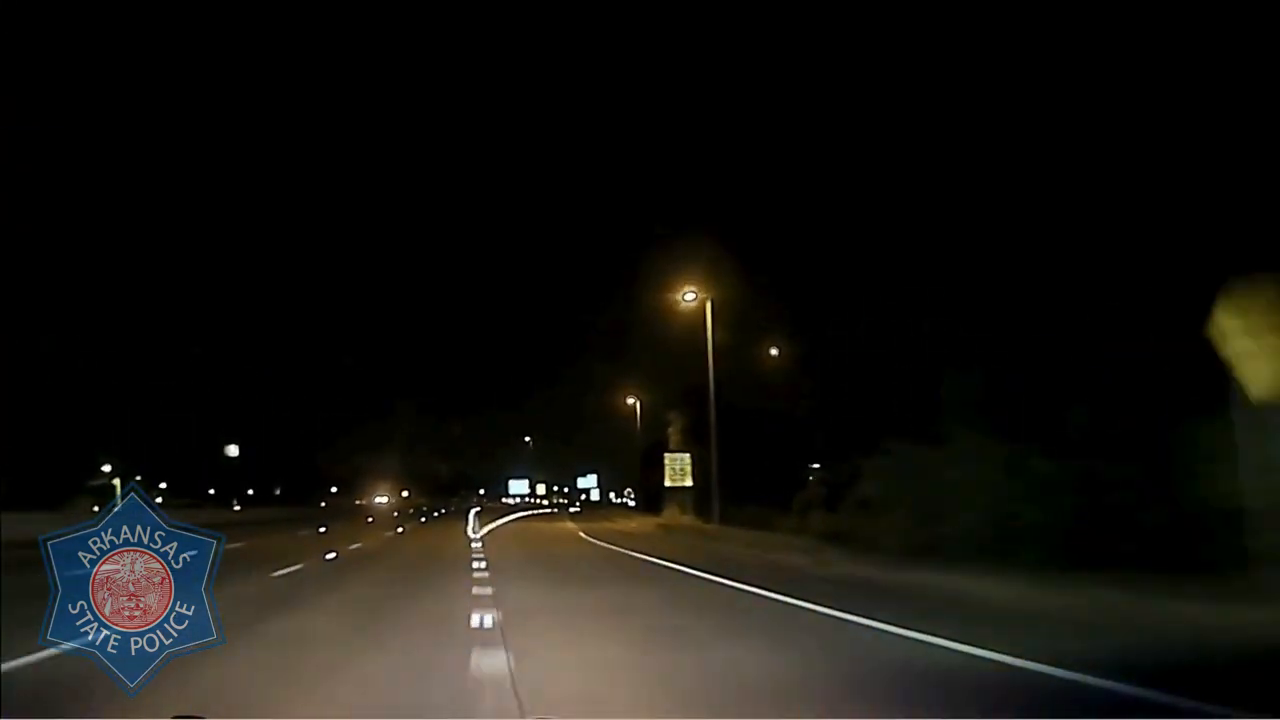
The Head-On Collision Was Deliberate
Police officers are normally trained to avoid head-on crashes. Duncan intentionally accepted one.
The distinction is important. The collision was not simply the accidental ending of a pursuit. According to the official Arkansas State Police account, Duncan knowingly positioned his cruiser so the wrong-way vehicle would hit him instead of continuing toward other motorists.
The two vehicles collided head-on, bringing the suspect vehicle to a stop.
State Police later said Duncan's actions “undoubtedly prevented” the fleeing car from striking another motorist head-on at extremely high speed. That conclusion became the central reason he was selected as the agency's Trooper of the Year for 2023.
The choice involved an extraordinary personal risk. Patrol cars provide significant crash protection, but no vehicle can make a 100 mph wrong-way collision safe. Duncan could not know precisely how the impact would occur, whether the suspect would strike his cruiser squarely, whether either vehicle would roll or whether the collision would push them into passing traffic.
Yet allowing the suspect to continue presented another danger: an uninvolved driver might absorb the same impact without warning.
Duncan effectively transferred that risk onto himself.
The Video Shows Why Seconds Mattered
The supplied footage compresses the event into a short, violent sequence. That brevity is part of what makes it powerful.
There is no long negotiation and no extended tactical setup. The conditions do not allow one. The suspect is approaching at highway speed in lanes intended for traffic traveling the opposite direction.
In situations like this, delay is itself a decision. Every additional second allows the wrong-way vehicle to travel another 147 feet at 100 mph.
The interstate environment makes the problem worse. Unlike a city street, I-630 provides drivers with few opportunities to escape laterally. Concrete barriers, ramps and traffic can limit evasive options. Motorists may also be traveling at normal highway speed, reducing the time available to process an unexpected threat.
Duncan's response therefore had to occur before the wrong-way vehicle reached another driver.
After the Crash, Duncan Immediately Returns to Police Work
The head-on collision was not the end of the incident.
Arkansas State Police said Duncan took the female passenger in the suspect vehicle into custody after the crash. He also advised responding officers that the male driver had fled on foot.
That transition is significant. Duncan had just been involved in a deliberate head-on collision, yet the scene still had to be secured. Officers needed to account for occupants, determine whether anyone was injured, locate the fleeing driver and protect the interstate from secondary crashes.
The aftermath of a high-speed collision can be chaotic. Disabled vehicles may block lanes. Debris can scatter across the roadway. Drivers approaching from behind may not understand what has happened. Officers must manage those hazards while also dealing with suspects.
The supplied footage gives only a limited view of that aftermath, but the official account confirms Duncan remained engaged in the arrest response immediately after the collision.
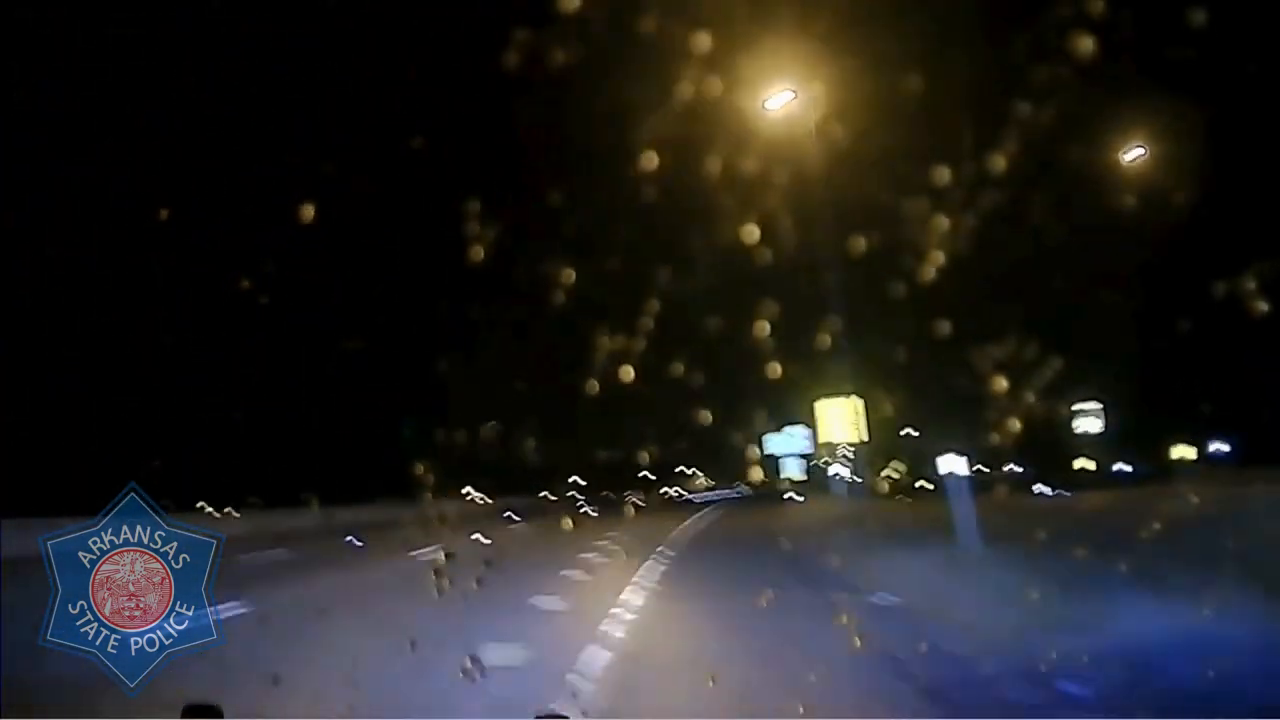
Why Wrong-Way Interstate Driving Is So Dangerous
Wrong-way crashes are uniquely destructive because they often involve direct frontal impacts at high combined speeds.
Modern vehicles are engineered with crumple zones, airbags and passenger compartments designed to absorb collision energy. Those systems greatly improve survival, but physics still imposes limits. A high-speed frontal collision can overwhelm even sophisticated safety systems.
Wrong-way drivers also remove one of the normal protections motorists rely on: predictable traffic flow. Drivers expect vehicles in their lane to be moving in the same direction. They look behind before changing lanes and ahead for slower traffic. They do not normally expect a vehicle to appear directly ahead traveling toward them.
That expectation can delay recognition. At night, headlights can further complicate perception because a motorist may initially believe the lights belong to traffic on the opposite side of the highway.
By the time the danger is recognized, closing speed can leave little room for braking or steering.
This explains why Arkansas State Police characterized Duncan's action as preventing an imminent threat to other motorists rather than merely ending a pursuit.
From Benton Police Officer to Arkansas State Trooper
Duncan's career provides additional context for the award. Arkansas State Police records show he joined the agency in 2020. He graduated with the 2020 recruit class and was assigned to Highway Patrol Division Troop A in Pulaski County.
Before becoming a state trooper, Duncan had served with the Benton Police Department. Local reporting from MySaline noted his earlier Benton law-enforcement background when covering his Trooper of the Year recognition.
By the time of the September 2023 incident, Duncan had several years of state-police experience. But experience alone cannot make a decision like this routine. Deliberately moving into the path of a wrong-way vehicle at approximately 100 mph is an extreme circumstance even for veteran officers.
The award therefore focused less on routine performance and more on Duncan's willingness to make a split-second decision when civilian lives were at immediate risk.
The Award Arrives Nine Months Later
The collision occurred on September 15, 2023. Duncan's formal recognition came the following summer.
On June 27, 2024, the Arkansas State Police Foundation hosted the agency's annual awards ceremony. Duncan was named Arkansas State Trooper of the Year for 2023.
KAIT reported the award the same day, describing Duncan's bravery and quick thinking in stopping the wrong-way vehicle on I-630. Regional outlets including Kicker 102.5 and MySaline also covered the honor.
Arkansas State Police released the in-car video publicly alongside the story, allowing viewers to see the event behind the award rather than relying only on a written citation.
That footage gives the recognition unusual clarity. Awards for law-enforcement service often summarize actions in formal language. Here, the public can watch the moment Duncan positioned himself in the path of the oncoming threat.
Trooper of the Year Was Not His Only Recognition
The 2024 awards coverage also listed Duncan among officers receiving a Medal of Valor.
The combination reflects two different aspects of the incident. Trooper of the Year recognizes exceptional overall conduct associated with the year's service, while valor awards focus specifically on courage in dangerous circumstances.
Duncan's intervention fits both descriptions. He identified an immediate threat, developed a plan with almost no time available and accepted substantial personal risk to protect motorists he did not know.
Later recognition continued as Duncan's career progressed. Arkansas State Police materials from subsequent award ceremonies show him receiving additional honors, including a Trooper's Cross Award in a later year. Those later awards concern separate events, but they reinforce that the I-630 incident was not the end of his service record.
Why the First Block Was Not Enough
One of the most important details in the official account is that the suspect initially swerved around Duncan.
That detail changes how the event should be understood. Duncan did not simply park a cruiser across the roadway and wait for an impact. He attempted to block the vehicle, saw the driver evade him and then deliberately repositioned.
The second movement required another decision.
After the suspect avoided the first block, Duncan knew the driver was willing to continue wrong-way at extreme speed rather than stop. That made the threat even clearer. The driver had seen a marked police unit with emergency lights and still continued.
Duncan then turned the patrol unit back into the suspect's path.
In a matter of seconds, the incident moved from attempted deterrence to deliberate physical intervention.
Why a Conventional Pursuit Tactic Was Not Enough
Most high-speed pursuits involve police vehicles following a suspect from behind. Officers may deploy spike strips, perform a PIT or TVI maneuver, coordinate roadblocks or wait for the suspect to slow.
Duncan's situation did not fit that model.
The suspect was traveling the wrong way. Duncan was facing the vehicle from the opposite direction. A standard rear-quarter intervention was not available. Waiting for another officer to get behind the suspect could allow the wrong-way driver to strike civilian traffic first.
Spike strips also require time and safe positioning. An officer must deploy them ahead of the suspect while avoiding the path of the vehicle and other traffic. At 100 mph, timing becomes extremely difficult.
The immediate resource Duncan had was his own patrol vehicle.
That made the cruiser both transportation and protective barrier.
The Patrol Car Became a Shield
Police vehicles are often described as tools, but in this incident the description became literal.
Duncan used the patrol car to absorb a collision that might otherwise have involved an ordinary motorist.
This is different from using a cruiser to push a stopped vehicle or perform a low-speed block. The suspect was approaching at approximately 100 mph. Duncan knew the collision could be severe.
The decision illustrates a fundamental element of emergency policing: officers sometimes have to choose between two dangerous outcomes rather than between a safe option and a dangerous one.
Allowing the vehicle to continue was dangerous.
Blocking it was dangerous.
Duncan chose the danger he could control more directly.
What the Public Video Adds to the Award Citation
The written Arkansas State Police description explains Duncan's reasoning and the sequence of events. The video supplies something text cannot: speed, distance and immediacy.
Readers can understand the phrase “100 mph,” but footage allows them to see how quickly the roadway changes at that speed.
A written citation can say Duncan moved into the suspect's path. The recording allows viewers to appreciate how little time separated recognition of the threat from the collision.
That combination makes this an unusually well-documented award case. The agency's public statement, independent local reporting and the in-car footage all point to the same core event.
The Story Is About the Motorists Who Never Became Victims
There is an unusual challenge in telling a prevention story: the most important outcome is something that never happened.
No uninvolved motorist was struck head-on by the fleeing vehicle after Duncan intervened.
There is therefore no civilian crash victim whose injuries demonstrate what Duncan prevented. The absence of that tragedy is the point.
Arkansas State Police credited Duncan with preventing the wrong-way driver from striking another motorist. The agency's conclusion reflects the circumstances: the suspect was moving against traffic at extreme speed, and Duncan stopped the vehicle before it could continue farther into westbound traffic.
Preventive actions can look less dramatic in hindsight precisely because they worked. Once the threat is stopped, it is impossible to know which particular motorist would otherwise have been in the wrong place seconds later.
But at 100 mph, those seconds represented hundreds of feet of roadway.
Why the Incident Holds Attention Despite Its Short Runtime
The supplied video is much shorter than many police pursuit recordings, yet it has a strong narrative structure.
The opening establishes the threat: a wrong-way vehicle is approaching at high speed.
The next question is immediate: what can the trooper do?
Duncan positions his cruiser. The suspect avoids him.
That creates a second question: will Duncan try again?
He does.
The head-on collision becomes the climax, followed immediately by the arrest response and search for the fleeing driver.
The story therefore contains escalation, failed first intervention, renewed action and resolution within a very short period. Nothing needs to be exaggerated to maintain attention.
A Decision That Defined Duncan's 2023 Service
When Arkansas State Police selected Austin Duncan as its 2023 Trooper of the Year, the agency highlighted a single extraordinary decision.
He knew a wrong-way vehicle was approaching.
He knew it was traveling around 100 mph.
He knew other motorists were ahead.
And he knew placing his cruiser in the vehicle's path could result in a severe collision.
Duncan did it anyway.
The suspect swerved around the first attempt. Duncan repositioned and blocked the vehicle again. The resulting head-on crash stopped the threat.
State Police officials described the action as an example of the agency's mission and credited Duncan's courage with protecting other motorists.
Nine months later, the agency formally recognized him as Trooper of the Year.
From a Radio Warning to Arkansas State Police's Top Trooper Honor
The complete timeline begins with Trooper Joseph Killian attempting a stop on I-430 near Shackleford Road on September 15, 2023.
The suspect fled and entered I-630 traveling east in the westbound lanes.
Duncan was traveling west to assist. Radio traffic warned him that the fleeing vehicle was coming toward him.
He continued to the University Avenue exit area and positioned his cruiser on the shoulder with emergency lights activated.
The suspect approached at approximately 100 mph.
Duncan moved into the vehicle's path. The driver swerved around him.
Duncan moved again.
The vehicles collided head-on.
Duncan took the female passenger into custody and advised other officers that the male driver had fled on foot.
The wrong-way threat was over.
On June 27, 2024, Arkansas State Police announced that Duncan had been selected as the 2023 Trooper of the Year.
It is difficult to imagine a clearer example of why a single moment can define an officer's year of service. Duncan did not know who was driving toward him or which civilian might be struck if the vehicle continued. He only knew the threat had to stop.
His patrol car became the barrier.
Watch the Full Incident
The collision itself happens quickly, but the full video provides the context that makes Duncan's decision understandable: the wrong-way direction of travel, the approaching speed, the failed first attempt to block the suspect and the deliberate second movement into the vehicle's path.
Sources and Verification
This article was cross-checked against the Arkansas State Police video and official description published June 27, 2024, KAIT's coverage of the 2024 Arkansas State Police awards ceremony, Kicker 102.5's report on Duncan's Trooper of the Year recognition and MySaline's coverage of the former Benton officer's award. Arkansas State Police records also confirm Duncan joined the agency with the 2020 recruit class. The two images displayed above are distinct real frames from the supplied Arkansas State Police video. No AI-generated images are used.
Comments (0)
Loading comments...
May You Like

I CAN’T WALK! — BODYCAM PROVES OTHERWISE DURING ARREST

A Suspicious Vehicle Leads Officers Into an Unexpected Chase

Police Chase Ends as Driver Hits Stoplight, Crashes Into West Towne Mall













