
[BODYCAM] Police vs Unstoppable Bus — Insane High-Speed Pursuit!
Stolen Charter Bus Leads Arkansas Troopers From I-40 Into a North Little Rock Rail Yard
A Stolen Motorcoach Turns Into an Unusual Police Pursuit
In the early hours of August 29, 2024, a full-size charter bus disappeared from Little Rock. By the time Arkansas State Police located it later that morning, the vehicle was no longer simply the subject of a theft investigation. It was about to become the center of one of the more unusual pursuits captured by an ASP dash camera.
The bus belonged to Village Travel and was a large Prevost motorcoach. Arkansas State Police said it had been stolen at approximately 3 a.m. Several hours later, around 7:40 a.m., troopers encountered the bus and attempted to stop it.
The driver did not pull over.
Police identified him as 29-year-old Elvin Richard of Lonoke County. Instead of stopping, Richard fled eastbound on Interstate 40. The pursuit soon left the interstate, moved onto Highway 161 and eventually entered terrain few drivers would ever consider suitable for a motorcoach: railroad tracks and the Union Pacific Rail Yard Terminal in North Little Rock.
The supplied video, titled “ASP Bus Pursuit 08-29-2024,” is the Arkansas State Police footage of that chase. The rear of the bus clearly carries Village Travel branding, while an Arkansas State Police watermark remains visible throughout the recording. The footage follows the motorcoach from ordinary roads into the rail yard, where troopers ultimately stop it.
The ending is even more unusual than the chase itself. With the massive vehicle continuing through the rail facility, Arkansas State Police Sgt. Gabe Monroe fired at the bus's tires to disable it. Richard was then arrested without injury.
Months later, the Pulaski County Prosecutor's Office reviewed Monroe's use of deadly force and concluded that his actions were justified.
The Bus Was Taken Hours Before Police Found It
Arkansas State Police said the Village Travel bus was stolen from Little Rock at approximately 3 a.m.
That creates a gap of several hours between the theft and the pursuit visible on camera.
The Little Rock Police Department took the lead on investigating how the motorcoach was stolen, while Arkansas State Police handled the pursuit and the later investigation into the trooper's gunfire.
Separating those investigations is important. The dashcam shows what happened after troopers found the bus. It does not show the original theft.
Contemporary reporting from KTLO, MySaline and other Arkansas outlets consistently identifies Village Travel as the owner and places the theft in Little Rock early that Thursday morning.
Troopers Locate the Bus Around 7:40 A.M.
The next confirmed point in the timeline comes at approximately 7:40 a.m.
Arkansas State Police encountered the stolen bus and attempted a traffic stop.
Richard fled eastbound on Interstate 40.
A motorcoach changes the dynamics of a pursuit immediately. It is far larger and heavier than a passenger car, requires more distance to stop and cannot maneuver through traffic with the same agility as a sedan or SUV.
At the same time, its size makes it easy for pursuing officers to maintain visual contact.
The dashcam footage shows exactly that unusual balance: the bus is an enormous target ahead of the trooper, yet stopping it safely is much more difficult than simply catching up to it.
A Vehicle Too Large for an Ordinary Pursuit Strategy
Police pursuit tactics are often built around passenger vehicles.
A precision immobilization technique, for example, relies on controlled contact with a fleeing vehicle to rotate it and bring it to a stop. A full-size motorcoach presents a radically different problem because of its weight, wheelbase and high center of mass.
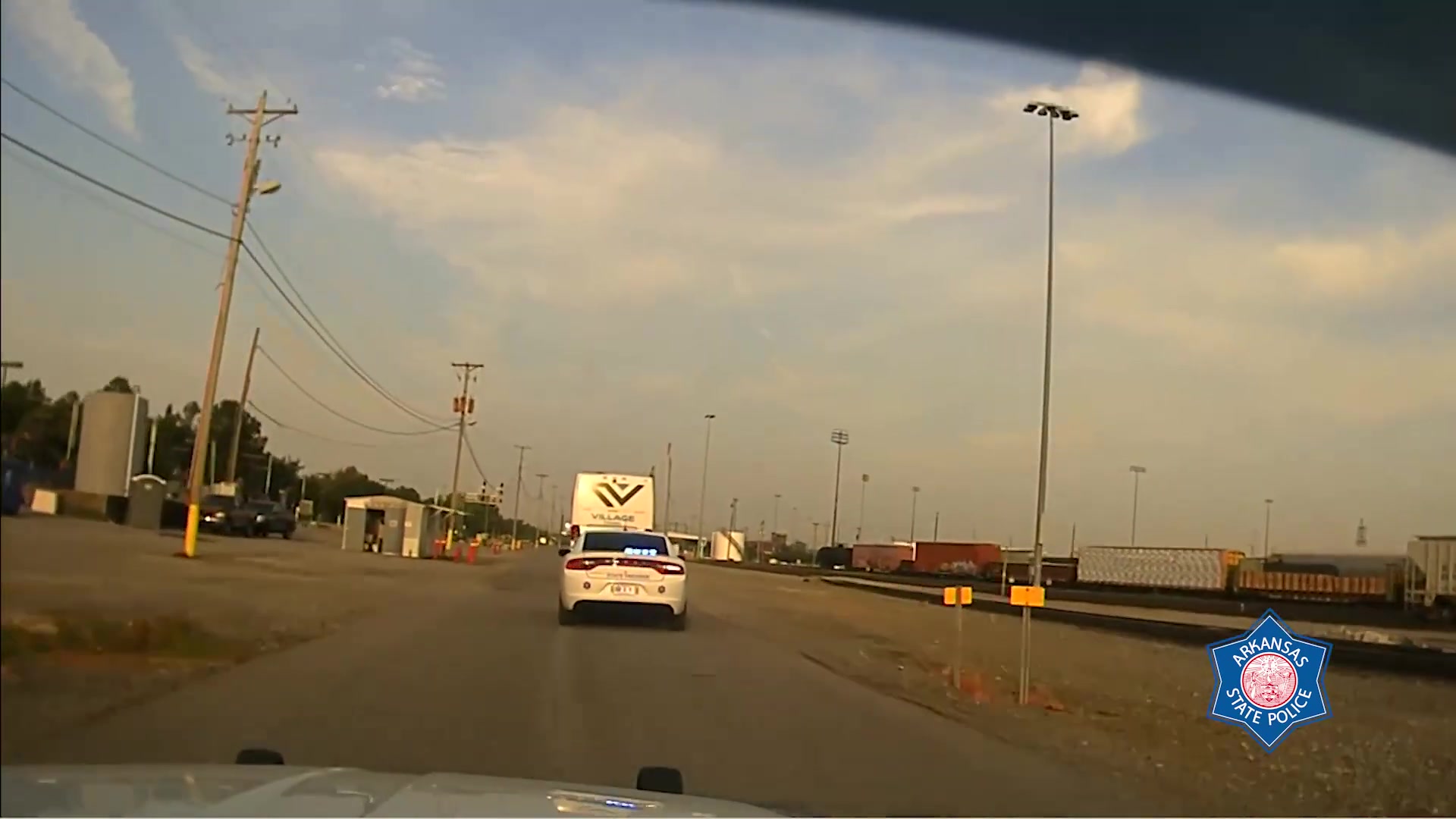
The footage makes the scale difference obvious. The Arkansas State Police cruiser appears small behind the towering Prevost.
That size mismatch is one reason the chase becomes so unusual. Troopers can follow the bus, but physically forcing it to stop requires a different calculation.
The pursuit therefore continues as officers look for an opportunity to contain the vehicle without creating an even larger hazard.
The Village Travel Branding Confirms the Vehicle
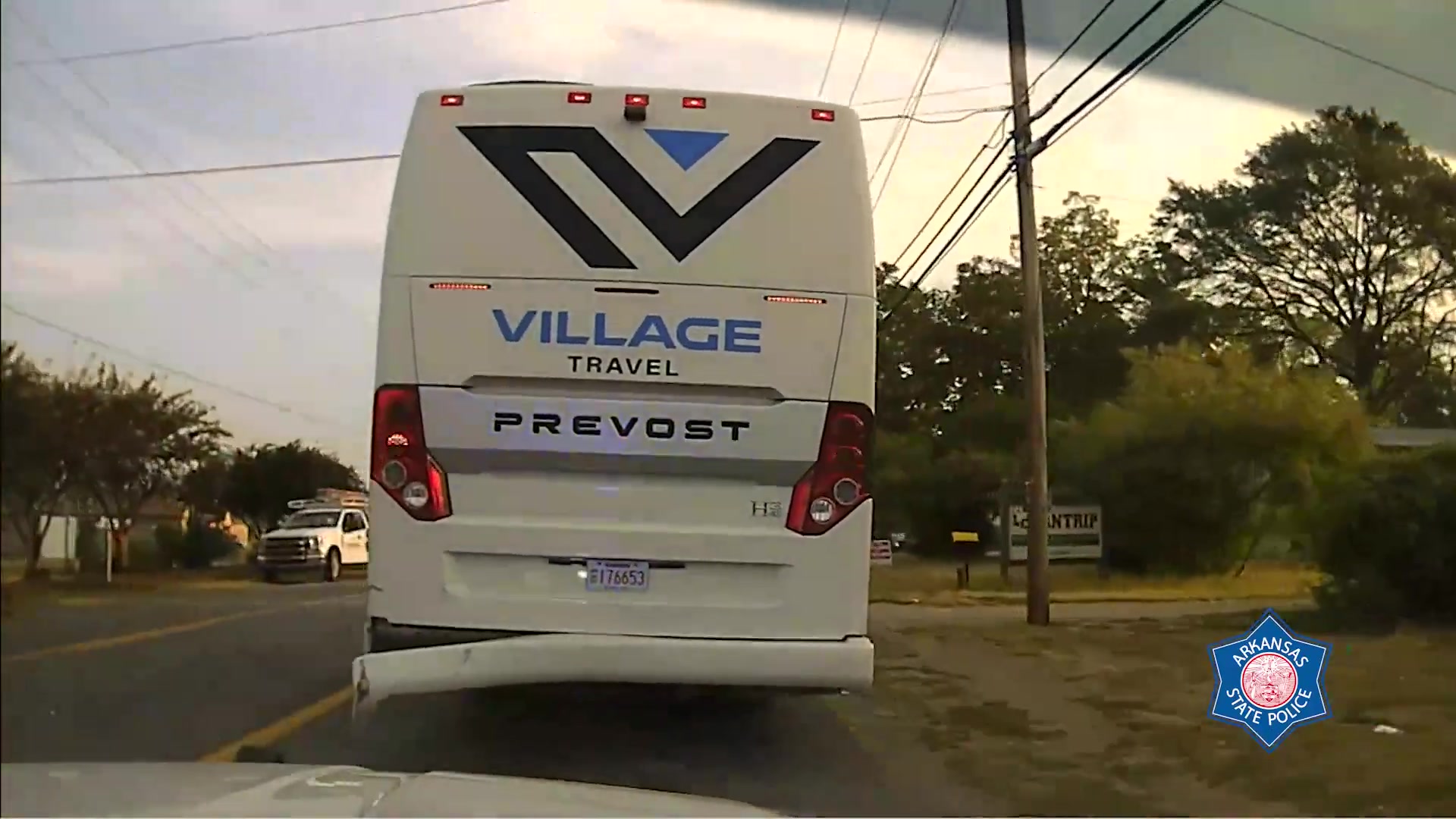
One of the strongest visual verification details appears directly on the back of the bus.
Large blue letters spell “VILLAGE TRAVEL,” with “PREVOST” beneath them.
That matches contemporary reporting identifying the stolen vehicle as a Village Travel charter bus.
Village Travel operates motorcoaches in Arkansas and surrounding states and has used Prevost buses in its fleet. The footage therefore provides a direct visual link between the vehicle described in news reports and the bus pursued by ASP.
This kind of detail is especially useful when matching police footage to an incident because it does not depend on a reposted filename or social-media caption.
The Pursuit Leaves Interstate 40
Arkansas State Police said Richard eventually left I-40 and turned onto Highway 161.
The change from interstate to surface road alters the risks around the pursuit.
On an interstate, traffic generally moves in the same direction and intersections are controlled through ramps. A surface highway introduces driveways, cross streets, traffic lights and vehicles entering from multiple directions.
For a full-size bus, those tighter roads also reduce maneuvering space.
The dashcam shows the motorcoach continuing ahead while troopers remain close behind, emergency lights visible in the reflections around the scene.
No Passengers Were on the Bus
One fact significantly reduced the potential human cost of the pursuit: authorities said there were no passengers aboard the stolen motorcoach.
That does not make the chase safe.
Other motorists, troopers, railroad employees and the driver remained exposed to the risks created by a large fleeing vehicle.
But an occupied charter bus would have created an entirely different tactical problem. Officers would have had to consider dozens of potential passengers before attempting any forceful intervention.
ASP's confirmation that the bus was empty is therefore one of the most important pieces of context in the official account.
The Chase Moves Onto Railroad Tracks
The pursuit takes its strangest turn when Richard drives the bus onto railroad tracks.
A motorcoach is designed for paved highways, not rail infrastructure.
Railroad tracks create uneven surfaces, narrow paths and the possibility of encountering active rail traffic. A vehicle as large as a charter bus can also obstruct tracks and create hazards far beyond the immediate police pursuit.
Yet Richard continued.
The footage follows the bus as the chase moves away from conventional roadways and deeper into the rail environment.
For viewers, this is the point where the incident stops looking like a typical stolen-vehicle pursuit and becomes something much harder for troopers to manage.
The Union Pacific Rail Yard Becomes the Final Arena
Richard drove into the Union Pacific Rail Yard Terminal at 1020 West Bethany in North Little Rock.
The dashcam footage clearly shows the transition into the industrial rail facility.
Tracks, rail cars, open service areas, utility structures and industrial equipment replace normal road traffic.
Police vehicles continue behind the bus while additional units converge.
The rail yard offers fewer ordinary escape routes, but it also creates a dangerous environment for a pursuit. Officers have to navigate around tracks and equipment while staying aware of workers and rail operations.
The bus is now away from the interstate, but the problem of how to stop it remains.
A Trooper Looks for Another Way to End the Chase
By the time the pursuit reaches the rail yard, simply following the bus is no longer enough.
The motorcoach continues moving through an area where its size could cause significant damage.
Arkansas State Police Sgt. Gabe Monroe ultimately chooses a direct method of disabling it: shooting its tires.
Because a firearm is being discharged at a moving vehicle, the action is treated as a use of deadly force and becomes subject to investigation.
That distinction is important. The trooper was not shooting at Richard according to the official account. The purpose was to disable the bus by damaging its tires.
Shots Are Fired at the Tires
The footage captures the pursuit reaching the point where troopers attempt to stop the bus by gunfire.
Sgt. Monroe fired at the tires.
The strategy worked.
The damaged tires reduced the motorcoach's ability to continue and allowed officers to bring the pursuit to an end inside the Union Pacific facility.
No passengers were inside the bus, and Arkansas State Police reported that Richard was not injured.
That outcome is notable given the combination of a large stolen vehicle, a prolonged pursuit and gunfire used to disable it.
Richard Is Taken Into Custody
Once the bus could no longer continue effectively, officers moved in.
Richard was arrested without further incident.
He was initially transferred to the Little Rock Police Department because that agency was investigating the original theft. He was later transported to the Pulaski County Detention Center.
The chase that had begun on I-40 ended not with a collision or rollover but with the bus immobilized inside a rail yard and the driver in custody.
The footage's final phase is much slower than the pursuit itself. Police vehicles surround the bus and officers shift from chase tactics to arrest and scene security.
The Arrest Brought Multiple Allegations
Contemporary Arkansas reporting listed several charges associated with Richard's August 29 arrest.
They included breaking or entering, failure to stop after an accident, felony fleeing in a vehicle or conveyance involving substantial danger of death, theft by receiving valued at $25,000 or more, commercial burglary and first-degree criminal mischief, along with an allegation concerning an incorrect permanent physical address on identification.
Those were arrest charges reported at the time and should not automatically be described as final convictions.
The distinction matters because criminal cases can change as prosecutors review evidence and cases move through court.
The Theft Investigation and Shooting Investigation Split Apart
Two agencies had different responsibilities after the arrest.
Little Rock Police Department continued as the lead agency investigating the theft of the bus.
Arkansas State Police Criminal Investigation Division examined the officer-involved shooting portion, meaning Sgt. Monroe's decision to fire at the tires.
This separation is a normal accountability step when police gunfire is involved.
Investigators can examine the pursuit video, radio traffic, the location of the bus, the risk to surrounding people and property, and the circumstances immediately before Monroe fired.
Why Shooting a Tire Still Triggered Deadly-Force Review
A firearm remains a deadly-force tool even when an officer aims at a vehicle rather than a person.
Bullets can miss, ricochet or penetrate unintended objects. A suddenly disabled vehicle can also become difficult to control.
For that reason, the legal review did not simply treat the shots as a mechanical way of deflating tires.
The Pulaski County Prosecutor's Office later evaluated whether Monroe's decision was justified under the circumstances.
That later review gives this case something many pursuit videos do not have: a documented prosecutorial conclusion about the most controversial police action captured in the incident.
The Prosecutor Clears Sgt. Gabe Monroe
On January 8, 2025, Sixth Judicial District Prosecuting Attorney Will Jones concluded that Sgt. Gabe Monroe acted justifiably when he used deadly force to disable the stolen bus.
The decision became public later that month.
Reports describing the prosecutor's finding state that Monroe was cleared of wrongdoing.
This provides a clear distinction between the immediate August investigation and the later legal conclusion.
At the time of the chase, ASP said its Criminal Investigation Division would review the shooting. By January, the prosecutor had completed his review and determined Monroe's actions were justified.
Why the Rail Yard Changed the Tactical Equation
A stolen bus on an interstate is dangerous, but it is moving through an environment designed for large vehicles.
A stolen bus inside an active rail facility is a different problem.
The driver can cross tracks, approach rail cars and move through industrial areas not designed for ordinary public traffic.
A disabled bus can block infrastructure. A collision could damage rail equipment. Workers may be present in locations a fleeing driver does not anticipate.
The rail yard therefore increased the urgency to stop the motorcoach before the pursuit created a larger industrial or transportation hazard.
The Dashcam Shows the Scale Better Than a News Report
A written report can say that police chased a charter bus.
The video makes the scale tangible.
The rear of the Prevost fills much of the frame. Its roof towers above the patrol car. Its width occupies most of the lane.
When the bus enters the rail yard, police cruisers around it look comparatively small.
That visual scale helps explain why standard vehicle-intervention tactics were difficult. Officers were not trying to stop a compact stolen car. They were dealing with a commercial motorcoach built to transport groups over long distances.
The Pursuit Is Unusual Without Needing Exaggeration
There is no need to add invented drama to this case.
A stolen charter bus fleeing Arkansas State Police is already unusual.
The bus leaves I-40.
It moves onto Highway 161.
It drives onto railroad tracks.
It enters a Union Pacific rail yard.
A state police sergeant fires at its tires to disable it.
The suspect is arrested without injury.
Months later, a prosecutor rules the trooper's gunfire justified.
That sequence has a natural escalation that holds attention without unsupported claims about speeds, near misses or motives.
What the Footage Can Verify
The supplied video provides strong visual evidence for several parts of the official account.
It shows an Arkansas State Police pursuit.
It shows the Village Travel Prevost motorcoach.
It shows multiple police units becoming involved.
It shows the pursuit entering an industrial rail environment.
It shows the bus continuing through the Union Pacific facility.
And it shows the final police response around the motorcoach.
The footage therefore aligns closely with the date-specific reporting about Richard's August 29, 2024 arrest.
What the Footage Cannot Establish Alone
The dashcam does not show the bus being stolen at 3 a.m.
It cannot by itself identify the driver as Elvin Richard.
It does not establish the final legal disposition of every charge.
It also cannot explain the prosecutor's later legal reasoning without the external review.
Those facts come from official statements and contemporary reporting.
Keeping that distinction clear prevents the article from presenting narration as if it were visible evidence.
The Four-Hour Gap Before the Pursuit
One interesting part of the timeline is the period between the reported theft and the police pursuit.
The bus was reportedly taken around 3 a.m.
Troopers began the pursuit around 7:40 a.m.
That leaves roughly four and a half hours during which the motorcoach was outside the owner's control before ASP encountered it.
The public reports reviewed for this article do not provide a complete account of where the bus traveled during that entire period.
Rather than speculate, the reliable timeline resumes when troopers locate the vehicle and attempt the stop.
Why an Empty Bus Still Posed a Major Public Risk
The absence of passengers prevented one obvious danger, but the vehicle itself remained capable of causing tremendous damage.
A motorcoach has far more mass than a passenger car.
At highway speed, that mass translates into enormous momentum.
Stopping distances are longer, sharp maneuvers are more difficult and collisions can involve multiple vehicles.
The risk did not disappear when Richard left the interstate. Inside the rail yard, the bus was still moving among infrastructure, police vehicles and potentially occupied work areas.
The empty passenger compartment changed the tactical calculation, but it did not make the pursuit harmless.
From Highway Pursuit to Industrial Chase
The changing landscape gives the footage a strong narrative progression.
At first, viewers see a recognizable traffic pursuit.
The bus travels along ordinary roads with the trooper directly behind it.
Then the surroundings become less conventional.
Rail lines appear.
Industrial structures replace storefronts and houses.
More police units converge.
The bus moves into a place where a vehicle of its size has fewer safe options.
By the time it reaches the rail yard, the question is no longer whether police can catch the bus. They are already beside and behind it. The question is how they can stop it.
The Moment Police Choose Immobilization Over Continued Pursuit
Every pursuit forces officers to continually reassess whether following remains the best option.
In this case, the rail yard provided both an opportunity and a reason to end the chase.
The bus was away from ordinary highway traffic, but it was moving through sensitive infrastructure.
Sgt. Monroe's decision to shoot the tires represented a shift from tracking the vehicle to deliberately disabling it.
That decision ended the pursuit, but it also triggered a separate legal review because of the method used.
The later prosecutorial finding confirms that investigators considered the circumstances sufficient to justify Monroe's action.
No Injuries Reported to Richard
Arkansas State Police specifically said Richard was not injured during the incident.
That is significant given how the pursuit ended.
Gunfire was used against the bus's tires, yet the driver was taken into custody without injury.
Reports also said there were no passengers aboard, meaning the chase ended without reported passenger casualties.
The available sources reviewed for this article do not identify injuries to troopers or rail-yard workers from this incident, so no such injuries are claimed here.
The January 2025 Decision Adds Closure
The pursuit itself ended on August 29, 2024, but one major question remained unresolved for months: whether the trooper's use of gunfire to stop the bus was legally justified.
The January 2025 prosecutor's decision answered that question.
Will Jones concluded Monroe acted justifiably.
That finding does not resolve every criminal allegation against Richard, nor does it replace the separate theft investigation.
It does, however, provide a documented outcome for the officer-involved shooting component of the case.
Why This Case Stands Out Among Arkansas Pursuits
Arkansas State Police pursuit footage often involves fast passenger cars, pickup trucks or motorcycles.
A charter bus changes almost every visual and tactical expectation.
It cannot disappear easily.
It cannot corner like a sports car.
It is difficult to physically immobilize.
And once it leaves the road, its size creates entirely new hazards.
The rail-yard ending makes the case even more distinctive. Instead of a roadside PIT or a crash at an intersection, the pursuit concludes among railroad infrastructure after a trooper targets the bus's tires.
The Most Reliable Timeline
The bus was stolen in Little Rock at approximately 3 a.m. on August 29, 2024.
Around 7:40 a.m., Arkansas State Police attempted to stop it.
Police identified the driver as Elvin Richard, 29, of Lonoke County.
Richard fled eastbound on Interstate 40.
He turned onto Highway 161.
He drove onto railroad tracks.
He entered the Union Pacific Rail Yard Terminal at 1020 West Bethany in North Little Rock.
Sgt. Gabe Monroe fired at the bus's tires and disabled it.
Richard was arrested without injury.
There were no passengers on the bus.
Little Rock Police investigated the theft, while ASP investigated the trooper's gunfire.
On January 8, 2025, the Pulaski County prosecutor concluded Monroe's use of deadly force was justified.
A Chase That Ends Where Roads Give Way to Rails
The most memorable aspect of the footage is not simply that police chased a stolen bus.
It is where the chase went.
A vehicle built for interstate travel leaves the highway, moves through local roads and eventually drives into a rail facility.
Troopers remain behind it while other units converge.
The normal tools of a vehicle pursuit become increasingly difficult to use.
Finally, the bus is disabled by shots to its tires.
The suspect steps out of a moving story and into the criminal-justice process.
Why Full Context Matters
A short clip of an officer firing at a bus could easily be misunderstood without the preceding pursuit.
The complete sequence establishes why police were there and what had happened before the shots.
The bus had been reported stolen.
The driver had fled a traffic stop.
The pursuit moved from I-40 to Highway 161 and onto railroad tracks.
The motorcoach entered an active rail yard.
Only then did Monroe use his firearm to disable the tires.
The later prosecutor's review provides an additional layer of context by confirming that the use of force was examined and found justified.
Watch the Full Pursuit
The complete Arkansas State Police footage shows the scale of the motorcoach, the transition from public roads to railroad property, the growing police response and the unusual tactics used to finally stop the stolen bus.
Comments (0)
Loading comments...
May You Like

Entitled Driver Learns Why You Must Obey Lawful Orders During Traffic Stop

One Driver’s Decision to Flee Brings Police Racing After Him

Woman Tries to Stop Police From Arresting “Brother” — He Denies Knowing Her












