
[BODYCAM] Police Use Taser to Subdue Resisting Suspect
A Chaotic Austin Police Call Ends With a Man Dying Minutes After Officers Restrain Him
A Series of 911 Calls That Became Increasingly Urgent
It began not with an arrest, but with people in a North Austin neighborhood trying to understand what they were seeing.
On the evening of June 6, 2026, multiple callers contacted 911 about a man moving through the area around Woodrow Avenue.
The descriptions were disturbing.
The man appeared to be bleeding.
He seemed disoriented.
He had reportedly broken a vehicle window.
At different moments, witnesses saw him sitting in the roadway, attempting to flag down passing vehicles and running through the neighborhood with blood visible on his arms.
Austin Police Department later identified that man as 32-year-old Josh Ryan Trumble.
At approximately 5:42 p.m., the first calls began arriving. Austin-Travis County EMS was notified almost immediately. But when officers searched the neighborhood, they initially could not find Trumble.
For roughly the next fifteen minutes, additional sightings continued.
Then he disappeared from officers' view.
The situation might have ended there.
It didn't.
About half an hour later, another resident called 911 from Grover Avenue.
Someone was banging on the front door.
The homeowner initially believed somebody was attempting to kick their way inside.
According to APD, the resident armed himself with a shotgun while remaining inside his home.
More callers reported seeing a shirtless man who was bleeding and knocking on neighborhood doors.
This time, officers found him.
At approximately 6:35 p.m., police located Trumble lying in the front yard of a residence in the 7600 block of Grover Avenue.
Less than five minutes later, he would be handcuffed and unresponsive.
Less than an hour later, he would be dead.
The case immediately became more complicated than a conventional arrest.
Police believed they had located someone connected to property damage and a nearby burglary.
But they were also looking at a man covered in cuts who appeared to need medical attention.
Those two realities existed at the same time.
And the next few minutes would force officers to decide how to handle both.
Officers Find a Man Who Appears to Be in Crisis
The footage released by Austin Police provides a much more immediate view than the written timeline.
Officers approach Trumble in the yard.
He is shirtless.
Cuts are visible across his body.
There is blood.
His behavior does not resemble someone calmly waiting to speak with police.
APD later said officers observed behavior consistent with a possible medical or psychological crisis.
That assessment matters because emergency medical personnel were already part of the response.
Police updated Austin-Travis County EMS about Trumble's condition while attempting to communicate with him.
But officers were simultaneously receiving information suggesting Trumble may have been involved in something more serious.
A separate 911 call had reported a burglary at a home in the 7700 block of Woodrow Avenue.
A Ring doorbell camera captured a man matching Trumble's description slamming his body into the home's front door hard enough to force entry.
Police later found blood inside, damage consistent with forced entry and a broken rear window.
Witness descriptions, physical characteristics and video evidence led investigators to believe Trumble was the same person.
That created an extraordinarily difficult combination.
He appeared injured.
He appeared to be in crisis.
He was potentially connected to a burglary.
And police needed to control the situation while medical responders were coming.
The officers begin giving commands.
Remain on the ground.
Put your hands behind your back.
Initially, Trumble complies.
He rolls onto his stomach.
He puts his hands behind his head.
At 6:37 p.m., officers tell dispatch they are detaining him and that other responding units can slow down.
At this point, the scene appears to be moving toward a controlled detention.
Then Trumble's behavior changes.
Officer Benjamin Ye attempts to place him in handcuffs.
According to APD's preliminary account, Trumble pulls his hands underneath his body and appears to push upward against the officers trying to restrain him.
Several officers are now physically involved.
Commands continue.
Then Officer Justin Wright deploys his Taser.
The electrical discharge is brief.
Officers gain control.
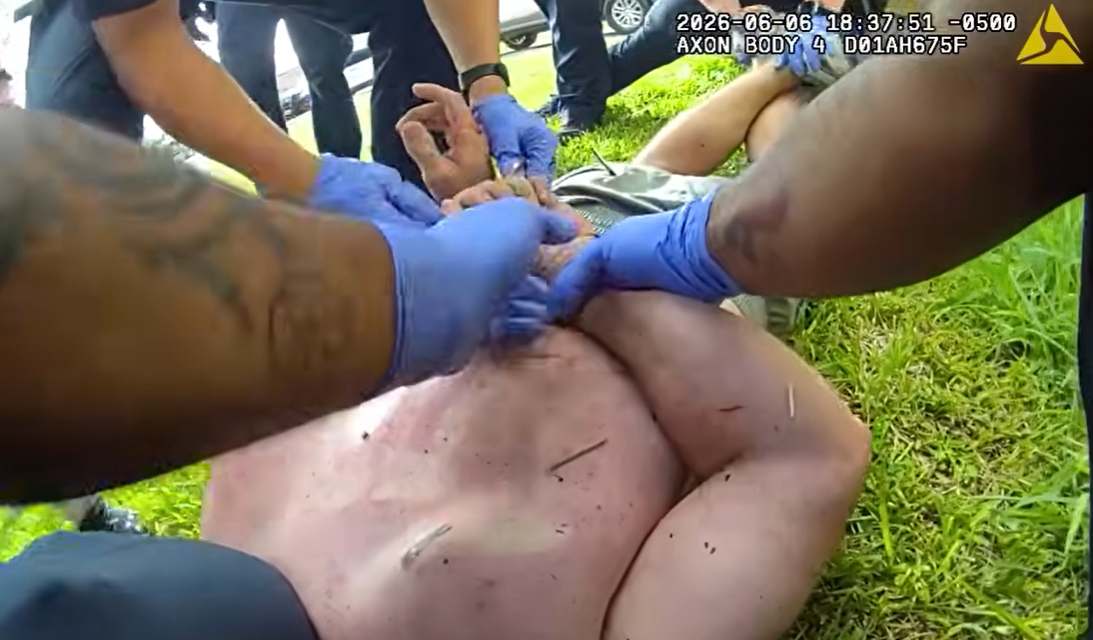
At approximately 6:38 p.m., they report that Trumble is handcuffed.
The struggle is over.
But the emergency is about to become much worse.
Seconds After the Handcuffs Go On, Everything Changes
The most disturbing part of the footage is not necessarily the Taser deployment.
It is what happens immediately afterward.
Once Trumble is restrained, officers notice something is wrong.
His resistance stops.
He becomes unresponsive.
That distinction is critical.
A person who suddenly stops fighting during an arrest may simply have decided to cooperate.
But they may also be experiencing a medical emergency.
The officers recognize the change quickly.
They roll Trumble onto his side.
They check him.
At approximately 6:39 p.m., APD updates EMS regarding the deterioration in his condition.
Then officers roll him onto his back and check for a pulse.
They cannot find one.
The police call has now transformed again.
Minutes earlier, officers were attempting to detain someone they believed could be connected to a burglary.
Seconds earlier, they were struggling to secure his hands.
Now they are attempting to keep him alive.
CPR begins.
Officers request that EMS expedite its response.
The incident is upgraded to a cardiac arrest.
Austin Fire Department and Austin-Travis County EMS arrive and take over advanced lifesaving measures.
The effort continues for approximately 38 minutes.
It is unsuccessful.
At 7:18 p.m., Josh Ryan Trumble is pronounced dead at the scene.
He was 32 years old.
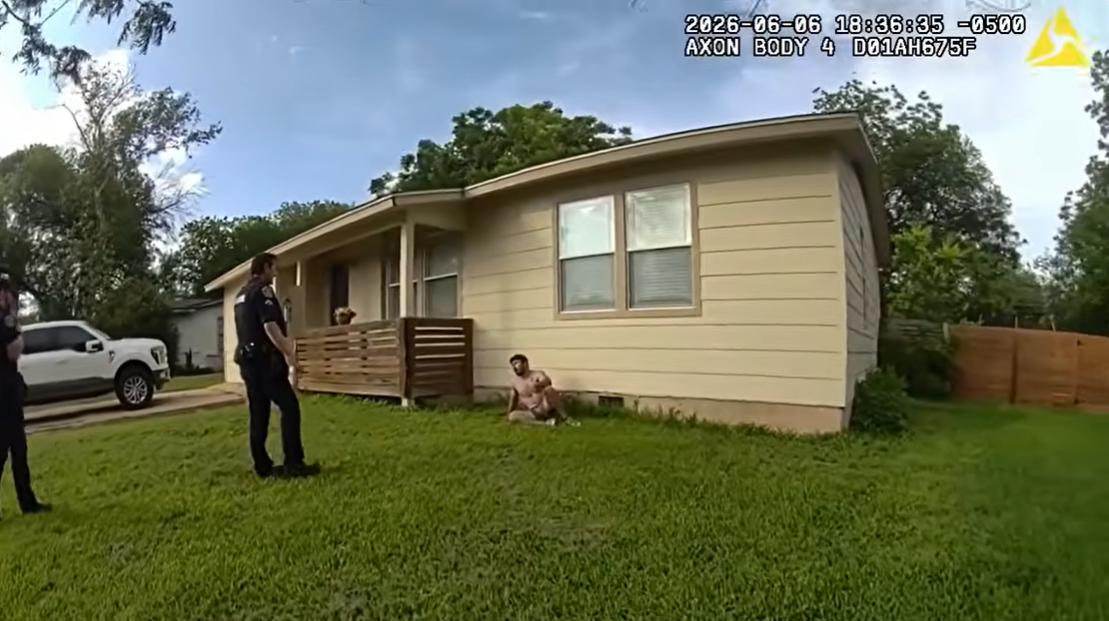
That outcome immediately changes the legal and administrative status of the entire encounter.
This is no longer simply a burglary investigation or use-of-force incident.
Because Trumble died after being detained by Austin police, APD treats the case as an in-custody death.
A critical-incident investigation begins.
Seven officers are placed on administrative leave.
The questions surrounding those few minutes now become much larger.
What caused Trumble's death?
What condition was he already in before officers touched him?
What role, if any, did the Taser deployment or physical restraint play?
Could the arrest have been handled differently?
And how should officers balance immediate medical needs against the need to restrain someone who may be resisting and connected to a crime?
Those questions cannot be answered simply by replaying the most dramatic seconds of the bodycam.
They require the complete timeline.
The Events Before Police Found Trumble Matter
One of the easiest mistakes when watching body-camera footage is beginning the story when the camera begins.
Police incidents often start much earlier.
Trumble's case demonstrates why that matters.
By the time Officer Santos Beltre's body camera records officers approaching him, Trumble has reportedly been moving through the neighborhood for almost an hour.
At around 5:42 p.m., callers describe a man in a blue shirt and gray shorts who had broken a vehicle window.
He is bleeding.
He is sitting in the road.
He is attempting to flag down vehicles.
Witnesses describe him as dazed and behaving abnormally.
EMS begins responding.
Additional calls follow.
Police search.
They cannot find him.
The medical response is canceled after officers lose track of the man.
Then the situation resumes around 6:31 p.m.
A resident on Grover Avenue reports somebody trying to enter the home.
Other callers describe a shirtless man bleeding and banging on doors.
Officers find Trumble four minutes later.
Meanwhile, police are learning about the separate burglary.
The Ring footage is particularly important.
It reportedly shows a man matching Trumble's description throwing himself into a front door until it opens.
Investigators later find blood evidence and damage inside the residence.
All of that suggests Trumble may have been experiencing significant physical or psychological distress well before police attempted to handcuff him.
It also means the officers were not simply approaching a random injured man.
They had public-safety concerns.
A homeowner had armed himself because he believed somebody was trying to force entry.
Another residence had apparently already been entered.
Police needed to prevent additional encounters between Trumble and frightened residents.
That context helps explain why officers chose to detain him rather than simply stand back and wait indefinitely for EMS.
But explaining the reason for detention is not the same thing as answering what caused his death.
That remains a separate question.
The Taser Becomes the Focus, but It Is Only One Part of the Investigation
The public headline is naturally simple:
Man dies after police use Taser.
That is factually connected to the chronology.
Officer Justin Wright deployed a Taser during the effort to restrain Trumble.
Trumble was handcuffed.
Within seconds, he became unresponsive.
But chronology alone does not establish medical causation.
APD explicitly stated that the official cause of death would be determined by the medical examiner.
That distinction is important.
Trumble had numerous lacerations before officers found him.
Witnesses had described him behaving abnormally long before police contact.
He had apparently been physically striking objects or structures.
He had blood on his body.
He may have been experiencing a medical or psychological crisis.
Then came physical exertion during the restraint.
Then the Taser deployment.
Investigators and medical experts have to consider the complete picture.
Declaring immediately that the Taser caused his death would go beyond the preliminary evidence released by APD.
Declaring that it had nothing to do with his death would be equally premature.
The purpose of an in-custody-death investigation is to determine precisely those relationships.
This is why multiple investigations were launched.
APD's Special Investigations Unit is conducting a criminal investigation in conjunction with the Travis County District Attorney's Office.
Internal Affairs is conducting an administrative investigation.
Austin Police Oversight is involved in oversight of the process.
The seven officers identified by APD are Justin Wright, Kate Hagemeier, Carl Chester, Jeremmy Santos Beltre, Calvin Fusilier, Gabriella Fekete and Benjamin Ye.
Their placement on administrative leave is procedural and should not be interpreted by itself as a finding that any officer committed wrongdoing.
The evidence has to be examined first.
Why Officer Santos' Camera Is Important
The file released as “Body-worn Camera Officer Santos - June 6, 2026” comes from Officer Jeremmy Santos Beltre.
APD lists Santos Beltre as having approximately two years and eight months of service at the time of the incident.
His camera provides one perspective.
APD also publicly released footage from Officer Justin Wright, the officer identified as deploying the Taser.
That distinction matters because no single body camera shows everything.
During a physical restraint, officers move constantly.
One officer may see Trumble's hands while another sees his upper body.
Someone's arm may block a camera.
The camera may point toward the ground while the officer wearing it looks elsewhere.
This is why investigators synchronize multiple recordings whenever possible.
The department also released three 911 calls, police radio traffic and the Ring-camera footage.
Together, those recordings allow investigators and the public to reconstruct the encounter from before officers ever arrived.
The broader record reveals something the bodycam alone cannot.
Trumble's crisis appears to have begun well before the physical arrest.
That does not remove scrutiny from police actions.
It makes accurate scrutiny more important.
The question is no longer simply whether an officer used a Taser.
The questions become whether the force was reasonable under the circumstances, whether medical distress was recognized appropriately, whether officers' restraint tactics followed policy and what actually caused the fatal cardiac arrest.
A Neighborhood Was Watching the Crisis Develop in Real Time
The 911 calls add another dimension to the case.
Residents were not seeing one consistent behavior.
They were seeing pieces of a rapidly developing crisis.
One person saw a bleeding man.
Another saw him in the roadway.
Someone reported a damaged vehicle.
Others saw him moving through the neighborhood.
Later, residents heard banging at doors.
One homeowner became frightened enough to load a shotgun.
This detail shows how close the incident may have come to producing another tragedy before police located Trumble.
A confused or distressed person trying to enter an occupied home can easily be perceived by the resident as an attacker.
The resident does not necessarily know that the person outside may be experiencing a medical emergency.
They hear someone trying to get through the door.
They react to the threat they perceive.
Police therefore had a genuine reason to intervene quickly once Trumble was located.
At the same time, officers could see that the person they were confronting was physically injured.
That duality is what makes the case so difficult.
Trumble may simultaneously have posed a public-safety concern and needed urgent medical help.
Those categories are not mutually exclusive.
Real police calls rarely arrive neatly labeled as either “criminal” or “medical.”
Sometimes they are both.
And officers have to make decisions before doctors, investigators or lawyers have the benefit of knowing the outcome.
The Medical Response Becomes Central to the Final Minutes
Once Trumble becomes unresponsive, there is no ambiguity about the immediate priority.
Officers check for a pulse.
They begin CPR.
EMS is asked to expedite.
Austin Fire arrives.
ATCEMS arrives.
Advanced resuscitation continues for approximately 38 minutes.
Despite those efforts, Trumble cannot be revived.
That sequence matters when evaluating the complete police response.
The footage does not end with officers placing him in handcuffs and walking away.
His condition is noticed almost immediately.
The arrest turns into a resuscitation attempt.
Yet the fact that officers attempted to save him does not end scrutiny over what happened before the cardiac arrest.
Both parts matter.
The restraint deserves examination.
So does the medical response.
The investigation must account for the entire encounter.
The Man in the Video Was More Than a Critical-Incident Case Number
Police reports naturally focus on actions.
Locations.
Times.
Commands.
Force.
Medical response.
But Josh Ryan Trumble was also a person whose life existed long before June 6.
His obituary states that he was born on October 20, 1993.
After his death, a Celebration of Life was scheduled for June 20 at Sugar Hill Methodist Church.
The obituary describes him as someone who would be remembered by the people who knew him and notes his close ties to his roots.
Those details are brief, but they provide an important counterweight to bodycam footage.
In a police video, Trumble appears during perhaps the most chaotic minutes of his life.
Viewers see him bleeding.
They see officers surrounding him.
They see resistance.
They see the emergency that follows.
That is not a complete biography.
Critical-incident footage has a tendency to freeze a person forever at their worst, most frightened or most distressed moment.
A responsible account should remember that the camera captures an event, not an entire human life.
The Final Answer Depends on Evidence That Wasn't Available That Night
The bodycam establishes a timeline.
It does not establish every conclusion.
We know police received multiple calls beginning around 5:42 p.m.
We know witnesses described Trumble as bleeding and behaving abnormally.
We know investigators believe he forced entry into a nearby residence.
We know officers located him at approximately 6:35 p.m.
We know they believed he appeared to be experiencing a possible medical or psychological crisis.
We know he initially complied with commands.
We know officers say he then pulled his arms beneath his body while they tried to handcuff him.
We know Officer Justin Wright deployed a Taser.
We know Trumble was handcuffed around 6:38 p.m.
We know he became unresponsive almost immediately afterward.
We know CPR began.
And we know he was pronounced dead at 7:18 p.m.
What the footage alone cannot establish is the ultimate medical cause of that death.
That determination belongs to forensic medical evidence.
Nor can the footage alone determine whether every officer action complied with law and policy.
That requires the criminal and administrative investigations.
This is precisely why APD's June 10 release repeatedly described the information as preliminary.
The camera gives the public something extraordinarily valuable: the ability to see a significant portion of what happened.
But transparency should not be confused with instant certainty.
A Call That Changed Categories Again and Again
The most revealing way to understand the Josh Trumble case may be to look at how many times the nature of the emergency changed.
It begins as reports of strange behavior.
Then property damage.
Then a possible medical crisis.
Then a search for a missing person.
Then an attempted home entry.
Then a burglary investigation.
Then police detention.
Then physical resistance.
Then a Taser deployment.
Then cardiac arrest.
Then an in-custody death investigation.
All of that unfolds in less than two hours.
The final minutes happen even faster.
At 6:35 p.m., officers find Trumble.
At 6:37, they are trying to detain him.
At 6:38, he is handcuffed.
At 6:39, police are checking for a pulse and beginning lifesaving measures.
That is the detail that makes this footage so unsettling.
There is almost no separation between arrest and medical catastrophe.
One moment officers are attempting to control a moving person.
The next they are performing CPR on an unresponsive man.
For Josh Ryan Trumble, there would be no recovery.
For the officers, the encounter immediately became something that would be reviewed from multiple perspectives.
For his family, June 6 became the day a 32-year-old relative never came home.
And for investigators, the central work began only after the body cameras stopped recording.
They must determine not merely what happened.
They must determine why.
Watch the complete released footage and follow the encounter from officers' first contact with Josh Trumble through the sudden medical emergency and lifesaving response here: https://www.youtube.com/watch?v=qf0o_2LWrU4&t=15s
Comments (0)
Loading comments...
May You Like

Couple Arrested for leaving 10 Dogs and Cats in Hot car in Florida

MERIDEN POLICE OFFICER SHOOTS MAN BEATING FATHER WITH A BASEBALL BAT













