
[Bodycam] Police Confront Man Trying To Burn Down House
Salt Lake City Domestic Violence Call Escalates After Armed Man Breaks Into Ex-Wife’s Home
A Midnight Call With Almost No Margin for Error
Shortly after midnight on May 27, 2025, a woman in Salt Lake City called 911 from inside her home. She told the emergency call-taker that her ex-husband had broken in despite a court-issued protective order and had threatened to harm her. She and her two teenage children had locked themselves inside a bedroom while the man moved through the house.
The danger described on the call went beyond an unlawful entry. The woman reported smelling gasoline. In the background of the 911 recording, her ex-husband could be heard saying that he had poured gasoline on himself and threatening to set himself on fire and burn the house.
Within minutes, Salt Lake City Police Department officers arrived at the residence on Judith Street. They established positions around the home, found evidence of a forced entry, heard a disturbance inside and moved in through the front and back doors.
The man inside was later identified as 60-year-old Christian Thomas Allen. Body-worn camera footage released by SLCPD shows Allen holding a large knife as officers enter. Police repeatedly order him to drop it. According to the department, Allen advances toward officers with the knife raised. Two officers fire.
Allen was critically wounded and died at the scene despite medical aid. The woman and her two children were found safe and were not physically injured.
The supplied video matches the official Salt Lake City Police footage. Its Axon overlay shows May 27, 2025, around 12:22 a.m., and the scenes correspond with the sequence documented in SLCPD's June 13 body-camera release and contemporaneous reporting by KSL.
The Emergency Begins With a Protective-Order Violation
SLCPD said officers were dispatched at approximately 12:13 a.m. to a domestic-violence burglary in progress at 2963 South Judith Street.
The caller told dispatch that Allen, her ex-husband, was violating a protective order and breaking into the home. She reported that he had previously threatened her and was now inside.
That information shaped the police response before officers ever reached the front door. They were not being sent to a routine argument or a vague suspicious-person call. Dispatch information described an unwanted entry, a history of threats, people hiding in a locked bedroom and a rapidly developing danger inside the residence.
The woman remained on the phone with SLC911 while officers responded. Her ability to communicate gave police an unusually direct source of information from inside the home.
Gasoline Changes the Nature of the Threat
During the 911 call, the woman reported smelling gasoline inside the house.
SLCPD later released a summary of statements captured on the emergency call. Allen could be heard saying that he had gone to a Chevron station, poured gasoline over himself and intended to set himself on fire and burn the house.
That information dramatically increased the potential consequences of the incident.
A domestic burglary involving a knife already presents a serious threat. The reported presence of gasoline introduces the possibility of a rapidly spreading fire in an occupied residence. The woman and her children were still inside, sheltering behind a locked bedroom door.
Officers therefore had to consider not only the possibility of an assault but also the possibility that delaying entry could leave the occupants trapped in a burning home.
Officers Arrive Under an Emergency Response
Multiple officers responded Code 3, meaning emergency lights and sirens were activated.
The first arriving officer observed a white van with its lights on in the driveway and called out its plate information. Additional units arrived and officers began establishing containment around the house.
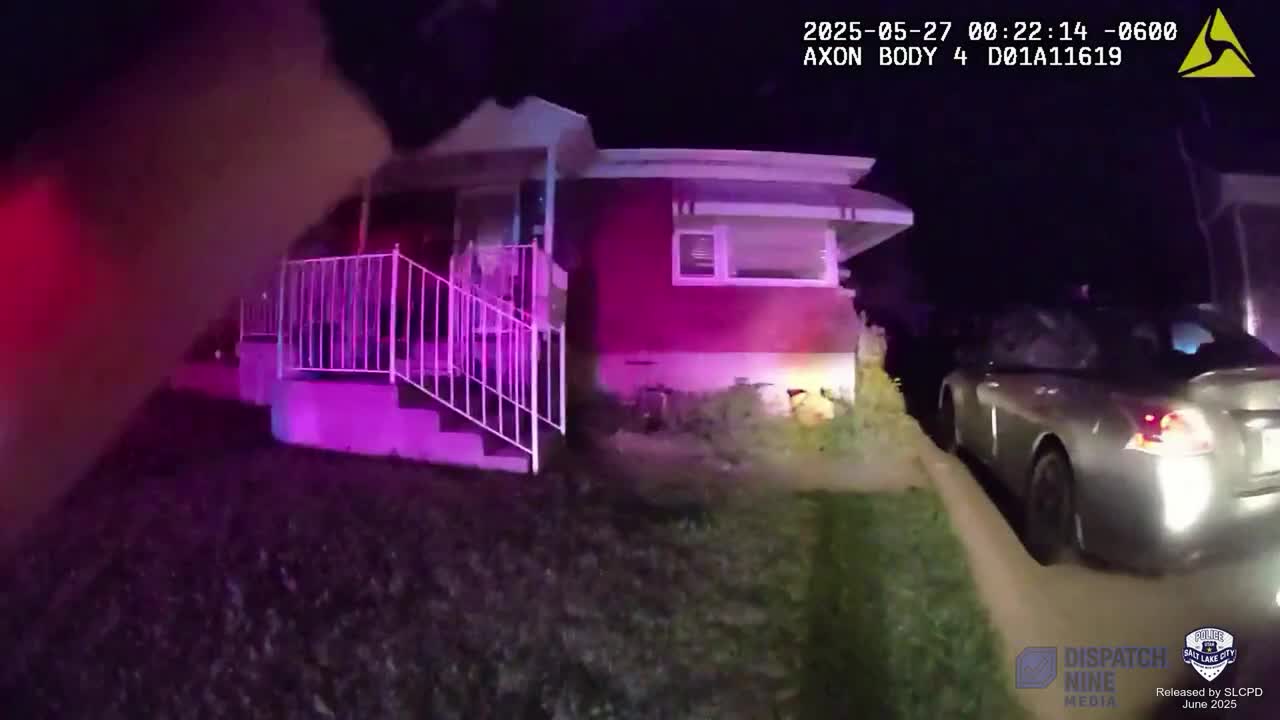
The bodycam footage shows the dark residential street illuminated by emergency lights. The exterior appears quiet, but officers know the 911 caller is still inside with her children.
That contrast is central to the video. From outside, the residence looks like an ordinary home late at night. The information being relayed over the radio describes something entirely different happening behind its walls.
Police Divide Between the Front and Back
As more officers arrived, they moved into positions at both the front and rear of the residence.
KSL reported that officers covering the back discovered a broken basement window believed to be the point through which Allen entered the house.
At the front, officers initially attempted to make contact without immediately forcing the door. But the situation inside did not remain static.
An officer positioned along the side of the house heard Allen yelling. The body-camera footage and reporting indicate officers then heard sounds consistent with a disturbance or fighting.
At that point, waiting outside carried its own risk.
The Decision to Force Entry
The officers at the front and back doors forced entry almost simultaneously.
This is a critical point in the incident because it explains why the police response moved from containment to direct intervention.
The people officers were trying to protect were not outside the home. They were inside it.
The 911 caller had described an ex-husband who had entered in violation of a protective order, threatened harm and brought gasoline into the residence. Officers then heard an active disturbance.
Under those circumstances, the house itself was the emergency scene. Reaching the occupants required entering it.
The Bodycam Moves Through the Front Door
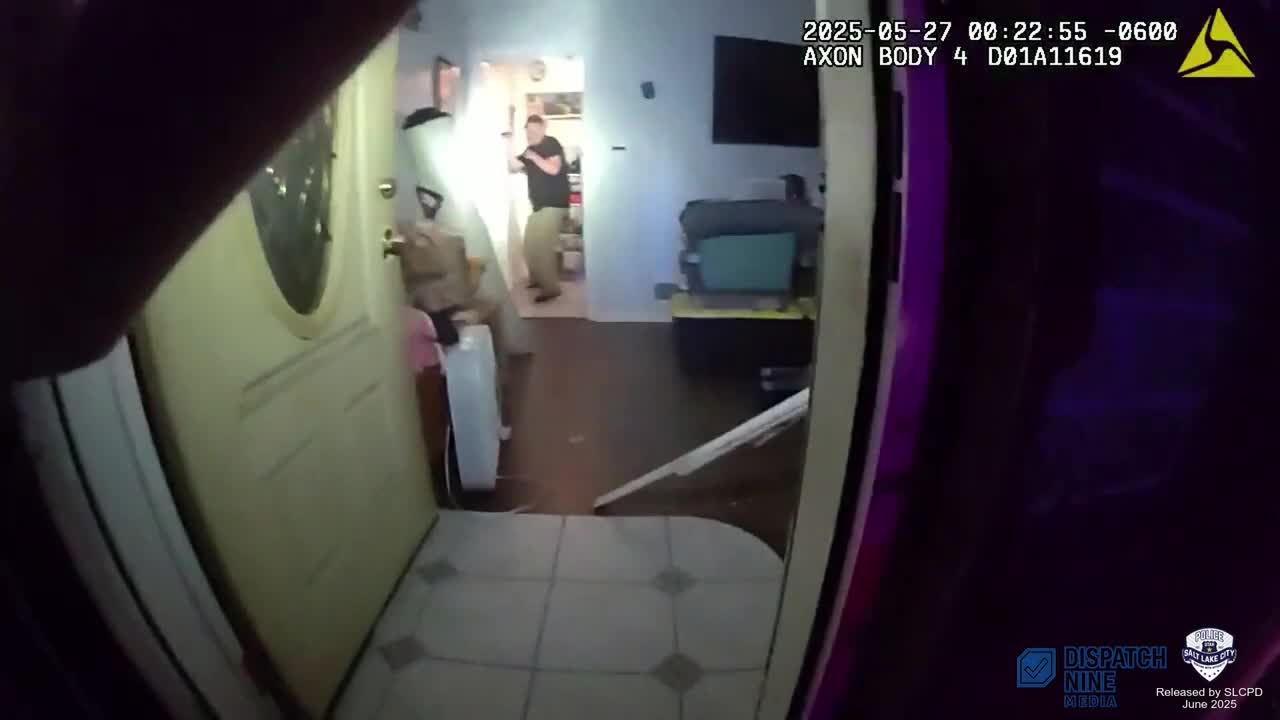
The supplied footage captures the transition from the exterior to the interior of the residence.
The front door opens into a confined living space. Furniture, walls and doorways immediately narrow officers' movement and lines of sight.
Unlike an encounter in an open parking lot, there is little room to create distance. Officers cannot see through every doorway, and they do not yet know exactly where the caller and her children are.
The camera moves quickly because officers are responding to what they believe is an active threat.
That rapid movement is one reason still frames can be misleading. The full sequence shows how little time officers have between entering the house and confronting Allen.
Allen Appears With a Large Knife
Inside the residence, body-camera footage shows Allen holding a large knife.
SLCPD said officers gave repeated loud commands for him to drop the weapon.
The knife is the immediate threat visible on camera. The gasoline threat remains part of the broader context, but officers now have an armed person directly in front of them inside a confined home.
The footage is tense precisely because the distance is short. Officers do not have the separation available in many outdoor encounters.
Their commands are direct and repetitive, intended to create a simple path toward de-escalation: put the knife down.
The Encounter Reaches Its Critical Moment
According to SLCPD's preliminary account, Allen advanced toward officers with the knife raised.
Two Salt Lake City police officers discharged their firearms.
The shooting happens quickly in the bodycam footage, after the officers have entered and confronted Allen.
Immediately afterward, officers announce that shots have been fired and begin transitioning to the next priorities: securing the house, locating the family, separating the weapon from Allen and providing medical aid.
The speed of that transition is important. A use-of-force incident does not end when the gunfire stops. Officers must immediately determine whether other threats remain and whether injured people can be treated safely.
The Family Is Located Safe
Officers conducted a protective sweep and found the woman and her two teenage children.
SLCPD reported that none of them suffered physical injuries.
This is one of the most consequential facts in the entire case. The 911 caller had been hiding with the children while describing a threat involving gasoline and an ex-husband inside the residence.
The police response was centered on reaching those occupants before the situation became even more dangerous.
Once officers located them, they were escorted from the home and triaged by responding personnel.
Officers Begin Medical Aid
After the shooting, officers did not simply wait for paramedics.
SLCPD said they applied chest seals and performed CPR on Allen. Additional medical support was requested.
Salt Lake City Fire Department personnel and Gold Cross Ambulance arrived shortly afterward and took over life-saving efforts.
Allen was critically wounded and died at the scene.
The medical response is an important part of the bodycam sequence because it shows how quickly officers' roles changed. Moments earlier they were confronting an armed man. Once the immediate threat had been stopped, they shifted to trying to preserve his life.
A House Contaminated by Gasoline
The gasoline did not disappear as a concern after the shooting.
SLCPD said officers had to manage the scene and ventilate the house because gasoline was present inside.
That detail confirms that the 911 caller's report of a strong gasoline smell was not simply a misunderstanding during a stressful call.
Investigators continued examining where the gasoline came from and how Allen arrived at the house. The department noted that the caller had said during the 911 call that her ex-husband did not have a car, while officers found a white van in the driveway.
Those questions became part of the broader investigation after the immediate threat was over.
Why the Protective Order Matters
The existence of a court-issued protective order provides essential context.
According to police, Allen was prohibited from the conduct that brought him to the residence. His alleged entry was not simply an unexpected visit between former spouses.
Protective orders are intended to create a legal barrier around someone who has sought court protection. When a person accused of violating such an order enters a protected residence and threats are reported, officers have reason to treat the call as potentially high risk.
The order does not determine every later question about police force, but it helps explain the urgency of the initial dispatch.
The 911 Call Gives the Story Its Clearest Timeline
Bodycam begins when officers are already arriving. The emergency call explains what happened before the cameras reached the property.
The woman describes the break-in.
She reports previous threats.
She realizes Allen is inside.
She and the children remain locked in a bedroom.
She reports gasoline.
Allen can be heard making statements about setting himself on fire and burning the house.
Those details provide the information officers were responding to. Without the 911 call, a viewer might see only armed police surrounding a home and wonder why they move so quickly.
The call explains the urgency.
The Footage Was Released Under City Rules
Salt Lake City Police released body-worn camera footage on June 13, 2025, a little more than two weeks after the shooting.
The department cited Salt Lake City ordinance 2.10.200, which governs release of footage from officer-involved critical incidents.
SLCPD emphasized that its release contained preliminary information and that several investigations were still underway.
That caveat matters. A bodycam release is a transparency measure, not a final investigative finding.
The department's June account is therefore best treated as the official preliminary reconstruction of what happened, while later independent review addresses the legal and policy questions.
An Independent OICI Investigation Begins
Utah's officer-involved critical incident process was activated after the shooting.
Protocol Team 2, led by the Unified Police Department of Greater Salt Lake, was assigned to conduct the outside and independent investigation.
The two officers who fired were placed on paid administrative leave, which SLCPD described as standard procedure.
Independent investigation is especially important in a fatal police shooting because the agency employing the officers should not be the only body examining the evidence.
Investigators can review bodycam, 911 audio, physical evidence, officer statements, witness interviews and forensic findings before reaching conclusions.
The Initial Age Report Was Corrected
Early information released in the hours after the shooting described the man as 42 years old.
Later identification established that Christian Thomas Allen was 60.
This is a useful reminder of why early breaking-news details should be treated cautiously. Police scenes evolve quickly, and information available before next-of-kin notifications and full identification can change.
The later SLCPD bodycam release identifies Allen as 60, and that is the age used throughout this article.
KSL Reporting Adds Family History
KSL's reporting added background beyond the initial police release.
Family members and family friends identified Allen before police publicly released his name and said the incident was not the first serious domestic episode involving the family.
That reporting is relevant background, but the strongest details about the May 27 encounter come directly from SLCPD's bodycam release and 911 summary.
For that reason, this article uses the police release for the immediate sequence and treats outside reporting as additional context rather than blending every allegation together.
The Video Title Tells Only Part of the Story
The supplied file is framed around a man trying to burn down a house.
That description captures one reported threat, but the actual incident is more complex.
The call involved a protective-order violation, a break-in, a woman and two children hiding inside, gasoline, reported threats, a large knife, forced police entry and a fatal officer-involved shooting.
Reducing the event to arson alone would leave out the domestic-violence context that shaped the police response.
A more accurate account follows the chain of events from the 911 call to the entry, confrontation, shooting, rescue of the family and subsequent investigation.
Why the Confined Interior Matters
Distance is one of the most important variables in encounters involving edged weapons.
Inside a home, furniture and walls limit an officer's ability to retreat or move laterally. Doorways can funnel people into the same small area.
The bodycam footage demonstrates those limitations. Officers enter through a narrow doorway and encounter Allen within the interior living space.
That does not by itself decide whether the shooting was legally justified. It does show why investigators will pay close attention to distances, movements and timing when reviewing the event.
What Is Directly Confirmed
Several core facts are strongly established by the overlap between the footage and official reporting.
The incident occurred early on May 27, 2025 in Salt Lake City.
Christian Thomas Allen was identified as the 60-year-old man inside the residence.
His ex-wife had a protective order and called 911 reporting that he had broken into the home.
She and two teenage children hid in a bedroom.
She reported gasoline inside the house, and Allen could be heard making threats involving fire.
Police surrounded the residence and forced entry after hearing an active disturbance.
Bodycam shows Allen with a large knife.
Officers repeatedly ordered him to drop it.
SLCPD says Allen advanced toward officers with the knife raised.
Two officers fired.
Allen died at the scene.
The woman and children were physically unharmed.
What Should Not Be Invented
The public footage is dramatic enough without filling gaps with speculation.
The sources reviewed do not justify inventing a precise motive for every action Allen took that night.
They do not establish what he was thinking when officers entered.
They do not allow a viewer to independently reconstruct every drop of gasoline in the house.
And the department's preliminary release should not be rewritten as a final judicial finding about the officers.
Maintaining those boundaries makes the article more reliable and gives readers a clearer distinction between visible evidence, police statements and matters still subject to investigation.
Why This Incident Naturally Holds Attention
The strongest retention structure comes from the facts themselves.
The opening question is immediate: can officers reach a woman and her children before the threat inside the house escalates?
The gasoline report raises the stakes.
The protective order explains why the ex-husband's presence is especially serious.
The broken window provides evidence of forced entry.
Officers surround the home.
A disturbance is heard.
The doors are breached.
The camera enters a confined room.
A knife appears.
Commands are given.
Gunfire follows.
Then the story changes again as officers search for the family and begin medical aid.
Each development answers one question while creating another. No artificial cliffhanger is necessary.
A Response Measured in Minutes
The incident began with the 911 call around 12:13 a.m.
The supplied bodycam shows officers at the house only minutes later.
By approximately 12:22 a.m., officers are moving through the residence.
That compressed timeline helps explain the intensity visible in the footage. There is no long negotiation period shown before the critical confrontation because officers believed people inside were facing an immediate threat.
For the woman and children hiding in the bedroom, those minutes likely felt much longer.
For responding officers, every new piece of information made delay more difficult.
After the Gunfire, the Investigation Begins
Once Allen was pronounced dead and the family was safe, the scene became an investigative site.
The knife had to be identified and secured.
The gasoline inside the home had to be documented.
Bodycam recordings had to be preserved.
The broken window and entry points could be examined.
The white van in the driveway became part of the inquiry.
The independent OICI team then took responsibility for reviewing the shooting.
This second phase receives less attention than the bodycam confrontation, but it is what determines the official record that follows a fatal police encounter.
The Human Outcome Behind the Footage
At the end of the video, there are no winners.
Allen is dead.
A woman and two children have survived an incident inside their home but have experienced a frightening domestic emergency and fatal police confrontation.
Officers have been involved in a shooting and placed on administrative leave while investigators review their decisions.
The house itself becomes a crime scene.
That reality is worth remembering when bodycam footage is presented as entertainment. The video is compelling because it documents real decisions made under pressure, but those decisions carry consequences for everyone involved.
A Call That Could Have Ended Differently
The threat of gasoline makes the alternative possibilities especially troubling.
Had the occupants not been able to remain behind a locked door, the confrontation could have reached them before police entered.
Had a fire started, officers and firefighters would have faced a different emergency entirely.
Had Allen dropped the knife when ordered, the police encounter might have ended without gunfire.
Instead, according to SLCPD, he advanced with the weapon raised and officers fired.
The bodycam preserves the point where those possibilities narrowed into the outcome that actually occurred.
The Full Context Changes the Headline
Seen only as a few seconds of bodycam, the incident is a police shooting inside a house.
Seen from the beginning, it is a domestic-violence emergency involving a protective order, forced entry, gasoline, people hiding inside and an armed confrontation.
That fuller context does not tell readers what opinion they must hold about the shooting.
It gives them the information needed to understand why officers were there, what they had been told, what they encountered and what happened afterward.
That is the difference between a viral clip and a documented incident.
Watch the Full Incident
The complete footage shows how officers moved from containment outside the home to forced entry, the confrontation with Allen, the search for the family and the emergency medical response that followed.
Comments (0)
Loading comments...
May You Like

MERIDEN POLICE OFFICER SHOOTS MAN BEATING FATHER WITH A BASEBALL BAT

[DASHCAM] Drunk Driver Leads Trooper on High-Speed Pursuit Through City Streets

Karen Entitled’ Woman Gets Tased After Allegedly Ramming Police Cars













