
BodyCam Officer Slams Handcuffed Woman During DUI Arrest
How a DUI Arrest in Ormond Beach Became a Criminal Case Against an Officer
A December 2024 DUI investigation in Ormond Beach, Florida, might have remained one more local arrest arising from a traffic crash. Instead, what happened inside the police department transformed the case into a public examination of police force, accountability, video evidence, and the responsibility officers carry when a person is already restrained.
The woman in custody was Shanna McRee. Police had arrested her after a crash involving a motorcycle on West Granada Boulevard. By the time she reached the Ormond Beach Police Department, she was handcuffed and being processed in connection with the DUI investigation. The body-camera footage shows an increasingly hostile exchange inside a small testing room. McRee is argumentative and refuses directions. Officer Jacob Cannon becomes visibly frustrated. Then, in a matter of seconds, the encounter changes completely.
Cannon grabs the handcuffed McRee and drives her toward a chair and glass wall before she falls to the floor. The impact leaves a deep wound on her forehead. Later reporting said the injury required seven stitches. The consequences did not end with the injury. The video became central evidence in an investigation of Cannon himself, and the former officer eventually faced a felony battery case. He pleaded no contest and, in July 2025, was sentenced to six months in jail and two years of probation.
The story has continued beyond the criminal case. In July 2026, McRee filed a federal lawsuit against Cannon and the City of Ormond Beach, alleging excessive force and other claims arising from the incident. That civil litigation means an encounter lasting only moments has continued producing legal consequences more than a year and a half later.
What makes the case especially significant is that it resists a simplistic interpretation. McRee's behavior during the DUI investigation was confrontational, according to video and court reporting. But the central question in the case against Cannon was not whether she was cooperative or pleasant. It was whether the force used against a handcuffed detainee was lawful and justified. Investigators, the police department's internal review, prosecutors, and ultimately the criminal court treated that as a separate question.
A December Crash Starts the Chain of Events
The incident began on December 6, 2024, in Ormond Beach. Local reporting based on police and court records says McRee was arrested after her vehicle rear-ended a motorcycle in the area of West Granada Boulevard. The investigation developed into a suspected DUI case, and officers transported her to the police department for processing.
That beginning matters because it explains why McRee was inside the department rather than standing beside a vehicle when the most controversial part of the incident occurred. The roadside investigation was already over. She was in custody. Her hands were cuffed behind her back, and officers were dealing with the breath-testing process.
News reports described McRee as intoxicated and verbally hostile during processing. Reporting based on the arrest affidavit said an initial breath sample registered 0.24, although the later conflict arose during the process surrounding additional testing. Florida's standard legal threshold for driving is 0.08, making the reported reading significant to the separate DUI investigation.
But McRee's suspected intoxication and the evidence supporting the DUI case did not give officers unlimited authority to use force. That separation became fundamental to everything that followed. Police could have probable cause to arrest her for DUI while an officer could still be held criminally responsible for excessive force used later in custody. Both propositions can exist at the same time.
Inside the Testing Room, Tension Builds Quickly
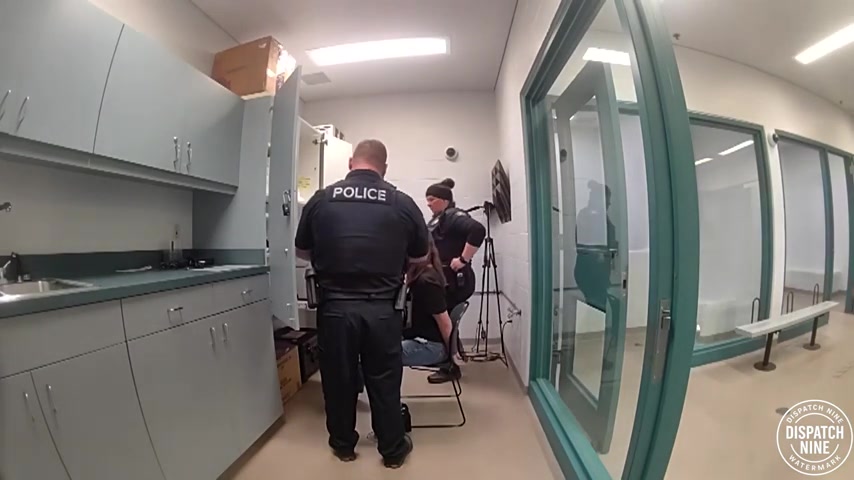
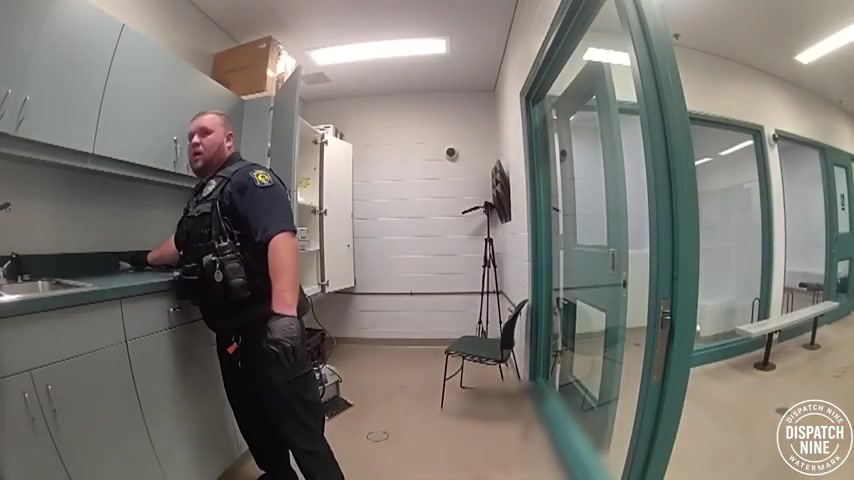
The supplied footage places the viewer inside a small police facility room with cabinets, a chair, testing equipment, and a glass wall. McRee is seated while officers stand nearby. The space is confined, making every movement appear close and immediate.
The video does not portray McRee as calm or cooperative. She argues with the officers and resists instructions. At one point she rises from the chair. Cannon responds with increasingly forceful commands for her to sit. The atmosphere is tense, and the verbal exchange becomes openly hostile.
For police officers, dealing with intoxicated and argumentative detainees is difficult. Intoxication can make behavior unpredictable, instructions may need to be repeated, and a person who is verbally aggressive can rapidly increase stress inside a confined space. Officers still have to maintain security, complete required procedures, and prevent a detainee from leaving or interfering with the process.
Yet the fact that a detainee is difficult is not the end of a use-of-force analysis. The person's physical condition, level of restraint, immediate actions, proximity to officers, and actual threat all matter. A person with both hands cuffed behind the back is in a fundamentally different position from an unrestrained person actively attacking an officer.
This distinction later became central in Cannon's case. According to reporting on the investigation, officials reviewing the video did not accept the idea that the force visible on camera was a necessary response to an immediate physical threat.
The Moment That Changed the Case
The pivotal moment occurs when McRee stands and does not comply with Cannon's instruction to sit back down. Cannon moves toward her, grabs her, and forcefully propels her toward the chair and glass wall. She goes down hard.
The scene lasts only seconds, but the consequences are immediate. McRee cries out. Blood later becomes visible. Reports say she suffered a forehead laceration requiring seven stitches and was left with a noticeable scar.
Body-camera footage is particularly important in a moment like this because physical force often happens too quickly for witnesses to reconstruct accurately afterward. Human memory is imperfect even under ordinary conditions. Stress makes it worse. Video does not answer every legal question automatically, but it provides a fixed record that investigators can replay frame by frame and compare against statements made afterward.
That comparison would become especially damaging for Cannon.
Investigators Compare the Video With Cannon's Account
According to WFTV and other local reporting, Cannon initially gave explanations that investigators found inconsistent with the recorded evidence. Reports said he described McRee as attempting to leave or moving in a way that led to her fall. He also reportedly told medical personnel that she had slipped.
The footage gave investigators another source of evidence. An FDLE investigator reviewing the recording concluded that McRee did not appear to move toward Cannon or the other officer immediately before Cannon put his hands on her, according to reporting based on the arrest affidavit.
This is one of the most consequential aspects of modern body-camera cases. The camera is not simply a tool for documenting civilian behavior. It records officers as well. When an officer writes a report or gives a statement, investigators can compare the description with what the recording actually shows.
A discrepancy does not automatically prove intentional dishonesty. Cameras can miss angles, audio can be incomplete, and stressful encounters can produce imperfect memories. But when a video clearly contradicts a material explanation, the discrepancy can become central to both an internal investigation and a criminal case.
Here, the video did more than document the use of force. It provided a way to test the explanation for that force.
The Police Department Investigates One of Its Own
The Ormond Beach Police Department opened an internal investigation, while the Florida Department of Law Enforcement conducted a criminal investigation. Cannon was removed from normal duty and placed on administrative leave.
WFTV later reported that the department determined Cannon had violated eight departmental rules, including rules involving excessive force. Police Chief Jesse Godfrey publicly distanced the department from Cannon's conduct and said the incident did not represent the way the agency policed the community.
That response matters because use-of-force accountability operates on several different tracks. A department can investigate whether an officer violated internal policy. A state investigative agency can determine whether there is evidence of a crime. Prosecutors can decide whether charges are appropriate. A licensing authority can address professional certification. A civil court can later consider damages.
Those processes overlap, but they are not identical. Conduct may violate department policy without constituting a crime. Conversely, criminal conduct can also trigger employment consequences and civil liability. Cannon's case ultimately touched nearly every one of those systems.
From Police Officer to Criminal Defendant
On January 31, 2025, Cannon resigned from the Ormond Beach Police Department. Reporting from the Ormond Beach Observer says the 32-year-old former officer was arrested that same day on a felony battery charge.
The reversal was striking. Less than two months earlier, Cannon had been the officer standing over a handcuffed detainee inside a police facility. Now he was the person facing the criminal justice system.
The felony charge reflected investigators' conclusion that the force went beyond a permissible effort to control McRee. Prosecutors did not need to prove that McRee had behaved perfectly. Her intoxication, refusal to sit, and verbal hostility were part of the factual background. The question was whether Cannon's response was legally justified.
This is an important principle in police accountability cases. A person does not need to be innocent of the original offense to have rights while in custody. Someone lawfully arrested for DUI remains protected against unlawful force. A difficult detainee remains a detainee whose level of restraint and threat must be considered before force is used.
The Video Becomes Public
When the footage was released publicly in 2025, the case attracted wider attention. Local television stations including WFTV, WESH, FOX 35 Orlando and WSVN reported on the recording and the felony case against Cannon.
The images were powerful because viewers did not have to rely only on competing written descriptions. They could see McRee handcuffed, hear the argument, watch Cannon approach, and observe the physical force.
Public video can dramatically alter how a case is understood. Written police language is often clinical: a person “failed to comply,” an officer “redirected” a subject, or force was used to “gain control.” Video restores physical scale and speed to those descriptions. It shows what those phrases looked like in real time.
That does not mean every viral interpretation is accurate. Short clips can omit context, and emotionally charged headlines can push viewers toward conclusions before they see the full sequence. In this case, however, the full context did not prevent investigators from finding serious problems with Cannon's conduct. The internal investigation and criminal prosecution were already moving through official channels.
The Injury Becomes Impossible to Ignore
After the impact, the consequences are visible in the later portion of the footage. McRee has suffered a head injury and requires medical attention. Reports consistently state that the wound required seven stitches.
The physical injury mattered legally because felony battery in Florida can involve intentionally causing great bodily harm, permanent disability, or permanent disfigurement. The precise charging analysis belonged to investigators and prosecutors, but the severity and lasting nature of McRee's wound became a recurring part of reporting on the criminal case.
At Cannon's later court proceedings, McRee described living with the visible reminder of what happened. Court TV reported that the wound left a roughly 1.5-inch scar. The case therefore moved beyond a debate about a few seconds of force. There was a lasting physical consequence that the court could evaluate.
Cannon Pleads No Contest
In July 2025, the case moved toward resolution. Cannon pleaded no contest to felony battery. A no-contest plea does not function as a trial in which prosecutors prove every allegation to a jury, but it permits the court to impose judgment and sentence without the defendant contesting the charge.
WFTV reported that prosecutors sought a 19-month jail sentence. Cannon's defense argued for a more lenient outcome and presented mitigating circumstances, including his service history and mental-health diagnoses discussed during sentencing.
The judge nevertheless had to balance those considerations against the recorded conduct, the victim's injury, Cannon's position as a law-enforcement officer, and the principle that police officers are not entitled to a different standard of criminal responsibility simply because their job sometimes requires force.
Six Months in Jail and Two Years of Probation
On July 29, 2025, a Volusia County judge sentenced Cannon to six months in jail followed by two years of probation. Court TV reported that he was also required to surrender his law-enforcement certification and was prohibited from possessing firearms.
The sentencing gave the body-camera footage a final significance in the criminal case. What began as evidence created during McRee's DUI processing ultimately helped document conduct for which the officer himself was punished.
The judge's reasoning, as reported by Court TV, emphasized equal treatment under the law. The court acknowledged the difficult circumstances surrounding an intoxicated and verbally abusive detainee while refusing to treat those circumstances as permission for excessive force.
That is a useful distinction for anyone watching the footage. A viewer does not have to approve of McRee's behavior to conclude that the officer's response was improper. Nor does Cannon's criminal responsibility erase the separate DUI allegations against McRee. The justice system was capable of examining both people's conduct independently.
McRee's Own DUI Case Remained Separate
One of the easiest mistakes in discussing the case is to assume that misconduct by an officer automatically invalidates everything that happened before it. The two matters are legally distinct.
McRee had been arrested in connection with the crash and suspected impaired driving before the incident inside the station. Reporting said prosecutors pursued misdemeanor charges connected with DUI and refusal to submit to testing while declining some other allegations initially associated with the arrest.
Whether Cannon later committed battery did not, by itself, determine whether McRee had driven under the influence. Likewise, whether McRee was intoxicated did not determine whether Cannon was legally entitled to use the level of force captured on video.
This separation is essential to a fair reading of the story. Accountability is not a contest in which only one person can have acted wrongly. Different conduct can create different legal consequences.
The Case Continues Into Federal Court
The story did not end with Cannon's jail sentence. In July 2026, McRee filed a federal lawsuit against the City of Ormond Beach and Cannon. The suit alleges excessive force and seeks compensation related to her injuries, medical costs, and emotional harm.
WFTV reported that the lawsuit also alleges failures involving training and supervision by the city. The Ormond Beach Observer reported that McRee's claims stem from the deep forehead laceration and the force used while she was in police custody.
A civil lawsuit is not the same as a criminal conviction. Cannon's criminal case addressed whether he committed felony battery and what punishment he should receive. The civil case addresses alleged legal responsibility for damages. Claims against the city also raise separate questions about municipal responsibility that must be litigated under civil-law standards.
As of the latest reporting available in September 2026, that lawsuit represents the newest major development in a case that began nearly two years earlier with a traffic crash.
Why This Case Matters Beyond Ormond Beach
The footage illustrates one of the central purposes of body-worn cameras: accountability can run in both directions. Cameras can document evidence against suspects, but they can also document officers' actions when no independent civilian camera is present.
Inside a police station, the imbalance of control is particularly strong. The detainee is in an unfamiliar environment, may be handcuffed, and cannot simply walk away. Officers control the room, the doors, the testing process, and access to medical assistance. That authority creates a heightened responsibility to use force only when justified.
The case also demonstrates why de-escalation is not merely a public-relations phrase. McRee was plainly difficult to manage. But difficult people are a predictable part of policing. Officers routinely encounter people who are intoxicated, angry, frightened, insulting, confused, or mentally distressed. Professional training exists precisely because an officer cannot respond to every provocation as an ordinary person might.
The power of the state changes the standard. A civilian who loses patience in an argument does not possess a badge, arrest authority, restraints, and control over another person's freedom. An officer does. That is why courts, departments, and communities scrutinize the use of force differently.
The Camera Preserved More Than a Moment
Without video, this incident might have depended heavily on written reports and conflicting memories. With video, investigators had a record that could be replayed and compared with the statements given afterward.
The recording did not merely make the incident viral. It became part of an accountability process that included an internal investigation, an FDLE investigation, resignation, arrest, a felony prosecution, sentencing, loss of law-enforcement certification, and eventually civil litigation.
That sequence is why the Ormond Beach case remains significant. It shows that the consequences of a few seconds can unfold for years.
McRee's alleged DUI conduct was investigated. Cannon's use of force was investigated. Each was evaluated separately. That is exactly how accountability should function: not by deciding which person is more sympathetic, but by examining what each person actually did and applying the relevant law to those actions.
From a DUI Booking to a Case About Police Accountability
The incident began with a crash. It moved to a DUI arrest. Inside the station, an argument escalated. A handcuffed woman was forcefully thrown toward a chair and wall. She was injured. The officer's explanation was compared with video. Investigators opened a criminal case. The officer resigned, was arrested, pleaded no contest, and went to jail. Then the dispute entered federal civil court.
Seen as a complete timeline, the story is much larger than the few seconds that made headlines.
It is a case about the limits of police authority when dealing with an uncooperative detainee. It is about why a person's misconduct does not eliminate their legal protections. It is about the evidentiary value of body cameras. And it is about the fact that officers who enforce the law can themselves become defendants when investigators conclude they crossed the line.
The most important detail may be the simplest one: McRee was already handcuffed. That fact shaped how investigators and the court viewed the level of force that followed. Her words and refusal to sit provided context, but they did not end the inquiry.
For viewers, the full footage offers something a headline cannot. It shows the tension before the force, the force itself, and the immediate aftermath. The reporting and court record then reveal what the camera could not show: the months of investigation and legal proceedings that followed.
Watch the Full Incident
The brief viral moment is only one part of the story. Watching the complete footage provides the context surrounding the DUI processing, the escalating exchange inside the station, the use of force, and the aftermath that became central to the investigation of former Officer Jacob Cannon.
Comments (0)
Loading comments...
May You Like

Chrysler 300 Gapped Cops at 150+ MPH | Police Dashcam

A Late-Night Escape Attempt Ends With Officers Making an Arrest

MERIDEN POLICE OFFICER SHOOTS MAN BEATING FATHER WITH A BASEBALL BAT












