
[Bodycam] K-9 Lorde scores a win during a check of a suspicious vehicle
Routine Park Forest Traffic Stop Takes a Turn When K9 Lorde Is Called In
A Midday Traffic Stop Becomes Something More
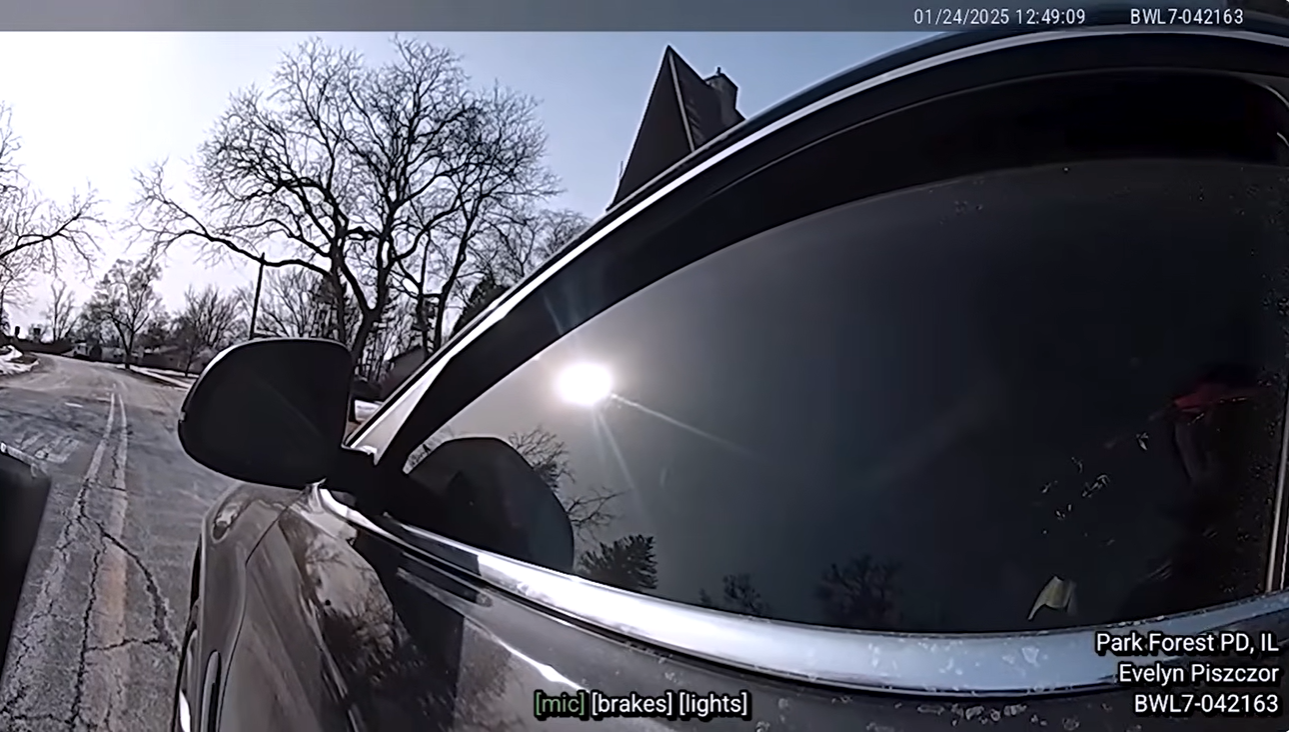
At first glance, the January 24, 2025 encounter captured on Park Forest Police body-worn camera looks ordinary. It is midday in a residential area of Park Forest, Illinois. An officer stands beside a dark SUV with heavily tinted windows. The road is quiet, winter snow remains along the edges of the pavement, and there is no obvious sign that the stop will become anything more than a roadside conversation.
But the footage contains a detail that points to a much larger story: the officer identified in the bodycam overlay is Evelyn Piszczor, the handler of Park Forest Police K9 Lorde.
The supplied images show the stop at 12:49 p.m. and, roughly twelve minutes later, Lorde working beside the vehicle. That progression closely matches a Park Forest case later reported by eNews Park Forest in which police said a nervous driver prompted an officer to request backup and a K9 deployment. According to that report, Lorde located a loaded Glock 23 chambered in .40 caliber with a loaded drum magazine and a conversion device commonly called a “switch.”
The available public article does not expose enough searchable detail to safely identify the driver, list every charge, or prove from the images alone that every moment shown belongs to the published Glock 23 case. For that reason, this article does not fill those gaps with guesses.
What can be verified is substantial. The bodycam is dated January 24, 2025. It identifies Park Forest Police and Officer Evelyn Piszczor. Park Forest's official website confirms that Piszczor is Lorde's handler. The department says Lorde is trained for narcotics detection, tracking, suspect apprehension, missing-person searches and community demonstrations. And local reporting documents a Park Forest traffic stop in which Lorde located the loaded Glock 23 with a drum and switch.
Together, those facts provide a responsible framework for understanding what the footage represents: the moment a seemingly routine traffic encounter shifts into a K9-assisted investigation.
The Bodycam Gives Us a Firm Date and Officer
The clearest evidence begins with the recording itself.
The upper-right overlay reads January 24, 2025 and 12:49:09. The lower-right corner identifies Park Forest Police Department in Illinois and Officer Evelyn Piszczor.
Those details are valuable because they allow the footage to be checked against public records rather than relying on a social-media caption.
Park Forest's official K9 page independently confirms that Piszczor is a department officer and K9 Lorde's handler.
The Village also documented Lorde's introduction to the community in 2023, when Piszczor and the German Shepherd returned from specialized training in Pennsylvania.
Who Is K9 Lorde?
Lorde joined the Park Forest Police Department in 2023.
The department describes him as a German Shepherd trained for a broad range of police work.
His assignments include narcotics detection, tracking offenders, locating missing people and assisting with suspect apprehension.
The Village says Lorde and Officer Piszczor graduated from Shallow Creek Kennels Training Facility in Pennsylvania before beginning patrol work together.
Will County State's Attorney records also identify Lorde and Piszczor as a Park Forest K9 team and note that the dog was funded through a program using assets seized from criminal activity.
That background helps explain why Lorde appears during a traffic stop. A K9 team is not limited to searching woods for fleeing suspects. Detection work around vehicles can also be part of the team's role.
The Stop Begins Beside a Dark SUV
The first genuine image used in this article comes directly from the material supplied for this story.
It shows Piszczor's bodycam positioned close to the driver's side of a dark SUV.
The window is heavily tinted, making the interior difficult to see from outside.
Winter conditions are visible in the background.
Nothing in the still image alone proves that contraband is present.
That distinction matters.
A traffic stop can become an investigation, but the presence of police or a K9 does not by itself establish guilt.
Why Backup Can Change the Direction of a Stop
The eNews Park Forest report says the driver in the reported Glock 23 case appeared nervous and that the stopping officer requested backup.
Calling another unit is a common way to add safety and flexibility to a roadside investigation.
One officer can continue speaking with the driver while another watches occupants, traffic and the surrounding area.
If the backup unit is a trained K9 team, officers may also have access to capabilities that ordinary patrol officers do not.
That is where Lorde becomes important.
From Conversation to K9 Deployment
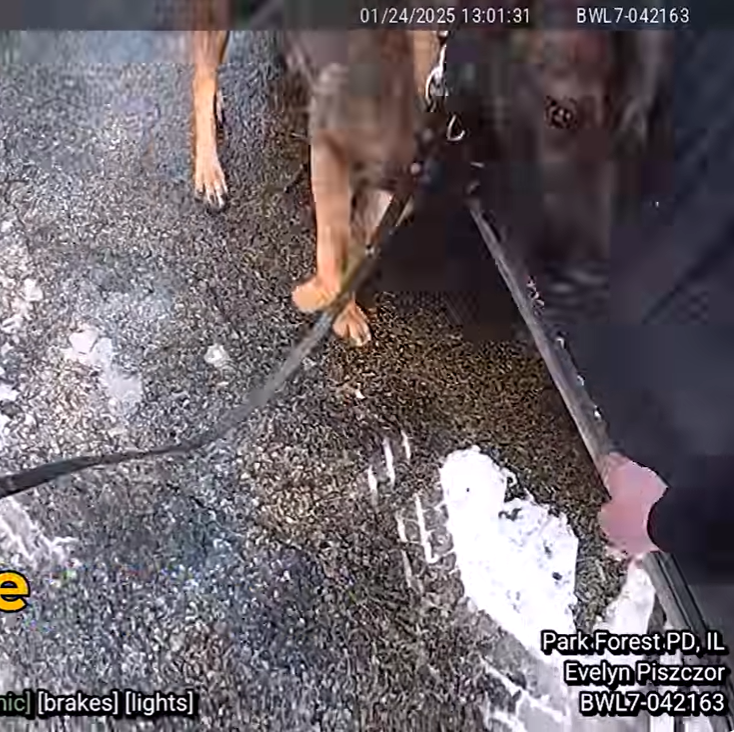
The later supplied image is timestamped 1:01:31 p.m.
Lorde is now beside the vehicle.
Only about twelve minutes separate that frame from the earlier image.
That compressed timeline is one reason bodycam footage can be so revealing. A stop that appears static in screenshots is actually a sequence of decisions.
An officer makes contact.
Information is checked.
Behavior is observed.
Backup arrives.
The K9 is brought into the investigation.
The entire character of the encounter can change within minutes.
The Second Frame Shows Lorde at Work
The second image embedded in this article is also a genuine frame from the supplied footage.
Lorde is visible close to the vehicle with his leash controlled by the handler.
Snow and road salt remain on the pavement.
The camera angle is low and tight, emphasizing how close the dog is working to the exterior of the SUV.
The frame does not need an artificial graphic or AI reconstruction. It already shows the central investigative tool in the story.
The Local Report Describes a Major Firearm Discovery
eNews Park Forest reported in May 2025 that K9 Lorde located a loaded Glock 23 during a Park Forest traffic stop.
The publication described the pistol as a .40-caliber Glock 23 equipped with a loaded drum.
More significantly, the report said the handgun had a “switch,” also known as an auto sear.
According to the report, the device converted the semiautomatic pistol so it could operate automatically.
That turns the discovery from a generic firearm story into a much more serious weapons investigation.
Why a Conversion Device Matters
A semiautomatic handgun normally fires one round for each trigger press.
A machinegun conversion device changes that operating behavior so multiple rounds can be fired automatically while the trigger remains depressed.
The physical device can be very small.
Its size can make the modification easy to overlook in a photograph, but its legal significance can be substantial.
For this article, the important point is limited to what local reporting states: police described the recovered Glock as equipped with such a device.
The exact criminal charges and final court disposition should be established from charging documents or court records, not guessed from the appearance of the gun.
The Drum Magazine Adds Another Visual Detail
The same local report says the Glock had a loaded drum magazine.
A drum magazine can hold substantially more ammunition than the standard magazine typically associated with a compact or service-style handgun.
That does not tell us why the weapon was allegedly in the vehicle or how it would have been used.
Those questions require evidence beyond a traffic-stop photograph.
But it explains why the recovered firearm became the centerpiece of the local news report.
Why the Dog's Role Is More Than Symbolic
Police K9s are visually striking, which can make them seem like the dramatic centerpiece of any video in which they appear.
But Lorde's role is functional.
Park Forest says the dog is trained in detection work.
In the reported Glock case, the department credited Lorde with finding the weapon.
That is a measurable investigative contribution, not simply a ceremonial appearance.
The dog helps officers move from suspicion to a physical item that can be secured and examined.
Officer Piszczor and Lorde Have Worked as a Team Since 2023
Park Forest introduced Lorde publicly in August 2023.
Village records identify Piszczor as the dog's handler and describe the pair graduating together from Shallow Creek Training Facility.
The Will County State's Attorney's Office also notes that Piszczor became Park Forest's first female K9 handler.
That history matters when interpreting the bodycam.
The handler is not simply an officer who happens to be holding a leash. K9 work depends on a continuing partnership in which the handler learns to interpret the dog's behavior and maintain control during searches.
Training Makes the Search Repeatable
Detection dogs work through conditioned behavior.
The goal is not for a dog to wander around a vehicle randomly.
Training creates a repeatable search process in which the handler directs the dog through an area and watches for changes in behavior associated with a trained odor.
That process can then be documented through bodycam, reports and testimony.
The dog's reliability, training history and deployment can become important if evidence discovered after a K9 alert is later challenged in court.
The Camera Records More Than the Driver
Body-worn cameras are valuable because they capture context that a written report may compress into a few sentences.
The video can show how long the stop lasted before backup arrived.
It can show where officers stood.
It can show commands and responses.
It can show the K9 deployment and the position of the vehicle.
That does not mean bodycam tells the entire legal story.
But it creates a contemporaneous record that can be compared with later reports.
A Routine Stop Can Become an Evidence Case Quickly
Traffic enforcement frequently begins with something mundane: a registration issue, equipment problem, moving violation or another observable reason to stop a vehicle.
The legal and investigative stakes can change if officers develop additional information during contact.
In the Park Forest case reported by eNews Park Forest, the story eventually centered not on the original reason for the stop but on what police said Lorde discovered.
That shift is what makes the footage compelling.
The viewer starts with a roadside interaction and gradually realizes that the K9 deployment may be the turning point.
Why the Exact Initial Violation Should Not Be Invented
The screenshots supplied for this article do not reveal the original reason the SUV was stopped.
The searchable portion of the local report focuses on the driver's nervous behavior, the request for backup and the firearm discovery.
It would be easy to fill the gap by assuming tinted windows, speeding, registration or some other traffic violation.
That would be irresponsible.
Unless the original police report or complete video establishes the reason, the accurate description is simply a traffic stop.
The Same Rule Applies to the Driver's Identity
The publicly accessible search results reviewed for this article do not provide a reliable name that can be safely attached to the January 24 footage.
A police blotter contains many unrelated Park Forest arrests around the same period.
Matching a random name to a vehicle simply because the date is close could falsely accuse someone of possessing the firearm described in another report.
For that reason, the driver remains unnamed here.
Accuracy is more important than making the narrative appear complete.
Charges Are Not the Same as Convictions
Even when a police report identifies a suspect and lists charges, those charges remain allegations unless established through a guilty plea or court judgment.
That distinction becomes especially important in firearm cases.
State and federal law can overlap.
Prosecutors may amend counts.
Some allegations may be dismissed.
A case may be transferred or resolved through a plea to different conduct.
Without verified court records, a blog should not jump from “police recovered a weapon” to “the driver was convicted.”
Park Forest's K9 Program Has a Broader Mission
The Village describes its K9 program as supporting both enforcement and community engagement.
Lorde can be deployed for narcotics detection and offender tracking, but he also participates in public demonstrations.
That dual role is common for police K9 teams.
The same dog that searches a vehicle during an investigation may later appear at a community event where residents meet officers and learn how the unit works.
The contrast helps explain why departments often invest heavily in the training and maintenance of K9 teams.
Lorde Was Added After Specialized Training
Village records say Lorde was approximately 18 months old when introduced to Park Forest in 2023.
He and Piszczor trained at Shallow Creek in Pennsylvania.
The department's official page says they began working a range of assignments after graduation.
By January 2025, the date shown on the supplied bodycam, the team had already been working together for well over a year.
That experience is relevant because K9 performance depends heavily on familiarity between dog and handler.
The Handler Has to Manage Two Scenes at Once
During a roadside K9 deployment, the handler is simultaneously responsible for the dog and the surrounding police environment.
Traffic may still be moving nearby.
Other officers may be interacting with the driver or passengers.
The vehicle may contain unknown hazards.
The handler has to keep the dog focused while remaining aware of everything happening around the search.
The close bodycam view in the supplied frame illustrates that workload.
Winter Conditions Add Small Complications
The January images show snow and wet pavement around the stop.
Those conditions are not the central issue, but they affect movement.
A handler needs stable footing.
The dog is working close to tires, doors and potentially slippery pavement.
Equipment and leash control matter.
Small environmental details like these are easy to miss in a headline, yet they are part of what officers and K9s actually encounter in the field.
The Tinted Glass Limits What a Still Image Can Reveal
The SUV's side window is dark enough that the interior is difficult to see.
That makes the first frame visually dramatic, but it should not be overinterpreted.
Tinted glass does not prove criminal activity.
The still image also cannot show what officers knew from dispatch, database checks or conversation with the driver.
This is why a responsible account separates visible facts from investigative claims reported by police.
The Firearm Discovery Becomes the Story's Turning Point
If the local report and footage are indeed the same January 24 stop, the narrative turning point is not an argument or a chase.
It is a search result.
Lorde's deployment produces information that officers did not have when the first officer approached the SUV.
Police then move from traffic enforcement to securing a loaded firearm described as having a drum magazine and conversion device.
The danger is discovered rather than displayed through violence.
That makes the case different from many bodycam stories.
No Dramatic Pursuit Is Needed for High Stakes
Police footage channels often focus on pursuits, crashes and physical arrests because those events are visually immediate.
This encounter is quieter.
The tension comes from uncertainty.
Why is backup being requested?
Why is a K9 being brought forward?
What is inside the vehicle?
The answer, according to the local report, is a loaded modified handgun.
That structure can hold a reader's attention without exaggerating what occurs on camera.
What the Official Park Forest Sources Confirm
Park Forest's official website confirms several foundational facts.
The police department serves a community of roughly 22,000 residents in suburban Chicago and handles law-enforcement responsibilities in both Cook and Will Counties.
Its officers include specialists such as K9 handlers.
The official K9 page identifies Lorde as a German Shepherd who joined in 2023 and names Officer Piszczor as his handler.
It also lists detection and apprehension among Lorde's duties.
These sources provide reliable background without requiring speculation about the January stop.
What the Local News Report Confirms
eNews Park Forest provides the incident-specific reporting.
Its May 15, 2025 article states that Lorde found a loaded Glock 23 during a Park Forest traffic stop.
It says the driver appeared nervous, prompting the stopping officer to request backup.
The article describes the firearm as a .40-caliber Glock 23 with a loaded drum and a switch.
Those details are attributed to police.
They should therefore be presented as the department's reported findings, not as an independent court judgment.
What the Images Confirm
The supplied images add another layer.
They establish a January 24, 2025 Park Forest Police encounter involving Officer Evelyn Piszczor.
They show a dark SUV.
They show Lorde working beside the vehicle.
The timestamps indicate the K9 deployment occurred within minutes of the initial roadside contact.
Those observations align closely with the reported K9 firearm case, though the available public material does not expose a case number that would allow every detail to be matched beyond doubt.
What This Article Does Not Claim
This article does not identify the driver.
It does not invent the original traffic violation.
It does not state that the driver was convicted of possessing a machinegun.
It does not invent narcotics, cash or additional weapons.
It does not assume that nervousness alone established probable cause.
And it does not add a criminal history.
Those details would require the original police report, charging documents or court records.
Why That Restraint Makes the Story Stronger
A factual police blog does not become more compelling by adding unsupported details.
The real sequence already has a strong hook.
A quiet winter traffic stop begins.
The officer cannot easily see through the dark window.
Backup enters the picture.
A trained K9 is brought to the SUV.
The dog works the vehicle.
Police reporting later describes a loaded Glock 23 with a drum and conversion device.
The tension comes from the gap between the ordinary beginning and the reported discovery.
A Small K9 Unit Can Have an Outsized Impact
Park Forest is not a massive metropolitan police department.
Its official website says the agency has about 60 employees.
Specialized resources therefore matter.
A K9 team can assist patrol officers without requiring an entirely separate investigative unit to respond to every developing stop.
The January footage illustrates how that capability can be integrated into everyday patrol work.
The Encounter Also Shows the Value of Documentation
The case can be reconstructed today because several forms of documentation overlap.
There is bodycam imagery.
There is an official municipal page identifying the K9 team.
There are Village records documenting Lorde's introduction and training.
There is local news reporting based on police information.
Each source answers a different question.
Together they provide a stronger account than any single social-media upload.
Why Readers Should Watch the Timeline
When viewing the full footage, the most useful detail may be the clock.
The initial image is stamped 12:49:09.
The K9 frame is stamped 1:01:31.
That means the visible transition occurs in about twelve minutes.
Watching what happens between those timestamps can reveal how officers move from initial contact to a K9-assisted investigation.
That progression is more informative than jumping directly to the recovered weapon.
The Bigger Lesson From a Quiet Traffic Stop
The Park Forest footage is a reminder that police encounters do not need to look chaotic to carry significant risk.
A driver can remain inside a vehicle.
Officers can speak calmly.
Traffic can continue normally.
And yet an investigation can still result in the recovery of a weapon police describe as capable of automatic fire.
For officers, that uncertainty is part of roadside enforcement.
For viewers, bodycam offers a rare opportunity to see how an apparently ordinary stop develops before the headline-making discovery.
The Legal Story Continues After the Camera Stops
Recovering a firearm is only the beginning of the evidentiary process.
Police must document where it was found and how it was secured.
Investigators may examine serial numbers and the conversion device.
Prosecutors determine which statutes apply and whether the evidence supports charges.
Defense attorneys can challenge the stop, search or other aspects of the case.
A court ultimately determines guilt.
The bodycam records an important part of the investigation, but it does not replace that legal process.
A K9 Turns the Direction of the Encounter
The strongest narrative element is the arrival of Lorde.
Before the K9 deployment, the stop is visually ambiguous.
Afterward, local reporting says officers recover a weapon with features that substantially raise the stakes.
That is why Lorde belongs at the center of the article rather than being treated as a decorative detail.
The K9 is the investigative pivot around which the story turns.
Watch the Full Encounter
The complete bodycam is worth watching for the transition rather than only the final discovery.
Pay attention to the first contact with the dark SUV, the time that passes before the K9 is deployed, Officer Piszczor's handling of Lorde and the way the stop changes once the dog begins working around the vehicle.
The most compelling part of the incident is how ordinary it initially appears.
Within minutes, the roadside encounter has become a K9-assisted investigation tied in local reporting to the recovery of a loaded Glock 23 with a drum magazine and conversion device.
Comments (0)
Loading comments...
May You Like

One Driver’s Decision to Flee Brings Police Racing After Him

Stolen Charger Flees Police During Highway Traffic Stop
Police vs Chevy Impala High-Speed Pursuit Ends in TVI













