[BODYCAM] Intoxicated Suspect Refuses Orders & Reaches For Gun In Truck
Domestic Violence Call Turns Into a Pursuit Before Deputies Find a Revolver Inside the Truck
A Face at the Bedroom Window Changes the Night
At around 11:30 p.m. on August 28, 2026, a woman in Pierce County found herself facing exactly the kind of situation a domestic-violence court order is supposed to prevent.
Her ex-husband had appeared outside her bedroom window.
According to the Pierce County Sheriff's Office, there was an active domestic-violence court order restricting the man's contact with her. Deputies were also told that he appeared to be intoxicated.
The woman did what authorities encourage people in these situations to do.
She called 911.
But before deputies could reach the property, the man began leaving in his pickup truck.
That could have ended the immediate confrontation at the house.
Instead, it created another danger.
Deputies arriving in the area spotted the pickup.
They attempted to stop it.
The driver did not cooperate.
Within moments, a domestic-violence response had transformed into a vehicle pursuit.
And that was only the beginning.
The chase would end with a PIT maneuver.
The pickup would be boxed in by patrol vehicles.
The driver would refuse repeated commands.
Deputies would watch him reaching around inside the cabin without knowing exactly what he was reaching toward.
A 40mm less-lethal round would be fired.
A shield team would approach.
And only after officers finally secured the man would they confirm something that made his movements inside the truck considerably more alarming.
There was a revolver on the passenger-side floorboard.
The Court Order Is What Makes the First Call Serious
Domestic-violence protection and no-contact orders are not simply requests that two people stay away from one another.
They are enforceable court orders.
When police receive a report that someone subject to such an order has appeared at a protected person's residence, the encounter can immediately become an enforcement matter.
In this case, the location makes the alleged violation particularly unsettling.
The Sheriff's Office says the woman's ex-husband appeared at her bedroom window.
This was not a chance encounter at a grocery store.
It was late at night, at the victim's home.
And the victim reportedly believed the man was intoxicated.
She immediately contacted emergency dispatch and told authorities he was leaving in his truck.
That information gave responding deputies an important advantage.
They knew what they were looking for.
As units arrived, they located the vehicle.
The next decision belonged to the driver.
He could stop.
He did not.
Instead, deputies say he fled, and the pursuit began.
This decision changed the risk profile for everyone involved.
The victim was no longer the only person potentially exposed to danger.
Now other motorists could be affected.
Deputies had to follow a vehicle driven by someone they believed had just violated a domestic-violence order and appeared intoxicated.
And police still did not know everything that was inside the truck.
Deputies Don't Let the Pursuit Continue for Long
Some police chases continue for miles.
This one did not.
The Sheriff's Office says a deputy quickly used a Pursuit Intervention Technique, commonly known as a PIT maneuver, to disable the pickup.
The strategy is significant.
Rather than allowing the pursuit to continue indefinitely, deputies attempted to remove the suspect's ability to keep fleeing.
The PIT worked.
But the driver was apparently not ready to surrender.
PCSO says he attempted to drive away again.
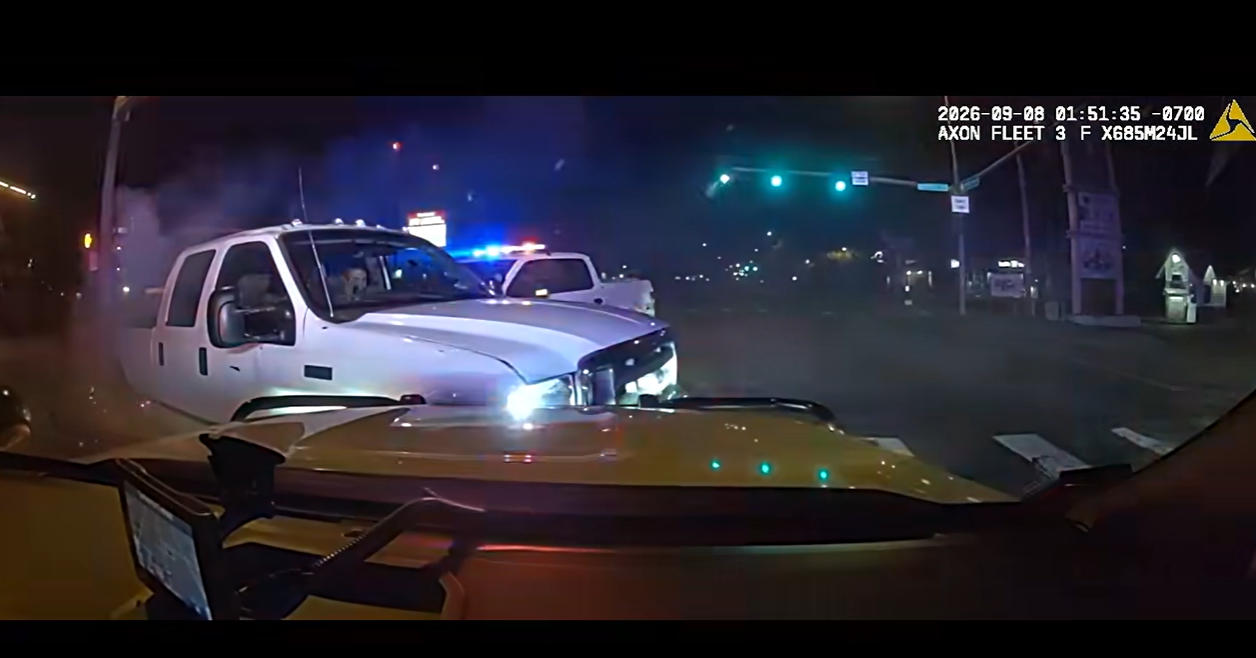
Deputies responded by pinning the truck in place with their vehicles.
Now the pursuit was over.
The danger had not disappeared.
In some ways, the situation had become more uncertain.
During a pursuit, officers can see the suspect vehicle moving ahead of them.
Once a vehicle is boxed in and officers approach on foot, the distance collapses.
The suspect's hands suddenly matter enormously.
Does he comply?
Does he reach toward the ignition?
Does he try to reverse?
Is there a weapon?
Those questions become urgent.
And inside this particular pickup, there actually was a gun.
The deputies simply did not know that yet.
The Truck Stops, but the Suspect Keeps Reaching Around
Once the pickup was pinned, deputies began issuing commands.
The 44-year-old suspect refused to follow them, according to the Sheriff's Office.
More concerningly, he continued moving and reaching around inside the truck.
This is the point where the bodycam footage becomes particularly tense.
To someone watching afterward, the scene has an advantage the deputies did not possess.
We know how the story ends.
We know police eventually discover the revolver.
Officers standing around the truck did not know that yet.
They could see movement.
They could see that the suspect was not following commands.
But they could not necessarily see what his hands might reach.
That difference between hindsight and real-time perception is crucial when evaluating police footage.
An officer cannot freeze the video.
He cannot skip forward thirty seconds and discover whether a gun will eventually be found.
He has to respond to the information available at that moment.
And the information here was troubling.
The driver had allegedly violated a domestic-violence court order.
He appeared intoxicated.
He had fled from police.
He had attempted to continue driving after the PIT.
He was refusing commands.
And now he was reaching around inside the vehicle.
Police needed to get him out.
But approaching the truck without knowing what was inside could expose deputies to serious danger.
So they tried a less-lethal option.
A 40mm Round Doesn't Produce the Surrender Deputies Want
Pierce County deputies deployed a 40mm less-lethal bean-bag round during the standoff at the truck.
According to PCSO, it did not appear to have an effect.
The terminology can sometimes confuse viewers.
“Less lethal” does not mean harmless.
It describes tools intended to provide officers with options other than conventional deadly force when circumstances allow.
Their purpose is often to create pain, distraction or temporary incapacitation sufficient to gain compliance.
But no less-lethal tool works perfectly.
People respond differently.
Clothing can affect impact.
Placement matters.
Adrenaline, intoxication and mental state may influence a person's reaction.
Here, the 40mm deployment did not resolve the situation.
The suspect remained inside.
Deputies still needed another way to take him into custody.
Instead of escalating immediately to gunfire, they waited several minutes and prepared to approach more deliberately.
A ballistic shield became part of the plan.
That choice is important.
A shield gives officers additional protection as they close distance on a person who may be armed.
At this point deputies still did not have confirmation of the revolver.
But the suspect's unexplained reaching meant they could not safely assume the truck contained nothing dangerous.
Deputies Finally Move Toward the Pickup
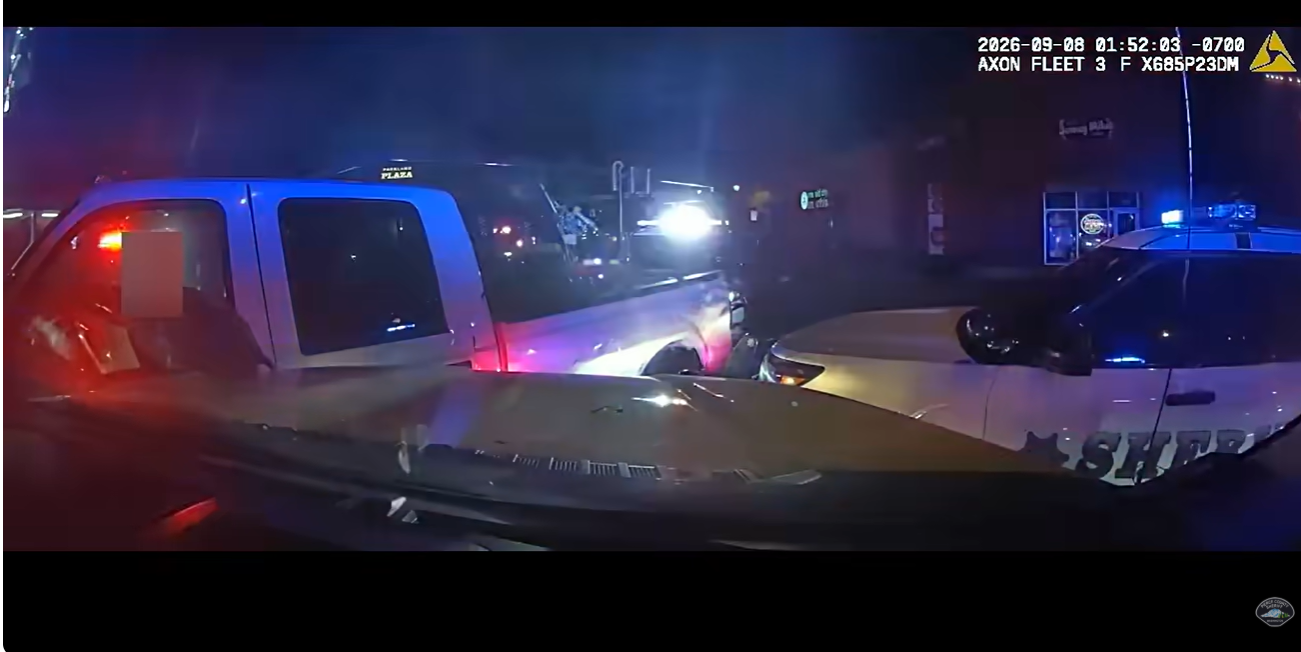
After several minutes, deputies advanced.
The shield went first.
Other deputies moved with it.
This is the moment when containment becomes arrest.
Until then, officers can use distance.
Once they reach the door, everything becomes close-range.
The suspect can no longer be treated simply as a driver inside a disabled vehicle.
Deputies need physical control.
According to the Sheriff's Office, the approach succeeds.
The 44-year-old is removed from the situation and taken into custody.
There is no prolonged gunfight.
Nobody needs to chase him on foot.
The standoff ends with deputies gaining control.
Then officers secure the scene and inspect the truck.
That is when the earlier movements acquire an entirely different significance.
On the passenger-side floorboard is a revolver.
Police say it is clearly visible once the scene is secured.
The discovery does not prove that every movement the suspect made inside the vehicle was an attempt to grab the gun.
That distinction matters.
Unless video or other evidence clearly establishes what he intended, it would be irresponsible to state that he definitely was reaching for the revolver.
But the weapon's presence explains why the deputies' uncertainty was legitimate.
They did not know what his hands were moving toward.
There was, in fact, a firearm within the vehicle.
And the suspect was later booked for unlawful possession of a firearm in the second degree, among several other allegations.
The Revolver Changes How the Standoff Looks in Hindsight
Police bodycam footage frequently produces a strange effect.
Viewers know more than the officers did.
If the title says “Deputies Find Gun,” we begin watching the footage already expecting a weapon.
Every movement then looks suspicious.
But that is not how the incident unfolded for deputies.
They had incomplete information.
This is why chronology matters.
First came the domestic-violence call.
Then the truck leaving.
Then the pursuit.
Then the PIT.
Then the attempt to continue driving.
Then the pin.
Then refusal to comply.
Then the reaching.
Then the less-lethal round.
Then the shield approach.
Only afterward came confirmation of the revolver.
Keeping that order intact prevents hindsight from rewriting the encounter.
It also highlights why the arrest ended without deputies immediately resorting to deadly force.
The officers did not know whether the suspect was armed.
They treated the movements seriously.
They tried a 40mm option.
When that failed, they used a shield to reduce their exposure during the approach.
Only after taking the suspect into custody did they discover the weapon.
That sequence is more informative than simply saying “armed suspect arrested after chase.”
The Pursuit Was Only One Piece of a Much Larger Case
Once the arrest was complete, the Sheriff's Office listed the offenses for which the suspect was booked.
There were eight:
- Domestic Violence Court Order Violation
- Unlawful Possession of a Firearm in the Second Degree
- Eluding
- Obstructing Law Enforcement
- Malicious Mischief in the First Degree
- Driving While License Suspended in the Third Degree
- Operating a Vehicle Without an Ignition Interlock
- DUI with a Previous DUI Conviction
That list shows just how far the incident had moved from the original 911 call.
The victim called because her ex-husband allegedly appeared outside her bedroom window in violation of a court order.
Had the suspect left and complied with deputies when stopped, the case would still have been serious.
Instead, police say he fled.
That created the eluding allegation.
His conduct during the arrest produced an obstruction allegation.
His driving status and ignition-interlock requirement created additional issues.
The revolver generated another alleged offense.
And deputies also booked him for DUI with a previous DUI conviction.
One late-night decision did not remain one charge.
The encounter accumulated legal consequences as it progressed.
That is a pattern visible in many pursuit videos.
The original problem motivates the escape.
But the escape does not erase the original problem.
It adds new ones.
The Ignition Interlock Detail Tells Its Own Story
One allegation on the booking list can easily disappear beneath the more dramatic charges.
Operating a Vehicle Without an Ignition Interlock.
An ignition interlock device is designed to prevent a vehicle from being operated under prohibited alcohol-related circumstances by requiring a breath sample before starting or continuing operation.
PCSO also says the man was booked for DUI with a previous DUI conviction.
Those allegations provide context for why deputies may have viewed the suspect's apparent intoxication as more than a minor detail.
Again, booking allegations are not convictions in the new case.
The suspect retains the presumption of innocence unless and until guilt is established through the legal process.
But from the roadside perspective, deputies were dealing with several risk factors simultaneously.
A domestic-violence order.
Possible intoxication.
A fleeing vehicle.
A suspended license.
An ignition-interlock issue.
Noncompliance after the pursuit.
And, unknown to officers at first, a firearm.
Any one of those could complicate a police encounter.
Together, they explain why what began at a bedroom window ended with several deputies surrounding a disabled pickup.
The Victim's Decision to Call Immediately May Have Prevented a Worse Outcome
One person can easily disappear from the narrative once police lights and pursuit footage take over.
The woman who called 911.
She was the reason deputies knew what was happening.
According to PCSO, she immediately reported her ex-husband's appearance at the bedroom window and told dispatch that he was leaving in his truck.
That information allowed deputies to locate the vehicle as they arrived.
Without the call, the suspect might simply have driven away.
Police may not have known about the alleged order violation until much later.
Instead, the response happened while the event was still unfolding.
Domestic-violence cases can be especially unpredictable because the people involved often know one another intimately.
There may be emotional history.
Prior incidents.
Court orders.
Shared locations.
And knowledge of one another's routines.
A person appearing outside a bedroom window late at night can therefore carry implications that an ordinary trespassing call does not.
The active court order matters precisely because a court had already established restrictions on contact.
The alleged violation signaled that those restrictions were not being followed.
Calling 911 created a record and brought law enforcement into the situation before it could develop further at the home.
Whatever happened afterward, the victim was no longer dealing with it alone.
A PIT Ends the Chase, but Not the Threat Assessment
The pursuit itself appears relatively short in PCSO's account.
That is significant.
Long pursuits expose more people to danger.
Every additional intersection introduces another possibility for collision.
Every mile creates more opportunities for the fleeing driver to lose control.
Here, deputies quickly used the PIT.
But stopping the vehicle did not automatically make the encounter safe.
That is one of the most useful lessons from the footage.
A pursuit has two endings.
There is the moment the vehicle stops.
And there is the moment the occupants are actually under control.
Those moments can be separated by seconds or minutes.
In this case, the truck stopped first.
Then the suspect tried to keep driving.
Deputies pinned it.
Then came the refusal.
The reaching.
The less-lethal deployment.
The shield.
Finally, the arrest.
Only then could deputies say the active threat had been contained.
This distinction is why officers often continue issuing forceful commands after a suspect vehicle has crashed or been PITed.
The motion of the car has ended.
The uncertainty about the person inside has not.
And here, that uncertainty turned out to involve an actual firearm.
Why This Encounter Could Have Ended Very Differently
There are several points where the outcome could have been worse.
The alleged court-order violation could have escalated at the victim's home.
The pursuit could have produced a serious collision.
The PIT could have failed to immobilize the truck.
The suspect could have escaped the vehicle.
The less-lethal round could have triggered further resistance.
Deputies approaching the cabin could have encountered the revolver under very different circumstances.
None of those outcomes occurred.
Instead, the suspect was taken into custody.
That does not make the incident routine.
It demonstrates how close high-risk police encounters can come to a much more serious ending without crossing that line.
The firearm is the clearest example.
A revolver on the passenger-side floorboard is not the same thing as a revolver being pointed at deputies.
Those distinctions matter.
Police did not report that the suspect fired it.
They did not report an exchange of gunfire.
The weapon was recovered after the arrest.
That factual precision is important because bodycam stories are easily exaggerated.
The real sequence is already dramatic enough.
There is no need to invent a shootout that never happened.
The Second Incident in the Weekend Report Shows a Very Different Kind of Violence
PCSO's August 31 roundup contained another serious incident from the same weekend.
At approximately 1:30 a.m. on August 31, deputies responded to the Hobo Inn in Elbe after reports of a stabbing.
Police learned that a 40-year-old woman had been stabbed three times.
Witnesses had already transported her to a local hospital before deputies arrived.
Her injuries were reported as non-life-threatening.
The suspected attacker, a 21-year-old man, remained at the scene.
Deputies found him covered in blood and described him as heavily intoxicated.
Unlike the domestic-violence suspect from August 28, he did not lead police on a pursuit or prolonged standoff.
He was taken into custody without further incident and booked for first-degree assault.
The contrast between the two incidents is striking.
Both involve alleged violence.
Both involve intoxication according to deputies.
Both end in jail.
But the path to arrest is completely different.
One suspect remains at the scene and is arrested.
The other allegedly flees in a truck, gets PITed, refuses commands and is ultimately found with a revolver in the vehicle.
The comparison demonstrates how much a suspect's choices after police become involved can shape the danger of an encounter.
The Charges Tell the Story of Escalation
The 44-year-old suspect's booking list functions almost like a timeline.
Court-order violation tells us why deputies were called.
Eluding tells us what happened when they attempted to stop him.
Obstruction reflects the confrontation after the truck was disabled.
Firearm possession reflects what deputies found inside.
The license, ignition-interlock and DUI allegations add the driving-related issues uncovered during the investigation.
What started as one reported violation became a case involving eight booking allegations.
That does not mean all eight will necessarily result in convictions.
Charging decisions, evidence, defenses and court proceedings come later.
But it shows why fleeing police so often makes an existing legal problem more complicated.
The driver does not leave the original allegation behind.
He carries it into the pursuit.
Then everything that happens during the escape becomes additional evidence.
The patrol cameras record it.
Body cameras record the arrest.
Deputies document the PIT.
The damaged vehicles can become evidence.
The firearm can be recovered.
The suspect's driving status can be checked electronically.
By the time the person reaches jail, the investigation may be far larger than it was when the emergency lights first appeared.
The Revolver Was There Even When Deputies Couldn't See It
The most unsettling detail remains the simplest.
There was a gun inside the pickup.
For several minutes, deputies did not know that.
They only knew the suspect was reaching around.
That is what gives the footage its tension.
Every command is being issued against uncertainty.
Every movement toward the truck requires officers to close distance without knowing exactly what they will find.
The 40mm round is an attempt to resolve that problem from farther away.
When it does not work, deputies change tactics.
The shield provides protection.
The team moves forward.
The suspect is taken into custody.
Then the uncertainty disappears.
A revolver is visible on the passenger-side floorboard.
Nobody was shot.
The suspect was arrested.
The victim who originally called 911 was no longer facing him alone outside her home.
And the pursuit was over before it could continue through Pierce County.
The incident demonstrates why a domestic-violence order violation can become a high-risk police call so quickly.
It also shows why the end of a vehicle pursuit does not necessarily mean the danger has ended.
Sometimes the most consequential information is discovered only after the chase is finished.
In this case, deputies began with a report of an ex-husband outside a bedroom window.
They ended with a disabled pickup, a 44-year-old man in custody and a revolver lying on the floor.
Between those two moments came a pursuit, a PIT maneuver, repeated refusals to comply, a less-lethal deployment and a shield-assisted arrest.
A call that might initially sound like a court-order violation became something far more dangerous.
And the object officers did not know was inside the truck explains just how differently the final minutes could have ended.
Watch the complete Pierce County encounter and see how a late-night domestic-violence call develops into a pursuit, PIT maneuver, tense vehicle standoff and the discovery of a revolver here: https://www.youtube.com/watch?v=JL2XnfPZ-jc
Comments (0)
Loading comments...
May You Like

One Driver’s Decision to Flee Brings Police Racing After Him

What Happens when you get Caught Shoplifter Stealing Local Store