
[Bodycam] Getaway car plunges off bridge onto highway at 100 mph!
West Allis Police Chase Ends With Car Plunging 25 Feet Onto I-894
A Traffic Stop That Ended Below the Road
Just before midnight on August 25, 2024, a West Allis police officer noticed a car moving at a high rate of speed on South 60th Street in suburban Milwaukee. What began as an attempt to stop a speeding driver would last only a matter of minutes, but the final seconds produced an outcome that looked almost impossible.
The driver, later identified in court records and news reports as 24-year-old Eduardo Gomez-Peralta of Milwaukee, did not stop when the officer activated emergency lights and siren. Instead, police said he accelerated.
The pursuit moved west along Greenfield Avenue, where the criminal complaint said the car reached about 100 mph in a 35 mph zone. Gomez-Peralta continued through red lights, entered I-894/I-41 and reached speeds near 115 mph.
Then he took the West Lincoln Avenue exit.
As the sedan reached the top of the ramp, Gomez-Peralta attempted a sharp left turn toward Lincoln Avenue. The car lost control, struck the overpass barrier, tore through the safety fencing and fell approximately 25 feet onto the interstate below.
Remarkably, Gomez-Peralta and his passenger survived.
Dashcam footage released by the West Allis Police Department captures both the pursuit and the aftermath. The supplied video matches that footage exactly, including the August 25-26 Axon timestamp, the route and the final crash.
The story did not end at the bridge. A pursuing officer suffered fractured vertebrae while assisting at the crash scene. Gomez-Peralta was charged with fleeing or eluding an officer resulting in great bodily harm, second-degree recklessly endangering safety and operating while intoxicated causing injury. The supplied video also includes later court updates showing that he eventually pleaded guilty to the fleeing and OWI counts and received a prison sentence.
The Pursuit Begins Seconds Before Midnight
According to the Milwaukee Journal Sentinel's account of the criminal complaint, a West Allis officer first saw Gomez-Peralta's vehicle at approximately 11:58 p.m. on Sunday, August 25.
The car was traveling on South 60th Street and turned onto West National Avenue at a high rate of speed before continuing toward West Greenfield Avenue.
The officer followed.
Near the 6700 block of West Greenfield Avenue, the officer activated the squad's emergency lights and siren to initiate a traffic stop for speeding.
Instead of slowing down, the driver accelerated.
That moment changed the encounter from a traffic stop into a police pursuit.
Greenfield Avenue Becomes a High-Speed Corridor
The chase quickly moved beyond ordinary traffic-stop speeds.
As the vehicles approached South 76th Street on Greenfield Avenue, the criminal complaint said Gomez-Peralta was traveling at approximately 100 mph.
The posted speed limit was 35 mph.
That difference matters because urban roads are designed around much lower speeds than an interstate. Intersections, traffic signals, turning vehicles, driveways and roadside objects all leave far less margin for error.
Dashcam footage shows the pursuing officer continuing behind the sedan while radio traffic communicates speed and direction to other units.
The Driver Passes Traffic and Ignores Signals
News reports based on the complaint said Gomez-Peralta passed another vehicle on the right near 86th Street.
He then continued west and disregarded red traffic signals around 99th and 100th streets.
Every intersection added another potential conflict point.
At 100 mph, a vehicle covers nearly 147 feet every second. A driver approaching a red light at that speed has very little time to react to cross traffic entering on a green signal.
The pursuit fortunately occurred late at night when traffic was relatively light, a fact the officer can be heard noting over the radio in the released footage.
The Chase Reaches I-894
Gomez-Peralta eventually entered I-894/I-41.
The roadway changed, but the speed continued climbing.
The Milwaukee Journal Sentinel reported that the car reached approximately 115 mph.
On the interstate, the officer remained behind while other law-enforcement units coordinated around the pursuit.
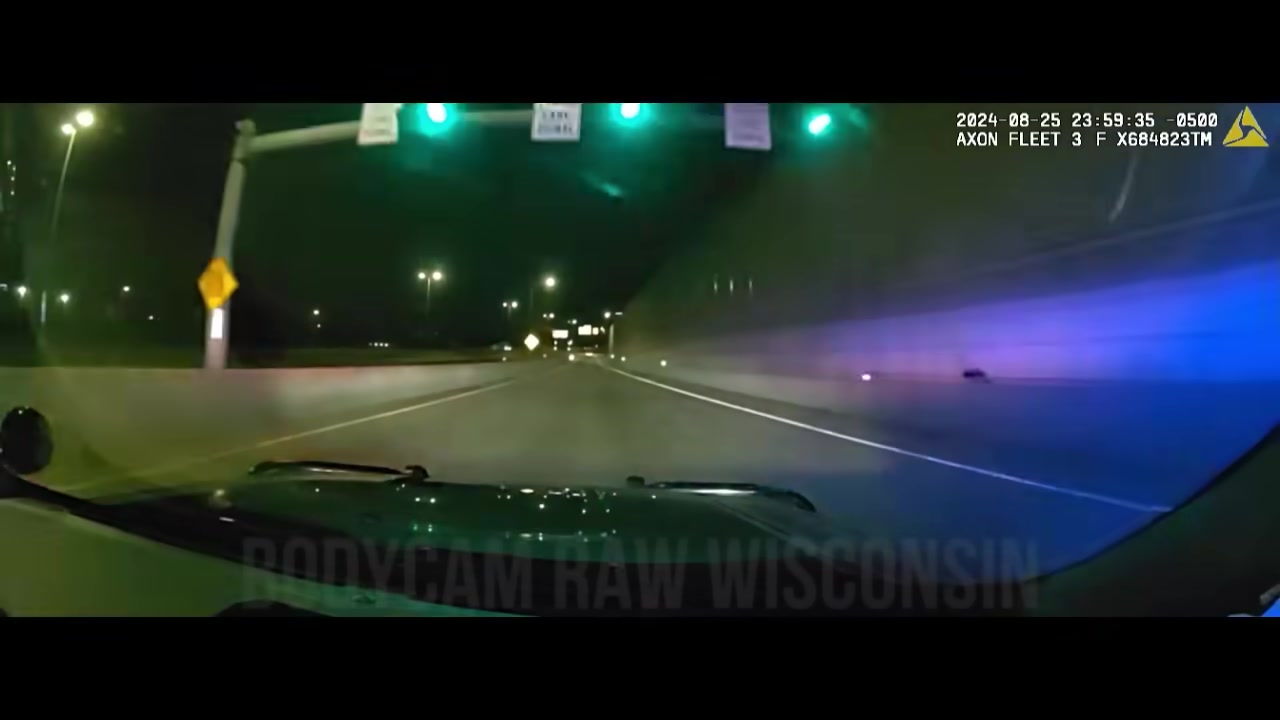
The supplied footage shows the timestamp crossing midnight. What began at 11:58 p.m. on August 25 continues into the first minutes of August 26.
The Axon Fleet camera records the chase from behind the windshield as freeway lighting and signs pass rapidly overhead.
The Lincoln Avenue Exit Changes Everything
A freeway pursuit at high speed requires long, gradual steering inputs.
An exit ramp introduces curves and a rapidly approaching decision point.
Gomez-Peralta took the West Lincoln Avenue exit.
At the top of the ramp, he attempted to turn left to travel east on Lincoln Avenue.
The sedan had carried freeway speed into a location that required a much slower turn.
The car lost control.
From this moment, the chase stops being about whether the driver will pull over. Physics takes over.
The Car Breaks Through the Overpass Fence
The sedan struck the south side of the Lincoln Avenue overpass.
It then crashed through the safety fencing.
Below the bridge was the same interstate the vehicle had just left.
The car plunged roughly 25 feet onto I-894.
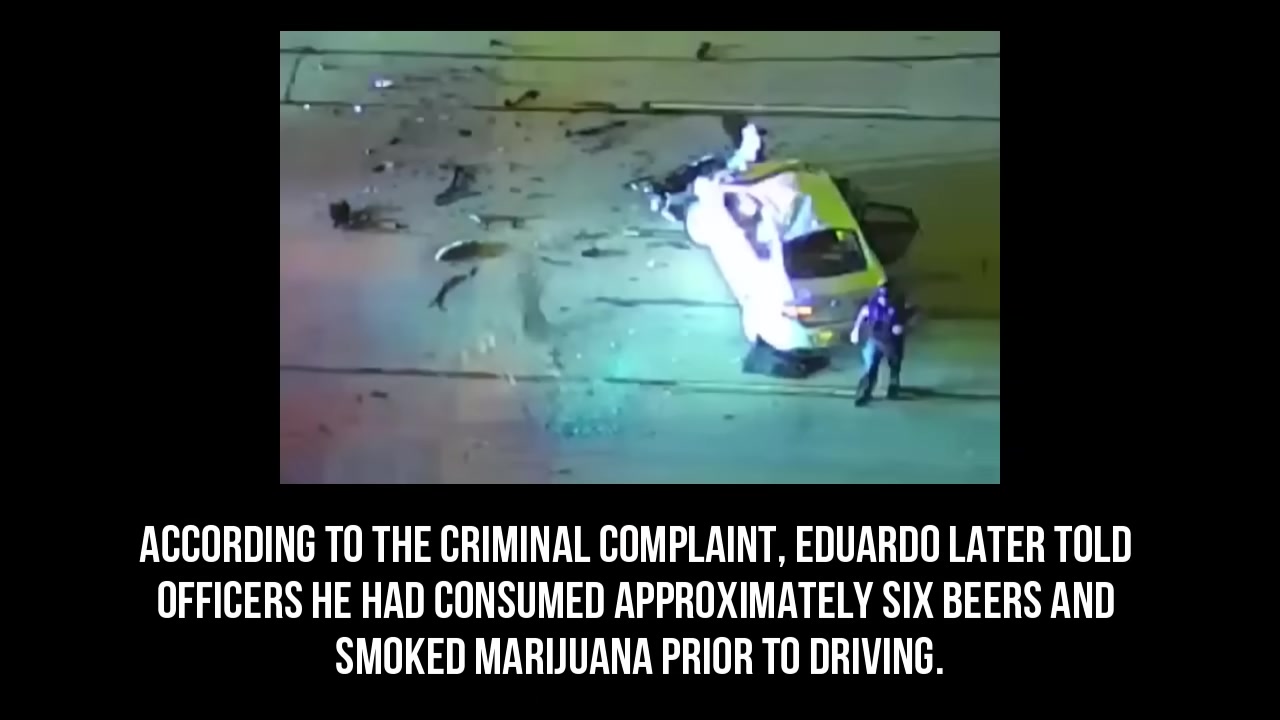
Dashcam from another police vehicle captures the aftermath below: the heavily damaged sedan sits upright amid debris scattered across the roadway.
That the car landed on its wheels is visually striking, but the impact was severe enough that the vehicle was effectively destroyed.
A Crash That Could Have Been Fatal
A fall of approximately 25 feet in a passenger vehicle creates multiple ways for occupants to be seriously injured.
The car first strikes the bridge structure and fence.
It then becomes airborne.
The landing sends enormous forces through the suspension, frame and passenger compartment.
Debris can become airborne around the vehicle.
And because the car lands on an active interstate, there is a secondary risk from approaching traffic.
Yet Gomez-Peralta and his passenger were able to exit the vehicle.
The survival of both occupants is one of the most remarkable facts in the case.
Officers Rush to the Wreck
Police units quickly converged on the crash site.
The supplied video includes footage from officers arriving on the interstate after the sedan fell from the overpass.
Gomez-Peralta can be seen outside the vehicle.
Officers issue commands for him and the passenger to get on the ground.
According to reporting, neither initially complied.
An officer deployed a Taser toward Gomez-Peralta, after which both men were taken into custody.
A Pursuing Officer Is Seriously Injured
The most serious reported injury connected with the chase involved one of the officers.
The officer who had initiated the pursuit attempted to assist at the crash scene near the damaged fence.
He injured his back and was transported to a hospital.
Doctors diagnosed several fractured vertebrae.
That injury became legally important because prosecutors charged Gomez-Peralta with fleeing or eluding an officer resulting in great bodily harm.
The charge therefore reflects consequences extending beyond the occupants of the fleeing car.
Two Officers and Both Occupants Went to Hospitals
WISN reported that two officers, Gomez-Peralta and the passenger were taken to hospitals that night.
The available reporting does not describe every injury in equal detail.
The initiating officer's fractured vertebrae are specifically documented in the criminal complaint coverage.
The footage itself shows the scale of the crash but cannot diagnose what happened medically inside the vehicle.
For that reason, the article relies on published reporting rather than attempting to infer injuries from body movements visible after the wreck.
What Gomez-Peralta Allegedly Told Police
After the arrest, Gomez-Peralta spoke with officers.
According to the criminal complaint, he said he had consumed approximately six beers and smoked marijuana before driving.
Police obtained blood for testing.
At the time the charges were initially reported, the laboratory results were still pending.
That distinction is important. His statement about alcohol and marijuana was reported from the complaint, but early news coverage did not claim a completed toxicology result.
The OWI-related charge was therefore presented as an allegation until the later court proceedings.
Three Charges Follow the Crash
Prosecutors initially charged Gomez-Peralta with three offenses arising from the pursuit.
The first was fleeing or eluding an officer resulting in great bodily harm.
The second was second-degree recklessly endangering safety.
The third was operating while intoxicated causing injury.
The first two were felony charges, while contemporary reporting described the OWI injury count as a misdemeanor.
At the time, reports said the combined maximum exposure could reach 25 years in prison and $75,000 in fines if he were convicted of all charges.
The First Court Appearance
Gomez-Peralta appeared in court on August 28, only days after the crash.
A judge set a $7,500 cash bond.
He was also ordered to maintain absolute sobriety.
When the Milwaukee Journal Sentinel reported on the released dashcam months later, the criminal case was still pending and Gomez-Peralta had not yet reached the later plea and sentencing shown in the supplied video.
That chronology is worth keeping clear: the dramatic footage became public while the court process was still developing.
The Video Reveals More Than the Headline
A headline saying that a car went off a bridge captures the ending but not the buildup.
The dashcam shows the pursuit moving through ordinary city streets.
It records the transition to freeway speeds.
It captures radio traffic as officers communicate.
The timestamp crosses midnight.
Then the car disappears toward the Lincoln Avenue exit.
Another camera shows the shattered vehicle on the interstate below.
Watching the sequence makes the final crash easier to understand as the endpoint of a rapidly escalating pursuit rather than an isolated accident.
The 115 MPH Figure Matters
The reported top speed of approximately 115 mph is not merely a dramatic number.
Speed changes every part of the risk calculation.
At 115 mph, a car travels about 169 feet per second.
A driver's ability to respond to an unexpected lane change, a slower vehicle or a curve is sharply reduced.
Braking distance increases dramatically.
And when a driver leaves the freeway for an exit ramp, the speed that felt manageable on a broad interstate can become impossible to carry through a tight turn.
That is exactly where this pursuit ends.
Why the Overpass Was So Unforgiving
The Lincoln Avenue exit presented a sequence of hazards in a very short distance.
The driver had to decelerate from interstate speed.
He had to follow the ramp.
He then had to negotiate a sharp turn.
Beyond the roadway was a barrier and safety fence.
Beyond that fence was a 25-foot drop.
Once the sedan failed to make the turn, there was almost no recovery space.
The barrier and fence were the final physical defenses between the car and the freeway below.
The Passenger Was Not the Driver
The footage shows two occupants emerging from the wreck.
Reporting identifies Gomez-Peralta as the driver and describes the second man as a passenger.
WISN reported that the passenger was cited for possessing THC.
That distinction matters because the pursuit charges were directed at the person police said was operating the vehicle.
A passenger's presence in a fleeing car does not automatically establish responsibility for the driver's decisions.
A Previous Pursuit Appears in the Court Background
WISN reported that court records showed Gomez-Peralta had previously pleaded guilty in connection with a 2020 police chase involving Greenfield officers.
He received probation in that earlier matter.
The prior case was not the reason officers initiated the August 2024 traffic stop. The West Allis officer initially attempted to stop the car for speeding.
But the earlier case became relevant background once prosecutors and courts addressed the new fleeing allegation.
This article does not assume facts about the 2020 incident beyond what contemporary reporting established.
The Supplied Video Includes the Later Plea
The video provided for this article continues beyond the raw pursuit footage and adds a later court update.
According to the video's case summary, on September 11, 2025, Gomez-Peralta pleaded guilty to fleeing or eluding an officer causing great bodily harm and operating while intoxicated causing injury.
The video states that the second-degree recklessly endangering safety count was dismissed but read in as part of the plea agreement.
Because the public news articles located for this article primarily cover the 2024 charging stage, this later disposition is attributed specifically to the supplied video's court-record summary rather than presented as though it came from those earlier reports.
The Video Also Reports a Prison Sentence
The supplied video states that approximately one month after the plea, the court sentenced Gomez-Peralta to three years in state prison followed by three years of extended supervision on the fleeing conviction.
It also states that he received 192 days of credit for time already served.
According to the same court summary, the judge noted possible eligibility for Wisconsin's Challenge Incarceration Program and Substance Abuse Program after serving the required period.
These later sentencing details provide closure that was unavailable when the dashcam footage first made news in late 2024.
Why the Officer's Injury Changed the Case
A fleeing case can become significantly more serious when the pursuit results in great bodily harm.
Here, the initiating officer's fractured vertebrae were not a minor consequence.
The injury helped shape the principal felony charge.
It also demonstrates how pursuit risks extend beyond crashes involving the fleeing vehicle itself.
Officers running toward a wreck, climbing barriers or moving through damaged infrastructure can be injured even after the suspect vehicle has stopped moving.
The Chase Lasted Minutes, the Case Lasted More Than a Year
The pursuit begins just before midnight and ends shortly after.
The criminal case continued far longer.
Charges were filed.
Bond was set.
Dashcam footage was released months later.
Court proceedings continued into 2025.
The supplied video reports a September 2025 guilty plea and a later prison sentence.
That difference in scale is common in serious pursuit cases: the driving decisions occur in seconds, while courts may spend months determining the legal consequences.
What Is Directly Visible in the Footage
Several facts can be confirmed without relying on narration.
The Axon timestamp shows the late-night August 25-26, 2024 timeframe.
The pursuing squad travels through West Allis and onto the interstate.
Speeds are communicated over police radio.
Emergency lights reflect across the roadway.
The pursuit continues toward the Lincoln Avenue area.
The aftermath shows a heavily damaged car on the freeway below the overpass.
Officers converge on the vehicle and its occupants.
Those visual details closely match the independent accounts published by the Milwaukee Journal Sentinel and WISN.
What Comes From the Criminal Complaint
Other important details are not something a dash camera can prove on its own.
Gomez-Peralta's identity comes from police and court records.
The allegation that he drank six beers and smoked marijuana comes from his reported statement to officers.
The officer's diagnosis of fractured vertebrae comes from medical information summarized in the complaint.
The exact criminal charges come from court records.
Separating these sources prevents the footage from being asked to prove more than it actually shows.
Why This Pursuit Holds Attention Without Sensationalism
The incident has a built-in narrative progression.
A speeding car attracts an officer's attention.
The driver refuses to stop.
The speed reaches triple digits on a 35 mph road.
Red lights are ignored.
The pursuit enters the interstate.
The car reaches roughly 115 mph.
The driver takes an exit.
A sharp turn appears.
The sedan crashes through a fence.
It disappears from the bridge.
Officers reach the freeway below and find both occupants alive.
The structure is already compelling. There is no need to invent near misses, dialogue or motives that are not in the evidence.
The Moment the Chase Becomes a Fall
The most unforgettable part of the video lasts only seconds.
Gomez-Peralta leaves the freeway.
The sedan approaches the end of the ramp.
The car cannot complete the turn.
It strikes the edge of the overpass and tears through the fence.
For the pursuing officer, the suspect vehicle suddenly vanishes from the roadway.
Units then have to reach the interstate below to determine what happened.
That abrupt change from horizontal speed to a vertical drop is what separates this pursuit from countless other fleeing cases.
Survival Does Not Mean the Crash Was Minor
Because both occupants climbed out, it can be tempting to underestimate the severity of the wreck.
The vehicle tells a different story.
Images from the aftermath show major structural damage and debris across the freeway.
The car had fallen about 25 feet.
Police and emergency personnel still had to treat the scene as a serious crash.
The fact that the occupants survived should be understood as the outcome, not evidence that the fall was harmless.
The Court Outcome Adds a Different Ending
For viewers watching only the dashcam, the story ends with handcuffs on the interstate.
The later court process gives it another ending.
The supplied case update reports that Gomez-Peralta ultimately admitted guilt to the fleeing count and the OWI injury count.
The fleeing conviction resulted in a three-year state-prison term followed by three years of extended supervision, according to the video's court summary.
The visual spectacle of the crash therefore became a criminal case with consequences extending years beyond the night of the pursuit.
A Traffic Stop With Consequences for Everyone Involved
The incident began because an officer tried to stop a speeding vehicle.
By the end, a car had fallen from an overpass.
A passenger had been carried through a 100-plus-mph pursuit and violent crash.
An officer had suffered fractured vertebrae.
Multiple people had gone to hospitals.
Gomez-Peralta faced felony prosecution.
The bridge fence had been destroyed and debris covered part of I-894.
That chain of consequences is why fleeing from a traffic stop can transform a relatively ordinary police encounter into a major public-safety event.
The Verified Timeline
At approximately 11:58 p.m. on August 25, 2024, a West Allis officer observed a speeding car near South 60th Street.
The officer attempted a traffic stop near the 6700 block of West Greenfield Avenue.
Gomez-Peralta accelerated and fled.
The car reached around 100 mph on Greenfield Avenue and later approximately 115 mph on I-894/I-41.
It exited at West Lincoln Avenue.
Gomez-Peralta lost control while attempting a left turn.
The sedan broke through the bridge fencing and fell roughly 25 feet onto I-894.
Gomez-Peralta and his passenger survived and were taken into custody.
The initiating officer suffered fractured vertebrae.
Prosecutors filed fleeing, reckless-endangerment and OWI-related charges.
The supplied video's later court update reports guilty pleas in September 2025 and a subsequent three-year prison sentence on the fleeing conviction.
When the Full Video Changes the Story
A single image of the wreck could look like an ordinary freeway crash.
A clip of the car leaving the bridge could look like a bizarre driving mistake.
The full pursuit connects those images.
It shows the attempted traffic stop.
It shows the acceleration.
It shows the sustained high speed.
It shows the transition onto the freeway.
And it shows the extraordinary result of carrying that speed onto an exit ramp.
That complete sequence is what turns a dramatic crash into a documented police-pursuit story.
Watch the Full Pursuit
The complete footage shows the pursuit from West Allis streets to I-894, the final Lincoln Avenue exit, the overpass crash and the officers' response on the freeway below.
Comments (0)
Loading comments...
May You Like
After Dad’s Arrest, One Emotional Moment With an Officer Stands Out

Neighborhood Grocery Store Suddenly Erupts Into Chaos

💨 High-Speed Police Pursuits Caught on Dashcam | Intense Moments Across the USA 🇺🇸














