
[Bodycam] 120 MPH chase in a snowstorm: Police deploy spike strips, shredding all four of the suspect's tires!
old Day, Hot Pursuit: Wisconsin Driver Flees I-41 Stop Before Tires Give Out
On the morning of January 21, 2025, the temperature in Fond du Lac County, Wisconsin, was brutally cold. Body-camera footage from the incident displays a temperature of roughly nine degrees below zero. The landscape beside Interstate 41 looks frozen and unforgiving. Yet what began on that bitter morning was anything but slow.
At approximately 10:13 a.m., a Fond du Lac County sheriff's deputy was driving south on I-41 near County Highway N in the Town of Eldorado when another vehicle came past at high speed on the gravel shoulder. According to an account attributed to Fond du Lac County Sheriff's Sgt. Logan Will and published by Washington County Insider, the deputy attempted to stop the vehicle. The driver did not yield.
Within moments, the encounter became a pursuit. The driver continued south on I-41, moving across both southbound lanes and onto the shoulder while traveling at excessive speed. The chase eventually covered approximately 13 miles. Deputies and Wisconsin State Patrol troopers deployed multiple tire-deflation devices. Near the County Highway B exit, the pursued vehicle lost control, entered the grass, struck a ditch and became disabled. The driver then tried to run, but officers caught him after a short foot pursuit.
The driver was identified publicly only as a 31-year-old man from Cecil, Wisconsin. Authorities said he was the sole occupant of the vehicle. He was evaluated by paramedics and taken to a hospital for further medical evaluation. The sheriff's office said he was expected to be taken to the Fond du Lac County Jail afterward on recommended charges of felony fleeing or eluding and first-degree recklessly endangering safety.
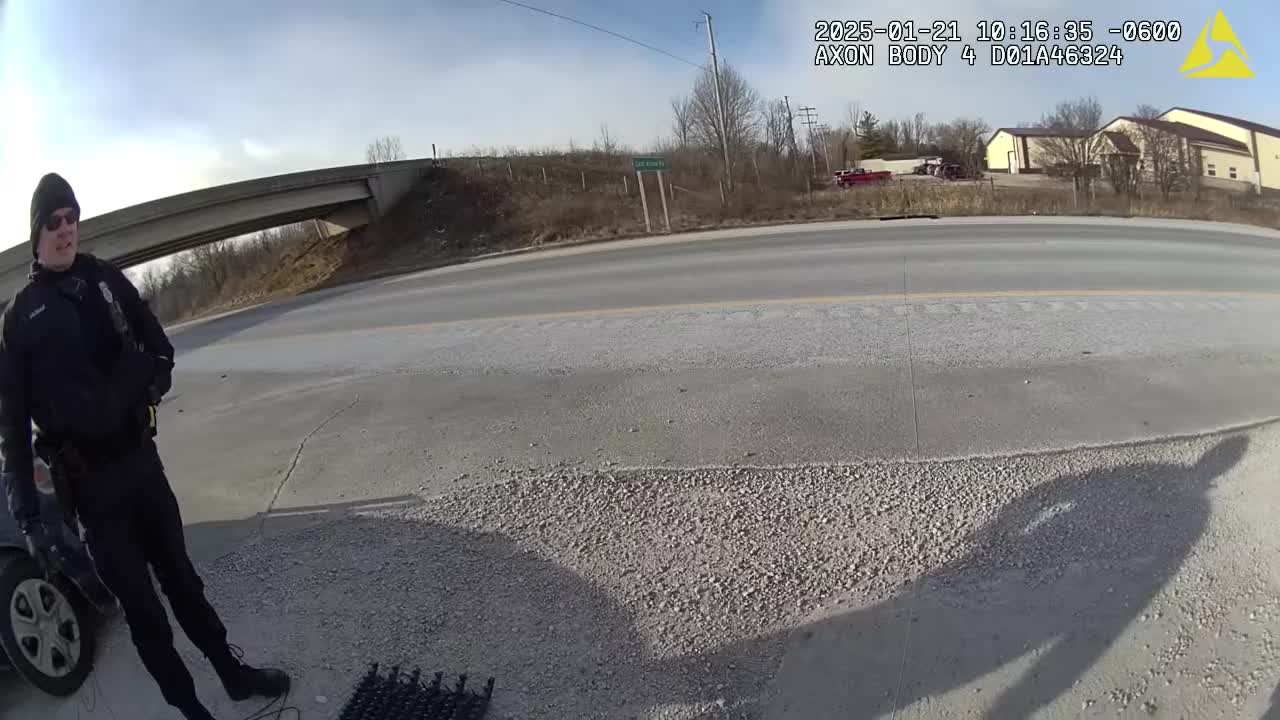
The supplied video, titled “Cold Day For a Hot Pursuit,” matches those details unusually well. Its Axon timestamps show January 21, 2025, beginning shortly after 10 a.m. The footage identifies the Wisconsin setting, shows the winter roadside conditions, and includes the aftermath of the chase. It also provides a ground-level view of what a short news report cannot fully communicate: how quickly a traffic violation can develop into a dangerous multi-agency pursuit.
A Vehicle Flies Past on the Gravel Shoulder
The defining moment came before the deputy had even initiated a conventional traffic stop. According to the sheriff's account, the deputy was traveling south on I-41 near County Highway N when the vehicle passed on the gravel shoulder at high speed.
That maneuver immediately created several hazards. A highway shoulder is not a normal passing lane. Gravel offers less predictable traction than pavement, and a fast-moving vehicle can throw stones and debris toward nearby traffic. The sheriff's office later reported that a civilian vehicle sustained minor damage from gravel kicked up while the fleeing vehicle used the shoulders.
The deputy attempted a traffic stop. Instead of slowing and pulling over, the driver continued.
That decision transformed the incident. The officer was no longer dealing only with speeding or improper use of a shoulder. Police now had a driver actively refusing to yield while moving through interstate traffic.
The Pursuit Moves South on I-41
The chase continued southbound through Fond du Lac County. Authorities described the driving as reckless, saying the vehicle traveled across both southbound lanes and onto the shoulder at excessive speed.
The interstate environment magnified the risk. I-41 carries passenger vehicles and commercial traffic, and the fleeing driver was not operating on an empty road. Every lane change forced officers to consider not only the suspect vehicle but motorists who had no role in the incident.
Police pursuits are dynamic because the danger can change from one second to the next. A clear lane can become blocked by a slower vehicle. A driver hearing sirens may move unexpectedly. A suspect who appears to be maintaining control may suddenly brake, cross the median or attempt an exit.
In this case, the shoulder itself had already become part of the escape route.
Why the Winter Cold Matters
The title of the video is not merely a joke. The cold was a genuine operational factor.
The bodycam overlay places the incident on January 21, 2025, and the video presentation notes a temperature around minus nine degrees. At temperatures that low, an ordinary roadside stop becomes uncomfortable almost immediately. A pursuit and foot chase add physical stress for everyone involved.
Cold can also affect vehicles. Tire pressure falls as temperatures drop. Rubber becomes less flexible. Batteries and other mechanical systems operate under greater strain. None of those factors is proof that the suspect vehicle's eventual tire failure was caused by the weather, because authorities specifically reported that law enforcement successfully deployed tire-deflation devices. But the extreme cold forms an important part of the environment in which the incident unfolded.
Officers Prepare to Stop the Vehicle Without a Collision
A fleeing driver moving unpredictably across an interstate can be difficult to stop safely. One option available to law enforcement is a tire-deflation device, often referred to generically as spike strips.
The goal is not to make a vehicle instantly crash. Instead, properly deployed devices puncture tires so that air escapes and the vehicle becomes progressively harder to continue driving at high speed.
According to the Fond du Lac County Sheriff's Office account, a county deputy and Wisconsin State Patrol troopers successfully deployed multiple tire-deflation devices on I-41 near Lost Arrow Road.
That detail is important because it explains the next stage of the footage. Once the tires were compromised, the pursuit was no longer simply about whether the driver would voluntarily stop. The vehicle itself was becoming less capable of continuing.
Tire Damage Begins Changing the Chase
A car can sometimes continue for a surprising distance after a tire is punctured, especially if the driver refuses to slow down. But the vehicle becomes progressively more difficult to control.
As air leaves a tire, the sidewall can collapse. The tire may begin to separate. Pieces of rubber can tear away and strike surrounding vehicles or the pursuing patrol car.
That appears to have become part of this incident. The sheriff's office reported that one Fond du Lac County patrol car sustained minor damage from tire debris coming off the pursued vehicle.
Now the suspect's attempt to continue fleeing was creating hazards even without direct contact between vehicles.
The Chase Covers About 13 Miles
Authorities calculated the pursuit at approximately 13 miles.
Distance alone does not communicate the intensity of a chase. Thirteen miles on an interstate can disappear quickly when vehicles are traveling at high speed. Yet during that distance, officers have to maintain radio communication, monitor traffic, coordinate with other units and anticipate where the fleeing driver may go next.
The involvement of Wisconsin State Patrol troopers demonstrates how quickly an interstate pursuit can become a multi-agency event. State troopers can position themselves ahead of a chase, help deploy tire-deflation devices and assist with the eventual arrest.
Fond du Lac Fire Rescue would also become involved after the vehicle stopped, providing medical support.
The County Highway B Exit Becomes the Turning Point
The pursuit finally reached a decisive moment as the vehicle approached the County Highway B offramp.
According to the sheriff's account, the driver lost control, traveled into the grass and struck the ditch. The vehicle became disabled.
For the officers behind him, that changed the tactical situation instantly.
A moving vehicle had become a stationary one, but that did not mean the incident was over. Officers still had to determine whether the driver would surrender, remain inside, attempt to use the vehicle again or flee on foot.
The driver chose the last option.
The Driver Leaves the Vehicle and Runs
Authorities said the man attempted to flee on foot after the crash.
In freezing weather, on uneven roadside terrain, that decision introduced another set of risks. Interstate ditches can contain snow, ice, frozen ground, drainage structures and thick vegetation. Running through those conditions is difficult even without officers close behind.
The foot pursuit was brief.
Deputies caught the man and took him into custody.
The supplied footage shows the arrest and aftermath at close range. Officers can be seen controlling the suspect near the roadside before moving him toward a patrol vehicle.
A Chase That Ended Without Reported Injuries
Perhaps the most important line in the sheriff's account is also one of the shortest: no injuries were reported.
That outcome was far from guaranteed.
The pursued vehicle had passed on a gravel shoulder, traveled recklessly across interstate lanes, continued after tire-deflation devices were deployed, lost tire material, left the pavement, struck a ditch and ended with a foot chase.
A civilian vehicle sustained minor gravel damage. A sheriff's patrol vehicle sustained minor damage from tire debris. But authorities reported no injuries to the suspect, deputies or members of the public during the pursuit itself.
The driver was nevertheless evaluated by paramedics at the scene and transported to a local hospital for further medical evaluation before the expected jail booking.
The Driver Was From Cecil, Wisconsin
The sheriff's office identified the driver as a 31-year-old Cecil man but did not name him in the public release cited by local reporting.
That distinction is worth preserving. When an agency deliberately publishes age and hometown without a name, attaching a name from an unrelated court or jail record can create a serious identification error.
For that reason, this article does not speculate about the man's identity or prior history.
What is verified is that authorities described him as the sole occupant of the fleeing vehicle and said he was expected to face felony-level allegations after medical clearance.
The Recommended Charges Were Serious
The sheriff's office said the man would be transported to the Fond du Lac County Jail on charges of felony fleeing or eluding and first-degree recklessly endangering safety.
Those were the charges announced immediately after the incident. They should be understood as allegations at that stage, not as convictions.
First-degree recklessly endangering safety is a serious Wisconsin offense. Its inclusion in the initial arrest announcement reflects how authorities characterized the risk created by the driving behavior.
The exact final charging decisions and any later court disposition should be taken from the filed criminal complaint and court record rather than inferred from the arrest announcement.
Why Passing on the Shoulder Was More Than a Traffic Violation
The opening maneuver is important because it foreshadowed the rest of the chase.
A driver using a gravel shoulder at high speed has already moved outside the normal flow of traffic. The shoulder may contain debris, broken pavement, disabled vehicles or roadside workers. It also gives surrounding motorists little reason to expect a fast vehicle to appear beside them.
Once the driver continued using lanes and shoulders during the pursuit, the risk expanded to everyone nearby.
The minor gravel damage reported to a civilian vehicle is a tangible example of that risk even though the incident did not produce a serious crash.
The Patrol Car Was Damaged Without a Direct Crash
The minor damage to a sheriff's patrol car illustrates another pursuit hazard that receives less attention than collisions.
A damaged tire can shed heavy strips of rubber at speed. Those pieces can strike windshields, lights, body panels and other vehicles.
When tire-deflation devices work, officers still have to manage the aftermath. The fleeing vehicle may slow unevenly, a tire may disintegrate, and debris may scatter across the road.
In this incident, the tactic helped bring the chase toward its conclusion, but it also produced debris significant enough to damage a pursuing squad.
Why Multiple Spike Deployments Matter
The report says officers successfully deployed multiple tire-deflation devices.
That suggests law enforcement was coordinating ahead of the pursuit rather than relying only on the deputy immediately behind the suspect.
Positioning officers for a spike deployment requires timing. The deploying officer has to identify the suspect vehicle, place the device in its path and then move to a safe location before the vehicle arrives.
Other motorists create an additional complication. Devices have to be retrieved or avoided so that uninvolved vehicles are not unnecessarily damaged.
On a high-speed interstate, the available window may be only seconds.
The Bodycam Reveals the Human Side of the Pursuit
A written incident summary can make the event sound mechanical: vehicle passes deputy, pursuit begins, spikes deployed, vehicle crashes, suspect runs, suspect arrested.
The video makes the sequence feel different.
The cold is visible in the clothing worn by officers. The wind and open landscape make the roadside look exposed. Officers move around the disabled vehicle and the ditch while trying to complete an arrest that began miles earlier.
By the time the camera reaches the final roadside interaction, the high-speed portion has ended, but the adrenaline has not necessarily disappeared.
The Suspect's Vehicle Becomes Evidence
Once the driver is in custody, the disabled vehicle is no longer merely the object officers were chasing.
It becomes part of the investigation.
Its tire condition can document the effect of the deflation devices. Damage to the underside or body can help reconstruct the ditch impact. Video from patrol cars and body cameras can be synchronized with radio traffic and location data to establish the sequence.
If prosecutors pursue felony fleeing or reckless-endangerment charges, those details can help demonstrate how the vehicle was operated during the chase.
The Foot Pursuit Adds a Final Burst of Uncertainty
A suspect leaving a disabled vehicle creates a moment when officers have to transition rapidly from driving to running.
Seat belts come off. Doors open. Officers may need to carry radios and other equipment while moving across uneven ground.
At the same time, they do not know whether the fleeing person is armed, injured or simply trying to create enough distance to hide.
In this case, authorities described the foot pursuit as brief. That prevented the search from expanding into nearby properties or requiring a prolonged perimeter in extreme cold.
The Cold Could Have Made a Longer Search Dangerous
A temperature near nine below zero is more than uncomfortable.
Extended exposure can create a genuine risk of cold-related injury, particularly for someone running, sweating and then stopping outdoors.
Had the driver escaped into fields or woods, officers might have faced a much longer search in conditions that posed danger to both the suspect and search teams.
The quick arrest therefore reduced more than the possibility of another escape. It limited the amount of time everyone remained exposed to severe winter weather.
What the News Report and Video Confirm Together
The strongest verification comes from the overlap between the video and the published sheriff's account.
Both place the event on January 21, 2025.
The bodycam timestamp is consistent with the reported 10:13 a.m. start.
The video is clearly in Wisconsin winter conditions and shows a sheriff's response consistent with the Fond du Lac County account.
The report describes the I-41 pursuit, tire-deflation devices, ditch crash and foot arrest that the footage presents.
Together, those details make this incident substantially easier to identify than a reposted pursuit clip with no visible date or agency clues.
What Should Not Be Added Without Court Records
The public incident report does not provide the driver's name.
It does not establish a motive for fleeing.
It does not provide a verified top speed in the account cited here.
And the initial sheriff's announcement describes intended or recommended charges, not a final conviction.
Those gaps should remain visible rather than being filled with assumptions.
A compelling story does not need an invented criminal history or unsupported motive.
The Pursuit's Natural Narrative Is Already Strong
The incident has a clear escalation.
A vehicle blasts past a deputy on the gravel shoulder.
The deputy attempts a stop.
The driver refuses.
The chase moves down I-41.
The vehicle uses lanes and shoulders recklessly.
Deputies and state troopers coordinate tire-deflation devices.
The damaged tires begin to fail.
The vehicle loses control near an offramp and hits the ditch.
The driver runs.
Officers catch him.
All of it unfolds on one of the coldest kinds of Wisconsin mornings.
Why the Ending Matters More Than the Speed
High-speed pursuit videos often focus attention on the fastest moment. But the more important measure is how the incident ends.
Here, the pursuit ended with a disabled vehicle and an arrest rather than a collision involving an uninvolved family, a commercial truck or an officer.
The tire-deflation devices appear to have played a major role in reducing the vehicle's ability to continue.
The ditch finally removed the car from the pursuit, and the brief foot chase ended the driver's remaining attempt to escape.
A Multi-Agency Response Brings the Chase to a Close
Fond du Lac County deputies did not handle every stage alone.
The Wisconsin State Patrol assisted with tire-deflation devices, and Fond du Lac Fire Rescue responded for medical evaluation.
That combination illustrates how highway incidents quickly require different specialties.
Deputies handle the initial enforcement and pursuit. Troopers can assist with interstate tactics. Fire and medical personnel evaluate anyone who may have been hurt during the crash or arrest.
The coordination is largely invisible when viewers see only a short viral clip, but it is essential to how these incidents are resolved.
The Aftermath Is Quieter but Still Important
Once the suspect is secured in the patrol vehicle, the urgency drops.
Officers can begin documenting damage, clearing debris and arranging for the disabled vehicle to be removed.
The civilian whose vehicle was struck by gravel may need a report. The damaged squad must be inspected. Tire-deflation devices have to be recovered. Body-camera and patrol-camera recordings become evidence.
The road eventually returns to normal traffic, but the investigation continues long after the sirens stop.
A Cold Morning That Could Have Ended Very Differently
The remarkable part of this pursuit is not simply that it lasted 13 miles.
It is that a driver allegedly used the interstate shoulder, moved recklessly through both lanes, continued after multiple tire-deflation deployments, shed tire debris, left the pavement and then ran, yet authorities reported no injuries.
That outcome does not make the behavior less dangerous. It shows how narrow the margin was between an arrest and a far more serious crash.
The Final Footsteps
When the driver climbed out and ran, the vehicle portion of the chase had already been decided. The tires were damaged. The car was disabled in the ditch. The interstate escape route was gone.
The remaining question was whether the suspect could get away on foot.
He could not.
Officers caught him after a brief chase, and the same morning that began with a vehicle racing past a deputy on the shoulder ended with the driver under arrest and headed for medical evaluation.
Watch the Full Pursuit
The written timeline explains the sequence, but the complete footage shows the conditions that made this pursuit distinctive: the brutal Wisconsin cold, the open interstate, the tire damage, the roadside crash and the final arrest after the driver tried one last time to get away.
Comments (0)
Loading comments...
May You Like

Chrysler 300 Gapped Cops at 150+ MPH | Police Dashcam

Police Follow the Driver Until His Escape Route Runs Out















