
Body Cam Shows Miami Police Shooting On Biscayne Boulevard
TRAFFIC CONTROL TURNS INTO GUNFIRE: INSIDE THE CONTROVERSIAL MIAMI POLICE SHOOTING NEAR BAYFRONT PARK
HOOK — A FEW FEET OF MOVEMENT CHANGED EVERYTHING
Thousands of people had gathered in Downtown Miami for a major music festival.
Traffic surrounding Bayfront Park was heavy. Cars filled Biscayne Boulevard. Pedestrians crowded sidewalks. Police officers were positioned throughout the area to manage vehicles and keep the flow of festivalgoers under control.
Then, in a matter of seconds, an ordinary traffic-control assignment turned into a police shooting.
At approximately 7:19 p.m. on May 25, 2025, a Miami Police officer was directing traffic at the intersection of Biscayne Boulevard and Northeast Second Street.
A black BMW was positioned in front of him.
Body-camera footage shows the car slowly moving forward while the officer signals for it to stop.
It keeps moving.
The officer ends up on the hood.
Then—
GUNSHOTS.
The officer fires through the windshield as the BMW continues forward.
Seconds later, the vehicle collides with a police cruiser.
A wounded 21-year-old man gets out.
Blood is visible on his clothing.
He walks away from the BMW as officers rush toward the scene.
That man was Menelek Emmanuel Clarke of Lauderhill, Florida.
He survived.
But what happened during those few seconds became the center of a much larger dispute involving police, Clarke's family, his attorney and investigators.
Police said Clarke's BMW struck the officer.
Clarke's family argued that he was merely trying to maneuver around the officer and never intended to hit him.
The bodycam footage does something the competing descriptions cannot.
IT PUTS THE VIEWER DIRECTLY INTO THE MOMENT WHEN EVERYTHING CHANGED.
A FESTIVAL BRINGS THOUSANDS INTO DOWNTOWN MIAMI
May 25 was not an ordinary Sunday evening around Bayfront Park.
The Best of the Best Music Fest, a Caribbean music festival, was taking place at the park. Authorities estimated roughly 10,000 to 12,000 people were attending, and around 50 Miami Police officers plus personnel from partner agencies were assigned to the event.
That meant traffic control was a significant part of the police operation.
Biscayne Boulevard runs directly beside the park.
Anyone trying to reach the festival had to navigate a downtown road network already filled with pedestrians, rideshare vehicles, private cars and police traffic posts.
Clarke and his sister were among those trying to reach the area.
His sister later told Local 10 that they were looking for parking.
At approximately 7:19 p.m., Clarke's BMW reached the area where an officer was directing traffic.
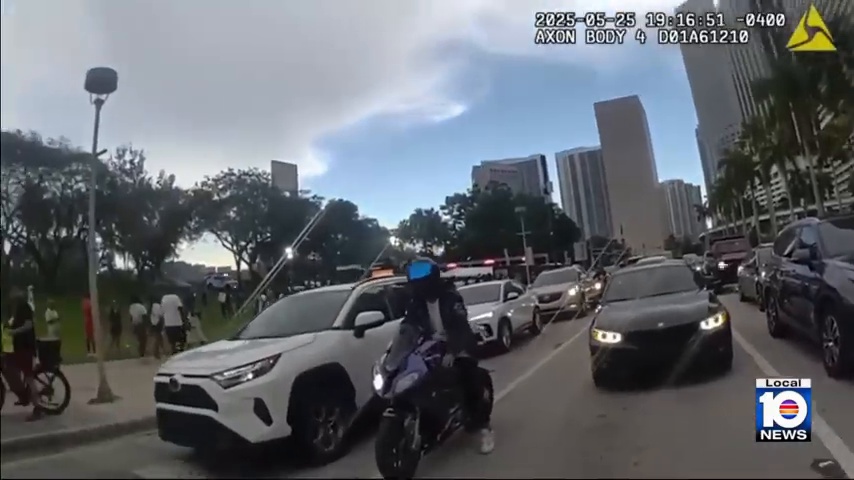
REAL FRAME FROM THE VIDEO — TRAFFIC OUTSIDE BAYFRONT PARK
The bodycam establishes the environment immediately.
Cars fill several lanes.
People are visible along the sidewalk.
Bayfront Park is only a short distance away.
Police vehicles are positioned throughout the area.
The officer is standing directly in the roadway, manually controlling traffic.
This context matters.
THE OFFICER WAS NOT CONDUCTING A TRADITIONAL TRAFFIC STOP.
He was standing in active traffic during a major event.
And Clarke was not initially being chased.
His BMW was simply one of numerous vehicles moving through the intersection.
Then the car began moving toward the officer.
THE BMW KEEPS INCHING FORWARD
The body-camera footage shows the officer positioned in front of the BMW.
According to the arrest report quoted by Local 10, Clarke began slowly driving toward the officer while the officer used a whistle and raised his hand with his palm outward, signaling for Clarke to stop.
The car continued moving.
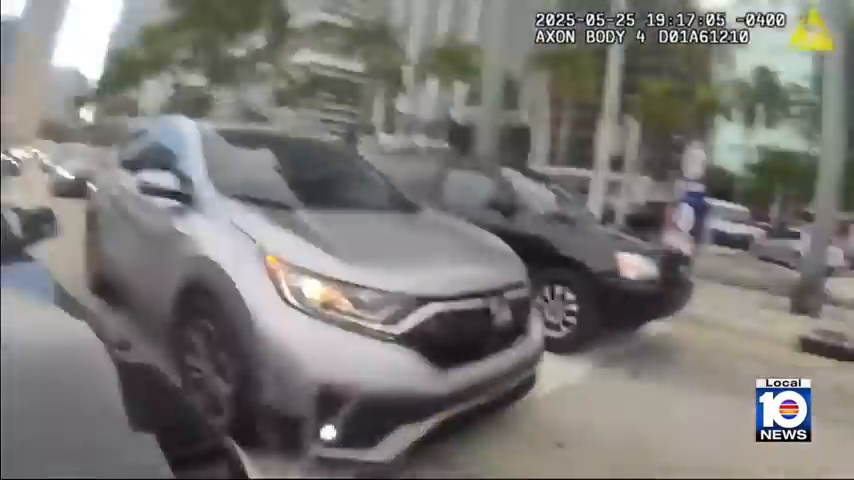
REAL FRAME — THE BMW DIRECTLY IN FRONT OF THE OFFICER
 This is the moment that later became the subject of dramatically different interpretations.
Police described the BMW as making physical contact with the officer.
The Miami Police Department's initial official statement was concise: an officer was struck by a vehicle while directing traffic, and the officer discharged his firearm in response, striking the driver.
The arrest report provided additional detail.
According to Local 10's account of the document, investigators said the BMW appeared to make contact with the officer, causing him to bend forward and place both hands on the hood to maintain his balance.
Clarke's family viewed the encounter differently.
His sister, who said she was inside the vehicle, argued that her brother was trying to move through traffic and did not intentionally strike the officer.
Those competing accounts make the bodycam particularly important.
Instead of relying entirely on one side's description, viewers can see the critical movement themselves.
And the window for interpreting what is happening is extraordinarily short.
THE OFFICER ENDS UP ON THE HOOD
As the BMW continues forward, the distance between the officer and the windshield disappears.
The camera suddenly changes angle.
The officer is now physically on the front of the car.
Cellphone footage recorded by bystanders provides another perspective, showing the officer on the hood as the BMW moves forward.
REAL FRAME — THE CRITICAL MOMENT BEFORE THE SHOOTING
This is where the incident crosses from traffic management into a deadly-force encounter.
The officer draws his firearm.
Shots are fired through the windshield.
The BMW continues moving.
Videos obtained by multiple Miami news organizations showed the officer on top of the hood as the shooting occurred.
There is almost no time between the apparent vehicle contact and the gunfire.
THE ENTIRE CRITICAL SEQUENCE UNFOLDS IN SECONDS.
That timing became central to the controversy afterward.
Clarke's attorney, Michael Orenstein, questioned whether the officer had actually been propelled onto the hood in the manner suggested by the police account.
Speaking after Clarke's court appearance, Orenstein argued that the footage appeared to show the officer on the hood and firing almost immediately.
That was the defense attorney's interpretation, not an official finding.
But it highlights the key issue raised by the footage:
What exactly did the officer perceive during those few seconds, and at what point did he believe deadly force was necessary?
GUNFIRE ERUPTS BESIDE A CROWDED MUSIC FESTIVAL
The location made the shooting especially chaotic.
Bayfront Park was packed with festivalgoers.
When gunfire erupted nearby, people did not know exactly what was happening.
WSVN reported that the shots triggered panic among attendees, with cellphone video showing people running and screaming after hearing the gunfire.
Some people feared there might be an active shooter.
In reality, the gunfire was coming from the police encounter on Biscayne Boulevard.
Meanwhile, the BMW was still moving.
REAL FRAME — SECONDS AFTER THE SHOOTING
The vehicle eventually struck a police cruiser.
The officer came off the hood.
Then the driver's door opened.
Clarke emerged.
He had been hit by gunfire.
Local 10 later reported that he was wounded in the leg, shoulder and side.
But even after being shot several times, Clarke was able to walk away from the BMW.
That created another tense moment.
Officers had just heard gunfire.
A vehicle had struck a police officer and then a cruiser.
The driver was now outside the car.
Commands began immediately.
A WOUNDED CLARKE WALKS AWAY FROM THE BMW
The bodycam footage now shifts from the shooting itself to the arrest.
Clarke exits the vehicle with visible blood on his clothing.
He begins walking.
An officer points his firearm toward him and orders him to stop and get down.
REAL FRAME — CLARKE AFTER EXITING THE BMW
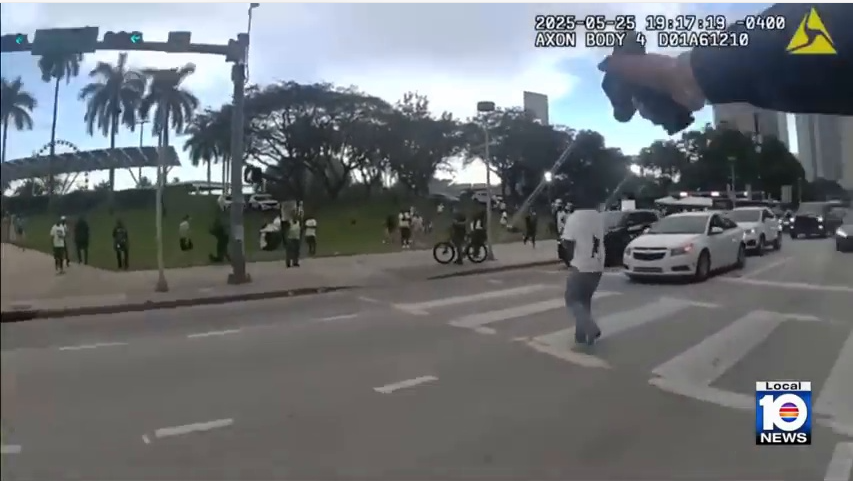
Moments later, Clarke collapses onto the roadway.
Other officers rush toward him.
This portion of the footage is important because it demonstrates how rapidly officers have to transition between roles.
Seconds earlier, an officer was firing his weapon.
Now police have a wounded person on the pavement.
The immediate priority changes.
Clarke is handcuffed.
Then officers begin attending to his injuries.
Miami Fire Rescue personnel also respond.
According to Miami Police's initial statement, both Clarke and the officer were transported to Jackson Memorial Hospital for treatment.
Clarke's injuries were serious, but he survived.
The officer reportedly suffered minor injuries.
REAL FRAME — CLARKE ON THE ROADWAY AS OFFICERS APPROACH
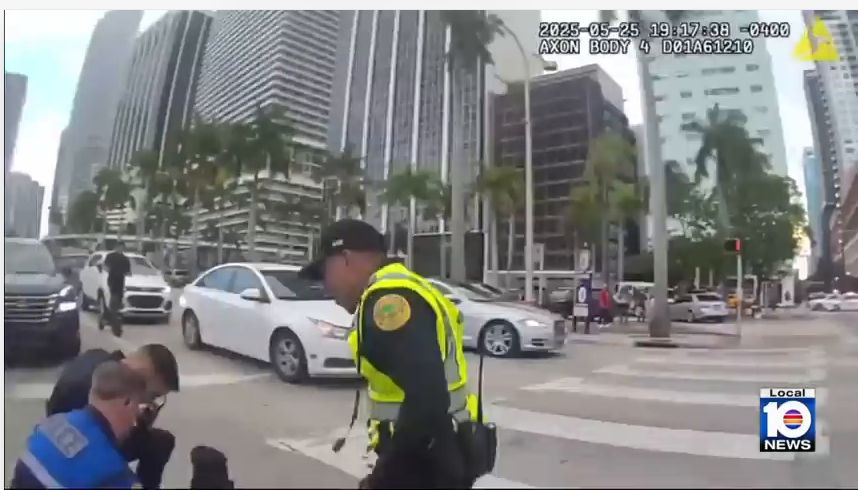
For the thousands of people nearby, the immediate danger appeared to be over.
But another phase of the incident was only beginning.
Now investigators had to determine whether the shooting was legally justified and exactly what had occurred in the seconds before the officer opened fire.
THE FAMILY TELLS A DIFFERENT STORY
Within a day, Clarke's family publicly challenged the police narrative.
His sister Sherylann Clarke, who said she had been in the car, told Local 10 that her brother had not intentionally struck the officer.
According to her account, they were trying to find parking for the festival.
She described traffic being allowed to move and said her brother attempted to maneuver around the officer.
Her position was straightforward:
THE CONTACT WAS NOT INTENTIONAL.
She also said her brother was unarmed.
The family's version matters because intent can be crucial when evaluating criminal allegations involving the use of a vehicle against another person.
But police investigators saw the event differently.
Their arrest report emphasized the officer's stop signal and the BMW's continued forward movement.
That disagreement became the central conflict surrounding the case.
Was Clarke intentionally driving into an officer?
Was he trying to maneuver through confusing festival traffic?
How much danger did the officer reasonably perceive while positioned directly in front of the moving BMW?
And what does the video actually establish?
Those are very different questions from simply asking whether the car touched the officer.
CLARKE FACES FOUR FELONY CHARGES
Four days after the shooting, Clarke appeared remotely in court from his hospital bed.
Local 10 reported that the 21-year-old faced four felony charges in connection with the incident, including aggravated battery on a law-enforcement officer.
An accusation is not a conviction.
That distinction is especially important here because the facts surrounding the vehicle's movement and the officer's use of force were disputed almost immediately.
Clarke's attorney publicly challenged the state's interpretation of the video.
Meanwhile, Clarke was still recovering from multiple gunshot wounds.
REAL FRAME — POLICE CONTROL THE SCENE
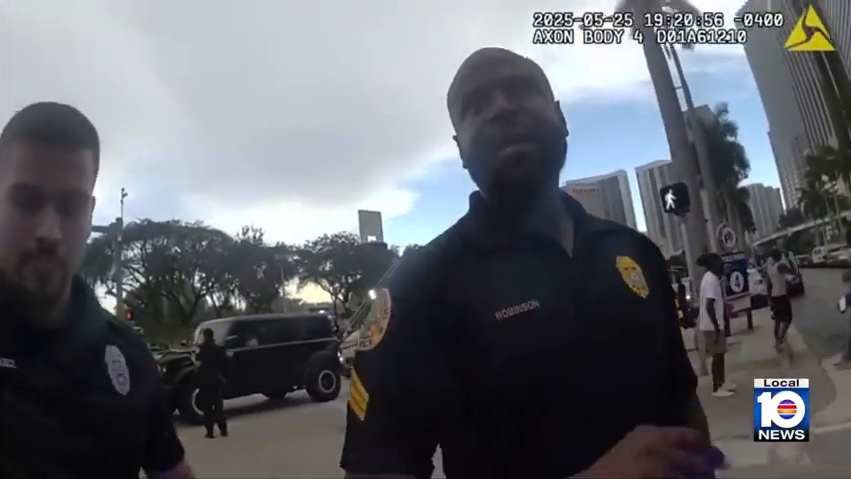
The contrast is striking.
The visible confrontation lasts seconds.
The legal consequences can last months or years.
That's one of the recurring realities of bodycam footage.
A viewer can watch an event in less than two minutes.
Investigators may spend months examining those same seconds frame by frame.
WHY THE BODYCAM RELEASE MATTERS
The video in this case was not publicly available immediately after the shooting.
For months, the public primarily had cellphone footage, witness accounts, police statements and court documents.
Then body-camera footage provided a new angle.
Local 10 reported in March 2026 that the newly obtained footage showed the officer standing in front of Clarke's BMW while directing traffic.
The car inches forward.
The officer raises his hand.
Then he is on the hood.
Gunfire follows.
The footage doesn't necessarily answer every legal question.
But it narrows the room for speculation.
That is one of the most important functions of police body cameras.
BODYCAM DOESN'T AUTOMATICALLY TELL VIEWERS WHAT CONCLUSION TO REACH. IT SHOWS THEM WHAT THE OFFICER'S CAMERA RECORDED.
That difference matters.
Video may establish where people were standing.
It can establish timing.
It can show commands.
It can reveal movement.
But legal conclusions require more than watching a dramatic clip.
Investigators may consider witness statements, physical evidence, vehicle data, medical records, officer statements, surveillance footage and relevant use-of-force law.
In this case, the Florida Department of Law Enforcement took over the investigation into the shooting, as is standard for this type of incident.
THE CAMERA ALSO REVEALS HOW LITTLE TIME THERE WAS
One reason this video is so compelling is that the key event occurs at extremely close range.
The officer isn't watching the BMW from across an intersection.
He is standing directly in front of it.
The vehicle begins moving.
The gap closes.
Contact occurs.
The officer ends up on the hood.
Then the weapon is fired.
There is no long pause where everyone has time to reconsider what is happening.
THE MOST CONSEQUENTIAL DECISIONS ARE COMPRESSED INTO ONLY A FEW SECONDS.
This is important when analyzing police footage.
Slow-motion replay can unintentionally distort how an event was experienced in real time.
A viewer can pause the footage.
An officer in the roadway cannot.
A viewer can replay the car's movement ten times.
Clarke could not replay his decision to move forward.
The officer could not replay his decision to fire.
Every action occurs once.
Only afterward do investigators gain the luxury of studying it frame by frame.
THE OFFICER'S POSITION CREATED A DANGEROUS DYNAMIC
The encounter also demonstrates one of the most dangerous configurations possible during traffic control:
A POLICE OFFICER DIRECTLY IN FRONT OF A MOVING VEHICLE.
A car does not need to be traveling at highway speed to create significant danger at close range.
Once an officer is physically touching the hood, the risk can change quickly if the driver accelerates, turns, collides with another vehicle or traps the officer between objects.
At the same time, the use of deadly force against a driver inside a moving vehicle creates its own risks.
A wounded or incapacitated driver may lose control.
Rounds can travel beyond the intended target.
Bystanders may be nearby.
And in this case, there were thousands of people surrounding a major public event.
That is why the exact circumstances matter so much.
The issue isn't simply whether a vehicle can be dangerous.
Of course it can.
The legal and investigative question is whether the circumstances at the precise moment force was used justified the officer's response.
That was a question for investigators—not something that can responsibly be settled from a single viral clip.
TWO STORIES DEVELOP FROM THE SAME FEW SECONDS
The aftermath demonstrates how the same footage can generate competing narratives.
The police account emphasizes commands.
An officer directing traffic signals a BMW to stop.
The BMW continues toward him.
Physical contact occurs.
The officer ends up on the hood.
He fires.
The defense and family account emphasizes context.
Traffic is confusing.
Cars are moving.
Clarke is trying to find parking.
The BMW is moving slowly.
His sister says he is attempting to maneuver around the officer rather than intentionally attack him.
The officer moves with the car.
Then gunfire erupts.
Both narratives focus on the same seconds.
THE DISPUTE IS ABOUT WHAT THOSE SECONDS MEAN.
That is precisely why original footage matters.
It allows the public to separate what can actually be seen from what each side argues should be inferred from it.
AN ORDINARY FESTIVAL TRIP ENDS AT A TRAUMA CENTER
Perhaps the most striking contrast in the entire case is how the evening began.
Clarke's sister said they were trying to attend the festival.
They were looking for parking.
Thousands of other people were doing essentially the same thing.
Then they reached one intersection.
Within moments, Clarke had been shot multiple times.
His BMW had collided with a police vehicle.
He was lying on Biscayne Boulevard.
Police were placing him in handcuffs.
Minutes later, he was headed to Jackson Memorial Hospital's Ryder Trauma Center.
His sister later described how serious his condition initially appeared, telling Local 10 that her brother felt as though he might die.
He survived.
But surviving the shooting did not end the case.
He also had criminal charges to confront.
And investigators still had to determine whether the officer's gunfire complied with the law and department policy.
ENDING — THE ENTIRE CASE COMES DOWN TO SECONDS
Strip away everything that happened afterward and the central event is remarkably short.
A Miami Police officer is standing on Biscayne Boulevard.
He is directing traffic for a festival drawing thousands of people.
A black BMW approaches.
The officer signals.
The BMW moves.
The distance closes.
The vehicle and officer make contact.
The officer ends up on the hood.
HE DRAWS HIS WEAPON.
Shots are fired.
The BMW continues forward and collides with a cruiser.
Twenty-one-year-old Menelek Clarke steps out, wounded.
He walks several yards.
Then he goes down.
Officers rush in.
Clarke survives.
The officer survives.
And almost immediately, two competing explanations begin emerging.
Miami Police said their officer had been struck by a vehicle while directing traffic.
Clarke's family said he never intended to strike anyone.
His attorney questioned the interpretation of the footage.
Prosecutors pursued felony charges against Clarke.
FDLE investigated the officer-involved shooting.
And months later, body-camera footage gave the public the closest perspective yet on the seconds that created the entire controversy.
There is no prolonged pursuit here.
No hour-long standoff.
No complicated search through multiple neighborhoods.
THE DRAMA COMES FROM HOW QUICKLY AN ORDINARY TRAFFIC INTERACTION BECOMES IRREVERSIBLE.
One car moves forward.
One officer ends up on its hood.
One firearm comes out.
And suddenly a 21-year-old is bleeding on Biscayne Boulevard while thousands of festivalgoers nearby are trying to understand why they just heard gunfire.
The incident is a reminder of something body-camera footage repeatedly demonstrates:
Police encounters do not always escalate gradually.
Sometimes the distance between normal and life-threatening is measured not in minutes—
BUT IN FEET AND SECONDS.
CTA — WATCH THE MOMENT EVERYTHING CHANGED
The BMW appears to be moving slowly. The officer is directly in front of it. Then, within seconds, he's on the hood and gunfire erupts. Was the driver intentionally striking the officer, or was he trying to maneuver through chaotic festival traffic?
WATCH THE FULL VIDEO BELOW AND SEE THE BODYCAM SEQUENCE FOR YOURSELF — FROM THE FIRST TRAFFIC SIGNAL TO THE MOMENT THE ENCOUNTER TURNS INTO GUNFIRE. https://www.youtube.com/watch?v=syjFxL0CdwE
Comments (0)
Loading comments...
May You Like

A Late-Night Escape Attempt Ends With Officers Making an Arrest

Chrysler 300 Gapped Cops at 150+ MPH | Police Dashcam

I CAN’T WALK! — BODYCAM PROVES OTHERWISE DURING ARREST












