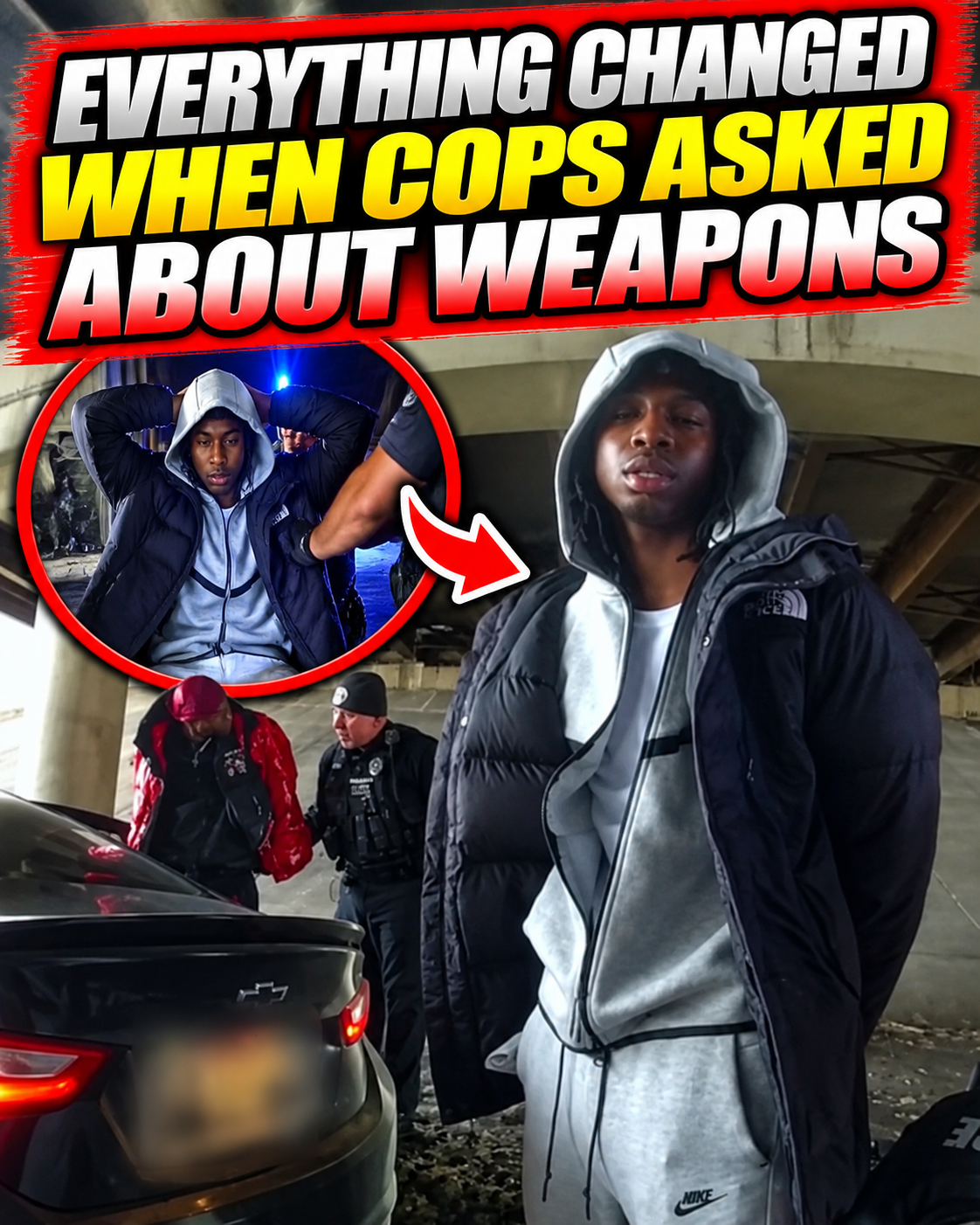
Body Cam Police Detain Man Accused of Brandishing Firearm & Making Threats
AN ARMED-THREAT CALL PUTS POLICE ON HIGH ALERT — THEN OFFICERS FIND THE MAN IN A PARKING LOT
A REPORT OF A GUN CHANGES THE WAY POLICE APPROACH EVERYTHING
A quiet parking lot at night can look almost completely ordinary.
A few cars sit beneath bright exterior lights. Buildings surround the property. Traffic is minimal. There is no visible crowd, no vehicle pursuit and no obvious emergency unfolding in front of the camera.
Then police arrive.
The officers aren't approaching this scene as if they are responding to a routine complaint.
They have received information suggesting that a man may have access to a firearm and may have been making threats.
THAT SINGLE PIECE OF INFORMATION CHANGES THE ENTIRE POLICE RESPONSE.
Body-camera footage dated February 16, 2026 captures officers converging on the area and eventually detaining a man wearing a bright red hooded sweatshirt.
What makes the footage compelling isn't a spectacular chase or a violent confrontation.
It is uncertainty.
Police have been told there could be a gun.
But when they encounter the man, they cannot immediately know whether that information is accurate.
They don't know whether a weapon is in his waistband, inside a pocket, somewhere nearby—or whether there is a firearm at all.
The officers therefore have to answer several questions almost simultaneously.
Is this the correct person?
Does he have a weapon?
Will he cooperate?
Is anyone else in danger?
And how quickly can officers establish control without unnecessarily escalating the encounter?
The answer begins unfolding as police vehicles surround the parking lot.
POLICE ENTER THE PARKING LOT
The first part of the footage establishes the environment.
It is nighttime.
Police emergency lights illuminate an otherwise quiet commercial or residential parking area.
Multiple officers are present.
REAL BODYCAM FRAME — OFFICERS ARRIVE
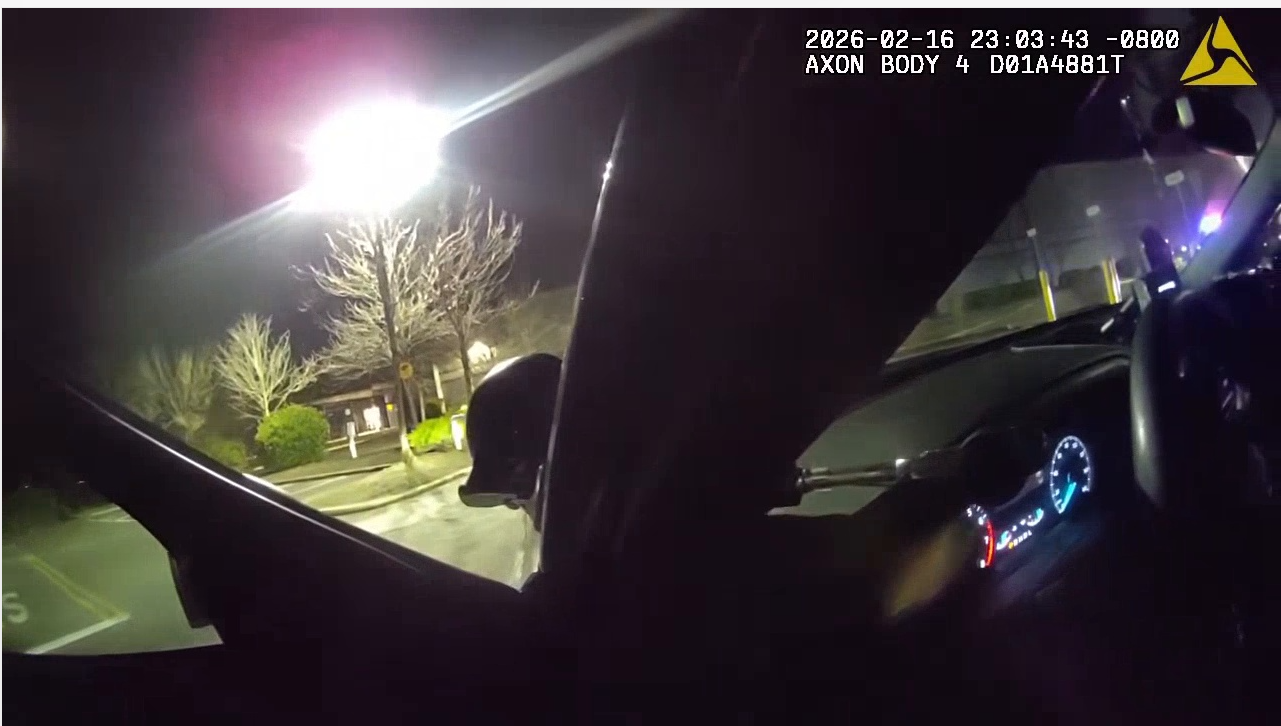
The number of officers immediately tells the viewer something about how seriously police are treating the information they received.
A reported firearm creates a fundamentally different risk profile from an ordinary verbal dispute.
Police do not necessarily know whether the information provided by a caller is accurate.
But officers also cannot safely assume it is false.
That creates one of the central dilemmas of calls involving weapons.
POLICE HAVE TO PREPARE FOR THE MOST DANGEROUS PLAUSIBLE POSSIBILITY WHILE STILL DETERMINING WHAT ACTUALLY HAPPENED.
An officer approaching someone who might be armed therefore has to watch the person's hands closely.
Distance becomes important.
Cover becomes important.
Communication between officers becomes important.
And even seemingly insignificant movements can attract immediate attention.
The footage reflects that caution.
Police establish control of the area before moving deeper into the investigation.
THE MAN IN THE RED HOODIE BECOMES THE FOCUS
Eventually officers make contact with a man wearing a distinctive red hooded sweatshirt.
The atmosphere changes immediately.
This is no longer simply officers searching an area.
They now have a person to investigate.
REAL FRAME — POLICE MAKE CONTACT
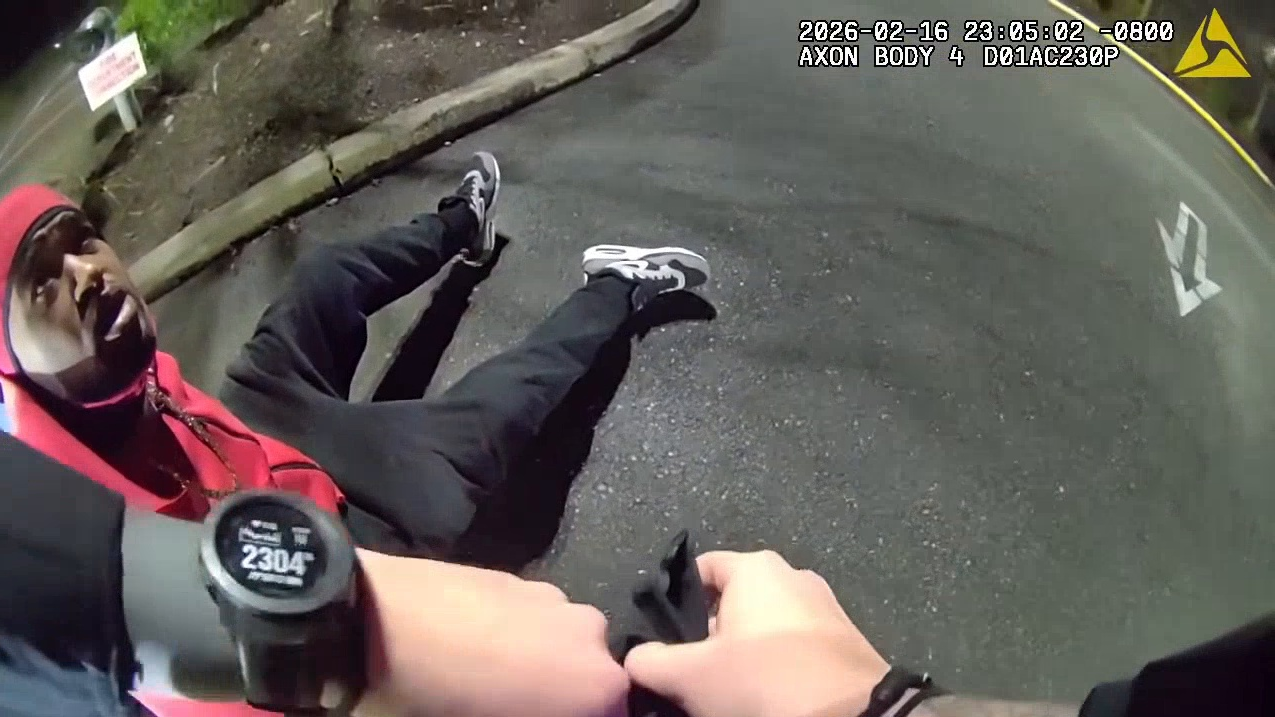
The man does not appear to launch into an immediate violent attack.
He communicates with officers.
But police still have to resolve the most important issue from the original call:
IS HE ARMED?
That question explains much of what happens next.
When police have specific information that a person may possess a firearm, officers may take temporary safety measures while they investigate the allegation.
The purpose is straightforward.
If a weapon exists, police want to locate and secure it before an ordinary conversation can unexpectedly turn into an armed confrontation.
Bodycam provides an unusually useful perspective here because the viewer sees the encounter from only a few feet away.
The red hoodie fills much of the frame.
Officers are positioned around the man.
Police vehicles and flashing emergency lights remain behind them.
There is nowhere for the tension to hide.
OFFICERS DETAIN HIM WHILE THEY INVESTIGATE
The man is eventually placed in handcuffs.
REAL BODYCAM FRAME — THE DETENTION
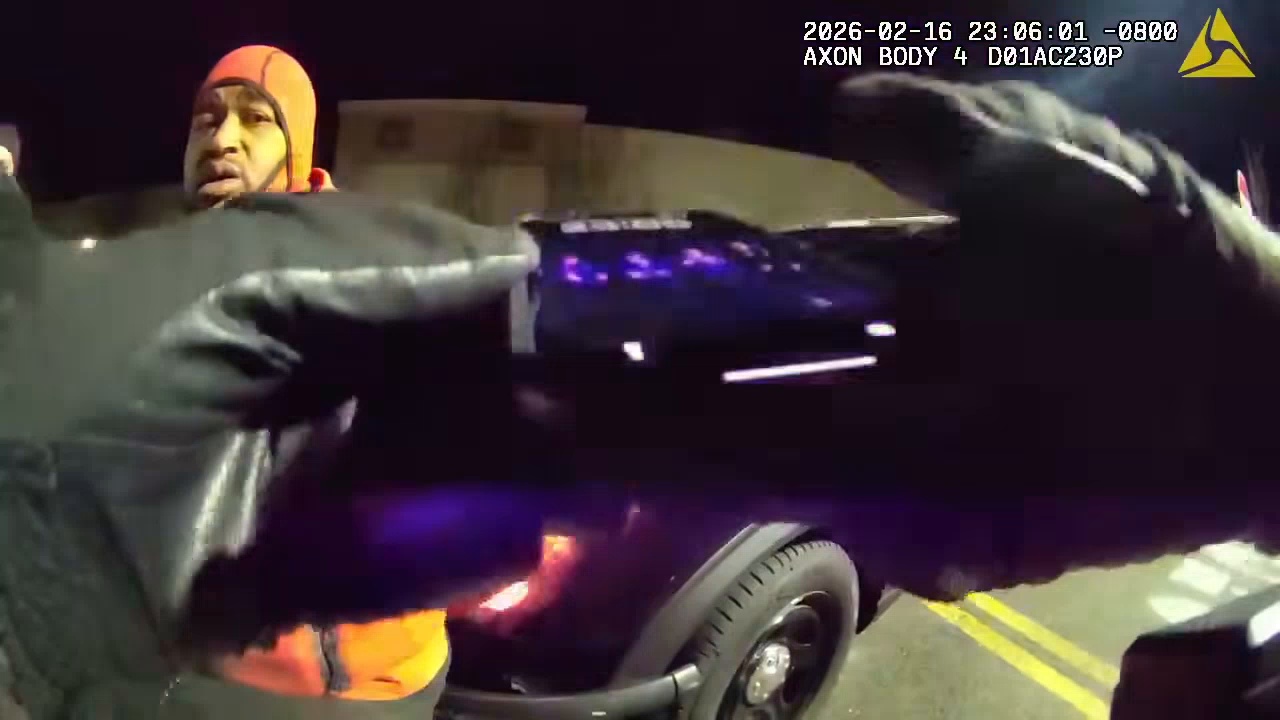
This is an important moment to describe accurately.
A detention is not automatically the same thing as a conviction—or even necessarily a final arrest.
Police may temporarily restrain someone while investigating a potentially dangerous situation, particularly when officers reasonably believe weapons may be involved.
What matters is what happens after control is established.
The footage shows officers continuing to speak with the man rather than treating the encounter as finished.
Questions continue.
Information is compared.
Officers communicate with each other.
THE HANDCUFFS SOLVE THE IMMEDIATE SAFETY PROBLEM. THEY DO NOT ANSWER THE INVESTIGATIVE QUESTIONS.
That distinction is central to understanding this type of police footage.
On social media, viewers frequently see someone in handcuffs and immediately assume the entire case has already been established.
Real investigations are rarely that simple.
Police still have to determine what was actually said.
Who heard it?
Was a weapon displayed?
Did witnesses see a firearm or merely hear someone claim to have one?
Was a weapon recovered?
Was the alleged statement legally a threat?
Did the man commit an offense?
Those questions require more than simply locating a person who matches a description.
THE ALLEGED FIREARM CHANGES THE RISK LEVEL
The most consequential word in the reported circumstances is firearm.
Police encounters involving possible guns demand caution because officers cannot determine whether a concealed weapon exists simply by looking at someone's clothing.
A handgun can be hidden beneath a sweatshirt.
It can be inside a pocket.
It can be inside a vehicle.
Or the report can ultimately prove inaccurate.
Until officers establish which possibility is true, they operate in uncertainty.
REAL FRAME — OFFICERS MAINTAIN CONTROL OF THE SCENE
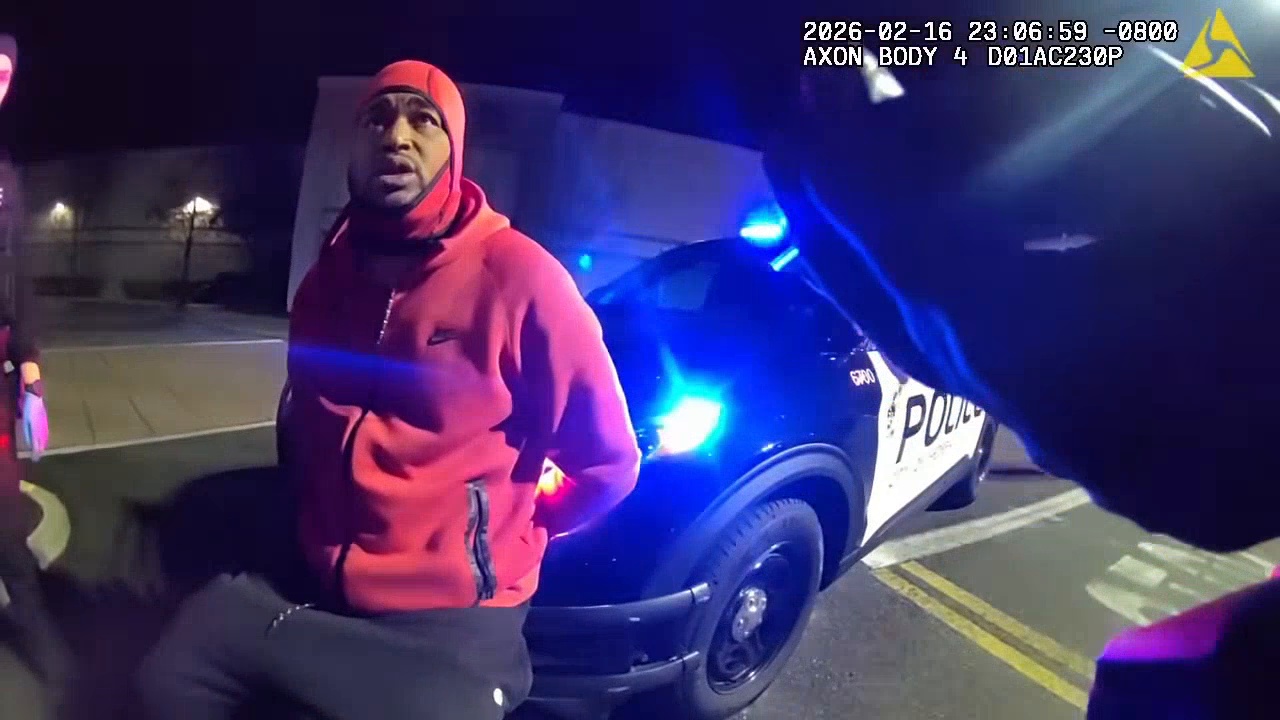
That uncertainty explains why officers may position themselves strategically rather than gathering casually around the person.
They need visibility.
They need space.
They need to avoid crossing one another's lines of movement.
And they need someone communicating with the detained person while other officers maintain awareness of the surroundings.
The bodycam footage makes these small tactical decisions visible.
Nobody watching from the safety of a screen faces the same uncertainty.
A viewer already knows the clip ends.
An officer arriving at the scene does not.
POLICE HAVE TO MAKE THEIR EARLY DECISIONS BEFORE THEY KNOW THE ENDING.
That is an important principle when interpreting body-camera footage.
MAKING A THREAT AND POSSESSING A FIREARM ARE SEPARATE QUESTIONS
There is another issue worth separating.
The claim that someone made a threat is not necessarily the same as proving that person possessed a firearm.
Likewise, legally possessing a firearm does not automatically mean someone committed a crime.
The significance depends heavily on jurisdiction and circumstances.
Police therefore have two different investigative tracks to resolve.
First:
WHAT WAS ACTUALLY SAID OR DONE?
Second:
WAS A WEAPON INVOLVED?
Witness interviews become crucial.
Officers may need to establish the precise words used, the context in which they were spoken, whether a weapon was displayed and whether the recipient reasonably perceived an immediate threat.
REAL BODYCAM FRAME — THE INVESTIGATION CONTINUES
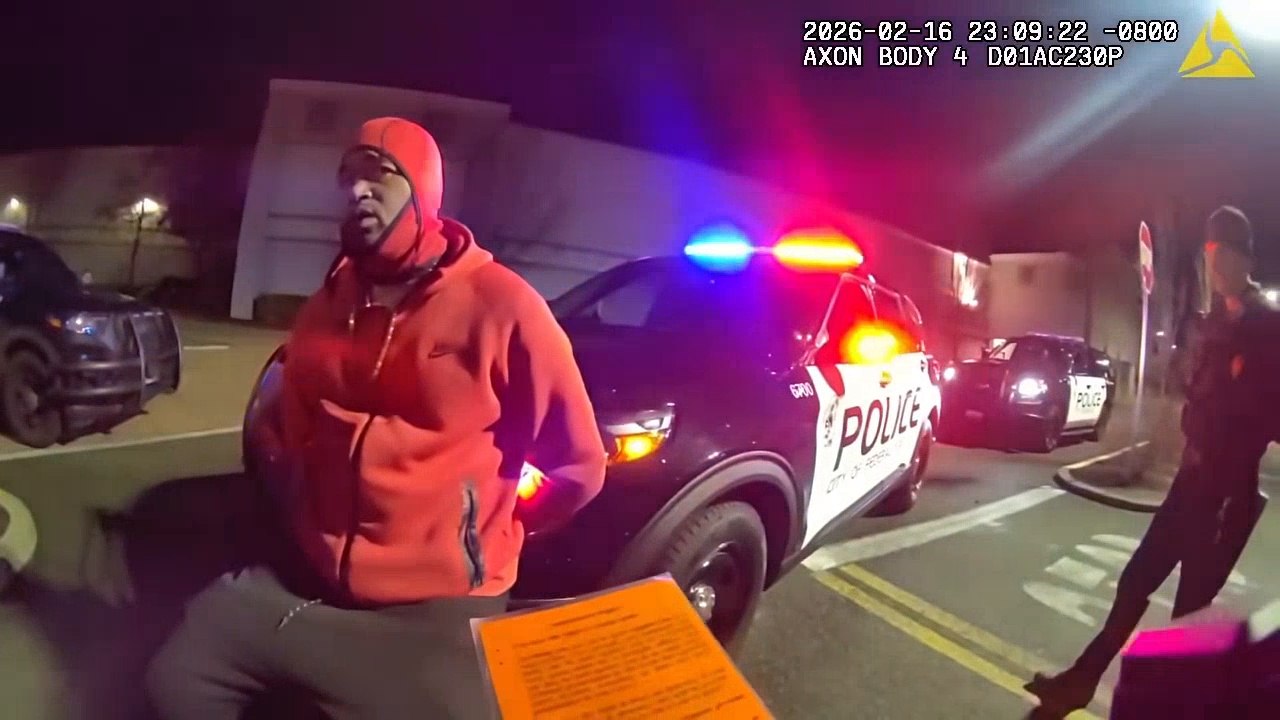
The bodycam cannot independently answer all of those questions.
It begins recording the police response—not necessarily whatever event caused someone to call police in the first place.
That is one of the limitations of bodycam video that viewers often overlook.
THE CAMERA CAN PERFECTLY RECORD AN OFFICER'S ARRIVAL AND STILL MISS THE MOST IMPORTANT THING THAT HAPPENED BEFORE POLICE GOT THERE.
Investigators therefore rely on other evidence.
Statements.
Dispatch recordings.
Security cameras.
Phone video.
Messages.
Physical evidence.
And, when firearms are alleged, the actual recovery or absence of a weapon.
This is why the detention shown in the footage should be understood as part of an investigation rather than proof of every allegation that brought police there.
THE MAN TALKS WHILE OFFICERS CHECK THE STORY
Once the scene is under control, the pace becomes slower.
That does not mean nothing important is happening.
In many police investigations, the period after detention is where officers begin deciding whether the facts support an arrest, a citation, release or some other action.
The man speaks.
Officers listen.
Different officers move in and out of the bodycam's field of view.
REAL FRAME — OFFICERS SPEAK WITH THE DETAINED MAN
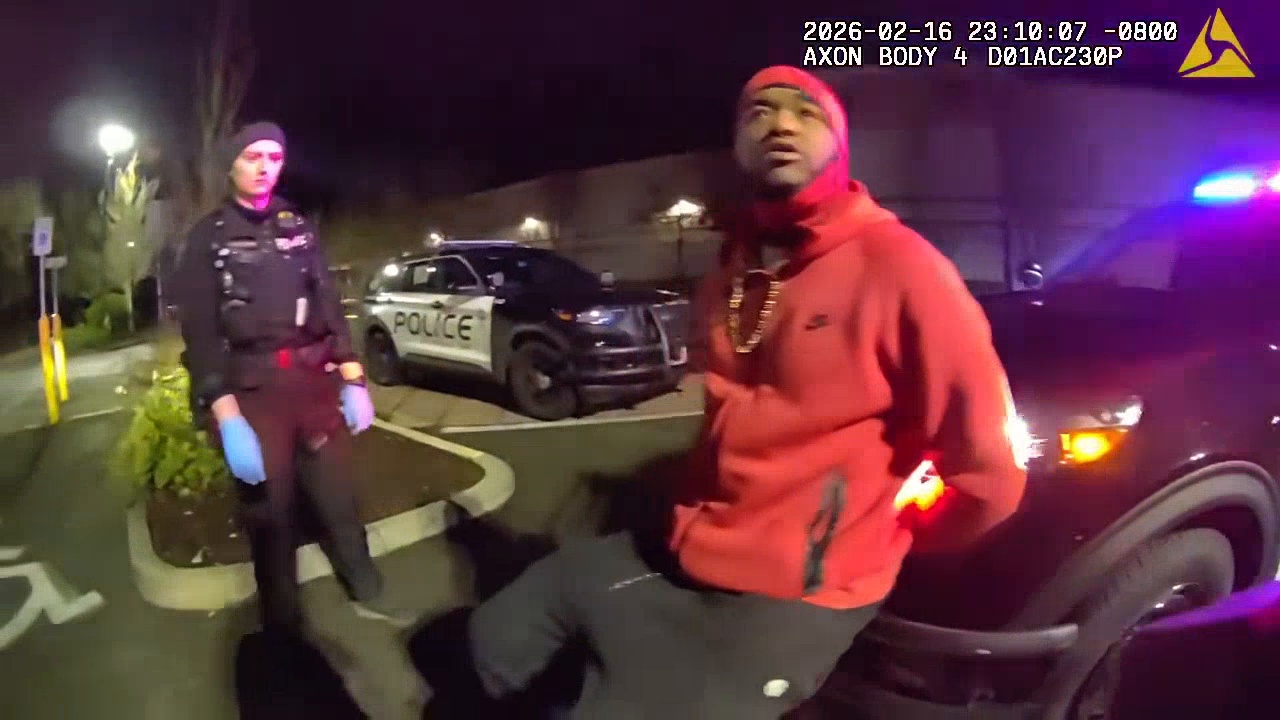
This portion of footage can seem less exciting than the initial contact.
From a storytelling perspective, however, it creates a different kind of tension.
The viewer knows the allegation.
A firearm.
Threats.
But the outcome remains unresolved.
WILL POLICE FIND A GUN?
WILL A WITNESS CONFIRM THE THREAT?
WILL THE MAN BE ARRESTED OR RELEASED?
Those questions can retain attention more effectively than artificial exaggeration.
A good police-footage story does not need constant shouting or physical confrontation.
Uncertainty can be the hook.
WHY OFFICERS DON'T SIMPLY TAKE THE ORIGINAL REPORT AS FACT
Someone calling 911 does not automatically prove that an offense occurred.
Police reports frequently begin with incomplete information.
A caller can misunderstand what happened.
A witness may have seen only part of an event.
People involved in disputes can provide contradictory accounts.
Descriptions can be inaccurate.
And statements made in anger can later become disputed.
Police therefore have to investigate rather than simply accept the first account they receive.
This is particularly important when the allegation is serious.
If someone is accused of threatening another person with a gun, the consequences of getting the facts wrong can be substantial in either direction.
Failing to intervene when a genuine threat exists could expose someone to danger.
Arresting a person without sufficient legal basis can also have serious consequences.
The officers therefore have to slow the situation down.
And that is exactly what handcuffing and separating people can accomplish.
FIRST CONTROL THE RISK. THEN DETERMINE THE FACTS.
BODYCAM SHOWS THE DIFFERENCE BETWEEN DANGER AND UNCERTAINTY
One of the most interesting features of this video is that the encounter remains controlled.
There is no dramatic shootout.
No officer is visibly forced to fire.
The man is not seen sprinting away through the parking lot in the section reviewed.
That doesn't make the response insignificant.
Quite the opposite.
It demonstrates that a potentially armed encounter can sometimes be stabilized before violence occurs.
REAL FRAME — POLICE VEHICLES SURROUND THE AREA
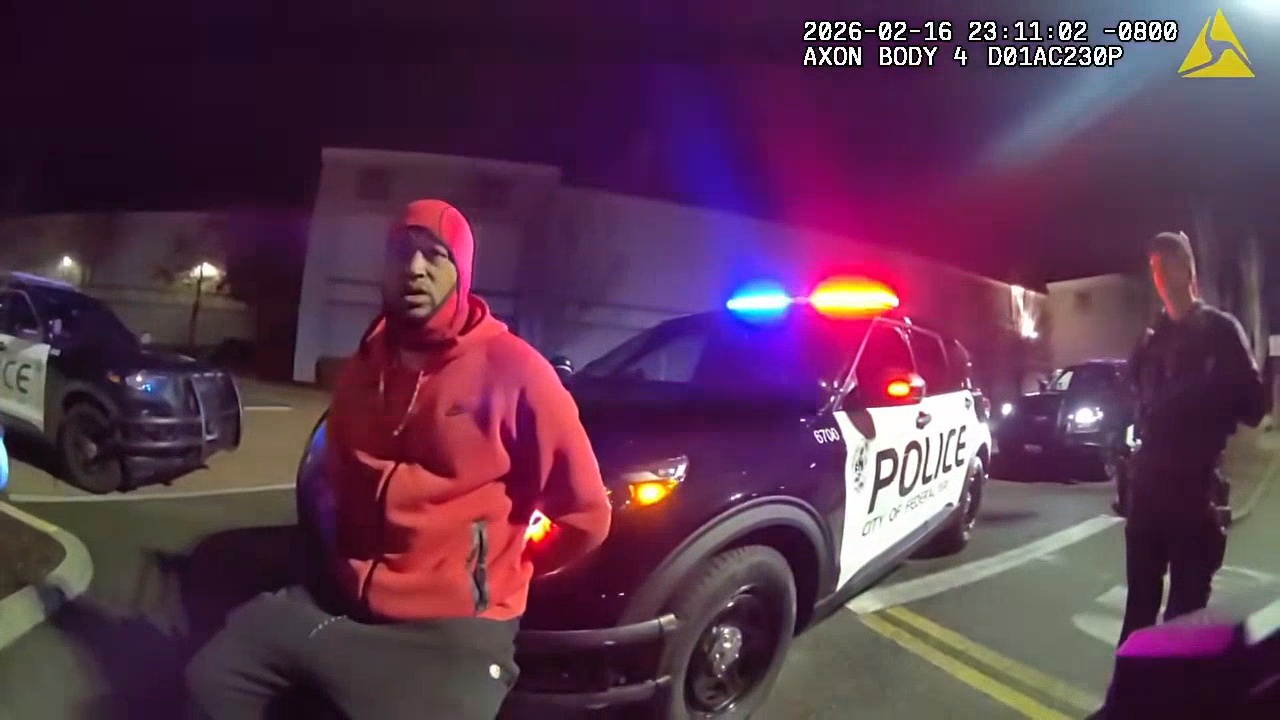
Police emergency lights remain everywhere.
Several officers are still present.
The man remains detained.
But the atmosphere has changed.
The first priority—preventing an unexpected escalation—has largely been accomplished.
Now the remaining work is investigative.
That contrast is useful because the most viral bodycam clips often show encounters after everything has already gone wrong.
Footage like this shows another possibility.
A HIGH-RISK CALL CAN END WITH OFFICERS GAINING CONTROL WITHOUT A SHOOTING OR A VIOLENT STRUGGLE.
That is less spectacular.
It is also far preferable.
THE TIMESTAMP PROVIDES ONE SOLID ANCHOR
The video itself gives us one important factual marker.
The Axon body-camera overlay displays February 16, 2026, with the contact occurring late at night.
That timestamp helps narrow potential public records and news reports.
But it does not, by itself, establish a city.
The patrol vehicle visible in the footage displays a large POLICE marking, but the frames available do not provide a sufficiently clear department identifier for me to responsibly assign this encounter to a specific agency.
That matters because multiple unrelated firearm-and-threat incidents were reported around the United States on February 16, 2026.
For example, Fort Madison, Iowa police reported a separate incident involving a man who allegedly pointed a handgun at an officer and barricaded himself in a bedroom; that case involved a two-hour tactical response and clearly does not match the parking-lot footage here.
Portland Police also reported an unrelated firearm arrest that day following a drive-by shooting; again, its documented circumstances do not match this footage.
That is why matching only the date or keywords would be dangerous.
A REAL CASE SHOULD BE IDENTIFIED BY THE FOOTAGE, LOCATION, DEPARTMENT, PEOPLE AND SEQUENCE—NOT BY A SIMILAR HEADLINE.
WHY I AM NOT ASSIGNING A NAME TO THE MAN
This point is important for a credible article.
Search results contain several incidents involving men, firearms and threats.
Some even occurred on the same date.
But that does not mean they involve the person in this bodycam video.
Without a matching police agency, address, identifiable report number or reporting that contains images matching the footage, attaching one of those names would risk falsely accusing an unrelated person.
A responsible article should prefer an unresolved detail over an invented one.
So the most accurate description is:
THE FOOTAGE SHOWS POLICE DETAINING A MAN WHILE INVESTIGATING AN ALLEGATION INVOLVING A FIREARM AND THREATS.
The video timestamp establishes February 16, 2026.
The bodycam establishes the detention and police response.
But the available public reporting I found does not yet establish, to a sufficiently high standard, the man's identity or final case disposition.
That limitation does not prevent us from analyzing what the footage actually shows.
THE DETENTION REMAINS CONTROLLED
As the encounter progresses, officers continue working around the detained man.
The footage demonstrates a noticeable difference between the opening uncertainty and the later scene.
Initially, police are entering a location where a weapon may be present.
Later, they have one person restrained and multiple officers positioned nearby.
REAL BODYCAM FRAME — LATER STAGE OF THE ENCOUNTER
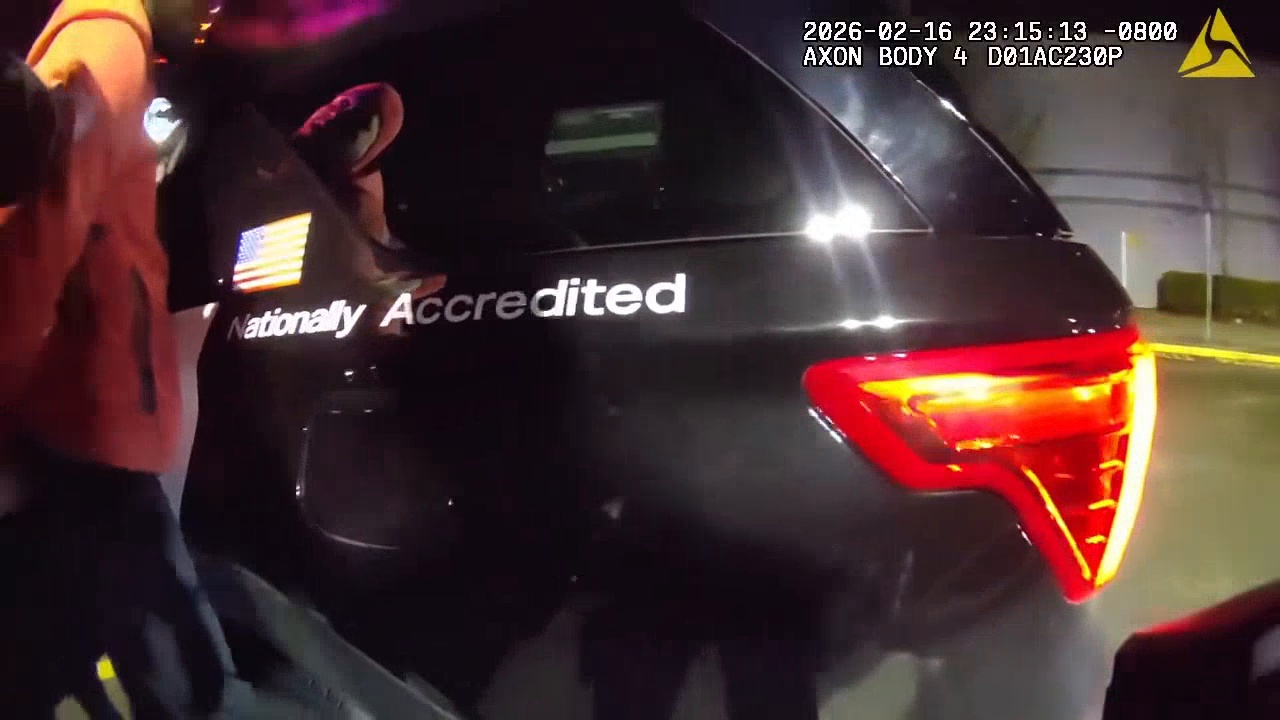
This is the point where the viewer can begin appreciating how much police work consists of managing uncertainty.
The dramatic part may last only seconds.
The documentation takes longer.
Officers may need to confirm identifying information, check databases, interview reporting parties and determine what evidence exists.
A bodycam keeps recording throughout.
That creates an unusually complete record of an event that, without video, might later be summarized in only several paragraphs of a police report.
ENDING — A POTENTIALLY ARMED CALL ENDS WITHOUT GUNFIRE
The footage begins with uncertainty.
Someone has reportedly made threats.
There may be a firearm.
Police arrive at night.
Multiple officers position themselves around a parking area.
Then they locate a man wearing a red hoodie.
He is detained.
His hands are secured.
Officers begin investigating.
And the confrontation does not erupt into the kind of violence officers had to be prepared for when they arrived.
That outcome is worth emphasizing.
THE MOST IMPORTANT THING THAT HAPPENS MAY BE WHAT DOESN'T HAPPEN.
Nobody in the footage needs to be shot.
There is no high-speed pursuit.
The man does not appear to force officers into a prolonged physical fight during the section reviewed.
Instead, police gain control and move into the slower process of figuring out whether the allegations can be substantiated.
The case therefore offers a useful contrast to many dramatic police videos.
A reported gun does not guarantee gunfire.
A serious allegation does not eliminate the need for investigation.
And a person being handcuffed does not automatically establish guilt.
Bodycam lets us watch those distinctions unfold.
The first officers arrive knowing only enough to recognize potential danger.
They cannot see the future.
They cannot know whether the firearm report is accurate.
They cannot know how the man will respond when approached.
They prepare accordingly.
Then, once the immediate risk is controlled, the nature of the encounter changes.
TACTICS GIVE WAY TO INVESTIGATION.
That is the real story contained in these eight minutes of footage.
Not an explosive confrontation.
Not a dramatic chase.
But the tense space between an allegation and the facts police are trying to establish.
And sometimes that is exactly what successful de-escalation looks like:
Police arrive prepared for violence—
AND LEAVE WITHOUT HAVING TO USE DEADLY FORCE.
CTA — SEE HOW OFFICERS HANDLE THE HIGH-RISK CONTACT
Police were responding to allegations involving threats and a possible firearm—but when they finally confronted the man in the red hoodie, the encounter took a different direction.
WATCH THE FULL BODYCAM BELOW TO SEE HOW OFFICERS APPROACHED THE SCENE, detained the man, controlled the immediate risk and worked through an allegation that could have turned dangerous in seconds: https://www.youtube.com/watch?v=HmNN0nnG6U0
Comments (0)
Loading comments...
May You Like

West Virginia Man Laughs at Police Officer and Ends Up Arrested
Entitled Driver Skips the Line and Gets Instant Karma3