
Atlanta Police Rescue Man Passed Out In A Burning Car!
Atlanta Officers Race Against Flames to Save Driver Trapped Inside Burning Car
Seconds Matter When a Routine Crash Turns Into a Rescue
A police officer can begin a shift expecting almost anything.
A traffic stop can become an arrest. A disturbance call can become a medical emergency. A seemingly ordinary vehicle crash can suddenly become a race to save someone's life.
On the afternoon of April 25, 2021, several Atlanta Police Department officers were confronted with exactly that kind of transformation.
At approximately 4:57 p.m., officers were dispatched to 4511 Campbellton Road SW following reports of an automobile accident.
When the first officers arrived, however, they immediately discovered that this was no longer simply a crash scene.
A vehicle was burning.
And there was still someone inside.
According to the Atlanta Police Department's official preliminary report, the driver appeared to be experiencing a seizure while trapped inside the burning vehicle.
The body-camera footage captures what happened next in remarkable detail.
There is no lengthy planning session.
No time to wait comfortably for specialized rescue equipment.
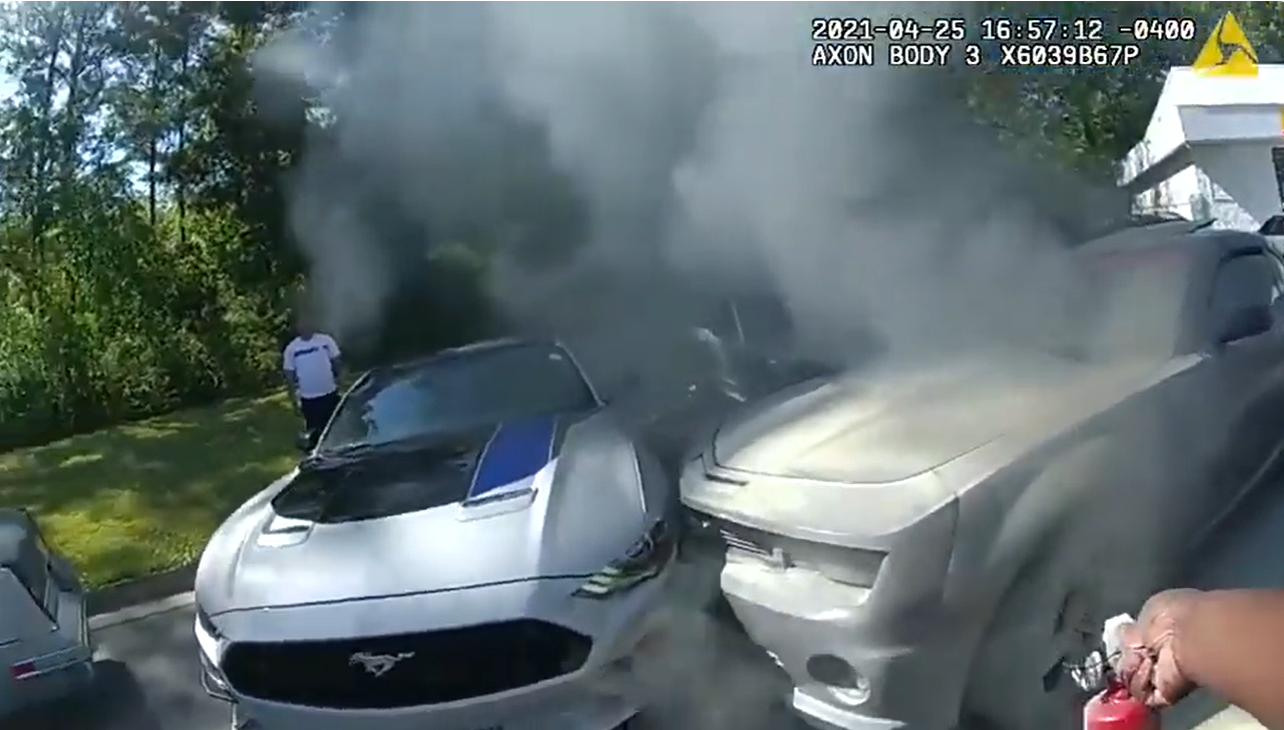
Smoke is already pouring from the vehicle.
The officers know somebody is inside.
Their priority changes instantly.
Get the driver out.
The footage dated April 25, 2021 shows officers converging on the dark-colored coupe as smoke becomes increasingly visible. One officer approaches the driver's side and tries to reach the occupant.
The driver cannot simply step out.
He is incapacitated.
That means the officers must somehow gain access to him while simultaneously dealing with the growing fire.
And every second they spend beside the car exposes them to the same danger threatening the man inside.
The Call Quickly Becomes a Life-or-Death Emergency
The location adds another layer of danger.
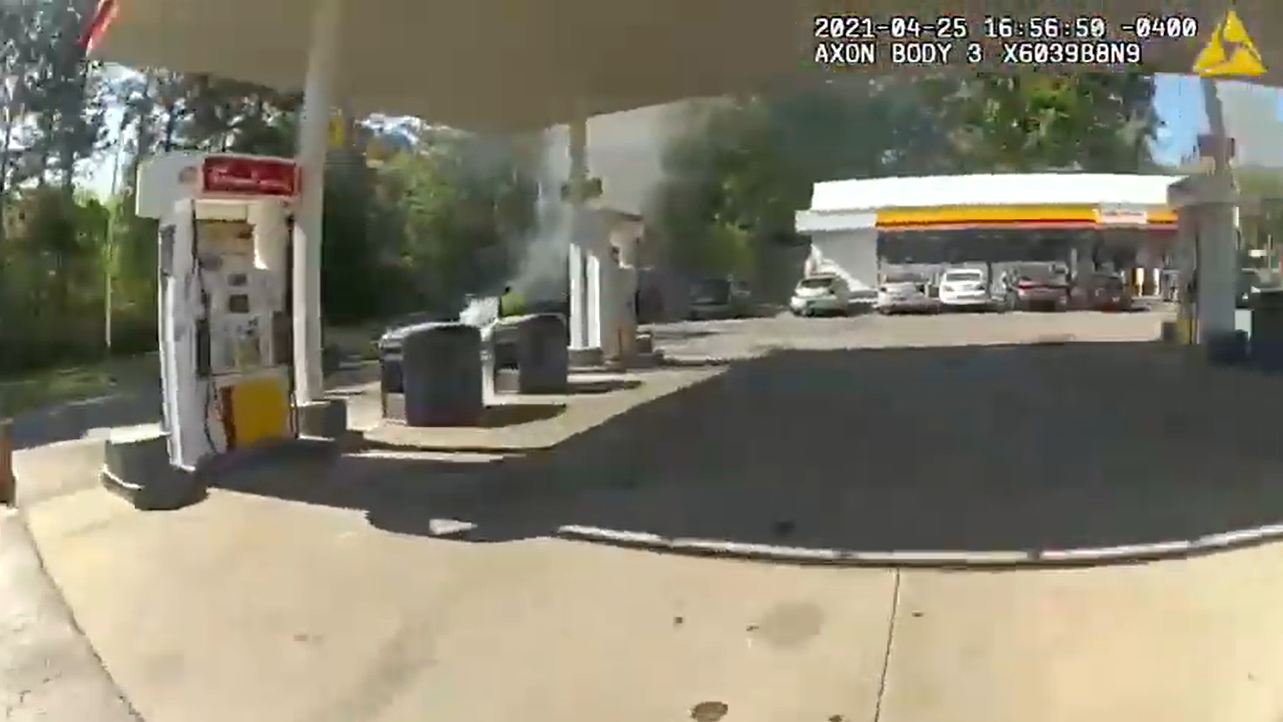
The crash occurred at 4511 Campbellton Road SW, an address occupied by a Shell service station.
A burning vehicle is dangerous anywhere.
A burning vehicle around other cars, structures and a service-station environment demands an immediate response.
The footage makes the urgency obvious.
Smoke begins obscuring parts of the vehicle.
Officers gather around it, attempting to reach the driver.
The man inside is not behaving like someone who can respond normally to instructions.
Atlanta Police later said officers observed him having a seizure.
That distinction completely changes the rescue.
If a conscious driver sees flames, the solution might be relatively simple: unlock the door, release the seat belt and get away.
An unconscious or medically incapacitated person cannot necessarily do any of those things.
Now the rescuers must do everything for him.
The officers have to open the vehicle.
They have to determine how the man is positioned.
They have to physically move him.
And they must accomplish all of that before conditions inside the car become unsurvivable.
Law&Crime reported that Atlanta Police later credited Sergeants J. Sutton and D. Davis along with Officers A. Ruffin, S. Verrelien and M. Bouquette for their response.
The video shows why the department considered their actions significant.
This is not an arrest.
Nobody is being chased.
There is no suspect to control.
The threat is fire, smoke and time.
And unlike a suspect, fire cannot be ordered to stop.
Getting Into the Car Is Only the Beginning
One of the most tense elements of the footage is how quickly an ordinary car door becomes an obstacle.
The officers need access to the driver immediately.
But a crashed vehicle does not necessarily behave like a normal parked car.
Doors can jam.
Electronic locks can malfunction.
Structural damage can change the geometry of the body.
The occupant may also be positioned in a way that makes removal difficult.
The officers work around those problems while smoke continues building.
There is another complication.
Simply reaching the driver does not mean he is safe.
They still have to move an incapacitated adult out of a confined seating position.
Anyone who has tried to lift an unconscious person knows how difficult that can be. A conscious person instinctively assists a rescuer. They stand, shift their weight, grab something or move their legs.
An unconscious or convulsing person cannot reliably help.
The entire physical burden falls on the rescuers.
That is essentially what the Atlanta officers are confronting.
They cannot wait for the driver to recover.
They cannot assume the fire will remain where it is.
They have to act.
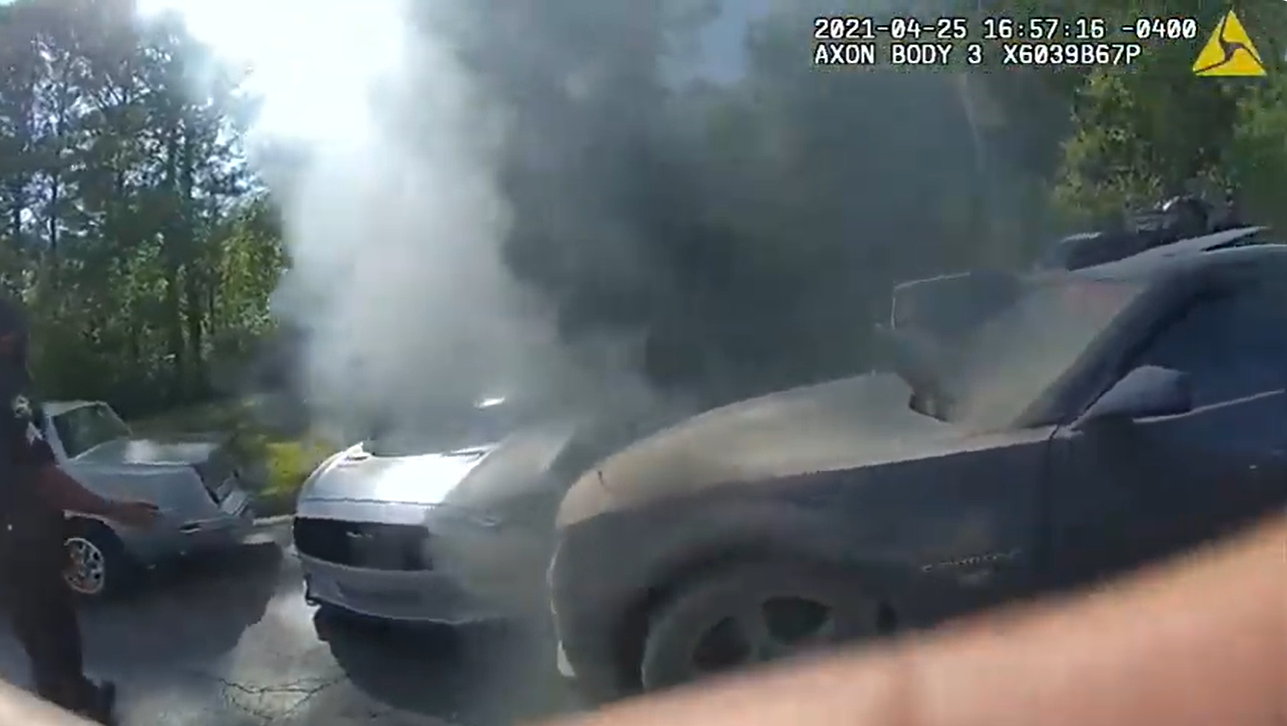
The footage shows officers repeatedly working around the driver's side of the vehicle as smoke fills the immediate area.
Eventually, they gain enough control of the situation to begin pulling him out.
The driver emerges from the car.
Then officers move him away from the danger.
Only after he has been removed does the scene begin transitioning from rescue to medical treatment.
The Atlanta Police Department later confirmed that the operation was successful.
The driver survived.
So did the officers who entered the hazardous area to reach him.
Both the driver and officers were transported to Grady Memorial Hospital with minor injuries, according to APD's official report.
That single sentence in a police report sounds simple.
The bodycam shows how much effort was required to make it possible.
Why Waiting Wasn't a Real Option
Police officers are not firefighters.
They do not normally carry the protective equipment that firefighters use when approaching an active vehicle fire.
There are no turnout coats protecting every inch of their bodies.
No self-contained breathing apparatus.
No fire-resistant hood.
No oxygen supply.
Yet emergencies do not always arrive in the correct order.
Sometimes police reach a crash before fire crews.
Sometimes bystanders arrive first.
And sometimes the person trapped inside does not have enough time for everyone to wait.
This incident demonstrates that problem clearly.
Atlanta Police said responding officers immediately shifted into what the department described as a life-saving response when they realized the driver was trapped.
Every additional second could allow smoke and heat to increase inside the passenger compartment.
Smoke can be as dangerous as flame.
A person who is already experiencing a seizure or loss of consciousness is particularly vulnerable because they may be unable to recognize the danger or move toward fresh air.
The officers therefore faced two competing risks.
Approaching the vehicle exposed them to fire and smoke.
Waiting exposed the driver to potentially fatal conditions.
They chose to approach.
That decision is the central story of the footage.
It also explains why the video spread well beyond Atlanta.
Sky News published footage of the rescue under the description “Atlanta: Unconscious man rescued from burning car.” iHeartRadio similarly reported that bodycam footage showed Georgia authorities rescuing a man suffering a seizure while trapped inside the burning vehicle.
The story resonated because there is almost no ambiguity about the objective.
A human being cannot get himself out.
The vehicle is burning.
Somebody has to reach him.
Bodycam Shows the Part a Police Report Cannot
The Atlanta Police Department's written incident summary is only a few sentences long.
It gives the essential facts.
Date.
Time.
Location.
Crash.
Seizure.
Fire.
Rescue.
Hospital.
But those facts do not communicate the atmosphere surrounding the rescue.
Body-camera footage does.
The camera moves rapidly as officers approach.
People shout.
Smoke drifts across the scene.
Multiple officers attempt to solve different problems simultaneously.
Someone has to gain access.
Someone has to control the driver's body.
Someone has to monitor the fire.
Someone has to make sure the rescued man is moved far enough away.
The footage turns an abstract phrase like “officers successfully removed the driver” into something tangible.
This is one reason body-worn cameras have become valuable beyond their original role as evidence.
They sometimes capture the moments between dispatch and the final incident report.
Those moments can reveal confusion, urgency and split-second decision-making that never appear in a written summary.
The April 25 rescue is an unusually strong example.
The officers arrive without knowing exactly what they are about to encounter.
Within moments, they are working beside a burning car.
Then they are physically removing an incapacitated driver.
Soon afterward, medical personnel are involved.
The entire nature of the call changes in minutes.
Atlanta Police emphasized that versatility when discussing the incident, noting that officers may encounter everything from violent crime to traffic accidents and other crises during a normal shift. The department praised the officers' life-saving actions and their role in preventing the fire from producing a far worse outcome.
That point deserves attention.
Saving the driver was the obvious priority.
But an uncontrolled vehicle fire can also threaten nearby cars and structures.
The faster the immediate emergency is stabilized, the more effectively firefighters and other responders can concentrate on extinguishing the blaze without simultaneously conducting a difficult occupant rescue.
The Medical Emergency Behind the Crash
The seizure reported by police is also an important part of the story because it changes how the crash should be interpreted.
Not every serious collision begins with reckless driving.
Medical emergencies can cause a driver to suddenly lose control.
A seizure, loss of consciousness, cardiac event or other acute medical episode can transform someone from an active driver into an incapacitated passenger inside their own moving vehicle.
Atlanta Police's preliminary account did not accuse the driver in this case of intentionally dangerous behavior.
Instead, officers reported finding him suffering a seizure after the accident.
That distinction is worth preserving.
It is easy for dramatic footage to encourage dramatic assumptions.
But the available evidence points toward a medical emergency.
The officers themselves appear to recognize immediately that the man needs rescue rather than enforcement.
Their response reflects that.
There are no demands for identification while the vehicle is smoking.
No roadside questioning.
No investigation taking priority over immediate danger.
First, save the person.
Everything else can wait.
That hierarchy is exactly what emergency response requires.
The Driver Makes It Out Alive
Once the driver is away from the vehicle, the story enters a completely different phase.
The fire remains a problem.
The crash still requires investigation.
The scene must still be secured.
But the most urgent question has been answered.
The man is no longer trapped.
APD's official statement confirmed that the driver and officers were taken to Grady with minor injuries.
Considering the circumstances visible in the footage, that outcome is remarkable.
A driver who could not independently escape a burning car was removed before the situation became fatal.
The officers who entered the hazardous area also avoided serious injury.
The department publicly praised the response afterward.
Other outlets followed.
Law&Crime highlighted the bodycam recording and identified the officers recognized by APD.
iHeartRadio reported the rescue two days after the crash, emphasizing that the driver was expected to recover.
Sky News also circulated footage internationally.
The story traveled because it captured something that rarely requires much explanation.
Someone needed help.
The danger was obvious.
Police arrived.
And they went toward it.
There is an instinctive simplicity to that narrative.
But the footage also demonstrates how quickly such a rescue can become dangerous for everyone involved.
A vehicle fire can intensify.
Smoke can overwhelm rescuers.
Components can fail under heat.
Nearby vehicles or structures can become involved.
And officers without specialized firefighting equipment have limited protection.
That means courage alone is not enough.
Speed matters.
Coordination matters.
Recognizing the priority matters.
On Campbellton Road, the officers appear to have understood all three.
A Three-Minute Video With a Much Bigger Story
The supplied video runs only a few minutes.
Yet it contains an entire emergency-response story.
The first moments establish the crisis.
A car has crashed.
Smoke is rising.
The driver cannot escape.
Officers arrive and discover that he appears to be having a seizure.
The middle of the footage becomes a race against worsening conditions.
Police attempt to access the vehicle.
They work together.
They pull the driver free.
And the final phase shifts toward medical care and securing the scene.
No arrest is needed to make the footage dramatic.
No pursuit is necessary.
No confrontation is required.
The danger comes entirely from circumstances.
That makes the April 25, 2021 rescue different from many body-camera videos that circulate online.
The person at the center of the footage is not somebody officers are trying to catch.
He is somebody they are trying to keep alive.
It also provides a reminder of how misleading the phrase “routine call” can be.
A dispatch for a traffic accident may sound ordinary.
For the officers responding to 4511 Campbellton Road that afternoon, it became anything but ordinary.
They arrived to find a driver medically incapacitated inside a burning vehicle.
There was no guarantee that the doors would cooperate.
No guarantee that the fire would remain manageable.
No guarantee that they could remove him quickly enough.
But the outcome is documented in APD's own report:
The driver was successfully removed.
He survived.
The officers survived.
Their injuries were described as minor.
The bodycam therefore captures something more valuable than a spectacular piece of footage.
It captures the difference a few minutes can make.
Had the response been slower, the story could have ended with investigators explaining why a driver died inside a burning car.
Instead, the story became one about the people who reached him in time.
The smoke filling the frame makes the danger obvious.
The driver lying helpless inside makes the urgency obvious.
And the officers moving toward the vehicle rather than away from it explains the outcome.
Sometimes police footage is remembered because of an arrest.
Sometimes because of a chase.
On April 25, 2021, this camera recorded something much simpler.
A man needed to get out of a burning car.
And several Atlanta officers refused to leave him inside.
Watch the complete bodycam rescue and see how Atlanta officers fought through smoke and flames to reach the trapped driver here: https://www.youtube.com/watch?v=BEURTOYw6tg
Comments (0)
Loading comments...
May You Like

What Happens when you get Caught Shoplifter Stealing Local Store

A Suspicious Vehicle Leads Officers Into an Unexpected Chase

Chrysler 300 Gapped Cops at 150+ MPH | Police Dashcam












