
ASP 130 MPH PIT Maneuver Triggers Violent Multi-Car Rollover Crash
130 MPH Arkansas Pursuit Ends in TVI Crash That Seriously Injures Two Bystanders
A Traffic Stop Becomes a 130 MPH Emergency
At about 6:56 p.m. on August 5, 2026, Arkansas State Police Corporal Logan Hall was traveling on Interstate 555 near Trumann when a black Hyundai Sonata came into view at a speed well above the limit. According to Arkansas State Police and subsequent local reporting, Hall clocked the Hyundai at roughly 90 mph in a 75 mph zone near the 23 to 24 mile marker.
What began as a speeding stop escalated almost immediately.
The driver, later identified by Arkansas State Police as 32-year-old Laloyd L. Hamilton III of Forrest City, did not stop. Instead, the Sonata accelerated north on I-555. The pursuit climbed toward approximately 130 mph as Hall followed through Poinsett County.
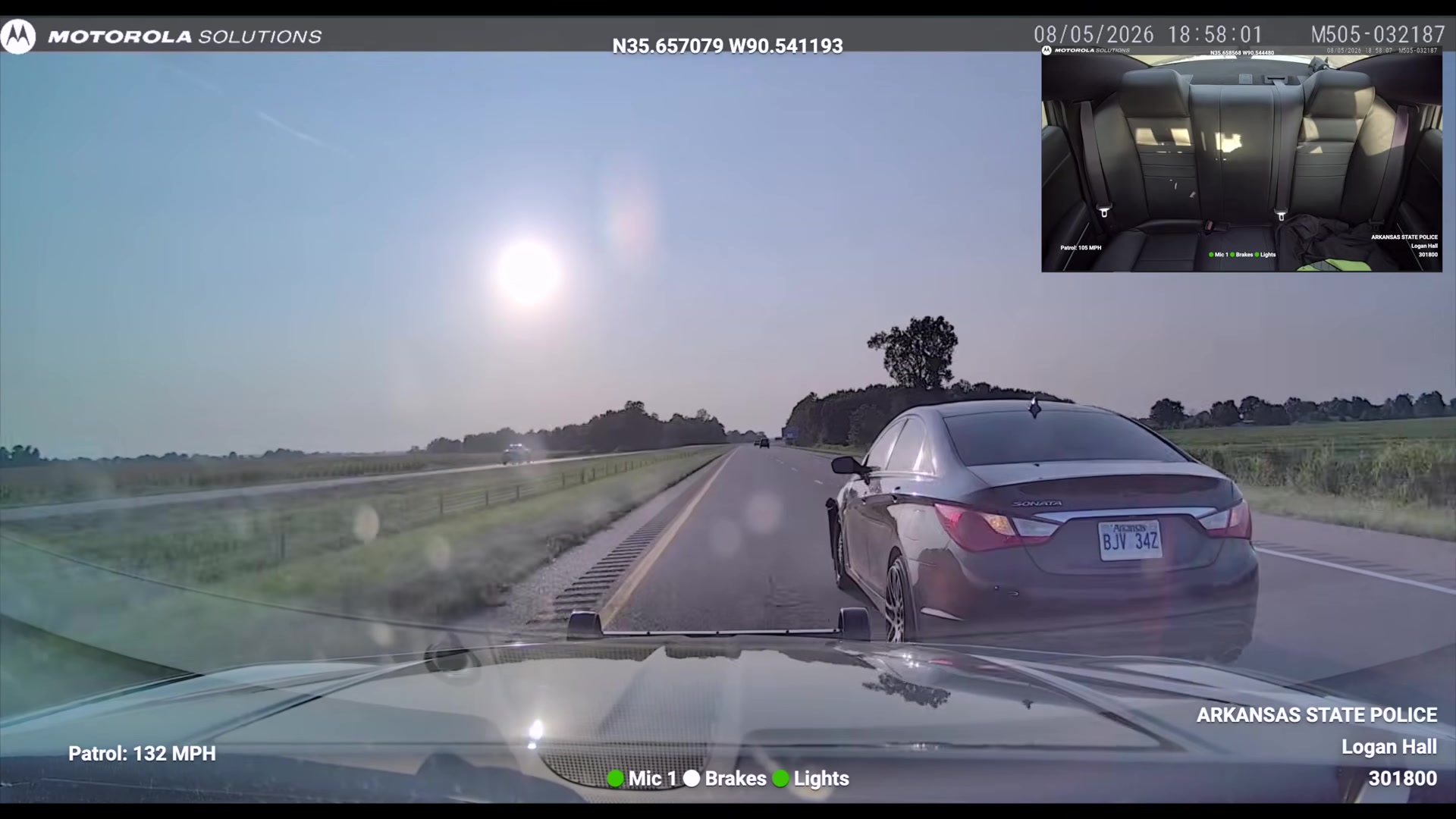
The dashcam makes the speed tangible. The Motorola Solutions overlay identifies Hall, records GPS coordinates and displays the patrol car's speed. One frame from the supplied footage shows the cruiser at 132 mph with the Sonata only a short distance ahead.
Then the pursuit reaches the moment that transformed a dangerous chase into a multi-vehicle emergency.
Near the 28 mile marker, Hall performed what Arkansas State Police calls a Tactical Vehicle Intervention, or TVI. The technique is commonly known as a PIT maneuver. The patrol car contacted the Hyundai, causing it to rotate across the interstate.
An uninvolved SUV was directly in the path of the spinning car.
The vehicles collided. The third-party SUV left the roadway and overturned. Inside were a 68-year-old woman and a 73-year-old man who had no role in the pursuit. Both suffered serious injuries and were transported to Regional One Medical Center in Memphis.
Hamilton was also taken to a hospital for evaluation before being held in the Poinsett County Detention Center.
The video is difficult to watch not because the pursuit is unusually long, but because the consequences arrive in seconds. A car fleeing at extreme speed, a police intervention intended to stop it, and an innocent vehicle occupying the wrong piece of highway converge almost simultaneously.
The result became one of the most discussed Arkansas State Police pursuit videos of August 2026 and renewed a familiar question: when a fleeing driver is already creating extreme danger, when does an intervention reduce that danger, and when can the intervention itself expose other motorists to even greater risk?
The Exact Incident Can Be Verified
Unlike many viral police videos, this incident is supported by several independent sources.
Arkansas State Police issued information identifying the date, location, suspect, pursuit speed, injuries and charges.
NEA Report published a detailed account based on the ASP incident report and newly released dashcam footage.
WMC Action News 5 independently reported the same core facts, including Hamilton's identity, the 130 mph speed, the TVI, the injured bystanders and the charges announced by police.
The dashcam supplied for this article independently matches those reports. Its overlay shows August 5, 2026, Arkansas State Police Corporal Logan Hall and GPS coordinates along the I-555 corridor near Trumann.
That combination of video evidence and external reporting makes this incident unusually well documented.
The Pursuit Begins With a Speeding Hyundai
NEA Report says Hall clocked the Sonata at about 90 mph in a 75 mph zone.
The initial violation was therefore serious but still recognizable as an ordinary traffic-enforcement situation.
Hall turned around and began following the car.
According to the incident report summarized by NEA Report, Hamilton initially activated his hazard lights and moved toward the outside lane, behavior that could suggest a driver preparing to stop or exit.
But the Sonata did not come to a stop.
The situation instead became a pursuit.
Acceleration Changes Everything
Once the Hyundai continued fleeing, speed became the central danger.
Arkansas State Police said the car accelerated to approximately 130 mph.
At 130 mph, a vehicle travels about 191 feet every second.
That is more than half the length of a football field in one second.
A driver at that speed has drastically reduced time to respond to traffic, debris, a tire failure or another vehicle changing lanes.
The pursuing trooper faces the same physical realities while also managing emergency equipment, radio communication and the fleeing car ahead.
The Dashcam Shows 132 MPH
The supplied footage gives viewers a direct measurement of how extreme the pursuit became.
At one point, Hall's patrol-speed overlay reads 132 MPH.
The Hyundai is still ahead.
The interstate looks relatively open, but it is not empty.
Other vehicles remain part of the environment.
This is one of the most important images in the entire incident because it requires no interpretation. The speed is recorded directly by the police video system.
A Rural Interstate Can Create a False Sense of Safety
I-555 near Trumann runs through stretches of open agricultural land.
Long sight lines and relatively light traffic can make very high speeds look less dangerous than the same speed on a crowded city freeway.
But open road does not eliminate risk.
Traffic still appears ahead.
Vehicles enter and exit.
Shoulders contain stopped motorists.
And at 130 mph, even a distant car can become an immediate obstacle within seconds.
The crash would demonstrate exactly why those other motorists matter.
The Trooper Closes the Distance
As the chase approaches the 28 mile marker, Hall closes the gap behind the Sonata.
The dashcam shows the Hyundai growing larger in the frame.
The patrol car moves into position near the fleeing car's rear quarter.
This is the setup for a Tactical Vehicle Intervention.
The goal of a TVI is to disrupt the fleeing vehicle's stability and rotate it, bringing the pursuit to an end.
At ordinary training speeds, the maneuver is designed to create a controlled spin.
At the speeds visible here, the energy involved is dramatically greater.
Arkansas Calls the Maneuver a TVI
Arkansas State Police commonly uses the term Tactical Vehicle Intervention rather than PIT.
The underlying concept is similar: a police vehicle makes deliberate contact with the rear portion of a fleeing vehicle to induce rotation.
ASP has used the tactic frequently in vehicle pursuits, and its pursuit practices have drawn both praise and scrutiny.
Supporters argue that quickly ending a dangerous chase can protect the public from a fleeing driver.
Critics focus on cases in which the intervention itself contributes to serious crashes.
The Trumann incident contains both sides of that debate in a single sequence.
The Critical Moment Arrives With Other Traffic Nearby
Immediately before the intervention, another vehicle is visible ahead.
The Sonata is traveling at very high speed and Hall is positioned close behind.
The road is no longer an empty corridor between two cars.
An uninvolved SUV occupies the space into which the fleeing Hyundai will rotate.
That fact becomes decisive.
When the TVI begins, the Sonata turns sideways across the interstate rather than simply spinning into an empty lane.
The Hyundai Rotates Across the Highway
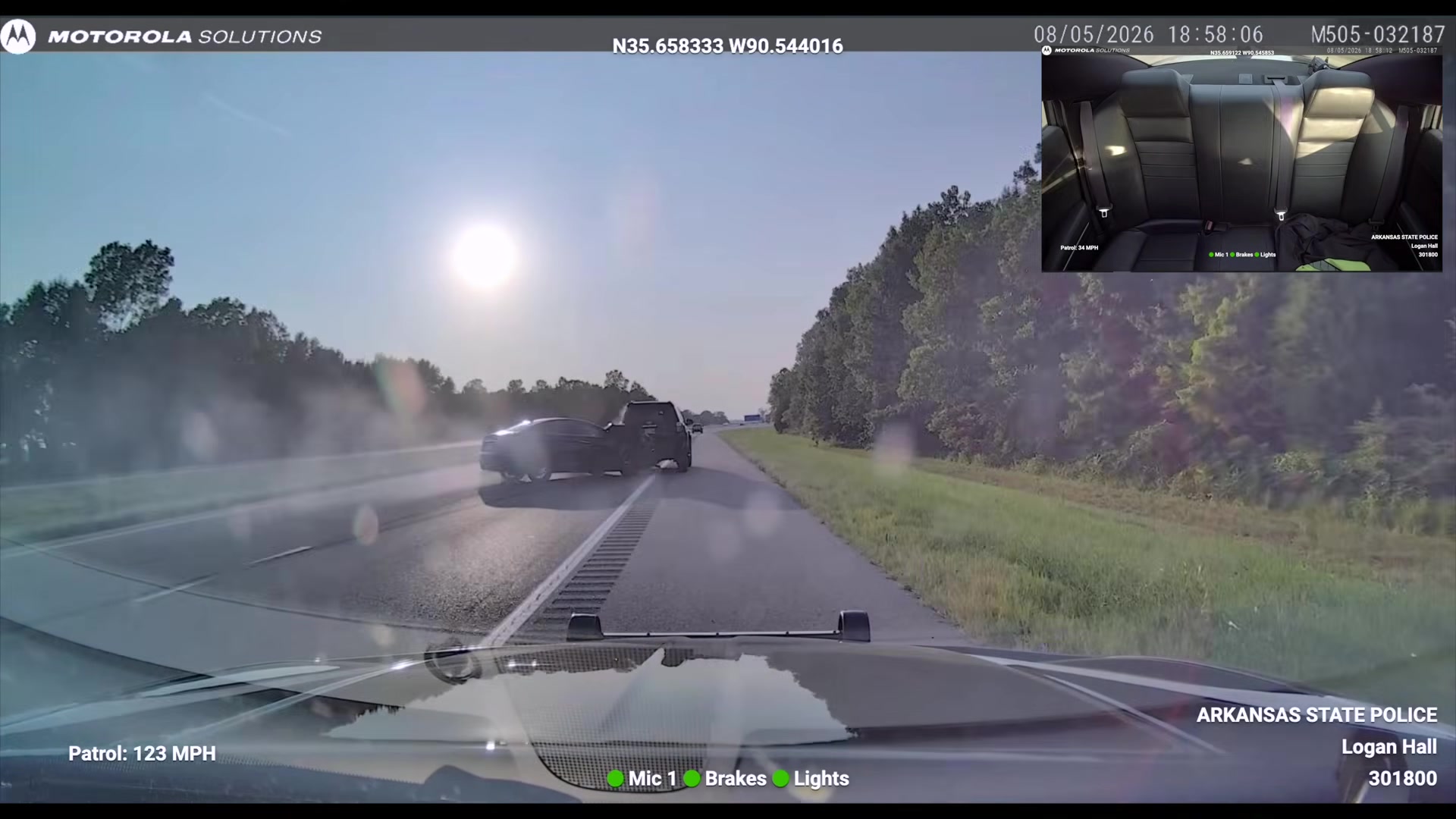
A genuine frame from the supplied dashcam shows the Sonata already sideways.
The patrol car has slowed sharply.
A dark SUV is directly ahead of the spinning Hyundai.
The geometry of the crash is visible before impact is complete.
This frame captures the central problem of any pursuit intervention around traffic: the fleeing vehicle does not stop in place. Its momentum has to go somewhere.
The Innocent SUV Is Hit
Arkansas State Police said Hamilton's car collided with a third vehicle.
That SUV then overturned on the east side of I-555.
The occupants were a 68-year-old woman and a 73-year-old man.
Neither was involved in the pursuit.
Both suffered serious injuries.
They were transported to Regional One Medical Center in Memphis, a major trauma hospital.
The crash therefore transformed a police pursuit involving one fleeing driver into an emergency affecting people who had simply been traveling on the same interstate.
Why the Bystanders Change the Story
If the TVI had ended with only the fleeing Hyundai spinning into an empty shoulder, the incident would likely have been viewed primarily as another dramatic Arkansas pursuit.
The injured couple changes the focus.
Now the central question is not merely whether police caught the fleeing driver.
It is how the pursuit and intervention affected people who never chose to participate.
That distinction is why the video generated such intense public discussion after its release.
The Injuries Were Reported as Serious
ASP described the injuries to both occupants of the third vehicle as serious.
Some secondary reporting described the SUV as rolling off the highway after the collision.
The official information confirms that both occupants required transport to Regional One Medical Center in Memphis.
Their names were not included in the ASP information relied upon for this article, so they are not identified here.
Keeping them unnamed also avoids turning injured bystanders into public figures simply because they were caught in a pursuit crash.
Hamilton Is Taken for Medical Evaluation
Hamilton survived the collision.
Arkansas State Police said he was transported to NEA Baptist Memorial Hospital in Jonesboro for evaluation.
That step reflects the violence of the crash.
Even when a driver appears capable of speaking or moving after a high-speed collision, significant injuries can be hidden.
Medical evaluation comes before the detention process is completed.
A Search of the Hyundai Adds New Allegations
After the crash, Arkansas State Police reported that a search of Hamilton's vehicle resulted in the recovery of suspected narcotics.
The agency described the items as illegal marijuana, pills and an unknown liquid substance.
Those discoveries expanded the case beyond fleeing and hazardous driving.
They also led to controlled-substance allegations announced by police.
As always, an allegation or police-reported recovery is not the same as a final conviction.
The Charges Announced by Arkansas State Police
ASP said Hamilton was being held at the Poinsett County Detention Center on multiple charges.
They included felony fleeing, second-degree battery, criminal mischief, possession with purpose to deliver a controlled substance, possession of a controlled substance, hazardous driving and driving while intoxicated.
Those are charges, not a final judgment.
A criminal case can change as prosecutors review evidence and as proceedings move through court.
This article therefore describes them as charges announced by police rather than established convictions.
Why Second-Degree Battery Appears in a Pursuit Case
To a casual viewer, a battery charge may seem surprising because the dashcam does not show Hamilton physically attacking the occupants of the SUV.
But criminal liability can extend beyond direct physical contact depending on the statute and the facts alleged by prosecutors.
The police announcement included second-degree battery among Hamilton's charges following the crash that seriously injured the two bystanders.
The exact legal theory and final disposition would require court records.
It should not be guessed from the video alone.
The Trooper's Name Is Visible in the Recording
The dashcam identifies the trooper as Logan Hall.
NEA Report refers to him as Corporal Logan Hall in its account of the incident report.
The visual overlay and reporting therefore reinforce one another.
Hall's role is not inferred from a social-media caption.
It is recorded directly by the police camera system and documented in reporting based on the official incident report.
The Video Preserves More Than the Collision
The full footage runs far longer than the few seconds that circulated widely online.
It records the initial driving, pursuit, intervention and aftermath.
After the crash, the roadway becomes a complex emergency scene.
There are damaged vehicles, injured people, debris and additional traffic approaching from behind.
Officers have to shift instantly from pursuit mode to rescue, arrest and traffic control.
A Secondary Crash Risk Develops Behind the Scene
Highway crashes can create additional collisions even after the first vehicles stop moving.
Drivers approaching at interstate speed may not understand what has happened until they are close to stopped traffic.
Emergency vehicles and police units can further change lane patterns.
The supplied footage shows the aftermath expanding beyond the original two vehicles.
This is one reason major interstate crashes often require rapid traffic control as well as medical response.
The Pursuit Had Covered Only a Few Miles
The initial stop began around the 23 or 24 mile marker.
The TVI occurred as the chase approached the 28 mile marker.
That means the most dangerous portion of the pursuit unfolded over only a few miles.
At 130 mph, those miles disappear quickly.
A vehicle traveling at that speed covers four miles in less than two minutes.
The short distance helps explain how rapidly the situation moved from a speeding observation to a major injury crash.
The Video Raises a Difficult Policy Question
The hardest question is not whether Hamilton should have stopped.
He should have complied with the traffic stop, and Arkansas State Police attributes the pursuit to his refusal to do so.
The more difficult policy question concerns how police should respond once a fleeing vehicle is already traveling around 130 mph.
Allowing the chase to continue carries enormous risk.
Using a physical intervention also carries enormous risk.
The presence of other motorists makes the decision even harder.
Police1 Highlights the Bystander Consequences
Police1's coverage focused directly on the pursuit-ending maneuver and the injuries to the uninvolved SUV occupants.
Its report described the case as a PIT of a fleeing suspect traveling around 130 mph that resulted in the bystander vehicle overturning.
That framing reflects why the footage attracted attention within law-enforcement circles as well as among the general public.
The incident is not simply a dramatic arrest video.
It is a case study in the consequences of pursuit-ending force at extreme speed.
Public Reaction Focused on the Speed of the TVI
Online discussion quickly centered on whether a TVI should have been attempted at such a high speed and with another vehicle nearby.
Those reactions are opinions, not findings of misconduct.
The official Arkansas State Police release available for this article did not announce discipline against Hall or state that the maneuver violated policy.
It would therefore be inaccurate to declare the intervention unauthorized solely because commenters criticized it.
What can be said is that the speed and presence of bystanders made the maneuver controversial.
The Fleeing Driver's Conduct Remains Central
The controversy surrounding the intervention should not erase Hamilton's alleged conduct.
Police say he refused to stop and accelerated to approximately 130 mph.
A driver fleeing at that speed creates an immediate threat independent of police tactics.
Every vehicle passed becomes a potential collision.
Every lane change carries heightened risk.
The pursuit existed because the driver did not stop.
The later debate concerns how police chose to end the danger he was creating.
The Bystanders Had No Control Over Either Decision
The elderly couple had no control over Hamilton's decision to flee.
They also had no control over the timing of the police intervention.
They were simply traveling on the interstate when the spinning Hyundai entered their path.
That is why their injuries are the emotional center of the story.
Police pursuits are often discussed as a confrontation between suspect and officer.
In reality, ordinary road users can bear the consequences of decisions made by both.
What the Dashcam Shows at 132 MPH
The first embedded image in this article is not a reconstruction or an AI illustration.
It is a frame extracted directly from the supplied Arkansas State Police dashcam.
The overlay reads 132 MPH.
The Hyundai Sonata is immediately ahead.
The afternoon sun is low.
The road stretches forward through rural Arkansas.
That single frame communicates the scale of the risk more effectively than any exaggerated headline.
What the Second Frame Shows
The second embedded frame captures the pursuit at the point where the Sonata has begun rotating.
Another vehicle is directly in its path.
Hall's patrol car is braking.
The roadway that looked open seconds earlier is suddenly occupied by multiple vehicles moving in conflicting directions.
This is the instant when the chase stops being a two-car pursuit and becomes a multi-vehicle crash.
Why Authentic Frames Matter
Police pursuit stories are especially vulnerable to misleading thumbnails and unrelated crash photographs.
A generic rollover image can make an article look more dramatic while quietly disconnecting it from the actual incident.
Using genuine frames avoids that problem.
Readers see the real Hyundai, the real roadway, the real patrol overlay and the real positioning immediately before the collision.
No AI-generated imagery is needed because the dashcam already documents the event in detail.
The Most Reliable Timeline
At approximately 6:56 p.m. on Wednesday, August 5, 2026, Corporal Logan Hall attempted to stop a Hyundai Sonata traveling north on I-555 near the 23 to 24 mile marker after clocking it around 90 mph in a 75 mph zone.
The driver, identified by ASP as Laloyd L. Hamilton III, 32, failed to stop.
The Hyundai accelerated and the pursuit reached approximately 130 mph.
Near the 28 mile marker outside Trumann, Hall performed a Tactical Vehicle Intervention.
The Sonata rotated and collided with an uninvolved SUV.
The SUV overturned off the roadway.
Its 68-year-old female occupant and 73-year-old male occupant suffered serious injuries and were transported to Regional One Medical Center in Memphis.
Hamilton was transported to NEA Baptist Memorial Hospital in Jonesboro for evaluation.
Police reported finding marijuana, pills and an unknown liquid substance in his vehicle.
ASP announced multiple charges, including felony fleeing, second-degree battery, criminal mischief, controlled-substance offenses, hazardous driving and DWI.
The agency said the investigation was ongoing.
A Few Seconds Redefined the Entire Pursuit
Before the intervention, the story is about a driver refusing to stop at extreme speed.
After the intervention, it becomes a story about injured bystanders.
That shift happens almost instantly.
The dashcam makes the transition difficult to ignore.
Hall moves alongside the Hyundai.
The car begins rotating.
The SUV appears.
Impact follows.
There is no long pause in which anyone can reconsider the decision.
At highway speed, cause and consequence are separated by fractions of a second.
The Case Is a Reminder About Pursuit Risk
Every pursuit policy attempts to solve an impossible problem: how to stop someone who refuses to stop without creating even greater danger.
Technology can help.
Helicopters, GPS tracking devices and coordinated units can sometimes reduce the need for direct pursuit.
But those options are not always available.
Officers still have to make decisions with the information and resources they have in real time.
The Trumann crash demonstrates why those decisions receive such scrutiny afterward.
The Investigation Was Still Ongoing
Arkansas State Police said the investigation was ongoing when it announced Hamilton's arrest and charges.
That wording matters.
The initial press release is not necessarily the final word on the crash.
Medical outcomes can change.
Charges can be amended.
Internal review can examine the pursuit.
Civil litigation can raise separate questions.
This article therefore avoids predicting what later proceedings will conclude.
The Human Cost Is Larger Than the Arrest
From a law-enforcement perspective, the pursuit ended with the fleeing driver in custody.
From the perspective of the injured couple, the same event ended in a trauma hospital.
Those two realities exist at the same time.
A successful apprehension does not erase collateral harm.
And collateral harm does not erase the fleeing driver's responsibility for initiating a 130 mph pursuit.
Understanding the incident requires holding both facts together rather than reducing the video to a simple hero-or-villain narrative.
Why This Footage Keeps Viewers Watching
The video has a natural escalation that requires no artificial drama.
A speeding car appears.
The trooper turns around.
The driver refuses to stop.
The speed rises.
The cruiser reaches 132 mph.
The trooper closes the distance.
A TVI begins.
Another vehicle suddenly enters the consequences of the maneuver.
The SUV overturns.
Then the chase gives way to emergency response.
Each stage changes the stakes, which is why the footage remains compelling even after the viewer knows how it ends.
The Larger Lesson
The August 5 pursuit near Trumann shows how little separation exists between enforcement, pursuit and disaster at extreme speed.
Hamilton's alleged decision to flee created the original danger.
Hall's decision to use a TVI was intended to end that danger.
The resulting collision seriously injured two people who had no connection to the stop.
All three facts are necessary to understand the case.
Removing any one of them produces an incomplete story.
The dashcam's value is that it forces viewers to confront the sequence as it actually happened.
Watch the Full Pursuit
The complete Arkansas State Police footage shows far more than the impact that circulated online. It documents the approach, the acceleration, the closing distance, the TVI and the immediate aftermath on I-555.
Watch the patrol-speed overlay and the traffic ahead as Hall moves into position. The final seconds demonstrate how quickly a 130 mph pursuit can spread beyond the fleeing driver and the officer trying to stop him.
Comments (0)
Loading comments...
May You Like

Entitled Driver Learns Why You Must Obey Lawful Orders During Traffic Stop

Traffic Stop Turns Deadly After Man Steps Out of Stolen Car

A Suspicious Vehicle Leads Officers Into an Unexpected Chase












