
After Customer Makes Threats, Store Owner Left Terrified
Store Owner Calls Police After Customer's Threats Turn a Routine Day Into a Tense Investigation
A FEW WORDS WERE ENOUGH TO CHANGE THE ENTIRE AFTERNOON
A normal afternoon inside a neighborhood store can feel predictable.
Customers enter. Someone grabs a drink. Another person pays at the counter. Cars move through the parking lot outside. For the person working behind the register, most encounters disappear from memory almost as quickly as they happen.
But on August 6, 2024, one interaction at a business in Ferndale, Michigan, apparently crossed a line.
By the time police arrived, the customer involved was gone and the woman behind the counter was left explaining why the encounter had frightened her enough to ask law enforcement for help.
The body-worn-camera footage does not open with a dramatic chase or officers rushing toward an immediate physical confrontation. Instead, it begins with something quieter and, in many ways, more difficult for police to evaluate: a frightened person's account of something that had already happened.
That creates the central question running through the entire encounter.
What did the customer actually say, how serious was it, and what should police do about it?
The answer would require officers to move beyond the store, locate the man connected to the complaint and hear his side of the story.
And that is exactly what they did.
INSIDE THE STORE, POLICE HAVE ONLY ONE SIDE OF THE STORY
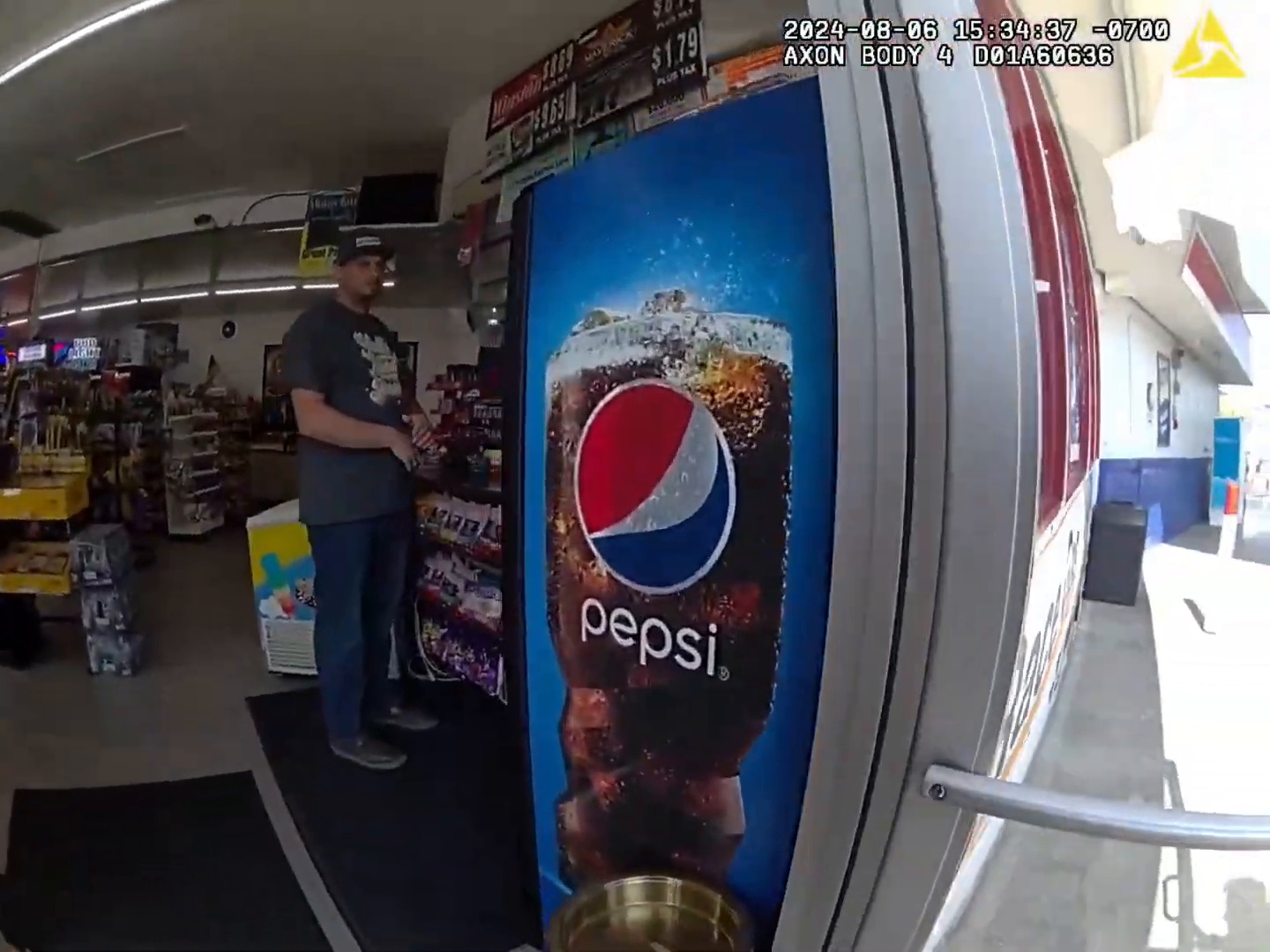
The first major portion of the footage takes place inside the business.
An officer enters and begins speaking with the woman working behind the counter. The environment could hardly look more ordinary: refrigerators, merchandise, advertisements and products surround them.
Yet the conversation taking place in the middle of that familiar setting is anything but routine for the woman involved.
She describes the earlier interaction and attempts to explain why the customer's statements concerned her.
For responding officers, this is the first crucial stage of the investigation.
They were not present when the alleged comments were made.
They did not hear the original conversation.
They cannot simply rewind the encounter in their own memory.
Instead, they have to reconstruct it.
That means listening carefully and separating what the witness directly remembers from what she interpreted or feared might happen next.
This is one reason the footage spends considerable time inside the store. To a viewer expecting instant action, several minutes of conversation may appear uneventful.
Investigatively, however, those minutes matter.
Officers need to understand the sequence.
Was there an argument before the alleged threat?
What triggered it?
What exactly did the customer say?
How did he behave while saying it?
Did he make any physical gestures?
Did he possess or display anything that made the statement more alarming?
Did he indicate that he intended to return?
Could another employee or customer corroborate what happened?
Was surveillance footage available?
Those questions can determine whether officers are dealing with an unpleasant argument, suspicious behavior or something potentially more serious.
The woman's account therefore becomes the foundation on which everything else is built.
THE WOMAN CONTINUES EXPLAINING WHAT HAPPENED
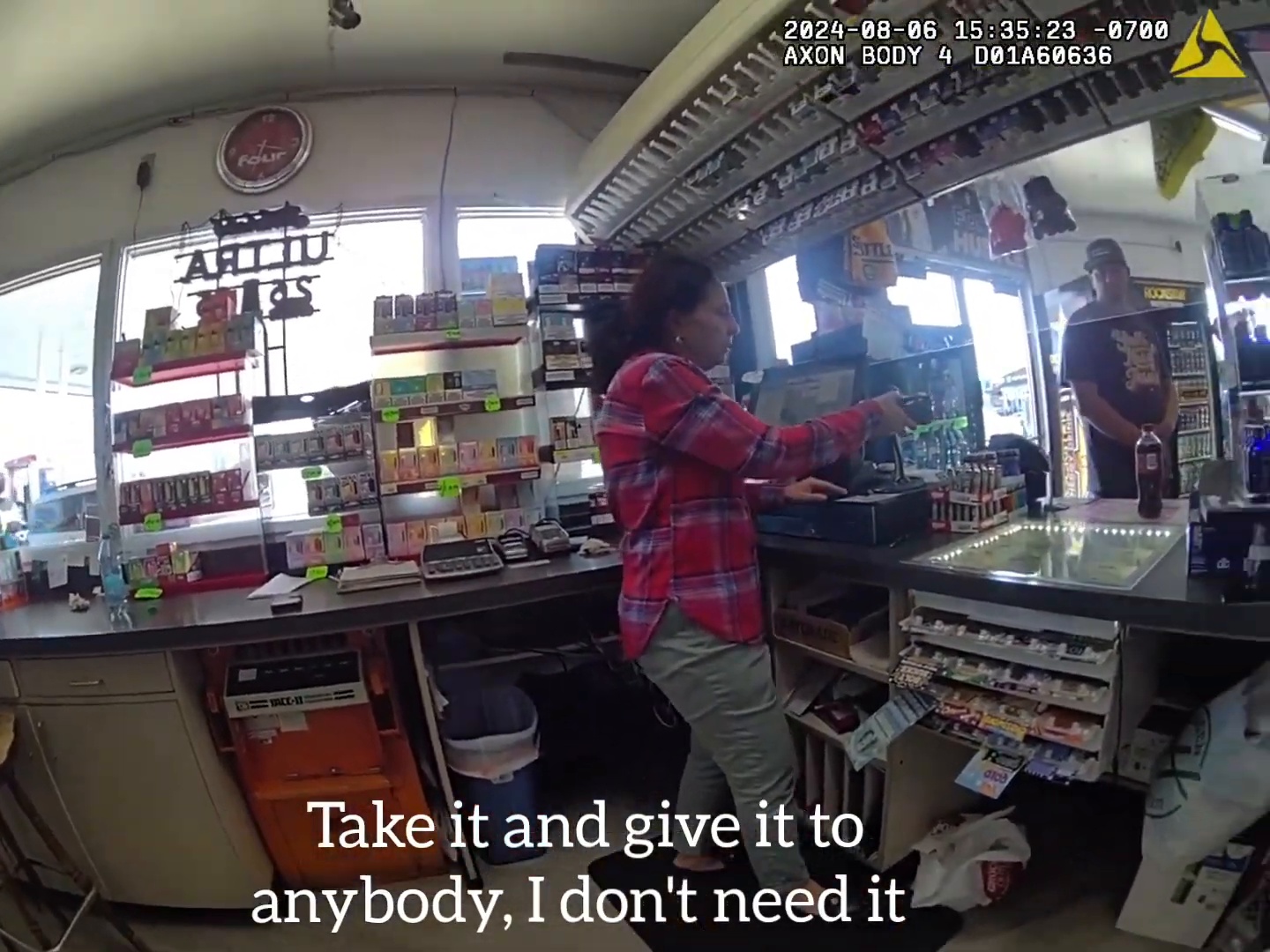 As the conversation continues, the footage provides something that a written police summary rarely captures as effectively: the atmosphere surrounding the complaint.
The woman remains behind the counter as officers listen.
There is no immediate emergency unfolding around them. Customers are not running from the building. No suspect is standing outside confronting officers.
The threat, if accurately reported, exists largely in what happened before police arrived and in the possibility of what might happen afterward.
That distinction makes this type of call challenging.
Police officers routinely respond to incidents in which the most important event occurred minutes or hours earlier. By the time they arrive, the scene may look completely peaceful.
The question is whether that calm represents the end of the problem or merely an interval before something else happens.
Body-worn cameras are particularly valuable in situations like this because they preserve the initial account close to the time of the event.
Ferndale Police began rolling out body cameras to patrol officers in 2018. Contemporary reporting said the city had approved 30 body cameras as well as upgrades to in-car video systems, with the department emphasizing officer training and privacy/redaction procedures during implementation.
That technological context matters here.
The camera is not merely recording an arrest.
It is documenting how the investigation develops from its earliest stage.
WHY THREAT COMPLAINTS ARE NOT ALWAYS SIMPLE
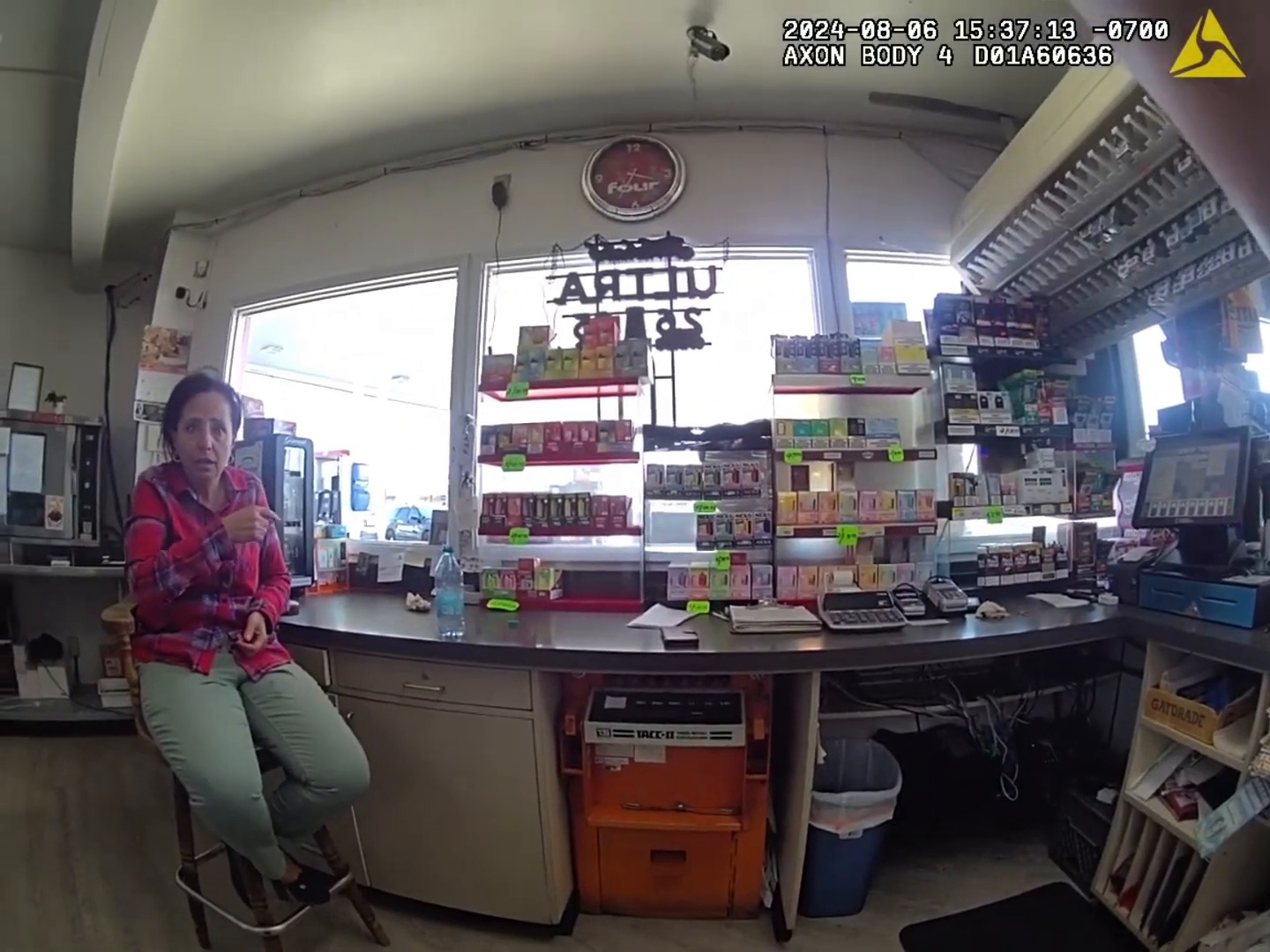
The easiest version of this story would be to reduce it to a few words:
Customer makes threat. Store employee calls police. Police find customer.
But the footage demonstrates why real investigations are rarely that simple.
Words depend heavily on context.
A statement that sounds threatening when isolated from the surrounding conversation may carry a different meaning in context. Conversely, a seemingly vague statement can become far more alarming when accompanied by aggressive behavior, gestures or previous interactions.
Officers therefore cannot responsibly decide what happened from a headline alone.
They have to investigate.
And viewers should approach bodycam footage with the same discipline.
One person's allegation is important evidence, but it is still an allegation until officers gather more information.
Likewise, a suspect's denial does not automatically disprove a complainant's account.
The challenge is comparing the evidence.
That can include witness statements, surveillance recordings, bodycam footage, dispatch information and later police reports.
The Ferndale footage allows us to watch the earliest part of that process.
The woman speaks.
Officers listen.
Questions follow.
Then the investigation leaves the store.
That transition is where the incident changes considerably.
THE INVESTIGATION MOVES OUTSIDE
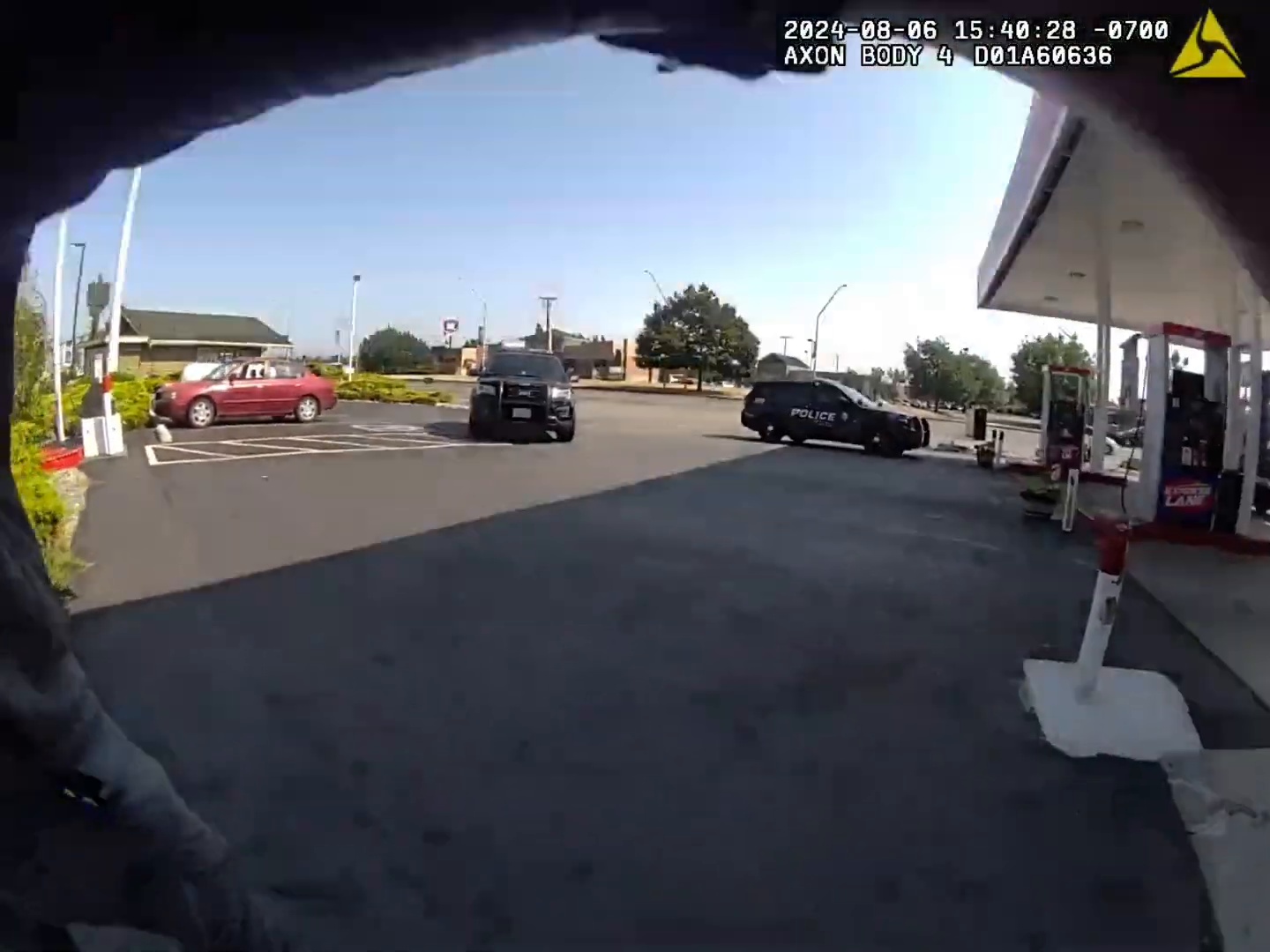
Once officers have gathered enough information from the woman, the investigation moves beyond the counter.
The bodycam emerges into bright daylight.
Police vehicles are visible outside the business, and officers begin working through the next problem: finding the person connected to the complaint.
Until this point, almost everything officers know has come from the store.
Locating the other person changes that.
Police can now compare accounts rather than relying on a single narrative.
This is also where bodycam footage becomes especially useful to viewers.
Instead of jumping from a complainant's statement directly to an arrest, the longer recording shows the investigative steps between those moments.
That distinction matters.
Online police videos are frequently condensed into short clips designed around the most dramatic 20 or 30 seconds. Those edits may be entertaining, but they can remove the very information needed to understand why officers acted as they did.
Here, the slower progression tells the story.
Police first establish what allegedly happened.
Then they search.
Then they locate a man.
Only afterward can they begin asking him questions.
There is no need to manufacture additional drama because the uncertainty itself creates tension.
Will his account match what officers just heard inside the store?
OFFICERS LOCATE THE MAN CONNECTED TO THE COMPLAINT
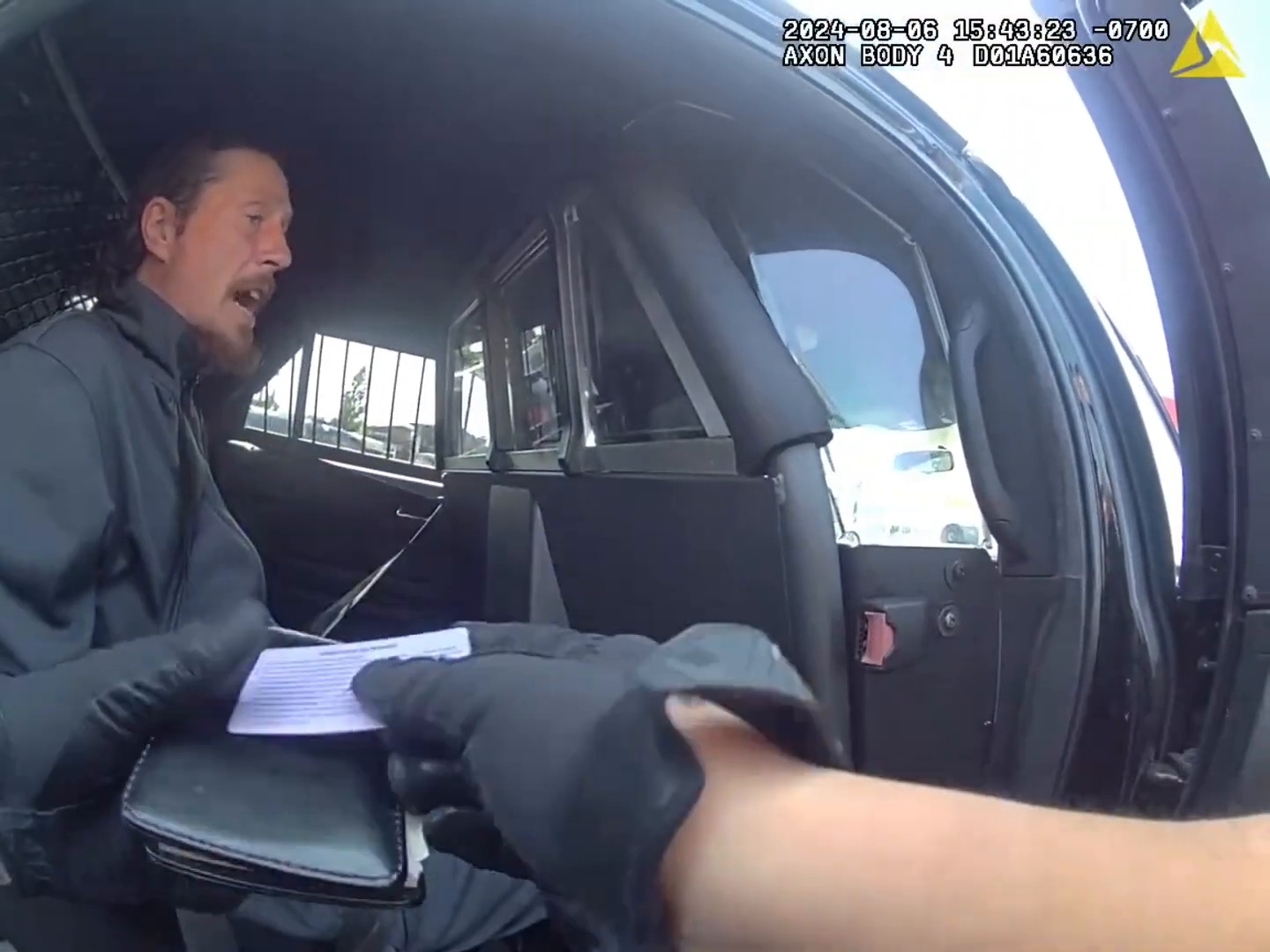
Eventually, the footage shows a man seated in the back of a patrol vehicle.
The encounter has now entered a completely different stage.
For the first time, officers have access to both sides of the dispute.
The man speaks with them from the rear seat as they continue trying to determine what occurred.
This is arguably the most important transition in the entire video.
During the first half, viewers naturally experience the incident through the store employee's perspective because hers is the only account available.
Once police contact the man, that changes.
Now investigators have to compare two versions.
People involved in confrontations frequently remember them differently.
One person may believe a statement was clearly threatening.
The other may describe it as anger, sarcasm or words taken out of context.
Neither interpretation should automatically be presented as proven fact merely because it appears first in a video.
That is why police interviews matter.
Officers can test details.
They can ask the same question in different ways.
They can compare timelines.
They can look for contradictions.
They can ask whether there was previous contact between the parties.
And, where available, they can compare both accounts against independent evidence such as store surveillance.
The footage captures part of that process rather than simply showing its outcome.
A CONTROLLED ENCOUNTER RATHER THAN A CHAOTIC ARREST
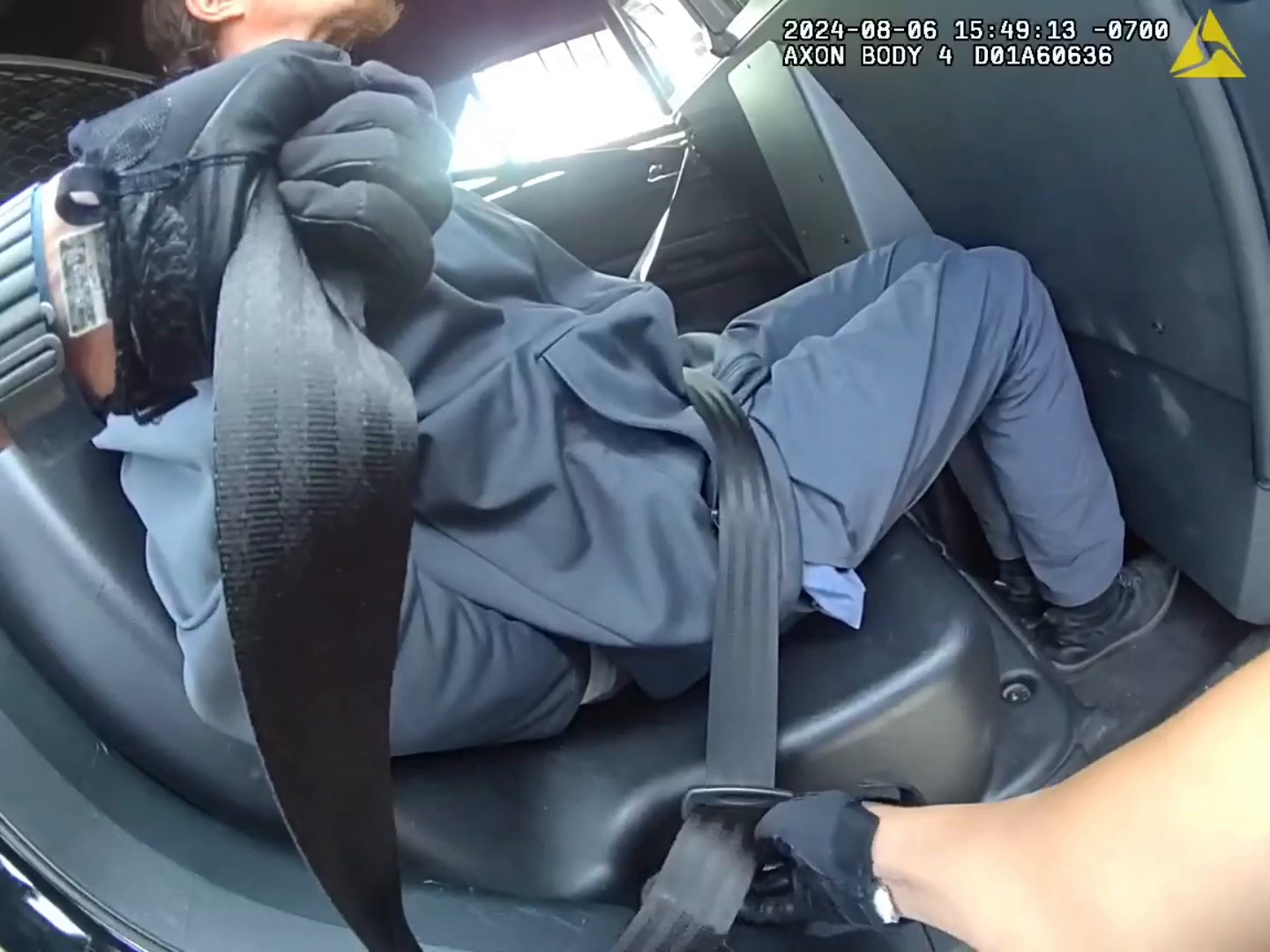
Another interesting feature of this case is how controlled the police contact remains.
Many bodycam videos become widely viewed because something suddenly goes wrong: a suspect runs, a struggle begins, officers draw weapons or a routine traffic stop becomes a pursuit.
This video derives its tension from something different.
Uncertainty.
Officers have received a concerning allegation. They have located the person connected to it. Now they have to decide what the evidence supports.
The man remains inside the patrol vehicle while officers continue dealing with the situation.
This gives viewers time to observe an aspect of policing that receives less attention than dramatic pursuits or use-of-force incidents.
A significant amount of police work involves information management rather than physical confrontation.
Officers arrive with incomplete information.
Dispatch gives them one version.
A complainant expands upon it.
Witnesses may add something else.
The person accused may offer an entirely different explanation.
Surveillance video might contradict one account or confirm another.
The officer's task is to put those pieces together.
Bodycam footage can reveal that process unusually clearly because the camera follows the officer between each stage.
WHY THE BODYCAM RECORD MATTERS
Ferndale's adoption of body-worn cameras predates this incident by several years.
When the program was initially rolled out, local reporting noted that the department wanted officers trained not only in using the cameras but also in handling the sensitive information those recordings can capture.
This incident illustrates why those recordings can be valuable even when there is no spectacular use of force.
A body camera can document:
the initial condition of the scene,
the complainant's first statements,
the questions officers asked,
the search for another involved person,
the subsequent police contact,
and the demeanor of everyone involved.
Those details can later become important if accounts change.
They can also provide supervisors, attorneys or courts with a contemporaneous record of what officers themselves saw and heard.
But bodycam footage also has limitations.
The camera does not necessarily record what happened before police arrived.
It does not automatically reveal what someone was thinking.
It may not show everything occurring outside the camera's field of view.
And an edited release may omit portions of a much longer investigation.
For those reasons, bodycam footage should be treated as an important piece of evidence rather than an all-knowing narrator.
THE FINAL STAGES OF THE POLICE RESPONSE
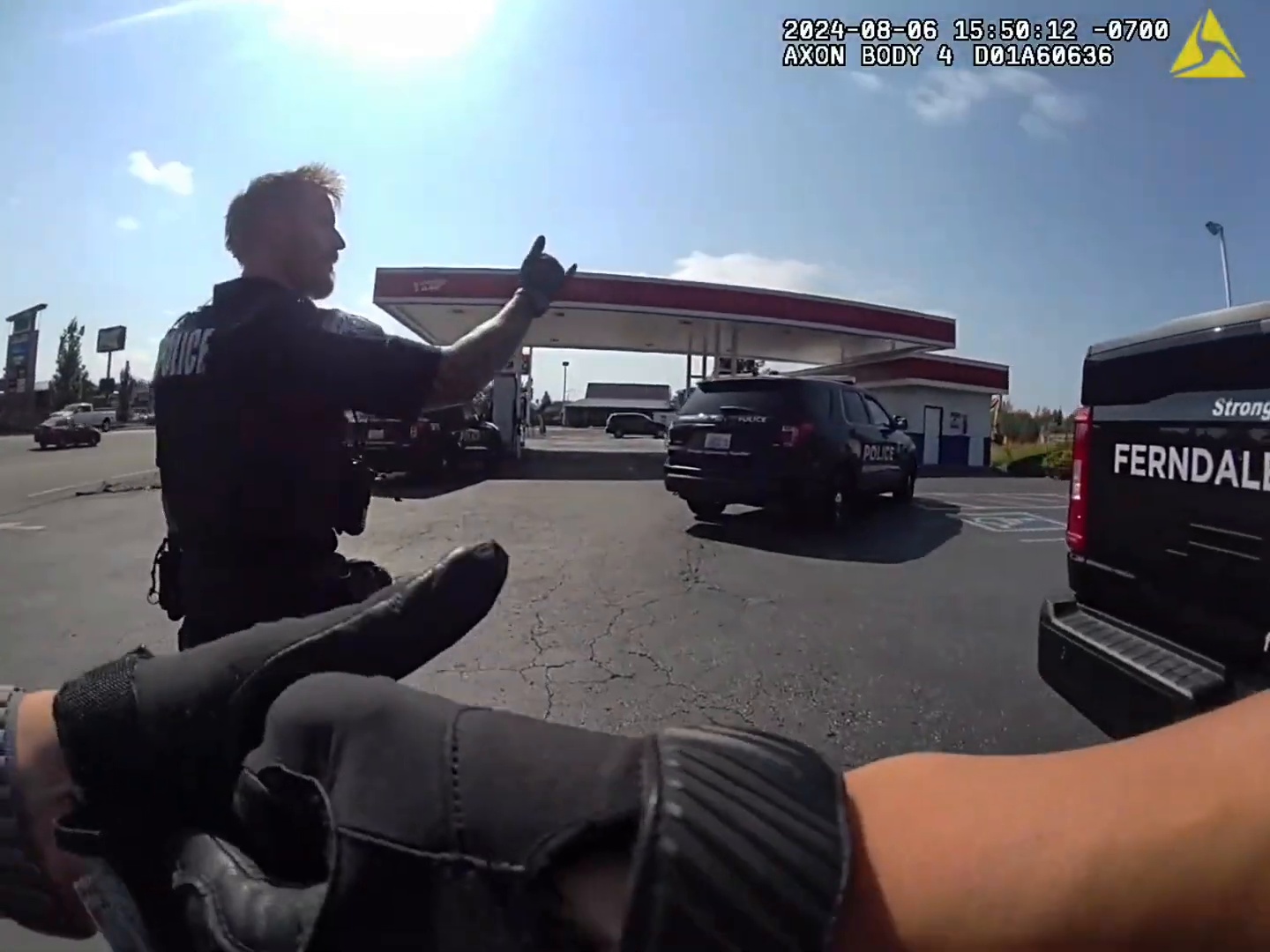
Toward the later portion of the video, the police presence outside the business is clearly visible.
The scene remains under control.
What began as a conversation behind a convenience-store counter has now resulted in multiple investigative steps and direct police contact with the person officers were looking for.
Yet this is also where responsible reporting becomes particularly important.
My search of Ferndale's publicly indexed 2024 city news around August 6 did not uncover an official city release describing this specific incident, even though the city's archive contains other municipal notices from the same period.
Therefore, details not independently established by the footage or a reliable public record should not be invented.
That includes the man's name.
It includes any specific criminal charge unless documented.
And it includes the ultimate disposition of the case.
Being placed in a patrol vehicle is not the same thing as being convicted of a crime.
Being accused is not the same thing as being found guilty.
Those distinctions matter, particularly when publishing an article that may remain online long after the original video disappears from social-media feeds.
WHAT THIS ENCOUNTER REALLY SHOWS
The most compelling lesson from this Ferndale encounter is not that every argument inside a store leads to an arrest.
It is almost the opposite.
The footage demonstrates how police must determine whether an argument has crossed a line requiring further action.
When officers first walk into the business, they do not possess a complete story.
They have a concerned woman and her account.
Minutes later, they have more details.
Later still, they are outside searching.
Eventually they locate the man and obtain another perspective.
The information changes at every stage.
That gradual evolution is what makes the full footage more revealing than a short viral clip.
The story is not contained in one explosive moment.
THE STORY IS THE PROCESS OF FINDING OUT WHAT HAPPENED.
For business owners and employees, the encounter also illustrates the importance of documenting troubling incidents quickly.
Surveillance video should be preserved where possible.
Witness information can be important.
Exact words are more useful than broad summaries.
The time of the encounter can help investigators locate additional video.
Descriptions of clothing, vehicles and direction of travel can help officers locate someone after they leave.
And if a worker genuinely believes an immediate threat exists, contacting law enforcement rather than personally pursuing the individual can reduce the risk of further escalation.
FROM AN ORDINARY STORE COUNTER TO A POLICE INVESTIGATION
Nothing about the physical setting initially suggests that viewers are about to watch a police investigation.
That is precisely why the footage works as a story.
The environment is ordinary.
The consequences are not.
One interaction between two people apparently became serious enough that police were summoned.
The officers then had to turn a frightened account into an investigation.
They listened.
They asked questions.
They left the store.
They located the person they were looking for.
They questioned him.
And throughout the encounter, the body-worn cameras preserved the process.
The incident also demonstrates why long-form bodycam footage deserves more careful interpretation than the fragments frequently shared online.
Real investigations contain pauses.
They contain uncertainty.
They contain conflicting accounts.
Sometimes the most important moment is not an arrest or confrontation. It is the moment an officer hears a second version of the story and realizes the situation may be more complicated than it initially appeared.
That is what keeps this encounter interesting.
The viewer begins in exactly the same informational position as the responding officers.
We hear the complaint first.
Then we follow the investigation.
Only later do we reach the other person involved.
By structuring the story in that same order, the footage naturally creates a question that carries the audience from beginning to end:
What actually happened before police walked through that store's door?
Without the complete underlying police and court records, the responsible answer is not to pretend we know more than the evidence establishes.
What we can see is the response.
And that response provides a revealing look at how an apparently ordinary customer dispute can become a police investigation within minutes.
WATCH THE FULL ENCOUNTER
The opening complaint tells only one part of the story. The real turning point comes when officers leave the store, locate the man connected to the incident and finally get the opportunity to compare what they have been told with his account.
For anyone interested in how officers move from an initial allegation to an investigative decision, the complete footage provides far more context than a short highlight ever could.
Follow the encounter from the first conversation behind the counter to the final police contact and decide for yourself which details matter most.
Click here to watch the full incident unfold and see what happened after officers began searching for the customer: https://www.youtube.com/watch?v=tejkptOIpZ0
Comments (0)
Loading comments...
May You Like

Cops Arrive for a Medical Emergency and Walk Into Drunken Chaos

💨 High-Speed Police Pursuits Caught on Dashcam | Intense Moments Across the USA 🇺🇸

Neighborhood Grocery Store Suddenly Erupts Into Chaos














