
A Heart-Pounding Chase: Fleeing From The Police And The Final Capture.
Georgia State Patrol Pursuit Ends With a Black Coupe Crashed in the Woods
A black two-door coupe moves down a Georgia highway in the warm light of late afternoon. From the dash camera of a patrol vehicle, the first seconds do not look especially dramatic. Traffic is flowing, the road is wide, and the car ahead appears stable. Then the distance closes. The coupe stays in front of the trooper instead of yielding, and an ordinary stretch of highway becomes the opening stage of a pursuit.
The supplied footage is clearly connected to Georgia law enforcement. The lower-right portion of the video carries a Georgia-related watermark, while the camera position and patrol-vehicle hood are consistent with dash-camera footage circulated from Georgia State Patrol pursuits. The final supplied image shows the same dark coupe heavily damaged off the roadway in a wooded area, with officers standing nearby and smoke or dust rising from the wreck.
That beginning-to-end contrast is what makes the sequence compelling. The car starts upright and apparently under control on a broad divided highway. By the end, it is destroyed among the trees. The distance between those two images represents the central danger of a police pursuit: apparent control can disappear in seconds.
Research was conducted across Georgia Department of Public Safety material and contemporary Georgia news coverage, with particular attention to 2021 pursuits involving dark passenger cars. Publicly indexed sources confirm that Georgia State Patrol was conducting a very large number of pursuits during this period. A July 28, 2021 statement from the governor's office reported 226 pursuits by the Atlanta Crime Suppression Detail between April 9 and July 25 alone. However, the searches did not produce a report containing enough unique details to identify this exact black-coupe incident with confidence.
For that reason, this article does not invent the driver's name, the exact county, the initial violation, the speed reached, or the charges. The story below uses the footage for the incident-specific sequence and verified Georgia sources for broader context. That approach keeps the narrative engaging without turning a visually similar case into a false identification.
A Calm Highway Scene Hides What Is About to Happen
The first frame is deceptively peaceful. The highway runs through dense green forest. The evening sun is low enough to cast long shadows across the roadway. A dark two-door car travels ahead of the patrol vehicle while another motorist occupies the adjacent lane.
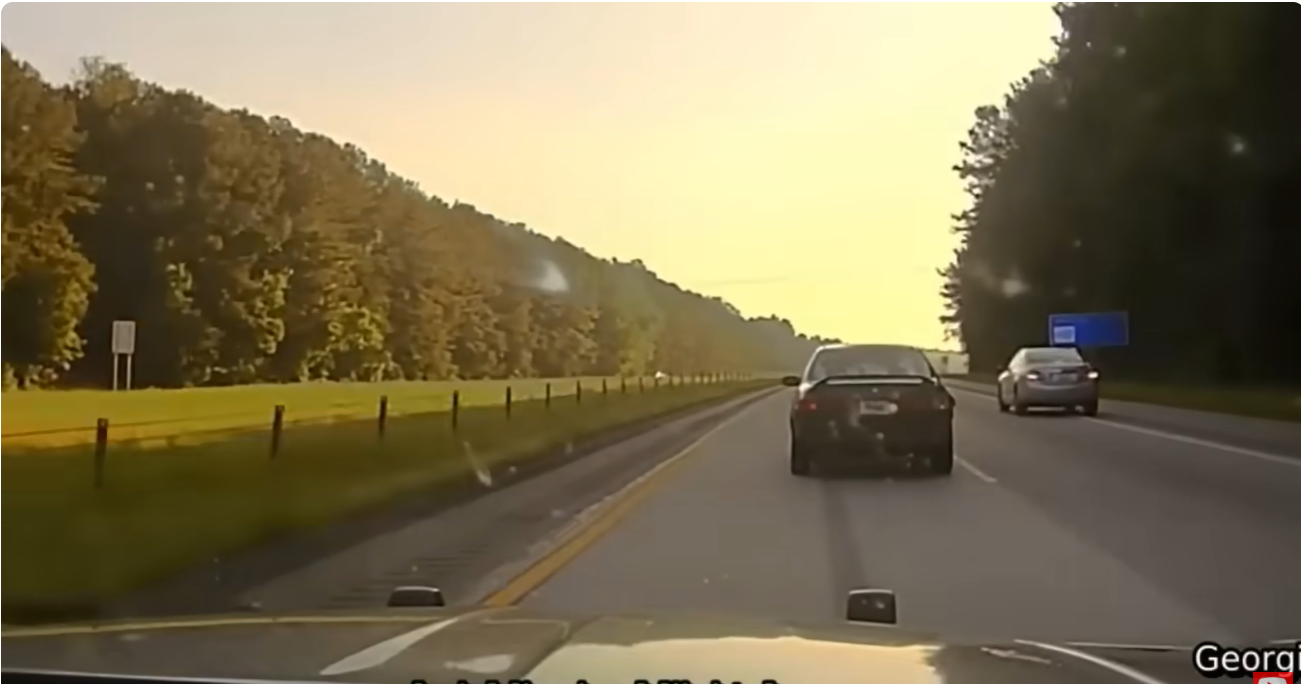
The fleeing car appears to be an older sport-oriented coupe with a rear spoiler. The available image is not clear enough to identify its exact model responsibly. Small styling details can be misleading in compressed video, particularly when glare, motion and distance obscure badges and taillights.
What matters more is its position. The patrol vehicle is directly behind it, close enough that the driver should be aware of the law-enforcement presence. The coupe continues forward.
There is no dramatic collision yet, no smoke and no wreckage. The tension comes from knowing that the driver is not stopping.
The Road Gives the Driver Room to Accelerate
A divided highway offers an escaping driver something a neighborhood street cannot: distance.
Long sightlines and multiple lanes allow a vehicle to build speed quickly. Intersections are fewer, and the road itself can create the illusion that the situation is manageable.
But speed dramatically reduces the time available to correct mistakes. At 70 mph, a vehicle covers more than 100 feet every second. At 100 mph, that distance rises to roughly 147 feet per second. A momentary steering error can therefore move a car across an entire lane before the driver has fully processed what is happening.
The pursuing trooper faces the same physics. The officer has to maintain visual contact without following so closely that a sudden brake application or spin leaves no escape route.
Georgia State Patrol Was Conducting Hundreds of Pursuits in 2021
The broader timing of the footage is important.
In April 2021, Georgia launched a multi-agency Atlanta Crime Suppression Detail that included the Georgia State Patrol and other state and local agencies. The effort targeted reckless driving, street racing and violent crime in the metro Atlanta area.
By July 25, according to an official state summary, the detail had conducted 7,950 vehicle stops, made 416 arrests and been involved in 226 pursuits. It had also stopped 150 reckless drivers and apprehended 116 wanted people.
Those figures do not identify the driver in this footage. They do show that the chase occurred during a period of unusually visible and intensive GSP enforcement activity.
The Black Coupe Becomes the Trooper's Only Moving Reference Point
As the patrol vehicle closes the gap, the dark coupe fills more of the frame.
The car's rear spoiler and compact profile make it easy to track against the pale roadway. The vehicle remains ahead as the highway bends gently through wooded terrain.
For the trooper, however, the coupe cannot become the only thing worth watching.
Other traffic remains present. A vehicle in the adjacent lane may suddenly move over after hearing a siren. A driver ahead may brake. An entrance ramp can introduce a car whose driver has no idea that a pursuit is approaching.
That divided attention is one of the most difficult parts of pursuit driving. The officer must monitor the suspect while continuously reading the entire road.
Why Pursuits Can Change Faster Than the Camera Suggests
Dash cameras make speed difficult to judge.
The camera is fixed to the patrol vehicle. The horizon remains relatively stable, and a wide-angle lens can make vehicles appear farther away. Smooth pavement can also make a very fast pursuit look almost calm.
Roadside objects provide better clues. Trees, signs, lane markings and other vehicles move through the frame more rapidly as speed increases.
The viewer can pause the recording and examine those clues. The trooper cannot.
Every decision must be made in real time.
A Pursuit Is Not Simply a Race
The goal of a police pursuit is not to win a contest of speed.
The objective is to bring a fleeing driver into custody while managing the danger created by the flight itself. Those two goals can conflict.
If officers push too aggressively, the suspect may drive even more recklessly. If they fall too far behind, the vehicle may escape and continue presenting a danger elsewhere.
That is why pursuit policies typically require continuous judgment about traffic, road conditions, the seriousness of the suspected offense and the behavior of the fleeing driver.
Georgia court cases and later investigative reporting have repeatedly focused on the broad discretion available to GSP troopers during pursuits and the risks associated with high-speed intervention tactics.
The Difference Between Following and Intervening
There are several ways a pursuit can end.
The driver may surrender voluntarily. The vehicle may run out of fuel or suffer a mechanical problem. Officers may coordinate tire-deflation devices. A driver may crash independently. Or an officer may use a vehicle-intervention technique when policy and conditions allow.
Georgia State Patrol is particularly associated with the Precision Immobilization Technique, commonly called PIT.
A PIT generally involves controlled contact near the rear quarter of a fleeing vehicle, causing it to rotate and lose forward momentum. The tactic can end a pursuit quickly, but it also introduces the possibility of a severe crash, especially at high speed or near fixed objects.
The Atlanta Journal-Constitution has reported that a substantial share of GSP PIT maneuvers in a five-year review occurred during pursuits with high average speeds, highlighting the debate surrounding the tactic.
What the Supplied Images Do Not Show
The final photograph clearly shows a catastrophic crash. It does not show what caused the car to leave the roadway.
That distinction is critical.
Without the uninterrupted footage or official pursuit report, it would be wrong to state that the trooper performed a PIT immediately before the crash. The coupe may have been contacted by police, or the driver may have lost control independently.
A single final frame cannot resolve that question.
Responsible reporting has to preserve that uncertainty rather than filling it with the most dramatic explanation.
The Highway Shoulder Is the Last Margin for Error
At high speed, a paved shoulder can briefly provide room for recovery. Beyond it, conditions change immediately.
Grass provides less predictable traction than pavement. A drainage slope can unsettle a vehicle. Trees, embankments and sign supports turn a loss of control into a much more serious event.
The wooded environment visible throughout this footage means the consequences of leaving the roadway are potentially severe.
Once a car reaches the tree line, there may be almost no open runoff area left.
The Final Scene Shows How Completely the Situation Changed
The third supplied image is the visual endpoint.
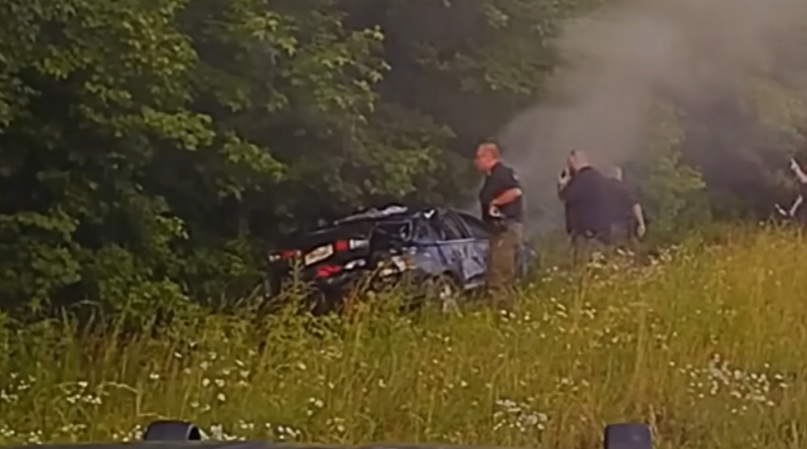
The black coupe is off the roadway among vegetation and trees. Its body is heavily damaged. The roofline and rear section appear distorted, and smoke or dust hangs above the vehicle. Several officers are standing nearby.
The clean silhouette visible on the highway has disappeared.
That contrast is the central story of the pursuit. A car that looked stable moments earlier is now a wreck.
Why Trees Make High-Speed Run-Off-Road Crashes So Dangerous
A modern car is engineered with structures designed to absorb crash energy, but those systems have limits.
Guardrails and many highway barriers are designed to redirect vehicles and spread impact forces. Trees are different. They are narrow, rigid objects that can concentrate crash energy into a small part of the vehicle.
If a car rotates before entering the woods, the impact may occur at the side or roof rather than the front, where many vehicles have their most substantial energy-management structures.
The damaged shape of the coupe demonstrates why leaving the pavement at pursuit speeds can have such serious consequences.
The Trooper's Job Changes the Moment the Car Stops
Once the suspect vehicle crashes, the pursuit phase is over.
The officer immediately becomes a crash responder.
The first questions change from “Where is the vehicle going?” to “Is anyone injured?” and “Is the scene safe?”
Officers also have to consider whether the driver or passengers may attempt to flee on foot. A damaged car can catch fire. Traffic behind the pursuit may create a secondary collision risk. Emergency medical personnel need a safe route into the scene.
Those responsibilities begin almost simultaneously.
Smoke Does Not Automatically Mean Fire
The final image contains a gray cloud above the wreck.
It is tempting to describe it as smoke from a vehicle fire, but the still image alone cannot establish that.
A crash can produce dust, steam from a damaged cooling system, vapor from fluids, smoke from tires or actual combustion.
Unless the complete footage clearly shows flames or an official report confirms a fire, the safest description is simply smoke, steam or dust rising from the damaged vehicle.
Small distinctions like this are important when reconstructing an incident from video.
Why the Exact Vehicle Model Is Left Unstated
The coupe has several recognizable styling cues: a dark body, rectangular taillight shapes, a prominent rear spoiler and a compact two-door profile.
Those features resemble several performance-oriented cars produced in the 1990s and early 2000s.
Compressed footage, however, can alter proportions and erase badges. Publishing a confident model identification without a readable emblem or corroborating report could send the research toward the wrong case.
The article therefore describes it only as a black or dark-colored coupe.
The Missing Police Report Is the Key to the Remaining Questions
Georgia Department of Public Safety maintains an official system for requesting crash, incident and citation records prepared by the Georgia State Patrol and other DPS divisions.
DPS also accepts open-records requests for incident reports, crash reports, photographs and related material.
An original report from this pursuit could answer nearly every question the footage leaves open: the date and time, exact route, trooper, suspect identity, reason for the attempted stop, pursuit speed, whether a PIT occurred, injuries, charges and final arrest details.
Without that report number or a uniquely identifiable location, however, attaching a public record to these images would require guesswork.
Why Similar News Stories Were Rejected
Several Georgia pursuit reports from 2021 initially appear promising.
In April 2021, for example, a Black Chrysler 300 fled GSP in Long County and was stopped by a PIT in Hinesville. The vehicle and crash location do not match these images.
On July 24, 2021, GSP pursued a red Chevrolet truck on Interstate 16 near Savannah and ended that chase with a PIT. Again, the vehicle does not match.
Another July 2021 Atlanta case involved a stolen vehicle that crashed into a utility pole and caught fire before three occupants fled on foot. Contemporary reports describe a different setting and sequence.
Rejecting near matches is just as important as finding a match.
The Pursuit Took Place During a Major Georgia Enforcement Push
The wider 2021 context is nevertheless relevant.
Georgia's Crime Suppression Detail was created in April of that year in response to concerns about reckless driving, street racing and violent crime around Atlanta.
Official state figures through July 25 show just how active the operation had become: nearly eight thousand vehicle stops and more than two hundred pursuits in a little over three months.
That enforcement environment helps explain why so much Georgia dash-camera pursuit footage exists from this period.
It does not establish that this particular chase was part of the Crime Suppression Detail, so the article does not make that claim.
The Camera Captures the Pursuit but Not the Driver's Motive
One of the easiest mistakes in police-video storytelling is to invent a reason someone fled.
A driver might run because of a warrant, a stolen vehicle, drugs, a suspended license, impairment or fear of arrest. But those possibilities are not interchangeable.
Nothing in the supplied stills tells us which, if any, applies here.
The footage proves the movement of the vehicle. It does not reveal the driver's thoughts.
That gap should remain a gap until a verified source fills it.
The Most Powerful Detail Is the Before-and-After Contrast
The first image contains order.
The coupe is centered in its lane. Traffic is flowing. The evening light makes the highway almost scenic.
The final image contains disorder.
The car is off the road. Its structure is damaged. Officers are gathered around it. The forest that formed a distant backdrop in the opening has become part of the crash scene.
This visual transformation creates a strong narrative without sensational language.
What Can Be Confirmed From the Footage
The pursuit takes place on a divided highway in Georgia.
A law-enforcement vehicle follows a dark two-door coupe with a rear spoiler.
Other civilian traffic is present during the pursuit.
The surrounding terrain is heavily wooded.
The pursuit ultimately ends with the coupe off the roadway in vegetation near the tree line.
The car sustains extensive visible damage.
Multiple officers are present at the final scene.
Those observations come directly from the supplied footage and do not depend on an external article.
What Has Not Been Reliably Confirmed
The driver's identity remains unverified.
The precise Georgia State Patrol post or trooper involved remains unverified from the supplied images.
The exact county and highway have not been established with enough confidence.
The reason for the original attempted stop is unknown.
The maximum pursuit speed is unknown.
The footage provided here does not establish whether a PIT or another form of vehicle contact occurred before the crash.
The injuries, charges and later court outcome have not been matched to a reliable public record.
Why Those Missing Details Do Not Weaken the Story
A factual account does not have to answer every question to hold attention.
In this case, uncertainty actually mirrors the experience of watching the footage.
The viewer sees the trooper close in but does not initially know why the driver is fleeing.
The road stretches ahead and the car appears stable.
The chase continues.
Then the final scene reveals the cost of losing control.
The unanswered questions create curiosity, while the visible evidence provides enough structure to keep the story grounded.
The Physics Do Not Care Why the Driver Fled
Whatever prompted the driver to continue, the physical risks are the same.
Speed increases stopping distance.
Sudden steering transfers weight.
Leaving pavement reduces predictable tire grip.
Fixed roadside objects do not move out of the way.
Once the coupe departed the highway, the driver's legal reason for fleeing no longer mattered to the laws of motion governing the crash.
That is one reason police pursuits can change from enforcement events into medical emergencies almost instantly.
The Final Image Is the Real Ending
Online pursuit clips often focus on the chase itself: acceleration, sirens, passing traffic and tactical maneuvers.
The final frame is more instructive.
The vehicle that refused to stop is no longer moving.
The trooper who spent the pursuit trying to catch it is now standing at a wreck scene.
Other officers have arrived.
What looked like a contest of speed has become an investigation.
A Story That Should Remain Grounded in What the Camera Shows
The strongest version of this incident is not one padded with an invented suspect history.
It is the sequence visible on camera.
A dark coupe continues down a Georgia highway with a trooper behind it.
The pursuit develops in ordinary traffic.
The roadway is bordered by dense woods.
Then the car leaves the highway and suffers devastating damage.
The ending explains why the opening matters.
What a Verified Report Could Add Later
If the matching Georgia DPS incident or crash report becomes available, the story can be expanded responsibly.
The report could identify the driver and trooper, explain the attempted stop, provide speeds and route information, document any PIT maneuver or contact, describe injuries and list the charges filed.
Those facts would deepen the article without changing the central visual narrative.
Until then, leaving those fields open is more accurate than borrowing details from another Georgia chase.
From an Open Highway to a Wreck in the Trees
The supplied footage captures one of the clearest realities of high-speed pursuits: the road can look forgiving until the instant it is not.
The highway is broad. The weather appears clear. Visibility is good. The coupe initially seems stable.
Yet none of those conditions guarantees a safe outcome once speed and evasive driving enter the equation.
The tree line waits only a few yards beyond the shoulder.
By the final frame, that narrow distance has defined the outcome of the chase.
Watch the Full Incident
The still images show the beginning and aftermath, but the complete footage is what reveals how quickly a seemingly controlled highway pursuit can become a severe off-road crash.
Comments (0)
Loading comments...
May You Like

Traffic Stop Turns Deadly After Man Steps Out of Stolen Car

Entitled Driver Learns Why You Must Obey Lawful Orders During Traffic Stop
COP SLAMS INTO PULLED OVER TRUCK













