68-Year-Old Refuses to Pay—Then a Simple Dispute Spirals Out of Control
68-Year-Old Woman Refuses to Pay, and a Routine Dispute Takes a Dramatic Turn
A body-camera video shows a disagreement inside a hotel or airport-area dining space escalating into a police response, an arrest, and a case that remains listed as pending in the footage.
A Small Bill Becomes a Police Call
What begins as an ordinary disagreement over a bill quickly becomes something far more serious. In the supplied body-camera footage, officers respond to a complaint involving a 68-year-old woman who is accused of refusing to pay. The scene does not look like a chaotic street confrontation at first. It appears to be an indoor hospitality setting, with tables, chairs, large windows, and the quiet atmosphere of a restaurant or hotel lounge. Yet the calm surroundings contrast sharply with what unfolds on camera.
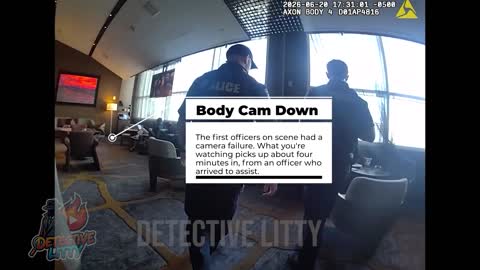
The video places viewers in the middle of a situation where a disagreement over payment has moved beyond a conversation. Officers are already involved when the recording begins, and the woman is eventually placed in handcuffs and escorted through the building. The footage also includes a notice explaining that the first officers on scene experienced a camera failure and that the available recording begins several minutes into the response. That limitation matters: viewers are seeing part of the incident, not every moment that led to the police being called.
That missing beginning is one of the most important details in understanding the case. A body-camera video can show what officers saw and heard after they arrived, but it cannot automatically establish everything that happened before the camera was activated. The clearest way to read this footage is therefore to separate what is visible from what remains unconfirmed.
What the Video Shows
The recording is marked with a date in June 2026 and carries body-camera information on screen. A title card explains that the first responding officers had a camera problem and that the footage begins with an assisting officer. The camera then shows an officer inside a bright, modern interior. A woman is seated near a table, and the officer speaks with her while another officer is present nearby.
The setting appears connected to a hotel, restaurant, or airport facility. Later shots show a corridor, elevators or doors, a lobby-like area, and an exterior curbside scene with police vehicles. The exact business name and location are not established by the video alone, so those details should not be treated as confirmed. What can be said is that the incident moves through several connected areas of a large public or hospitality building before the woman is taken outside and placed into a police vehicle.
The woman’s age is supplied by the original title, which identifies her as 68 years old. The footage itself shows an older woman speaking with officers, but it does not independently verify her age or provide a full personal biography. Similarly, the video’s title describes a refusal to pay, while the recording does not show the complete transaction or the original dispute from its beginning.
These distinctions are important because payment disputes can involve many different explanations: a customer may challenge a charge, claim that an item was not received, misunderstand a bill, or simply refuse to settle it. The video does not provide enough evidence to decide which explanation is correct. Instead, it shows how the disagreement was handled after law enforcement became involved.
Officers Try to Handle the Dispute
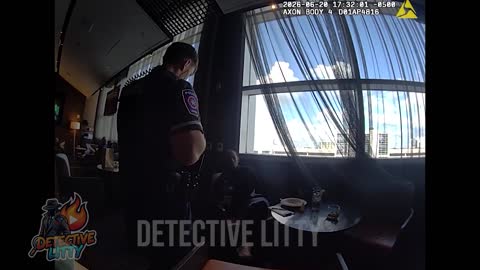
Inside the room, the interaction is initially conversational. An officer stands near the woman and appears to ask questions while she responds from her seat. The atmosphere is tense but not immediately explosive. The woman remains in the dining area, and the officer continues the discussion rather than rushing straight to physical force.
As the exchange continues, the officers’ attention shifts from the original payment issue to the woman’s conduct and what should happen next. The precise words are not fully available in the visual record, and the supplied video does not come with a verified transcript. For that reason, it would be misleading to quote statements or assign exact motives that cannot be heard or confirmed.
At some point, officers decide that the encounter will not end simply with the woman remaining at the table. The footage shows the situation progressing toward removal from the room. This is the turning point of the video: the disagreement is no longer only between a customer and a business. It has become an encounter involving police authority, instructions, and the possibility of arrest.
One of the most striking elements is the contrast between the ordinary surroundings and the seriousness of the response. The room contains the familiar details of a dining or lounge space—tables, chairs, windows, and service areas—yet the officers are dealing with a situation that now requires a controlled escort. The camera stays close to the action, making the encounter feel immediate and personal.
When a dispute reaches this stage, the central question for viewers is not simply who was right about the bill. It is also how the disagreement escalated, what instructions were given, whether those instructions were followed, and what legal basis officers believed they had for taking the next step. The video provides pieces of that sequence, but not every underlying document or statement.

From the Room to the Hallway
The footage later shows officers moving the woman out of the original room and through a hallway. The camera angle changes as the group travels through the building, giving viewers a wider sense of the location. At one point, the woman is seen being escorted while officers maintain control of her movements.
This portion of the recording communicates the seriousness of the situation without needing dramatic narration. The woman is no longer seated and discussing a bill. She is being moved under police supervision, and the interaction has clearly entered an enforcement phase. The video does not, by itself, establish every charge or explain the exact legal reasoning behind the arrest. Those details would normally require a police report, citation, arrest affidavit, or court record.
The hallway scenes also show how quickly a private disagreement can become a public incident. Employees, guests, or bystanders may be nearby, and the movement through shared spaces changes the character of the encounter. What began at a table is now visible to people outside the original dispute. That public dimension can add pressure to everyone involved and make de-escalation more difficult.
It is also worth noticing what the footage does not show. There is no complete opening sequence documenting the original order, the bill, the customer’s first objection, or the business’s initial request for payment. There is no independently verified account from the business in the supplied material. Without those pieces, the most responsible summary is that officers responded to a reported payment-related dispute and later took the woman into custody.
That wording may sound cautious, but it is essential for accurate reporting. A compelling blog post should not turn uncertainty into certainty. The strongest version of this story is one that explains the visible sequence while clearly identifying the information that still needs confirmation.
Handcuffs, Escort, and a Police Vehicle
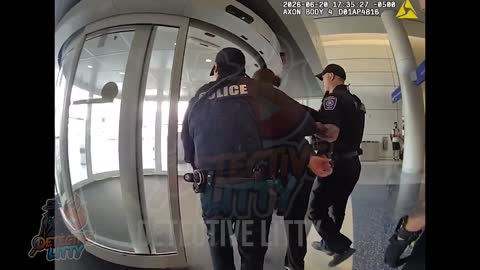
The later footage shows the woman in handcuffs as officers escort her through the building and toward the outside area. The camera captures close views of the officers’ hands and the woman’s restrained wrists, followed by scenes near the entrance and curb. A police vehicle is visible outside, and the encounter continues away from the original dining space.
For viewers, this is the moment when the consequences of the dispute become unmistakable. Whatever began as a disagreement over payment has resulted in a physical arrest process. The presence of handcuffs does not, by itself, prove guilt. An arrest is an allegation-and-process event, not a final court determination. The supplied video also does not show a completed court outcome.
The footage includes a closing graphic stating that the case is listed as pending. That means the video itself presents the matter as unresolved at the time of publication or editing. It would therefore be inaccurate to describe the woman as convicted or to claim that every allegation has been proven.
The arrest sequence raises several practical questions that the video does not answer: Was the woman cited or booked? What exact offense was listed? Was the alleged loss limited to a meal or service, or were other allegations added? Did the business pursue charges? Was the matter later dismissed, resolved by a plea, or scheduled for court? Those answers would require official records or a reliable report tied to the same incident.
Even without those details, the footage illustrates a broader pattern familiar in public-facing disputes: a conflict that seems small at the beginning can become much more consequential once police are called. The legal and personal stakes can change rapidly, especially when a person refuses an instruction, remains on private property, or is accused of conduct beyond the original disagreement.
WHAT CAN AND CANNOT BE CONFIRMED
Based on the supplied video, several points are visible or directly stated on screen. The incident occurs in an indoor hospitality or public-building setting. Police officers are present. The woman is shown speaking with officers, being escorted through the building, placed in handcuffs, and taken toward a police vehicle. The title identifies her as 68 years old and frames the dispute as a refusal to pay. The on-screen notice says the first officers’ cameras failed and that the available recording begins several minutes into the response.
Other details remain unconfirmed. The exact location is not clearly identified in the material reviewed. The name of the business is not established. The full bill, the original complaint, the precise words exchanged, the identity of the reporting party, and the exact criminal or civil allegation are not all available. The video also does not establish the final legal outcome.
Those gaps do not make the footage uninteresting. In fact, they provide the central reporting lesson: dramatic footage is only one part of a complete news story. A responsible account must distinguish direct evidence from labels supplied by a title, commentary, or social-media framing. It should also avoid presenting an arrest as proof of wrongdoing.
WHY THIS KIND OF DISPUTE CAN ESCALATE
Payment disagreements are often emotionally charged because they involve money, fairness, and the feeling of being treated properly. A customer may believe a charge is wrong, while a business may believe it has already provided the requested goods or service. If neither side feels heard, the conversation can become a contest over authority rather than a simple attempt to solve a bill.
Once police arrive, the situation changes again. Officers are no longer acting as ordinary customer-service mediators. They must assess complaints, safety concerns, property issues, and whether anyone is refusing lawful instructions. Their presence can calm a scene, but it can also increase the pressure on the person at the center of the dispute.
The video offers a visual example of that transition. The setting begins as a place associated with food, travel, or hospitality. It then becomes the scene of an enforcement encounter. The movement from a table to a hallway, from a hallway to an entrance, and from an entrance to a police vehicle gives the story its structure.
For people watching similar incidents online, the most useful takeaway is to avoid judging the entire event from a single short clip. Context matters. The beginning of the dispute, the instructions given by officers, the exact allegations, and the eventual court record may all change how the incident should be understood.
A Dispute That Remains Unresolved
The supplied body-camera video presents a clear escalation: a 68-year-old woman is involved in a payment-related dispute, police arrive, the encounter continues inside the building, and she is eventually handcuffed and escorted outside. The footage is compelling because the consequences become more serious with each stage, even though the original disagreement appears relatively ordinary.
At the same time, the video has limits. It begins after the first officers’ camera failure, does not show the full origin of the disagreement, and does not establish the final legal outcome. The case is presented as pending in the footage, so the story should remain focused on what was recorded rather than making a conclusion about guilt.
What makes this incident worth watching is the gap between the apparent simplicity of the original dispute and the seriousness of the final response. It is a reminder that conflicts involving payment, private property, and police instructions can change direction quickly. The complete context—not just the most dramatic moment—is what determines how the public should understand an event like this.
Click here to watch the full footage and see how the entire incident unfolded.
Comments (0)
Loading comments...
May You Like

🚨🚗 One Mistake Changes Everything During a DUI Arrest | Bodycam Footage US

UCF Student’s Pronoun Dispute With Campus Police Escalates Into an Arrest

Her Dad Is a Lawyer — Then He Shows Up After Her Arrest | Bodycam US