
20 Year Old Turns a Simple Traffic Ticket Into a Felony
HOW A TRAFFIC STOP TURNED INTO A FELONY CASE FOR A 20-YEAR-OLD FLORIDA DRIVER
HOOK — A TRAFFIC TICKET SHOULD HAVE BEEN THE SIMPLE PART
Most traffic stops end without becoming memorable.
An officer activates the emergency lights. The driver pulls over. Documents are checked. Perhaps a warning or citation is issued. Then everyone leaves.
THIS STOP DIDN'T FOLLOW THAT SCRIPT.
On January 22, 2022, Marion County, Florida, deputies encountered a young driver during what initially appeared to be a traffic-related incident.
The body-camera footage begins with the kind of roadside scene police handle every day: patrol vehicles, deputies moving around the shoulder and a driver being detained.
But the consequences were already becoming much more serious than a ticket.
Public booking records from that date identify 20-year-old Aavion Jakei Kinsler of Summerfield, Florida, and list a felony allegation under Florida Statute 316.1935(2): fleeing or attempting to elude a law-enforcement officer with lights and siren activated. His listed bond was $5,000.
A SITUATION THAT COULD HAVE REMAINED A TRAFFIC MATTER HAD BECOME A FELONY ARREST.
And as deputies began looking more closely at the vehicle, the encounter developed another layer.
The footage shows officers searching inside the car, examining bags and objects, and discussing what they are finding.
What makes the video compelling isn't a spectacular crash or a prolonged foot chase.
It's the escalation.
One decision leads to another.
A traffic encounter becomes an attempted escape.
The escape becomes an arrest.
The arrest leads officers back to the vehicle.
And the vehicle gives them more questions to answer.
A ROADSIDE ARREST IN MARION COUNTY
The bodycam timestamp places the incident on the afternoon of January 22, 2022.
Marion County Sheriff's Office markings are clearly visible on the patrol vehicles in the footage, providing an important visual identifier for the jurisdiction.
The public booking record provides another match: Kinsler was booked that day at age 20, with the booking time listed as 5:16 p.m.
REAL BODYCAM FRAME — DEPUTIES AT THE ROADSIDE SCENE
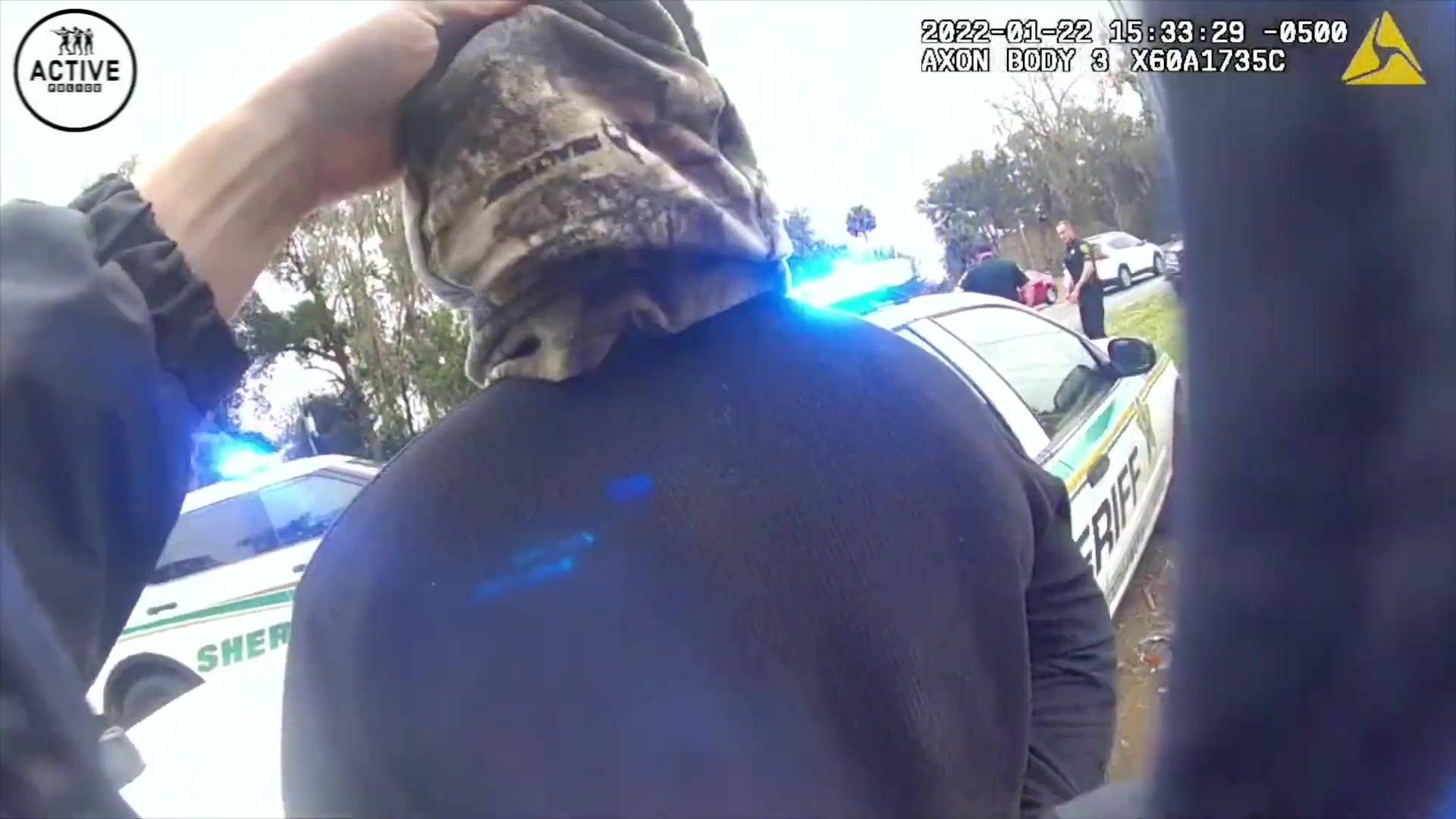
The opening portion immediately communicates that this is no longer a routine conversation between an officer and a motorist.
Multiple deputies are present.
Patrol vehicles occupy the roadway and shoulder.
The driver is under police control.
Those visual details matter because they establish the stakes before the viewer even knows exactly what preceded them.
And this is where the title of the footage — How to Turn a Ticket Into a Felony at 20 Years Old — captures the central theme remarkably well.
The important question isn't simply what traffic violation started the encounter?
It's:
WHAT HAPPENED AFTER POLICE ATTEMPTED TO STOP THE DRIVER?
According to the booking information, the resulting criminal allegation was not merely a moving violation. It was fleeing/eluding law enforcement.
That distinction dramatically changes the legal stakes.
THE DECISION THAT CHANGED EVERYTHING
Traffic enforcement and fleeing from police occupy very different legal territory.
A citation typically involves a traffic infraction.
Fleeing from a law-enforcement officer can become a criminal offense.
Florida's fleeing-and-eluding statute contains different levels of offenses depending on the circumstances. The specific charge shown in Kinsler's January 22 booking record references Florida Statute 316.1935(2).
That is why the central lesson of this footage is not really about the original ticket.
It's about escalation.
THE ORIGINAL REASON FOR A STOP DOESN'T DISAPPEAR BECAUSE A DRIVER REFUSES TO STOP. INSTEAD, THE DRIVER CAN CREATE AN ENTIRELY NEW LEGAL PROBLEM.
The bodycam records the aftermath of that decision.
REAL BODYCAM FRAME — THE DRIVER IN CUSTODY
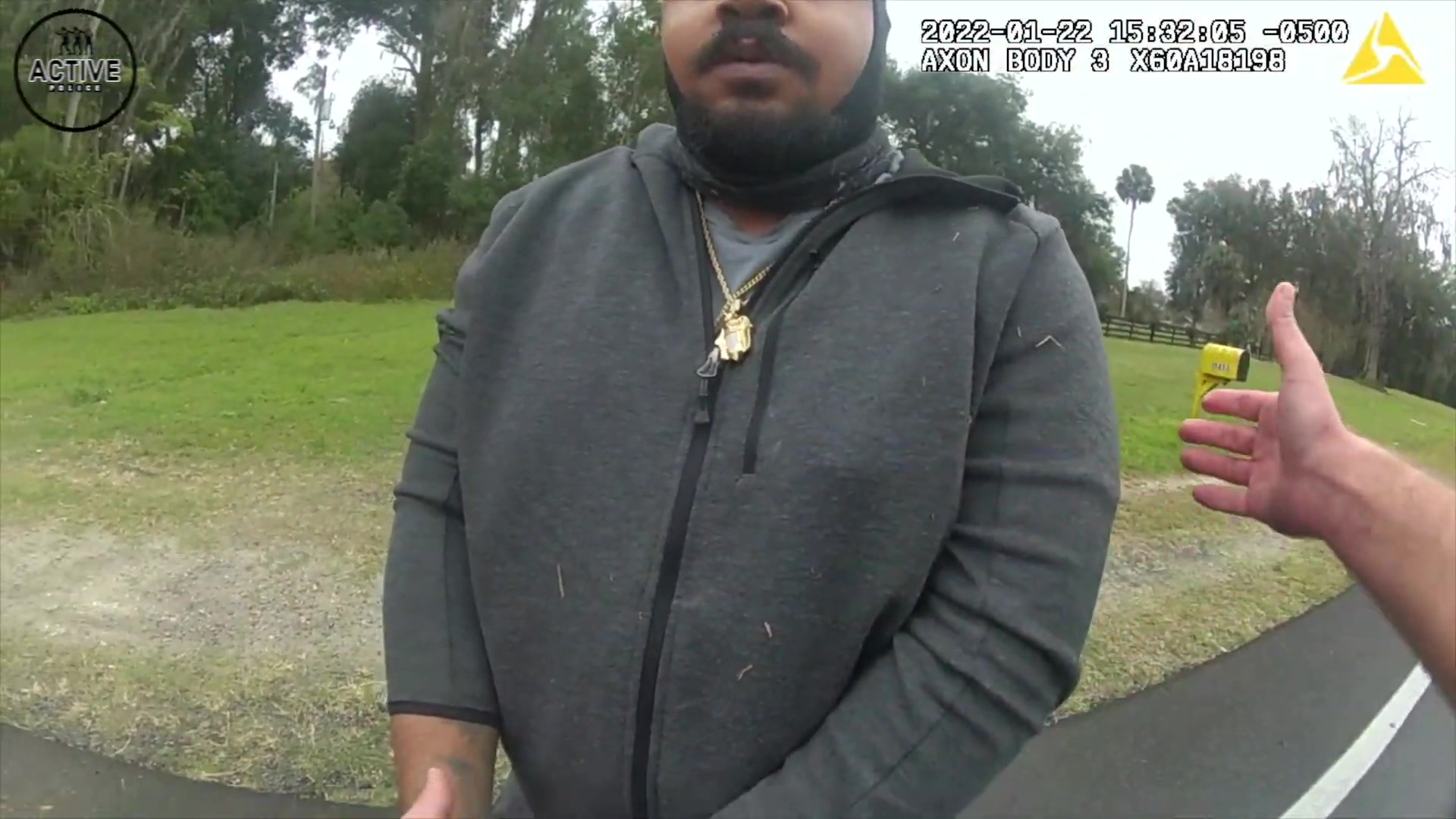
For a 20-year-old, the difference is enormous.
A person can go from worrying about a fine, points or an ordinary citation to being handcuffed, transported for booking and facing a felony allegation.
The public record for January 22 shows exactly that escalation: Kinsler was listed as arrested at age 20, and the fleeing/eluding allegation was classified as a felony.
Of course, an arrest record records an accusation rather than a determination of guilt. Any criminal allegation must be distinguished from a conviction.
But at the roadside, the immediate consequences are already substantial.
Freedom of movement is gone.
The vehicle becomes part of the investigation.
Deputies begin documenting what happened.
And the driver's decisions are no longer being evaluated simply under traffic rules.
DEPUTIES TURN THEIR ATTENTION TO THE CAR
After the arrest, the bodycam footage shifts.
The driver is no longer the only focus.
THE VEHICLE BECOMES THE NEXT IMPORTANT PART OF THE STORY.
Officers begin examining the interior.
This section of the footage slows the pace, but narratively it is important because it creates uncertainty.
What are officers looking for?
What will they find?
Will the search change the case again?
REAL BODYCAM FRAME — OFFICERS EXAMINING THE VEHICLE
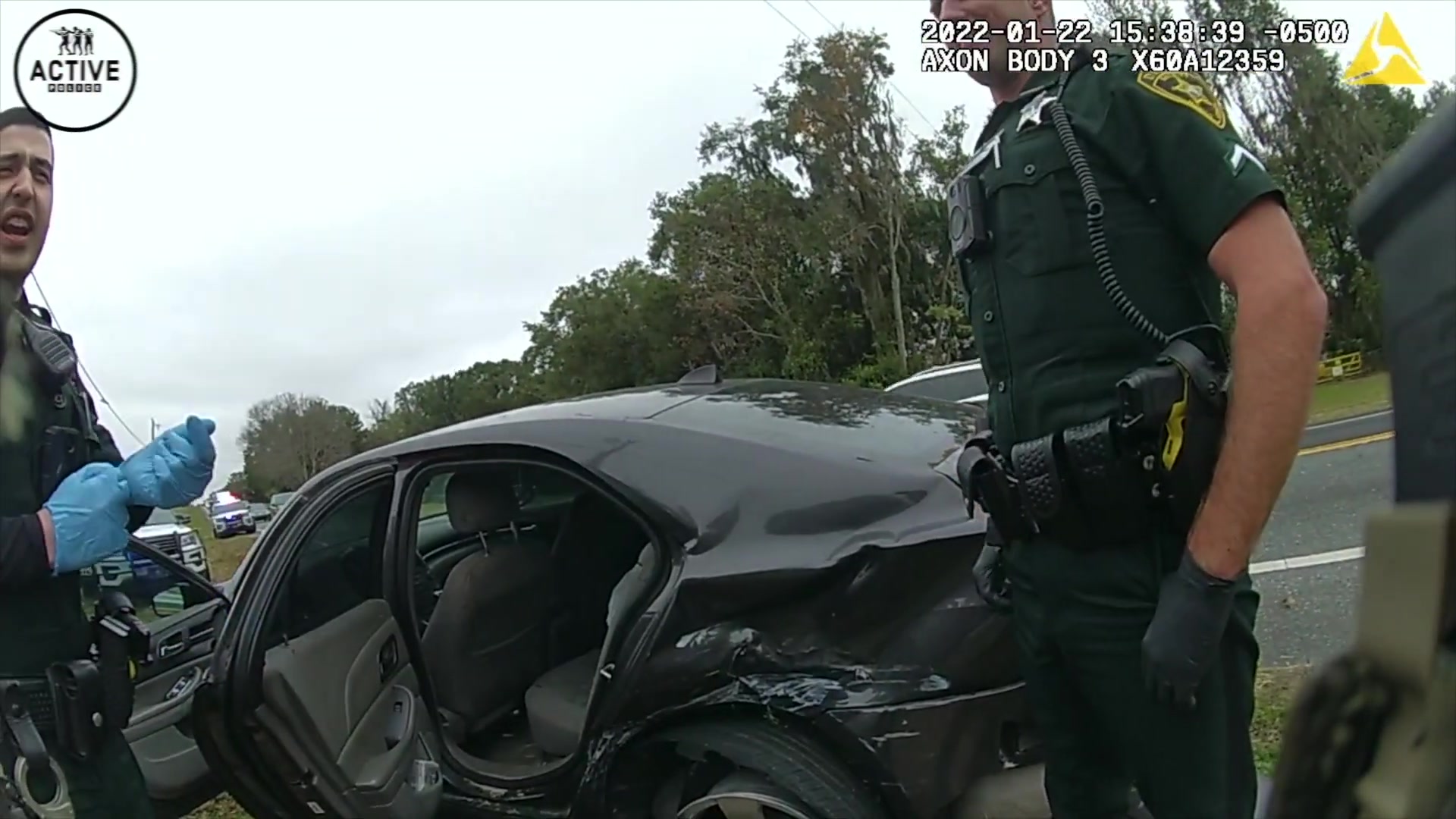
Police searches can be difficult to interpret from edited footage alone because the legal basis for a particular search may depend on facts, statements or observations that occurred before the visible segment.
For that reason, it would be irresponsible to infer a specific legal justification that isn't independently established in the material available here.
What the footage itself clearly establishes is simpler:
DEPUTIES SEARCH THE PASSENGER COMPARTMENT AND EXAMINE ITEMS INSIDE.
The camera moves close to the seats and center console.
Containers are opened or inspected.
Loose objects become the subject of officers' attention.
And eventually, the bodycam provides one of the video's clearest evidence-oriented shots.
WHAT OFFICERS FIND INSIDE
At approximately the middle portion of the video, officers can be seen examining a collection of objects from inside the vehicle.
REAL BODYCAM FRAME — ITEMS BEING EXAMINED
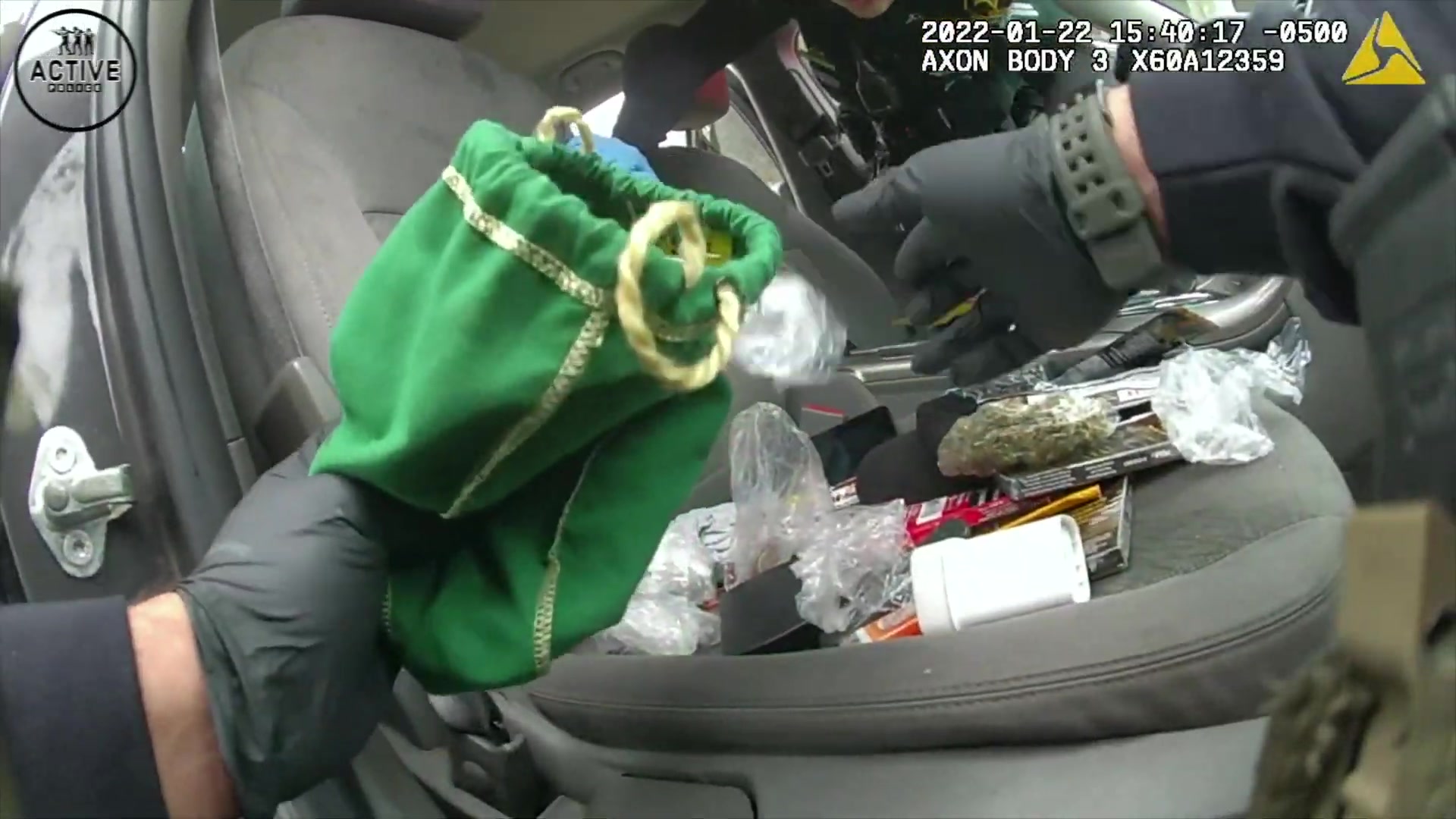
The footage visibly shows plastic bags and plant-like material among the items officers inspect.
This is precisely where careful reporting becomes important.
Images can suggest what an item resembles, but a bodycam frame alone does not establish laboratory identification, exact weight, ownership or an eventual criminal charge.
The booking source I was able to independently verify for January 22 specifically lists the fleeing/eluding allegation.
Therefore, rather than turning a visual impression into an unsupported criminal accusation, the safest description is exactly what the video supports:
OFFICERS FOUND AND EXAMINED ITEMS INSIDE THE VEHICLE DURING THE POST-ARREST INVESTIGATION.
That restraint actually makes the story stronger.
A good bodycam article does not need to exaggerate.
The documented escalation is already significant.
A 20-year-old driver was booked on a felony fleeing/eluding allegation after an encounter that began in the context of traffic enforcement.
WHY RUNNING FROM A TRAFFIC STOP CHANGES THE ENTIRE ENCOUNTER
This case illustrates a pattern seen repeatedly in police footage.
The original reason for contact can be relatively minor.
Then the person's reaction becomes the bigger issue.
Consider the sequence from the perspective of escalation:
A deputy attempts enforcement.
The motorist has an opportunity to stop.
The motorist allegedly does not comply.
Police now have to pursue or locate that driver.
Additional units may become involved.
The risk to other road users increases.
Once the driver is detained, officers have to reconstruct what happened.
The vehicle may need to be secured.
Evidence has to be documented.
Reports have to be completed.
And an encounter that could have lasted several minutes may generate an entire criminal case.
THE MOST CONSEQUENTIAL DECISION MAY OCCUR WITHIN SECONDS.
That is part of what makes footage like this effective storytelling.
The viewer already knows how it ends.
The young man is in custody.
What keeps the viewer watching is discovering how a seemingly ordinary traffic situation reached that point.
REAL BODYCAM FRAME — INVESTIGATION CONTINUES
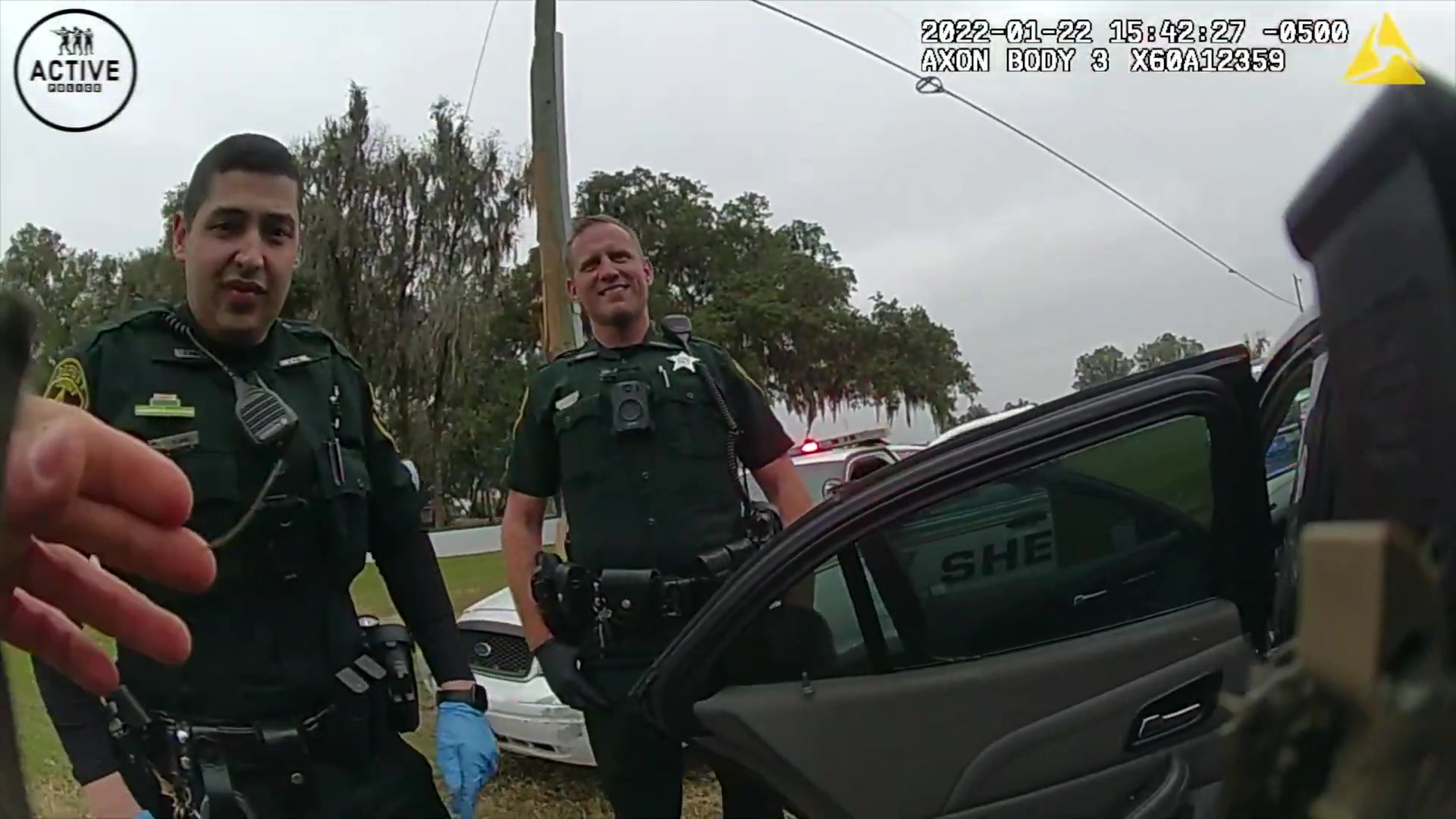
This structure is also why bodycam videos often retain attention without needing constant action.
There are essentially two stories occurring simultaneously.
The first is visible:
police lights, handcuffs, deputies and a vehicle search.
The second is reconstructed by the viewer:
What did the driver do to turn a traffic stop into this?
Every new piece of footage helps answer that question.
THE AGE OF THE DRIVER MAKES THE CONSEQUENCES STAND OUT
Kinsler's booking record lists his arrest age as 20.
That detail gives the case additional weight.
At 20 years old, a person is only beginning adult life.
A serious criminal allegation can affect far more than the hours spent in custody.
Court appearances, legal expenses, bond conditions and the uncertainty of a pending criminal case can all become part of life after an arrest.
Again, those consequences should not be confused with a conviction.
AN ARREST IS NOT PROOF OF GUILT.
But an arrest itself is a real event with immediate consequences.
The Marion County booking archive for January 22 confirms that Kinsler was among those booked that day.
His individual booking entry lists the fleeing/eluding allegation and a $5,000 bond.
That is a radically different endpoint from receiving an ordinary ticket and driving away.
And that contrast is the central tension running through the entire video.
BODYCAM SHOWS THE PART A BOOKING RECORD CANNOT
An arrest database is useful for verification.
It can establish a name, date, age, booking information and listed charge.
But it cannot recreate the roadside.
Bodycam footage can.
REAL BODYCAM FRAME — DEPUTIES WORKING AROUND THE VEHICLE
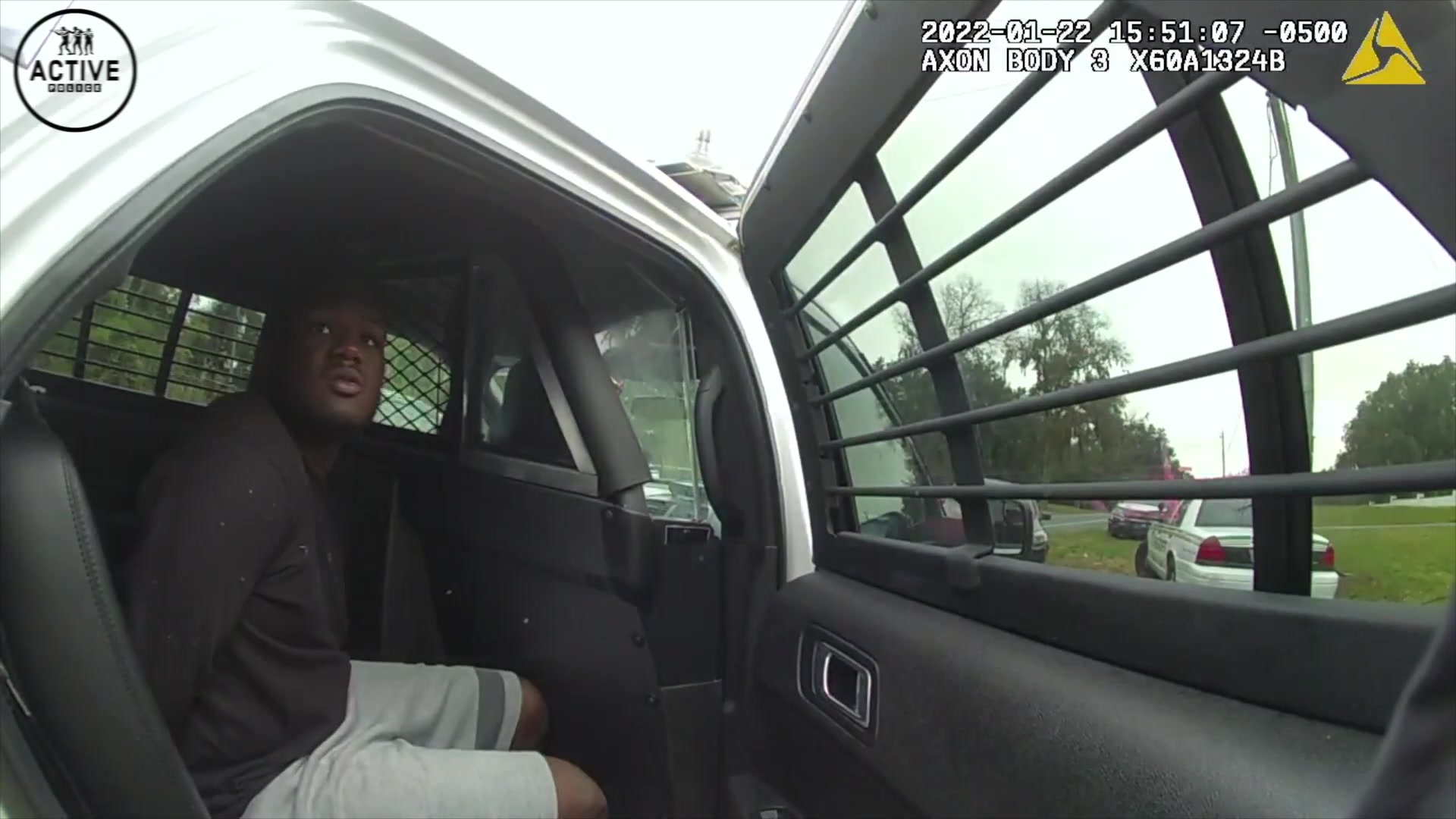
You see how many officers are involved.
You hear the conversations.
You see how deputies move between the detained person and the vehicle.
You watch the investigation unfold rather than receiving the final result as a single line in a database.
This distinction is important when writing about police footage.
THE VIDEO PROVIDES EXPERIENCE. THE RECORD PROVIDES VERIFICATION.
Using both produces a more accurate account.
Relying only on the video risks guessing about charges and identities.
Relying only on an arrest database strips away the sequence that explains why the incident is interesting.
Together, they show how quickly consequences can accumulate after someone allegedly decides not to stop for law enforcement.
A TRAFFIC STOP CAN CHANGE IN SECONDS
There is another reason the incident deserves attention.
Police cannot know exactly why a driver refuses to stop until they investigate.
A fleeing motorist may be scared.
The person may have an outstanding warrant.
The driver may believe something inside the vehicle will create additional trouble.
The person may simply make an impulsive decision.
The footage alone cannot establish what was going through this driver's mind, so assigning a motive would be speculation.
What can be established is the result.
THE DRIVER DID NOT SIMPLY WALK AWAY WITH A TRAFFIC CITATION.
The January 22 booking record instead shows a felony fleeing/eluding allegation.
From a storytelling perspective, that creates an almost perfect cause-and-effect structure.
The viewer doesn't need exaggerated narration.
The escalation supplies the drama naturally.
An ordinary traffic encounter.
A decision not to stop.
Police response.
Detention.
Vehicle investigation.
Booking.
Felony allegation.
Each stage raises the stakes of the previous one.
THE INVESTIGATION WINDS DOWN
Toward the later portion of the footage, the atmosphere changes again.
The urgency of the initial detention is largely gone.
Officers have control of the scene.
The vehicle has been examined.
Items have been documented.
The remaining work becomes procedural.
REAL BODYCAM FRAME — LATER STAGE OF THE STOP
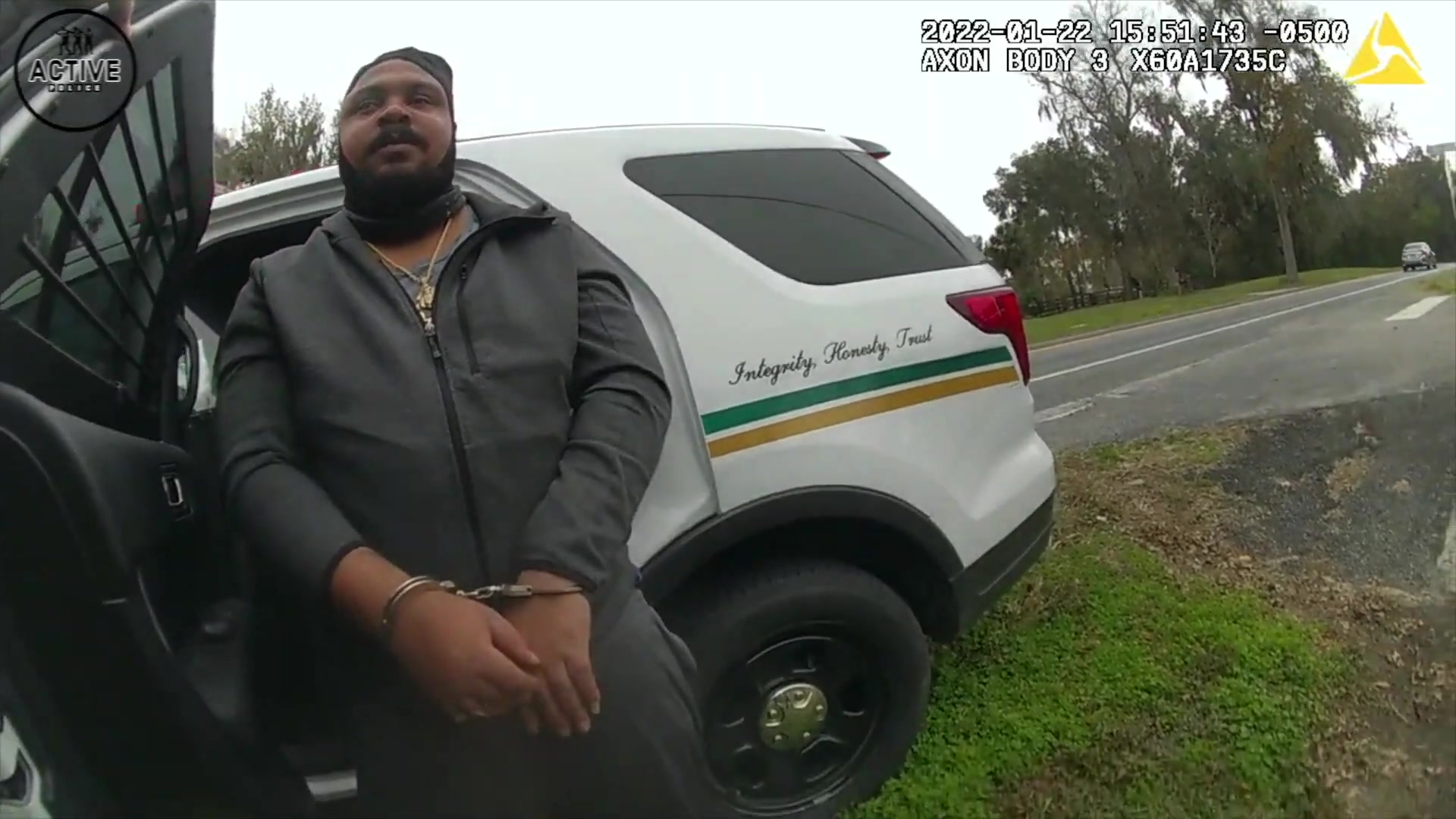
This is often where edited police videos end, but it is not necessarily where the real legal process ends.
For the arrested person, booking is merely the transition from roadside enforcement into the criminal-justice system.
Reports are submitted.
Charging decisions can be reviewed.
Bond may be set.
Court proceedings follow.
Evidence can be challenged.
Defenses can be raised.
Charges can be amended, dismissed or adjudicated.
That is why responsible reporting should avoid treating an arrest video as if it were the final judgment in a case.
BODYCAM SHOWS AN INCIDENT. IT DOES NOT REPLACE A COURTROOM.
The verified public information establishes that Kinsler was arrested and booked on the fleeing/eluding allegation.
It does not justify turning every visual detail in the footage into an additional allegation without supporting records.
That boundary matters.
ENDING — THE ORIGINAL TICKET WAS NO LONGER THE BIGGEST PROBLEM
Strip away the flashing lights and the dramatic title and the core lesson of this incident is surprisingly simple.
A traffic stop is temporary.
A decision made during that traffic stop can have consequences that last much longer.
On January 22, 2022, a Marion County Sheriff's Office encounter involving a 20-year-old driver escalated into an arrest.
Public records identify the arrested man as Aavion Jakei Kinsler of Summerfield, Florida.
His listed allegation:
FLEEING OR ATTEMPTING TO ELUDE A LAW-ENFORCEMENT OFFICER WITH LIGHTS AND SIREN ACTIVE.
Classification:
FELONY.
Listed bond:
$5,000.
The bodycam then reveals what those sterile booking details cannot.
A young man surrounded by deputies.
Multiple Marion County Sheriff's vehicles along the road.
An automobile being searched.
Officers carefully examining what is inside.
And an afternoon that clearly did not end the way the driver expected.
The irony is difficult to miss.
WHATEVER CONSEQUENCES THE ORIGINAL TRAFFIC MATTER MIGHT HAVE CARRIED, THE ALLEGED DECISION TO FLEE CREATED A MUCH MORE SERIOUS PROBLEM.
That's the moment at the center of this story.
Not the handcuffs.
Not the search.
Not even the eventual booking.
The decisive moment happened earlier — when a situation that still had the possibility of remaining an ordinary traffic stop crossed into something much more serious.
The rest of the bodycam footage is essentially the aftermath of that decision.
CTA — SEE HOW FAST THE SITUATION CHANGED
It started with traffic enforcement. It ended with a 20-year-old facing a felony fleeing-and-eluding allegation. But the arrest was only part of what deputies encountered once they began looking through the vehicle.
WATCH THE FULL VIDEO BELOW TO SEE HOW THE STOP ESCALATED — AND WHAT DEPUTIES DISCOVERED AS THE ROADSIDE INVESTIGATION UNFOLDED: https://www.youtube.com/watch?v=_tfA5ytbS-o
Comments (0)
Loading comments...
May You Like

I CAN’T WALK! — BODYCAM PROVES OTHERWISE DURING ARREST

Cop thinks sandwich is phone

Chrysler 300 Gapped Cops at 150+ MPH | Police Dashcam












