
109 MPH PIT Maneuver Ends in Double Crash & Foot Pursuit Across Interstate
109 MPH Arkansas Pursuit Ends With a High-Speed TVI and Two Crashed Vehicles
A late-night pursuit outside Little Rock, Arkansas, escalated from a local police chase into a 109 mph tactical vehicle intervention that wrecked both the fleeing car and an Arkansas State Police cruiser. The driver then ran across the interstate, jumped a concrete barrier and continued on foot before officers finally caught him behind a nearby business.
The driver was identified in the Arkansas State Police report as Tyrese Hampton. The pursuit unfolded on August 5, 2026, after the Alexander Police Department requested assistance with a fleeing vehicle. Arkansas State Police Trooper William Miller was positioned near the Alcoa Road overpass when the chase approached his location shortly before 11:24 p.m.
The supplied dash-camera footage carries the same date, time, location coordinates and trooper identification described in the report. It shows the pursuit moving along the I-30 frontage-road corridor at night, with the fleeing gold Acura traveling ahead of multiple police vehicles. Within minutes, speeds rise into triple digits.
The most dramatic moment comes when Miller closes on the Acura and attempts a Tactical Vehicle Intervention, or TVI. The patrol speed display reaches approximately 109 mph as the trooper contacts the fleeing car's rear corner. The Acura rotates into the grassy median. Miller's cruiser also loses control, leaves the roadway and strikes a concrete culvert and drain near Deer Road.
The collision does not immediately end the suspect's attempt to escape. Through the dust and smoke, Miller reports seeing a man running across the interstate. The trooper gets out of his disabled patrol vehicle and joins the foot pursuit. Hampton crosses the roadway, jumps the concrete barrier and heads southeast toward a nearby business before Miller and a Bryant Police officer catch him behind the Plaza 1 suites.
The case illustrates how rapidly the consequences of fleeing can grow. What began as a vehicle pursuit involving local police became a multi-agency response, a 109 mph intervention, two damaged vehicles, a foot chase, hospital evaluation and a list of criminal and traffic allegations.
Alexander Police Ask Arkansas State Police for Help
According to Trooper Miller's report published with the footage, Alexander Police Department requested assistance with a vehicle pursuit at approximately 11:24 p.m. on August 5, 2026. Miller was near the Alcoa Road overpass, directly in the direction the pursuit was traveling.
An Alexander officer advised that the suspect was traveling west on the North Service Road. Miller entered I-30 Frontage Road North and waited for additional information from dispatch.
Moments later, the fleeing vehicle passed him. Miller described it as a gold Acura passenger car. Several officers with emergency lights and sirens activated were already behind it.
The dash-camera recording confirms the nighttime interstate environment. The footage begins with Miller maneuvering into position as radio traffic provides updates. The road ahead is illuminated mainly by vehicle headlights, street lighting and commercial properties along the corridor.
For an officer joining a pursuit already in progress, the first task is to understand what the fleeing driver is doing and where the chase is heading. The officer has not necessarily witnessed the events that caused the original pursuit, but once involved, the trooper must evaluate the immediate danger in front of him.
Miller's report says he observed the Acura traveling at high speed and swerving between the left and right lanes. That driving behavior became especially important because of what lay ahead.
A Work Zone Raises the Stakes
Miller knew the suspect was heading toward a work zone. His report states that ramps were closed, access had been reduced to one lane and workers were present.
That knowledge changed the risk calculation. A high-speed pursuit on an open roadway is already dangerous. A high-speed fleeing vehicle entering a construction area introduces workers, narrowed lanes, barriers and reduced escape space for uninvolved motorists.
Road construction can also remove the options officers normally have during a pursuit. Shoulders may disappear. Lanes can shift unexpectedly. Concrete barriers can leave little room for evasive movement. A driver entering that environment at triple-digit speeds may have only seconds to respond to stopped traffic or equipment.
Miller wrote that he believed he needed to take the opportunity to perform a TVI before the pursuit reached that work zone.
This is an important point when evaluating the footage. The dramatic maneuver was not performed in isolation from the conditions ahead. According to the trooper's own report, the approaching construction zone was part of the reason he decided the vehicle needed to be stopped quickly.
The Acura Continues at Triple-Digit Speed
Once Miller takes a more active role in the chase, the patrol-car speed display rises rapidly. The Acura remains ahead as the vehicles move through the frontage-road corridor.
The speed shown on the footage passes 100 mph. At one point, the display reaches approximately 115 mph while Miller is closing distance.
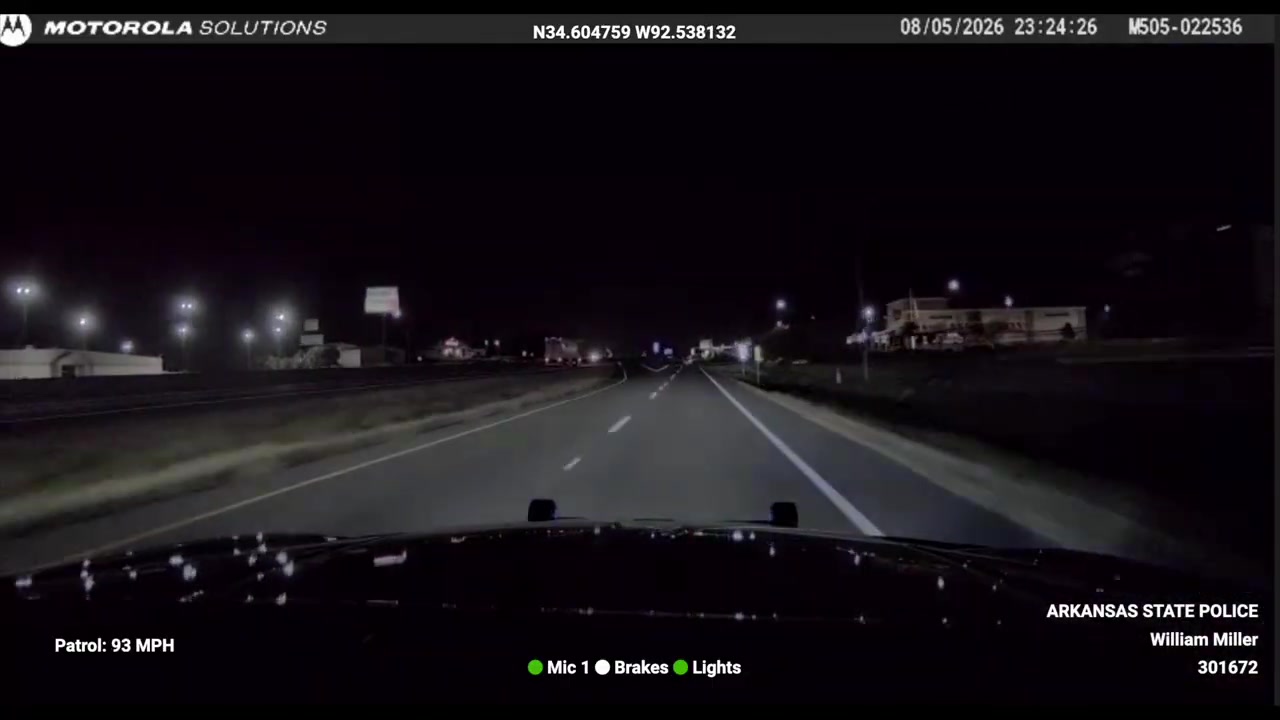
At 100 mph, a vehicle travels about 147 feet every second. At 109 mph, that figure is roughly 160 feet per second. Those numbers explain why high-speed pursuits leave so little margin for error. A driver who needs two seconds to recognize and react to a hazard can travel more than 300 feet before meaningful braking or steering begins.
The danger applies to police as well as the fleeing driver. Pursuing officers must watch the suspect vehicle, monitor traffic, listen to radio transmissions, maintain control of their own patrol cars and make tactical decisions while traveling at extreme speed.
Miller's footage shows the Acura moving quickly between lanes as the trooper closes the gap. The situation is developing too rapidly for a prolonged roadside strategy. If police intend to stop the car before the construction zone, the opportunity must come while the vehicles are still in a position where an intervention can be attempted.
The First Attempt Does Not Work
According to Miller's written report, he initially accelerated toward the passenger side of the Acura to set up the intervention. The suspect braked, causing the vehicles to lose matched speed.
That detail is significant because a TVI depends on positioning. The police vehicle must make contact at a particular area of the fleeing vehicle while both vehicles are moving in a predictable relationship. Sudden braking or steering can disrupt the setup and force the trooper to reposition.
Miller then moved to the driver's side of the Acura.
From the driver's perspective, aggressive braking or lane changes may seem like a way to prevent police from making contact. But at more than 100 mph, every evasive maneuver increases the possibility that either vehicle will lose control before an intentional intervention even occurs.
The trooper continued closing until he had another opportunity.
The TVI Happens at 109 MPH
Miller reported contacting the Acura's rear corner bumper area at 109 mph. The contact caused the suspect vehicle to rotate counterclockwise and leave the paved roadway toward the grassy median separating I-30 West from the frontage road.
The maneuver succeeds in ending the Acura's forward flight, but the police cruiser does not remain under control.
Miller wrote that after performing the TVI he lost steering control and traveled toward the north side of the roadway and onto the grassy shoulder. He attempted to regain control but was unable to do so because of the speed and road conditions.
The patrol car then struck a concrete culvert and drain at the corner of Deer Road and I-30 Frontage Road North.
The impact disabled the State Police vehicle. It eventually came to rest on the frontage road facing south and had to be towed.
The scene demonstrates the inherent risk of performing an intervention at extreme speed. A TVI may terminate the fleeing vehicle's movement, but the laws of physics do not stop applying to the police car. At 109 mph, both vehicles carry enormous kinetic energy. Once either car leaves the roadway, grass, ditches, drainage structures and concrete surfaces can turn the maneuver into a major crash.
Both Vehicles Crash, but the Suspect Keeps Running
After the impact, the camera view is filled with violent movement, darkness, dust and the abrupt end of the patrol car's controlled motion. For a moment, the pursuit appears to be over.
It is not.
Miller wrote that once his vehicle stopped, he could see through the smoke and dust a male figure running across the interstate.
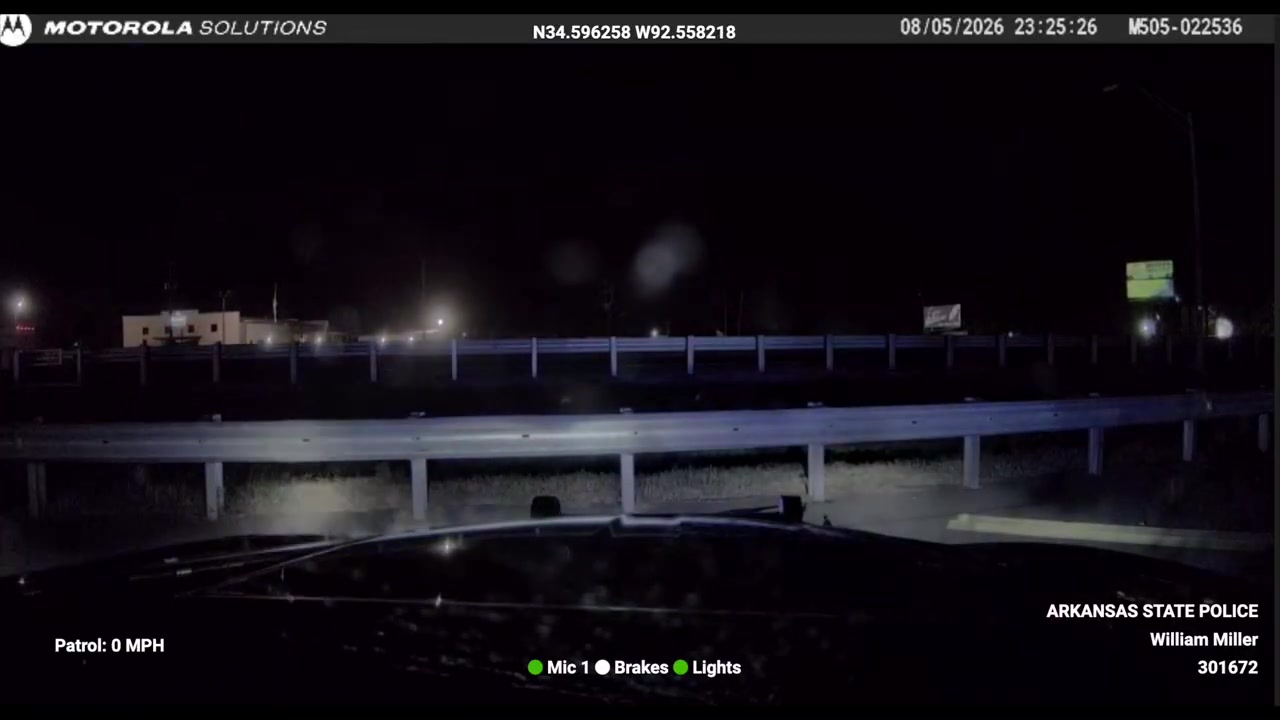
The trooper exited the damaged cruiser and gave chase on foot. The suspect ran across the interstate and jumped over a concrete barrier wall before continuing southeast toward the Jones Heating and Air business.
This decision added another layer of danger to an already hazardous incident. Crossing an interstate at night after a high-speed crash exposes a fleeing person to traffic that may not understand why someone is suddenly on the roadway. Officers pursuing on foot face the same danger.
Hampton's attempt to escape had now moved through several stages: a vehicle pursuit, evasive driving during the TVI setup, the crash and finally a foot pursuit.
Bryant Police Help End the Foot Chase
Miller was not alone once the pursuit moved onto foot. His report states that Officer Robinson of the Bryant Police Department joined him.
The two officers caught Hampton behind the Plaza 1 suites and placed him into custody without further incident.
That ending is notable because the most dangerous part of the encounter had already occurred. Despite the violent crashes and foot pursuit, the final arrest itself did not require another major use of force according to the trooper's report.
Hampton was escorted to the front of Plaza 1, where officers waited for additional units and an ambulance.
Emergency medical evaluation after a crash of this severity is important even when a person appears capable of running. Adrenaline can temporarily mask injuries, and occupants in high-speed crashes can suffer internal trauma that is not immediately obvious.
Hampton was transported to Saline Memorial Hospital for assessment before being taken to the Saline County jail for processing.
The Charge List Shows How Far the Incident Escalated
The publication carrying the trooper's report lists multiple allegations arising from the incident: fleeing, unauthorized use of property to facilitate a crime, no driver's license, first-degree criminal mischief, reckless driving, failure to register, no proof of insurance and violations involving tail lamps and reflectors.
Those are allegations associated with the arrest and should not be confused with final convictions. A criminal case can change after booking. Prosecutors may amend charges, dismiss counts, negotiate a plea or take a case to trial.
At the time of this article, a reliable final court disposition for Hampton's case was not located in the public reporting reviewed. For that reason, this article does not claim that he was convicted of every offense listed with the footage.
Still, the arrest allegations illustrate a recurring pattern in vehicle pursuits. The underlying traffic or vehicle issues may be relatively manageable. Fleeing introduces a far more serious charge, while the property damage and dangerous driving generated during the pursuit can add additional criminal exposure.
Why 109 MPH Changes Everything
A pursuit at 109 mph is fundamentally different from an ordinary attempt to stop a vehicle. At that speed, neither the fleeing driver nor police have much time to correct mistakes.
Stopping distance increases dramatically. Tires generate heat. Suspension systems react more violently to bumps. A small steering movement can shift a vehicle across an entire lane. Leaving pavement can immediately destabilize a car that was controllable only seconds earlier.
The footage demonstrates those physics when the TVI sends the Acura away from its forward path and Miller's cruiser also loses control.
It is easy to watch the maneuver after the fact and analyze it frame by frame. The trooper did not have that luxury. The decision was made while traveling more than 100 mph toward a construction zone that Miller believed contained workers and restricted access.
That does not mean the maneuver is beyond scrutiny. High-speed police interventions deserve careful review precisely because the consequences can be severe. But a fair analysis must include both risks: the danger of performing the intervention and the danger of allowing a fleeing vehicle to continue into the conditions ahead.
Arkansas State Police and the TVI
Arkansas State Police commonly uses the term Tactical Vehicle Intervention rather than the better-known term PIT, or Precision Immobilization Technique. Both describe a maneuver in which a police vehicle contacts a fleeing vehicle in a controlled way intended to induce rotation and end the pursuit.
Arkansas pursuit footage has become widely viewed online because state troopers have used TVIs in numerous high-speed cases. The agency's videos often show troopers making rapid decisions about when a fleeing driver's behavior creates enough public danger to justify physical intervention.
But every case is different. Traffic density, road design, speed, vehicle type, weather, passengers and nearby pedestrians can all affect whether an intervention is reasonable.
In Hampton's pursuit, Miller specifically cited the approaching construction zone, closed ramps, one-lane access and workers as reasons he believed immediate action was necessary.
The Trooper's Cruiser Pays the Price Too
One of the most striking aspects of the footage is that the police vehicle does not simply perform the TVI and continue driving. Miller's cruiser becomes a second crash victim.
After contact, the patrol vehicle travels off the road and strikes the concrete drainage structure. The damage is serious enough that the vehicle cannot continue and must be towed.
That outcome is a reminder that pursuit tactics place officers at real physical risk. A trooper attempting to terminate a chase is not operating from a protected position. The police vehicle is subject to the same speed, momentum and roadway hazards as the suspect's car.
The crash also creates practical consequences for the agency: an expensive patrol vehicle is removed from service, towing and repair or replacement become necessary, and the collision itself must be documented and reviewed.
None of those costs would exist if the original stop had ended without a pursuit.
The Foot Pursuit Adds One Last Risk
After surviving a 109 mph intervention and crashing, Hampton allegedly chose to keep running.
That decision is remarkable because the escape environment had become worse, not better. Police units were already converging on the area. The suspect had no vehicle. He was crossing an interstate and entering a commercial area on foot.
Continuing to flee may create a brief sense of distance, but a coordinated multi-agency response can rapidly close that distance. Officers can establish perimeters, use radio communications and approach from directions a fleeing person cannot see.
In this case, Miller and Bryant Officer Robinson caught Hampton behind a business relatively quickly.
The final arrest therefore contrasts sharply with the vehicle pursuit. The chase had reached 109 mph and wrecked two cars, yet the suspect ultimately ended up in custody only a short distance away.
What the Dash Camera Adds to the Written Report
Miller's written report provides the facts and reasoning. The dash camera provides the scale.
A report can state that a vehicle was traveling at a high rate of speed. The camera shows how quickly lights and lane markings move through the frame.
A report can say the Acura was swerving between lanes. The video allows viewers to see the changing positions of the cars.
A report can say the TVI occurred at 109 mph. The on-screen speed display lets viewers watch the patrol car reach those speeds immediately before contact.
Most importantly, the camera shows what happens after the intervention. The violent loss of control is not an abstract phrase. It is recorded from inside the cruiser.
This is why police video is so valuable when paired with official documentation. Neither source is perfect by itself. A camera does not explain every decision, while a written report cannot recreate every visual detail. Together, they provide a much stronger record.
A Chase That Could Have Ended Much Earlier
The most important lesson from the incident is also the simplest. A police pursuit creates risks that grow rapidly with speed.
Whatever Hampton believed he might avoid by continuing to drive became secondary once the chase moved into triple digits. Police resources multiplied. A TVI became necessary in the trooper's assessment. Both vehicles crashed. Hampton then ran across an interstate and ultimately went to a hospital and jail.
For motorists, stopping preserves legal options. A driver can challenge a citation, contest a stop, dispute ownership issues and obtain an attorney. None of those rights disappear because the driver pulls over.
Fleeing does not resolve the original problem. It usually creates additional ones.
Why the Video Holds Attention Until the End
The footage has a strong natural narrative because the stakes keep changing. First, viewers see a pursuit already underway. Then Arkansas State Police joins. The Acura continues at increasing speed. The construction zone creates urgency. Miller attempts to set up the TVI. The suspect brakes. Miller repositions. Speed reaches 109 mph.
Then both vehicles crash.
That would normally be the ending, but the suspect runs.
The story therefore produces a second climax after the collision. The viewer moves from wondering whether police will stop the Acura to wondering whether the driver will escape on foot.
This structure does not require exaggerated language. The actual sequence already contains uncertainty, escalation, reversal and resolution.
From 109 MPH to Handcuffs Behind a Business
On August 5, 2026, Alexander Police asked Arkansas State Police for help with a fleeing vehicle. Trooper William Miller positioned himself along the I-30 frontage-road corridor and watched a gold Acura pass with multiple officers behind it.
Miller knew a construction zone was ahead. The Acura was moving at high speed and changing lanes. He decided the vehicle needed to be stopped before it reached the restricted area.
An initial setup for the TVI was disrupted when the suspect braked. Miller repositioned to the driver's side. At approximately 109 mph, he contacted the Acura's rear corner.
The Acura rotated into the median. Miller lost steering control and crashed into a concrete culvert and drain. His cruiser was disabled.
Then the suspect ran.
Miller left the damaged patrol car and pursued on foot. The suspect crossed the interstate, jumped a barrier and headed toward nearby businesses. Miller and Bryant Police Officer Robinson caught Tyrese Hampton behind the Plaza 1 suites.
Hampton was medically evaluated at Saline Memorial Hospital and then taken to the Saline County jail.
The entire sequence shows how quickly a decision to flee can transform an encounter. A traffic stop becomes a pursuit. The pursuit becomes a 109 mph tactical intervention. The intervention becomes two crashes. The crashes become a foot chase. The foot chase ends in custody anyway.
Watch the Full Pursuit
The TVI is only one part of the incident. The complete footage shows why Arkansas State Police joined the chase, how quickly the speeds increased, the trooper's attempts to position for the intervention, the crash and the immediate transition into a foot pursuit.
Comments (0)
Loading comments...
May You Like

What Happens when you get Caught Shoplifter Stealing Local Store

A Late-Night Escape Attempt Ends With Officers Making an Arrest

Stolen Charger Flees Police During Highway Traffic Stop












